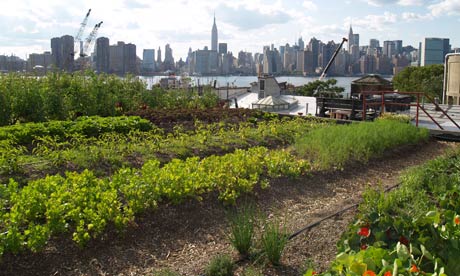
Green Urbanity


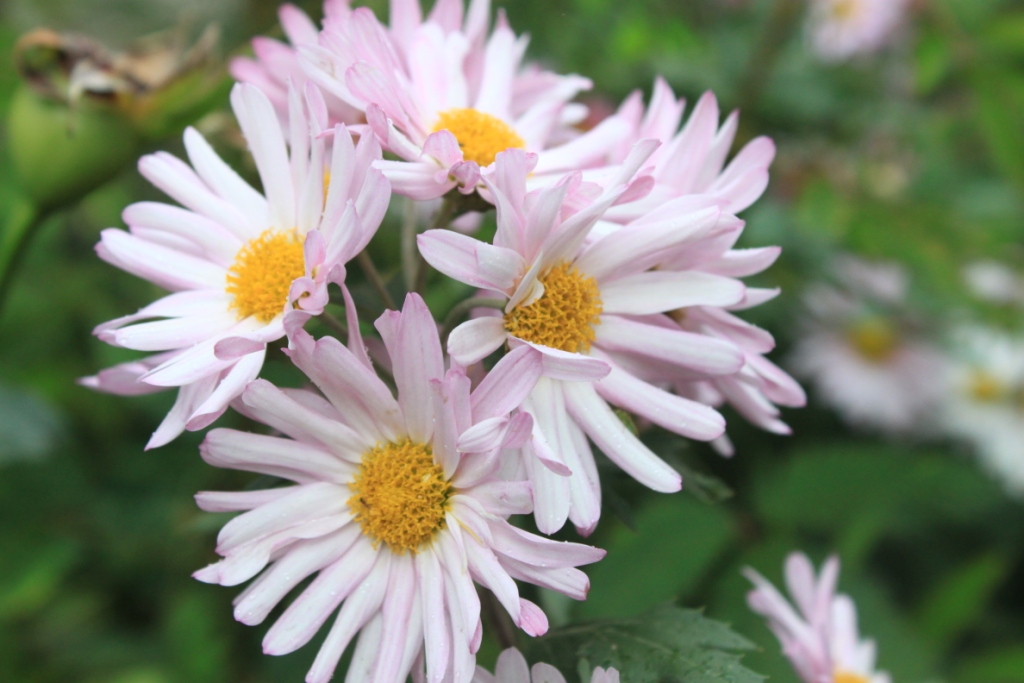
Plants grow on a rooftop farm in Greenpoint, New York. Photo: Mike Di Paola/Getty Images

Click the image above for the story in The Guardian:

Advocates say green infrastructure isn’t just about being green — it makes financial sense, as well. Its cost-effectiveness depends on how benefits are assigned and valued, and over how long a time scale, but green has been shown to be cheaper than gray.

A 2012 study by American Rivers, ECONorthwest, and other groups examined 479 projects around the country. About a quarter of the projects were more expensive, they concluded, and 31 percent cost the same; more than 44 percent brought the costs down, in some cases substantially. New York City, for example, expects to save $1.5 billion over the next 20 years by using green infrastructure.

Trailing Eclipta (Eclipta aalba)

Trailing Eclipta is an erect annual plant with rooted nodes and many branches. The leaves have fibrous hairs on both sides and the flowers are white. These plants thrive in the high ranges of Kerala and the rest of Western Ghats. In Ayurveda these plants are effective in treating inflammation, filariasis, wounds, skin diseases, leprosy, jaundice and fever.

Continue reading

Memo To CJ

Be careful what you wish for.  According to a story in the New York Times someone has been trying something similar:

To John Sims, the Himalayas, with some of the finest mountain slopes in the world, seemed like the perfect place to build India’s first Western-style ski resort.
But he got his first clue about the uphill challenge he faced when the local gods – or at least the holy men who claimed to speak for them – came out against his project here.
In the seven years since, Mr. Sims, an American hotel developer with years of experience working in India, has encountered seemingly endless setbacks.

Bon Anniversaire, Henri

This slideshow requires JavaScript.

If you happen to be in Paris, celebrate in person at the location he chose as repository for his photographic legacy.  Thanks to the foundation that he, his wife and daughter created, you can do so here.  If, like most people, you are not in Paris then their website will have to suffice for now:

“The 20th century was the century of the image …To tell Henri Cartier-Bresson’s story and to unravel his work is essentially to tell the story of a look. Continue reading

Jamanthi Flowers

Jamanthi Flowers are native to Southern India and grow widely in and around Kerala. These flowers are found in different colors such as yellow, white, cream and pale red. Jamanthi flowers blooms throughout the year and in Kerala these flowers are popular in all types of gardens.  An additional attraction is that the chemical content of this flower is used as a mosquito repellent. Continue reading

Bluefin Activism

Click on the logo image below to go to the main page of this activist organization.  Click here for the story where the text below the logo and after the jump comes from.

…The company which owns the tuna farm where the fish were released is called Kali Tuna and is part of the US based company Umami Sustainable Seafood. Umani is a major player in the bluefin tuna industry with operations in US, Mexico and Croatia. The firm went public last year with shareholders from around the world now cashing in on the company’s lucrative bluefin tuna trading, which is set to have landed them with over $54.000.000 US in profits last year. With slogans such as ‘Aquaculture – Growing to the tune of Mother nature’ and ‘Keeping Bluefin tuna stocks thriving’, the company is keen to portray itself as a ‘sustainable’ bluefin tuna trader. Continue reading

August 22, A Big Day For Tigers

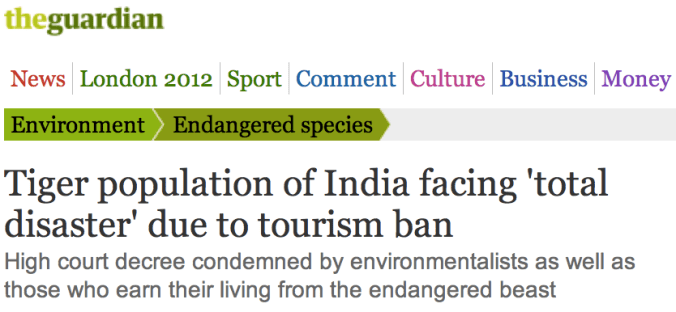
Click the headline above to go to the story, in advance of tomorrow’s ruling in India about a controversial ban.  These issues are at the core of the entrepreneurial conservation concept:

“If the ban on tourism continues, it will be the end of the tiger in India,” he said. “We’re the ones who put energy into tracking them. We deter poachers. Tourists are only allowed in the park for six hours every day, but we guides take it in turns to patrol the park from sunrise to sunset. Voluntarily.” Continue reading

Rethinking Good & Evil

Activists launch a long-range drone from the deck of the Steve Irwin to locate a Japanese whaling ship. Photograph: Observer

If cormorants can possibly be defined as evil, can drones be re-redefined in the opposite sense in which we commonly think of them–namely related to death and destruction, including innocent “collateral damage.”  Click the image above to see what these environmental activists are doing with drones:

They are better known as stealthy killing machines to take out suspected terrorists with pinpoint accuracy. But drones are also being put to more benign use in skies across several continents to track endangered wildlife, spot poachers, and chart forest loss. Continue reading

From Behind the Wheel

Road sign in Kerala’s Parambikulam Wildlife Sanctuary

Driving in India can be an eye opening experience.  Or you can close your eyes if you have the confidence. We’ve written about it several times over the past year, usually from the point of view of the passenger’s seat, but occasionally from the “right-hand seat” as well.

Continue reading

Ganges River Dolphin Conservation

Click the image for the story on BBC’s website:

The Ganges River Dolphin is one of the world’s most endangered freshwater mammals.

Its numbers in South Asia have plummeted in recent decades. But Indian conservationists working on the Brahmaputra River hope to reverse the dolphin’s decline by mobilising riverside communities to protect these amazing cetaceans.

Shellfish Prefer Noncaffeinated Beverages

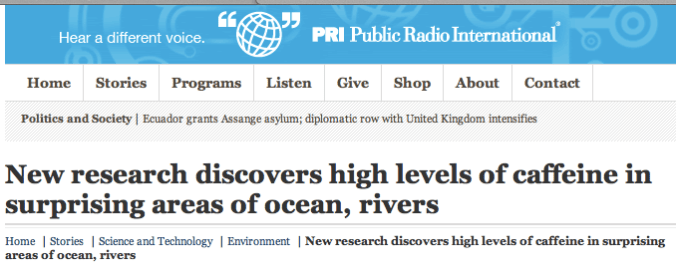
Click the headline to go to the story and podcast:

“There have been some reports that caffeine may affect reproduction. When organisms are stressed, they produce stress proteins to protect their cells. And, if an organism is under prolonged stress, then that organism may have to shift energy they would normally spend on growth and reproduction.”

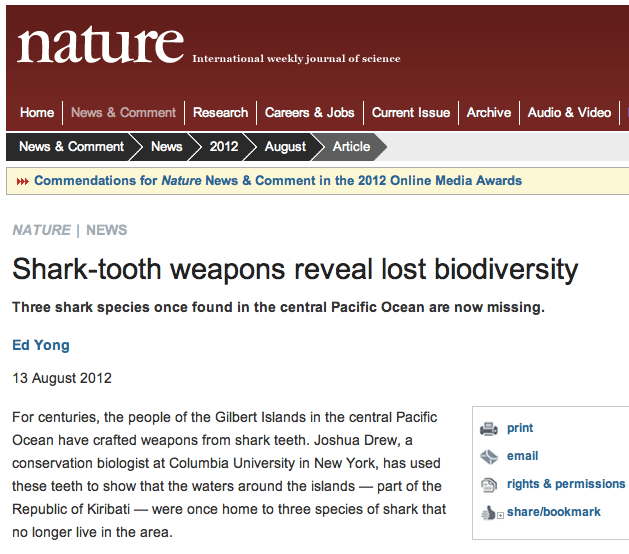
From Old Tools, New Knowledge

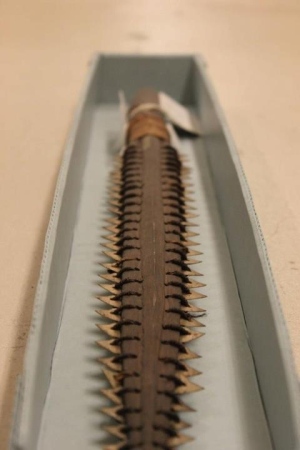
Weapons from the Gilbert Islands contain the teeth of shark species no longer found in the area. Photo by J. DREW/COLUMBIA UNIV.

Click the headline image above, or the photo to the left to go to the story:

“This is shadow biodiversity,” said Drew, presenting his results at the 2012 Ecological Society of America Annual Meeting in Portland, Oregon, last week. “Three sharks disappeared from these reefs before we even knew that they existed there.”

Drew analysed 124 shark-tooth weapons housed in the collection of the Field Museum of Natural History in Chicago, Illinois. The artefacts included swords, tridents and a 4-metre-long lance, dating back over 120 years.

All are built in the same way: the islanders drill hole in the teeth and lash them to buttresses of wood with cords made from coconut leaves.

Ocean Health Index

Click the logo to the left for the site of this useful index:

From the many millions who count on ocean fisheries for their livelihoods to the uncounted lives saved by intact coral reefs during the 2004 Asian tsunami, people all over the world depend upon healthy oceans. But how healthy are our oceans?

Continue reading

Gladiolus Flower

Gladiolus Flowers are widely cultivated throughout India and the rest of the world. Their longevity (8- 10 days) and wide range of colors (including white, cream, orange, yellow, pink, red, lavender, blue, purple and terra cotta) make them one of the most popular commercial cut flowers in the domestic market. Continue reading

Bees, Honey & Collaborative Rooftops

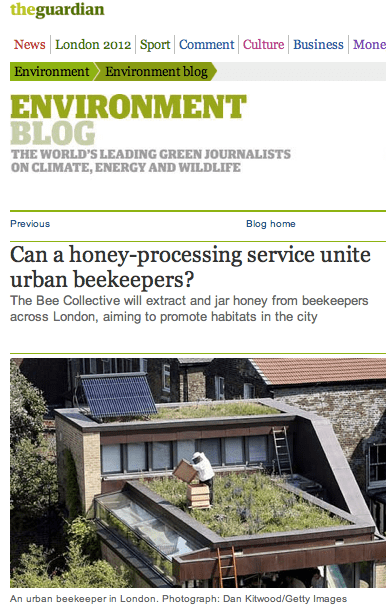
Among the various projects Raxa Collective asked of its Design Team of interns the last few months, one key idea was how to make a rooftop more green.  A future post by Rania will show some of the recommendations, but for now this article (click the headline image to the left to go to the source):

Caroline Birchall, founder of the Bee Collective, works at Natural England on landscape ecology in the capital. She says there is a huge amount of green infrastructure such as green roofs and rain gardens, which enable water to be absorbed rather than run off, that is being put in place to combat climate change and which could be made more suitable for bees and other pollinators.

Socially Mediated Discovery

This Green Lacewing is an entirely new species, discovered in a set of Flickr photos. (Photo: Species ID/Guek)

Click the banner above for a link to a publication we have just come across that looks quite interesting. Click the photo above for the source of the discovery explained in this story (quoted below).  There are still plenty of flora and fauna that have not been identified.  One of the hopes of nature conservation is to get further down the path to identifying and understanding all our co-habitants on this planet. It should come as no surprise that social media and photographers like Hock Ping Guek play a critical role in this race against time:

The lacewing Guek had photographed in May 2011 was quite distinctive. Beneath long antenna sat its bulbous, iridescent eyes in front of a turquoise thorax supported by six translucent legs. Continue reading

Mind Your Food’s Aquifer

Click the map for the brief review of what looks to be an important paper published in the current issue of Nature (which requires subscription for the entire article so this review in the Science section of the New York Times is important for non-subscribers).  For some, the constant reminders are tedious.  We appreciate them nonetheless because it is so much easier to forget, ignore, pretend otherwise that water is an infinite resource.  Not only is it finite, but solving this puzzle may be the next most important thing for mankind to get right:

The study underlines a problem that scientists have already pinpointed: that the demand for groundwater in several major agricultural regions of the world is unsustainable. Continue reading