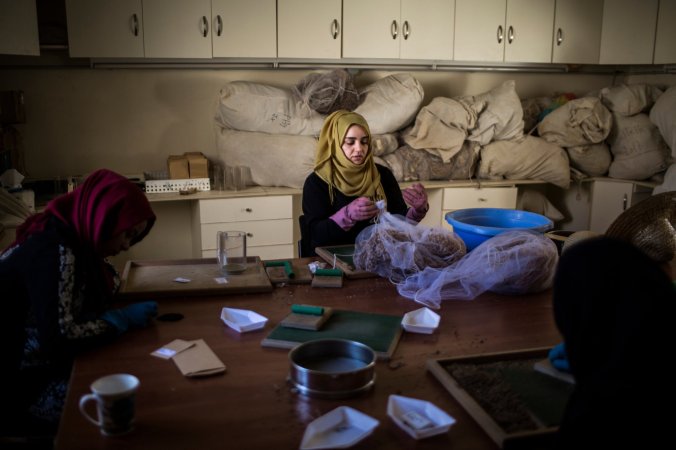
Lebanese workers at the seed bank in Terbol. Mr. Shehadeh’s organization, Icarda, moved operations out of Syria after the war broke out. Credit Diego Ibarra Sanchez for The New York Times
How a Seed Bank, Almost Lost in Syria’s War, Could Help Feed a Warming Planet
TERBOL, Lebanon — Ali Shehadeh, a seed hunter, opened the folders with the greatest of care. Inside each was a carefully dried and pressed seed pod: a sweet clover from Egypt, a wild wheat found only in northern Syria, an ancient variety of bread wheat. He had thousands of these folders stacked neatly in a windowless office, a precious herbarium, containing seeds foraged from across the hot, arid and increasingly inhospitable region known as the Fertile Crescent, the birthplace of farming.
Mr. Shehadeh is a plant conservationist from Syria. He hunts for the genes contained in the seeds we plant today and what he calls their “wild relatives” from long ago. His goal is to safeguard those seeds that may be hardy enough to feed us in the future, when many more parts of the world could become as hot, arid and inhospitable as it is here. But searching for seeds that can endure the perils of a hotter planet has not been easy. It has thrown Mr. Shehadeh and his organization, the International Center for Agricultural Research in the Dry Areas, or Icarda, squarely at a messy intersection of food, weather and war.
Icarda, though it received no state funding, was once known as a darling of the Syrian government. Based in Aleppo, its research had helped to make Syria enviably self-sufficient in wheat production. But a drive to produce thirsty crops also drained Syria’s underground water over the years, and it was followed by a crippling drought that helped to fuel the protests that erupted into armed revolt against the government in 2011.Icarda, in turn, became a casualty of the war. By 2014, the fighting drew closer to its headquarters in Aleppo and its sprawling field station in nearby Tal Hadya. Icarda’s trucks were stolen. Generators vanished. Most of the fat-tailed Awassi sheep, bred to produce more milk and require less water, were looted and eaten. Mr. Shehadeh and the other scientists eventually sent out what they could — including a few of the sheep — and fled, joining half the country’s population in exile. Continue reading








 Birds feature more than any other topic in these pages. We have laid out bird-friendly territory over the years, and now Natalie Angier brings us a science news story that would be disturbing if not for our overall appreciation for the value of biodiversity.
 Organikos