The Golden Swallow Expedition

From left: Justin Proctor, Seth Inman, and John Zeiger.

It’s now been several months since we last shared any news on the Smithsonian Institution’s expedition to search for the Golden Swallow (Tachycineta euchrysea) in Jamaica, where no sightings have been reported since 1989 — and even that report is a little questionable. While the Hispaniolan subspecies of the Golden Swallow is labeled as vulnerable, the Jamaican subspecies is labeled as critically endangered and possibly extinct, so this research trip is designed to lend some more finality to the issue. If our team of three positively identifies a Golden Swallow in Cockpit Country or the Blue Mountains between mid-January and late March, it will be the first confirmed sighting of the species in Jamaica in several decades, and new conservation efforts might be kick-started into action. If during our pair of one month trips to these two isolated areas of Jamaica we don’t see any signs of the Golden Swallow, the ornithological community can move a little closer to declaring the Jamaican subspecies of Tachycineta euchrysea extinct.

Continue reading →

Canadian Outdoor Hockey – Threatened by Climate Change?

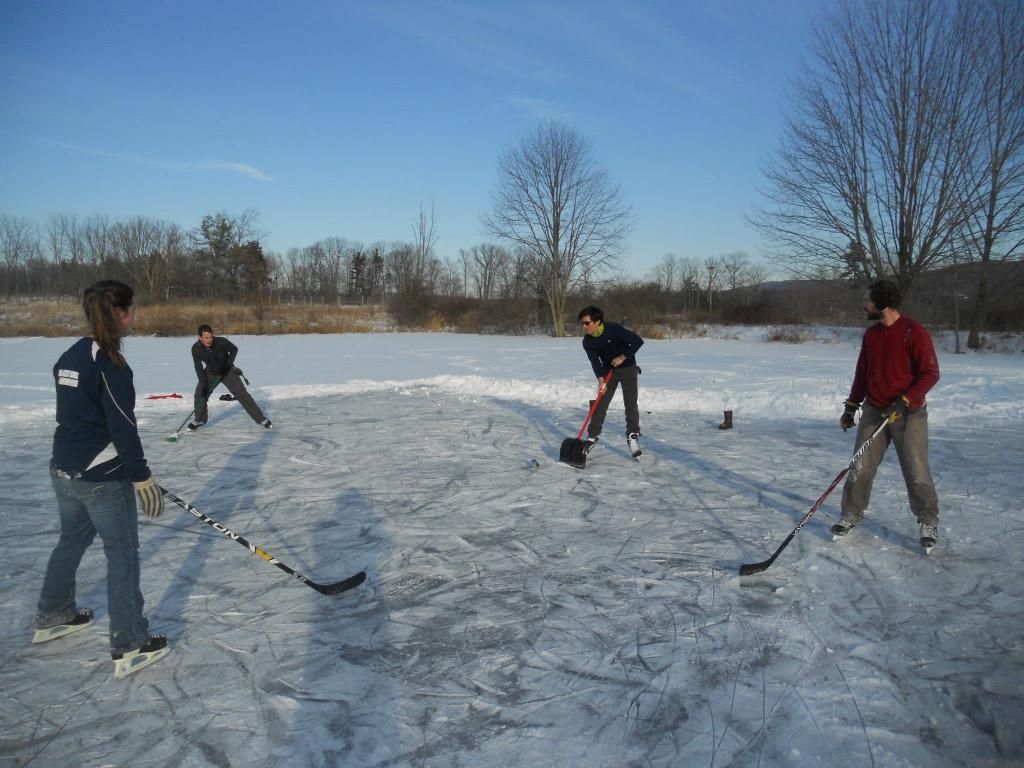
Photo of Cornell students playing outdoor hockey somewhere in NY, by Miles Luo

While a student at Cornell University, I played hockey out on a pond multiple times, and always had fun even on the occasions when several of us needed to use brooms or shovels as hockey sticks, and a crushed pineapple juice can as a puck. In recent years, it’s been a little tougher to find a good time to play since temperatures have fluctuated so wildly sometimes. Since my friends and I like to stay very conservative with our estimates on the ice’s thickness, an unusually warm day after a series of extremely cold — and typical Ithaca — ones can set us back a bit as we wait for a safer time to get on a pond.

So I at least partly understand the angst of all outdoor hockey-loving Canadians as described by Dave Levitan for Conservation Magazine:

Take anything from Canadians, anything at all—anything except hockey.

Few countries have such a relationship with an individual sport; cricket in India, soccer (football) in Brazil or various others, hockey in Canada. And while the Maple Leafs and the Canadiens aren’t going anywhere, the sport as it is played by millions of others in Canada is in serious danger thanks to climate change.

Continue reading →

The Glossiness of Tinamou Eggs

Eggs from tinamous being used for research at Hunter College. Tinamou eggs are up to 14 times as glossy as the average chicken egg. Credit Fred R. Conrad/The New York Times

Readers of the blog who have visited in recent months will know that I do a lot of work with chicken eggs for artistic purposes, and readers from years ago might remember that I worked with Celebrate Urban Birds at the Cornell Lab of Ornithology, and I often wrote about bird-related topics (and still do!). During one of CUBs’ photo competitions called Funky Nests, I posted on egg coloration, and looking back on that post I am very surprised to see that I didn’t mention the eggs of a family of birds called tinamous. I’m puzzled as to why I wouldn’t have written about tinamou eggs because they are curiously glossy. In addition to having quite pretty colors, the eggs are extremely shiny to the point of looking fake, or varnished by wood elves after they’re laid.

Perhaps I didn’t include tinamou eggs in my post because very little is understood about why their glossiness exists, as Rachel Nuwer reports for the New York Times this week in an article with a title that obviously caught my eye:

Easter Eggs Without a Kit

The Shy, Drab Tinamou Has a Stunning Palette That Still Holds More Mysteries Than Answers.

When it comes to shell color, most birds’ eggs conform to one of four motifs: colored with spots, colored without spots, white with spots or pure white.

Continue reading →

Biomechanics Exhibit at the Field

Animals that move through air and water have evolved a variety of wing and fin forms, as well as sleek, streamlined shapes that harness the power of fluid dynamics for propulsion. © Ernie Cooper 2012, macrocritters.wordpress.com

Every day, just using any part of our bodies to move, see, talk, or eat — among countless other activities, we are enjoying the biomechanics that have evolved to perform the functions necessary to survive. An exhibit at the Field Museum in Chicago called, “The Machine Inside: Biomechanics” will be closing on January 4th, so this post is more of a celebration of the exhibit than an invitation to check it out. If you won’t be in Chicago before the 4th, they have a great website with photos and a good video.

Imagine if your jaws could crush over 8,000 pounds in one bite, your ears could act as air conditioners, and your legs could leap the length of a football field in a single bound. From the inside out, every living thing—including humans—is a machine built to survive, move, and discover.  Beginning March 12, 2014, investigate the marvels of natural engineering in The Machine Inside: Biomechanics. Explore how plants and animals stay in one piece despite the crushing forces of gravity, the pressure of water and wind, and the attacks of predators. Using surprising tactics, creatures endure the planet’s extreme temperatures, find food against fierce competition, and – without metal, motors or electricity – circulate their own life-sustaining fluids.

Continue reading →

Throwback Thursday: Bog

Photo credit: BU Dining Services

About this time two years ago, I came across the YouTube video featured in the #throwback Thursday post below. Hope you enjoy it, especially in light of this week’s post on peatlands!

Original Post Date: December 28, 2012

Earlier this week I wrote about an entirely different sort of swamp. This brief post is about a topic much more in tune with the holiday season: cranberries. Grown in bogs with layers of peat, sand, gravel, and clay, cranberries are native to North American wetlands (our readers across the pond will probably know the European variety of the fruit as lingonberries). In the United States they are primarily grown in Massachusetts, New Jersey, Oregon, Washington, and Wisconsin (ordered alphabetically, not by output). Something not many people may know is that these cranberry bogs are cyclically flooded with vast amounts of water every season; some might worry over the constant waste of this precious liquid in areas of major cranberry production, or the contamination of water tables with pesticides and fertilizers common to agricultural use.

But I am about to tell you about some of the advantages cranberry-growers have over other industrial agriculturalists in terms of their water utilization. Why will I share this with you? Well, cranberry sauce features prevalently in the traditions of recent holidays, namely Thanksgiving and Christmas (and was thus probably consumed in an overwhelming majority of American households at least once in the past 60 days), plus my grandparents swear by cranberry juice, but I also recently found out that cranberries–and the water they are flooded with for harvesting–make for excellent art, or sport. What I never would have guessed is that Red Bull would be the one to show me this; just watch the video below:

Continue reading →

Order of the Falcon

Jason Koski/Cornell University Photography

A few weeks ago, while visiting Cornell University for two days, President Ólafur Ragnar Grímsson, in addition to giving the talk I briefly posted about, also bestowed the Icelandic Order of the Falcon upon a librarian I know. Patrick Stevens, curator of the Fiske Icelandic Collection in the Rare and Manuscript Collection of Kroch Library at Cornell, helped me find resources while I conducted research for my honors thesis in history.

Always friendly and offering helpful advice when I came in every day in the summer of 2013 to look at old texts in the RMC reading room, Patrick also read a couple drafts of my work toward the end of my writing process. Continue reading →

Are You Listening?

MOTHERNATUREConservation International’s new campaign, Nature Is Speaking, has released various short films from the perspective of different elements of nature voiced by an actor or actress: Harrison Ford is the Ocean, Lupita Nyong’o is a Flower, Edward Norton is the Soil. The organization’s “humanifesto” reads,

Nature doesn’t need people. People need nature.

Human beings are part of nature.

Nature is not dependent on human beings to exist.

Human beings, on the other hand, are totally

dependent on nature to exist.

The growing number of people on the planet

and how we live here is going to determine the future of nature.

And the future of us.

Nature will go on, no matter what.

It will evolve

The question is, will it be with us or without us?

Continue reading →

Xandari’s Latest Dozen+ Pysanky

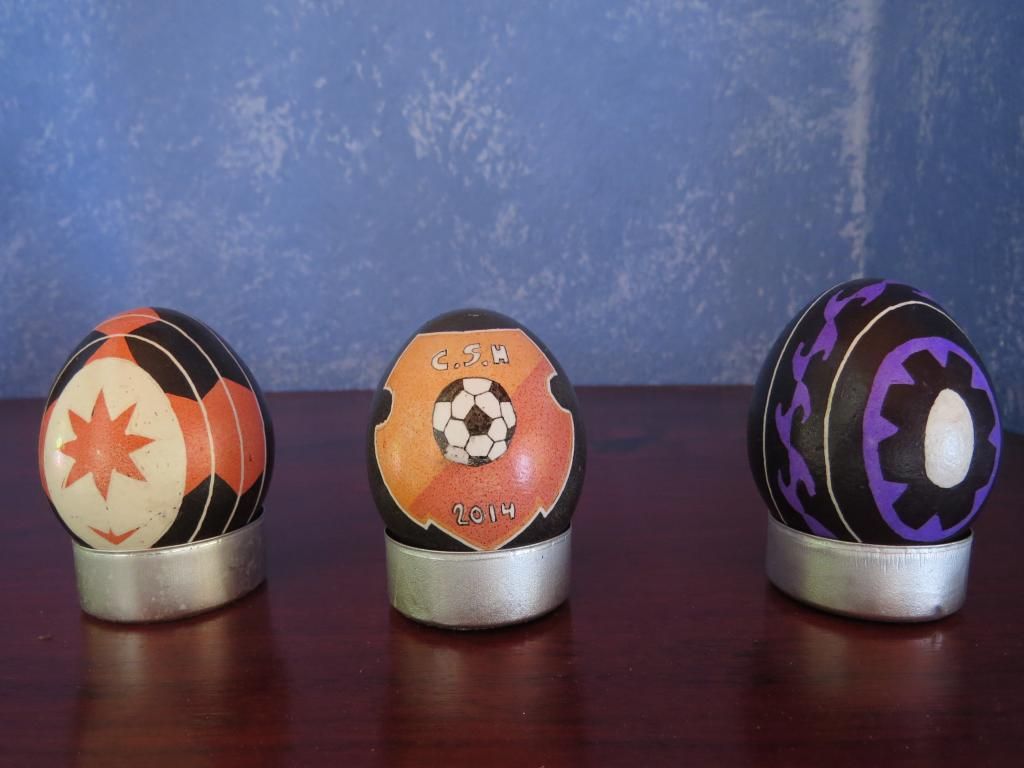
As my on-site time with Xandari wound down for the year early this week, I worked to make as many pysanky for the gift shop as possible, since an ornithological expedition in Jamaica will be taking up the first couple months of the new year. In the photo on the right, you can see that I finally got to one of the patterns I’d brainstormed when first starting this project, as well as a repetition of the Alajuelan soccer team insignia egg. Since the little tree for hanging the eggs in the gift shop is pretty full at sixteen eggs already, most of these eggs will stay in the office until an egg is sold or eggs are rotated.

Two adaptations of earlier patterns I developed and another soccer-themed egg, this time for Heredia’s team.

I’m hoping all these eggs, some of which directly reference Xandari and others Continue reading →

And the Winners Are…

Employees and guests at Xandari have voted over the last two weeks, and now we have our final fourteen: two winners from each grade, and four from 6th grade. Thank you to those of our readers who took the time to vote in our selection process as well!

Today the students had a Continue reading →

Xandari’s Holiday Tree is Up and Running


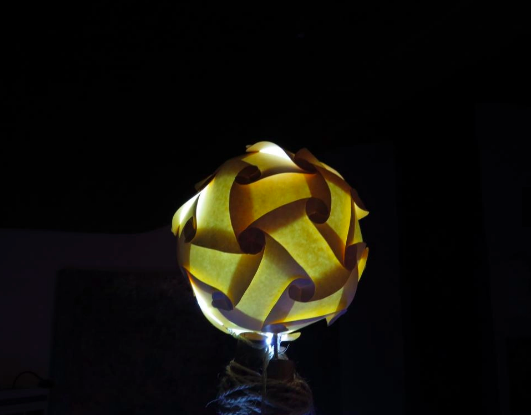
A homemade “loomi” lamp


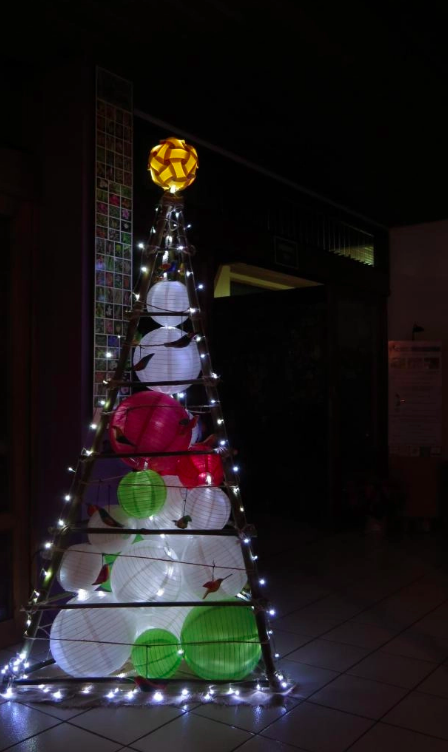
Like any other tree acquired this time of year, Xandari’s holiday tree had to be put on the roof of a car — in this case, the resort’s golfcart — to transport it up to the lobby area from its site of construction. We snaked an LED “hose” through most of the paper lanterns in the bamboo structure, and now we have balsa-wood bird ornaments made by Costa Rican artists (these birds normally hang in our gift shop). Finally, I made a modular paper lamp recycled from old manila folders (template and how-to pending, but the lamp is basically a DIY Loomi light).

Tomorrow, when I finish the second loomi tree “star,” I’ll put up photos of the smaller tree that Edwin and I made for the Xandari Spa.

Continue reading →

Bosque del Cabo and Xandari

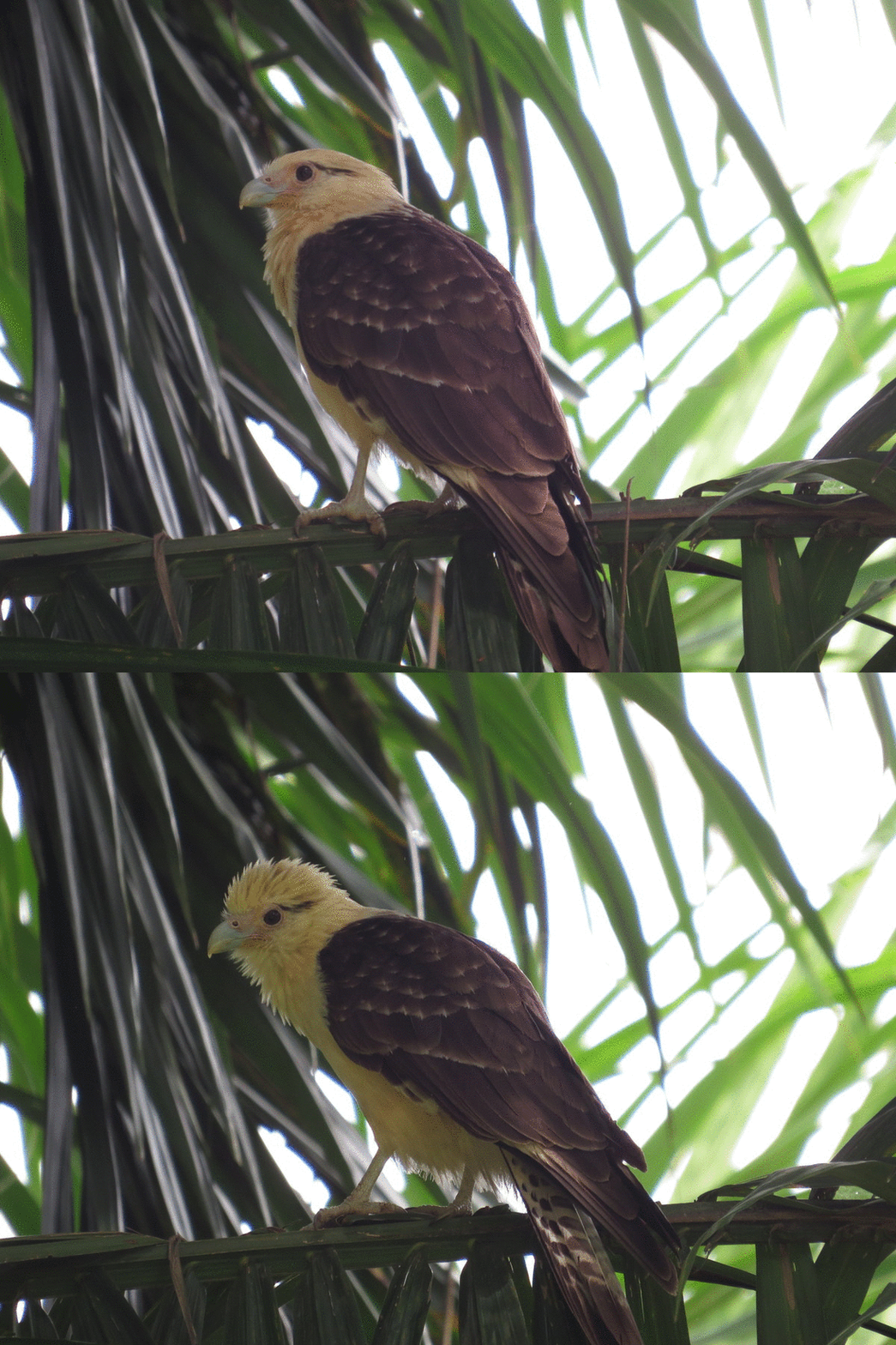
A Yellow-headed Caracara raising its head feathers

A Yellow-headed Caracara raising its crest at Bosque

I’ve posted before on the beauty of Bosque del Cabo and some of the wildlife that my family and I spotted when we were there just about a month ago, but at the time I didn’t touch on the complementarity of the coastal rainforest nature lodge with Xandari Resort in the Central Valley, where I’ve been based the last six months.

My first experience of the compatibility between Bosque del Cabo and Xandari was vicarious. One of my good friends at Cornell knew that I had lived in Costa Rica and asked for advice on places to stay for his parents and younger sister over spring break (unfortunately, he had to stay in Ithaca for varsity athletics). Of course, my first recommendation was Xandari Continue reading →

Murals at Cornell’s Lab of Ornithology

Video by Video by Lindsay France/University Photography

Video by Lindsay France/University Photography

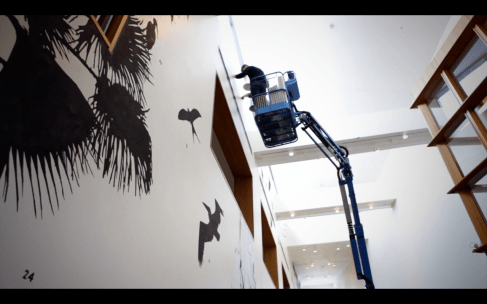
This past spring, naturalist, writer, and artist James Prosek completed the Wall of Silhouettes on the north wall of the Lab’s visitor center. As you can see from the video above, this mural is all in black and white, and shows the life-size, hand-painted silhouettes of 170 birds in different habitats, accompanied by numbers like those in a field guide to represent the relationship between us and nature and one of the ways in which people connect with birds.

A mural by artist Jane Kim planned for the wall facing Prosek’s paintings is scheduled to be completed next November, and will feature representatives from all 231 bird families, Continue reading →

Sneak Peek at Xandari’s Upcoming Holiday Tree

The Raxa Collective Holiday tree at Cardamom County, 2012.

Two years ago, the Raxa Collective team designed a new kind of conical decoration to replace the traditional pine tree at Cardamom County, one of Raxa Collective’s properties in Kerala, India. Pictured left, this tree received many compliments from employees and guests alike, was considered a success all around, and came out again last year with some new ornaments at Cardamom County. For the last several years, Xandari has relied on a small palm tree from the gardens here as the holiday ornament, but the resort has been looking for alternatives. When I showed the team what might now be considered the “Raxa Collective tree,” they were immediately excited and started planning to build one straight away.

And so it was that Edwin (José Luis‘s brother) and I found ourselves in two of the several bamboo groves on Xandari property with a saw and a machete on Tuesday. We started out with a simple sketch design of our planned tree based on the images we’d seen of the Indian version, then set out to cut a couple bamboo poles for the construction phase. We knew we’d need three 2.1 meter poles for the pyramid sides, so we got them from one type of medium-thickness bamboo. Then we needed twenty-one rods of seven different lengths (see design photo above), so we went to a grove of thinner type of bamboo.  Continue reading →