Starting 2013 With Promised Land

Scott Green/Focus Features. Matt Damon stars in “Promised Land,” directed by Gus Van Sant.

Scott Green/Focus Features.
Matt Damon stars in “Promised Land,” directed by Gus Van Sant.

From Green Blog, a suggestion first to read the review of, then listen the actor/director conversation about, a new film related to the most controversial of the alternatives to old school fossil fuels:

Writing in The Times, A.O. Scott praises “Promised Land,” Gus Van Sant’s new film about the battle over fracking, as a film that “works,” mainly “by putting character ahead of story” and “inviting the actors to be warm, funny and prickly.” Continue reading


Green Energy Prestidigitation Undermining Confidence In Alternative Pathways To Reducing Our Carbon Footprint

A CN freight train is shown leaving Sarnia for Port Huron in Michigan. (Dave Seglins/CBC)

Thanks to the CBC for some old fashioned investigative journalism.  Click the image to go to their report. In the macro view, considering the scope and scale of the challenge of weaning off of fossil fuels, the credits at the center of this story are small and seemingly minor parts of a bigger puzzle.  Perhaps.  But playing with smoke and mirrors and mystery trains crossing borders in the night?  Time to bring back tar and feathers for these Enron-ish slick vendors:

…”If the facts in your story bear out, there needs to be some people go to prison,” said Joe Jobe, CEO of the U.S. National Biodiesel Board. “It’s not a victimless crime. [RIN fraud] has impacted the livelihoods and jobs of absolutely everybody in this industry, and it has cost the folks in the petroleum industry who have to comply with this, millions and millions of dollars and it has put small- and medium-sized biodiesel producers completely out of business. Continue reading

Pedal Power


Read the Scientific American blog post from the beginning by clicking the image to the left:

… It costs $5,500, recharges its battery with its own rooftop solar panels, can legally take you on the road, on the sidewalk,* and on greenway trails, and has a 30-mile-per-charge range. Then you can either rely on those solar panels or you can take the little battery out and plug it in. And though it’s designed to carry me and up to 800 pounds of payload (guitar, amp, and groupie?), I can retrofit a little jumpseat so I can just haul around the groupie if I need to. You can read all about it in this story by the News & Observer of Raleigh. Continue reading

Green Tech, Served With Petro Chemicals

When this great series started, it was not clear that it was being sponsored by an oil company, which seems a slippery a slope; or, perhaps the way things out to be (click the icon to the right to go to the series home page, and if you watch the “green tech” video featured at the top of the site at the time of this writing, hold your nose when ExxonMobil presents itself as the best hope for our educational future):

You could be forgiven for thinking that after the burst of attention given to clean technology in the wake of the oil price spike of 2007, innovation in energy has faded away as it has several other times in the last 40 years.

But you’d be wrong. Continue reading

Algal Algorithm: SEE Sees Green Solution

SEE Algae. After its water is removed, this algae is destined to excrete biofuels.

Over at Green Blog, New York Times reporter Matthew Wald (click the image to the left to go to his report and the illustration below to go to the company’s website) writes about

…two companies that are racing to be first in commercial-scale production of motor fuel from nonfood sources. A large group of other companies is pursuing various other strategies, one or two steps behind. One of those companies is planning to use algae.

The company, SEE Algae Technology of Austria, is building a 2.5-acre factory on a sugar plantation near Recife, Brazil, that will use genetically modified algae that can eat carbon dioxide from the sugar. Adding urea and some nutrients, the algae excrete ethanol.

Continue reading

Accounting For Differences (Part 2)

A common sight in Germany: wind turbines in fields of rapeseed. Oil from the plant is made into biodiesel fuel to power cars, produce electricity and heat buildings. Credit: Osha Gray Davidson, InsideClimate News.

The second installment in a series we first linked to here (click the image to the left to go to the entire article at its source):

“What an eyesore, huh?” the man standing next to me on the beach said, nodding in the direction of a little girl flying a kite. The man, in his mid-40s, seemed to enjoy my confusion. He waited a beat before pointing beyond the girl, far out into the Baltic Sea. “There,” he said, smiling to make sure I understood Continue reading

There Is No Accounting For The Difference

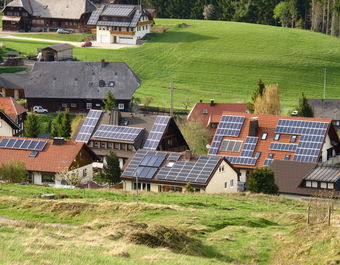
Small segment of a German farming village showing how pervasive solar panels are throughout the country. Credit: Osha Gray Davidson, InsideClimate News

From InsideClimate News (click the image to the right to go to the full story:

I’ve come to learn about what a majority of Germans believe is their future—and perhaps our own. There is no better place to begin this adventure than the Reichstag, rebuilt from near ruins in 1999 and now both a symbol and an example of the revolutionary movement known as the Energiewende.  Continue reading

Another Renewable Energy Innovation

Click the image above to go to the full story from Green Blog:

KiOR, a renewable fuel start-up based in Pasadena, Tex., said Thursday that it had produced a crude oil made from wood chips at a plant in Mississippi and expected to refine it into gasoline and diesel and sell it commercially later this month. That would be a first for the cellulosic biofuel sector.

Alternative Bulbs, Designed For Aesthetes

From Clean Technica, a story about a new light:

SWITCH Lighting has now designed a light emitting diode (LED) bulb that is much more industrial looking, like the standard incandescent bulbs, and demonstrates many of the same qualities that consumers like without the wasted energy.

They’ve been widely praised for their sleek industrial design and have even been featured as a work of art in several art galleries. In addition, the SWITCH75 was a Consumer Electronics Show 2012 Innovations Honoree, was named by TIME Magazine as one of the 50 Best Inventions of 2011 and also received a silver rating in the prestigious Edison 2012 Awards.

Alternative Energy, Scaling To Feasibility

Click the image to the right to go to the story in the Monitor:

Like many green technologies, wind power’s main drawback is a matter of size: Small turbines are inefficient and expensive, and utility scale turbines require too much land and capital for some communities.  Continue reading

Qatar Ups The Ante

Agence France-Presse — Getty Images. A Qatar Airways Boeing 787 Dreamliner.

Thanks to Green Blog for the story:

At the end of next year, Qatar Airways is scheduled to open a new airport that will include a 25-meter swimming pool and squash courts, among other amenities. But it will also be extraordinary from an energy standpoint because it will pump airline fuel made from natural gas.

Qatar has relatively little oil and vast supplies of natural gas. Continue reading

Let Them Drink Frack Juice

Did he really?  Was he channeling his inner snake oil salesman? Trying to demonstrate that Mr. Barnum had it right about we the people?  Or cluelessly re-enacting the image of a long ago empress who was thought not to have cared one iota about the needs of common people…

…During a keynote lunch speech at the conference presented by the Colorado Oil and Gas Association, Halliburton Co. CEO Dave Lesar talked about addressing public concerns about hydraulic fracturing, which extracts natural gas by blasting a mix of water, chemicals and sand underground.

He raised a container of Halliburton’s new fracking fluid made from materials sourced from the food industry, then called up a fellow executive to demonstrate how safe it was by drinking it, according to two attendees.

The executive mocked reluctance, then took a swig. Continue reading