Communities’ Cycling Commitments

New York this week became the latest major city to launch a bike-share program. Craig Ruttle/AP

New York this week became the latest major city to launch a bike-share program. Craig Ruttle/AP

Cyclists in the USA have much to cheer in this week’s community-centric news (thanks, NPR) about several new bike-sharing programs which all use check-in, check-out systems:

…with automated stations spread throughout a city, designed for point-to-point trips. “We try to encourage people to use it … almost like a taxi,” says Gabe Klein, commissioner of the Chicago Department of Transportation.

Continue reading

Roads Not Built For Cars

Hanover Street in Newcastle-upon-Tyne, originally built for horses and carts. Photograph: Carlton Reid

Hanover Street in Newcastle-upon-Tyne, originally built for horses and carts. Photograph: Carlton Reid

Definitely our cup of tea:

Even the BBC has called me it, so it must be true. Back in 2011 when I wrote this piece for the Guardian I was merely a journo-with-a-book-idea; now I’m a historian. Two years ago on this very blog I wrote:

Many motorists assume that roads were built for them. In fact, cars are the johnny-come-latelies of highways.

I went on to explain a little bit more about my highway history revisionism. Continue reading

Bicycle Information & Chitchat, UK Edition

We are not in the business of selling books nor promoting purchases at any particular outlet, but we do have a thing for bicycles.  More would be good.  Better regulations would be too.  Safety rules that everyone follows, check.  A book that covers these and other topics? Yes.  Will zany be more effective than serious-wonky?  Judge for yourself. Only certain island nations can pull off this sort of thing:

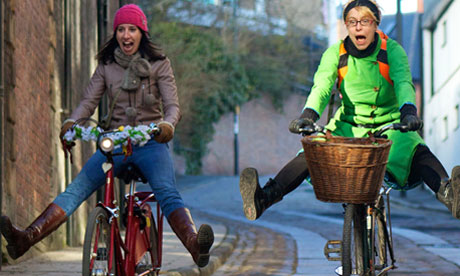
‘Cycling is the King of A to B. Whatever our differences, we love one another: Lycra mankini or tweed trousers tucked into your sock? Traffic lights – a suggestion or an order? Racer or hybrid, helmet or commando, freewheel or fixie? Nothing sours the bond.’ Zoe Williams Continue reading

Bike, Paper, Scissors

Although not quite in the category of “Don’t Try This At Home”, it looks like this bicycle animation is much more than the sum of its laser cut parts. Artist Katy Beveridge writes that the action must be filmed to animate as it isn’t visible with the naked eye.

The final results certainly impress!

Pedal Power


Read the Scientific American blog post from the beginning by clicking the image to the left:

… It costs $5,500, recharges its battery with its own rooftop solar panels, can legally take you on the road, on the sidewalk,* and on greenway trails, and has a 30-mile-per-charge range. Then you can either rely on those solar panels or you can take the little battery out and plug it in. And though it’s designed to carry me and up to 800 pounds of payload (guitar, amp, and groupie?), I can retrofit a little jumpseat so I can just haul around the groupie if I need to. You can read all about it in this story by the News & Observer of Raleigh. Continue reading

Bicycle Sharing Expands

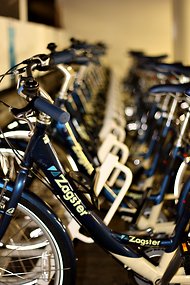
Photo: Zagster. So far Zagster has set up its “bike fleet in a box” at about 55 locations

Click the image to the left for the story about Zagster, in the New York Times Green Blog:

Municipal bike sharing has rolled into dozens of American cities, from Washington to Oklahoma City to San Francisco. Now a Massachusetts start-up called Zagster aims to take the idea of bicycles on demand and deliver it to university and corporate campuses, apartment complexes, hotels and resorts.

On Thursday, the company, formerly called CityRyde, announced a $1 million round of investment that will allow it to expand nationally. In essence, Zagster’s idea is to make access to bikes a coveted building amenity and corporate perk, right up there with pools, gyms, and cafeterias — at a relatively low cost. Continue reading

Denser, Faster, Greener

Click the image above to go to the article in which Alex Steffens, of Worldchanging (and TED, and plenty of other deserved) fame gives a synopsis on how to ramp up urban greening most efficiently:

If we’re talking about transportation, the best thing a city can do is densify as quickly as it can. That needs to be said every time this issue comes up, because it’s the only universal strategy that works. That’s the best-documented finding in urban planning—that as density goes up, trip length goes down and transportation energy use goes down.

Continue reading

Honesty Boxes

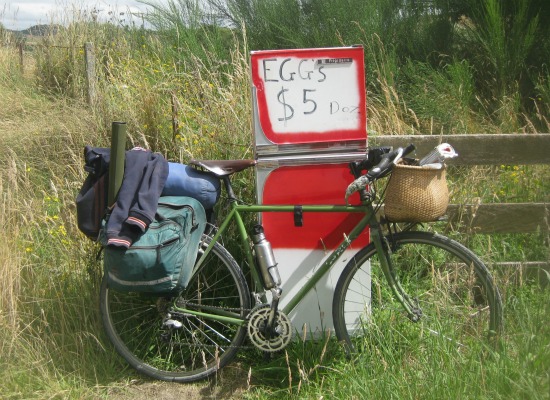
In case you missed the short item about this cyclist down under, it is worth a look.  So is the related item (click the image above to go to the original) about honesty boxes:

Many tourists in automobiles surely pass right by them unaware—but cyclists see these handmade, unguarded food stalls in the distance, usually first as a cardboard sign advertising some product of the homestead. Many times it’s just pine cones, sacks of sheep stool or firewood—and sometimes the sign is just a notice that a reputed local bull is ready and eager to mate.

Continue reading

Biking In The Catlins

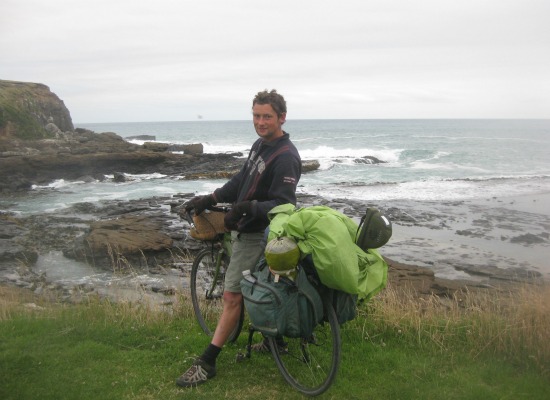
Facing off with the edge of the world, where the gray and blustery waters of the Southern Ocean meet the rocks of Curio Bay, in the Catlins (New Zealand). Photo by Geoff Green.

Today, a post on the Smithsonian blog (sub-blog?) called “off the road” catches our attention.  The photograph on its own would be enough to catch the eye, but reading this fellow’s several paragraphs about a place called the Catlins is enough to get on the raft and start paddling to New Zealand (if, like us, you like faraway places):

A main claim to fame of the Catlins is the area’s high latitude. Slope Point is the southernmost spot of land on the South Island, at 46 degrees, 40 minutes south. Oh, come on, now. Don’t raise your eyebrows and whistle like that. Seattle, for example, boasts a latitude of 47 degrees, and Glasgow goes just under 56 degrees. Yet I’ll grant that the Catlins are farther south than Tasmania, than Cape Town and than most cities in South America. This is, indeed, among the southernmost settled areas on the planet.

Continue reading

Le Vélo Bambou? Le Wow!

Bicycles are ubiquitous forms of transportation in my part of the world.  Previously I’ve posted how they can mean more than the sum of their parts, or in the urban art example, they can represent only their parts!

So what happens when form and function converge with sustainability, balance and simplicity? Continue reading

When Wheels Start Turning

“180+ countries. 2000+ events. A single day to move beyond fossil fuels.”

Even if you missed one of 350.org‘s September 24th Moving Planet events, the goals of reducing CO2 in the atmosphere is a 365 days per year project.

Whether its with Climate Ride in California, Clif 2 Mile Challenge in your neighborhood, or the Great Power Race in 2010, there have been many ways to get involved in this global call to action.

365 Days a year; 40,075.16 km around the globe; cast of thousands; cost? Priceless.  

Get Moving! 

Color Wheels

Whether by coincidence or just being on a roll (sorry), I just came across an inspiring urban art project that is part Civil Disobedience, part Public Art Initiative, part plain old recycling and completely FUN! Continue reading

What Wheels Can Do

This slideshow requires JavaScript.

From Bike Share programs to recycled wheels, Tour de France to backwater byways, bicycles are universal, or at least global.

More than just a method of transportation, they are often a form of expression, of the person riding it or the job they do. Continue reading