Yoga And Its Contents

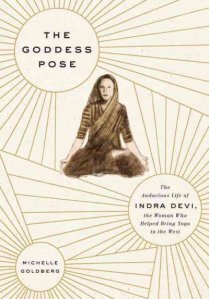
9780307593511_custom-96a370c39830fd94be59575d59bbffb4c13ce088-s500-c85We have been intrigued by news reports that the leader of the country where many of Raxa Collective’s contributors are based, and where yoga comes from, is leading an effort to get his country more devoted to its practice, and thereby export more of one of India’s most important innovations.
This intrigue is piqued especially after listening to an interview with the author of a book on this very subject–how yoga came to be disseminated from India to elsewhere–which puts the book on the top of our monsoon season reading list.

If you happen to be in Delhi two weeks from today, join in:

…On 21 June – the new International Yoga day – Narendra Modi, India’s prime minister, hopes the world will join in. The grass near India Gate will be transformed into the venue for what it is hoped will be the biggest single yoga session ever held, with up to 45,000 people running through a 35-minute routine.

The participants will include 64-year-old Modi, most of his government and, they hope, a range of celebrities. Officials have been sent to round up volunteers from scores of countries to reinforce the international credentials of the ancient Indian practice…

Meanwhile, listen to this interview to learn more about yoga’s journey to the West:

Continue reading

Museums, Libraries, And An Innovative Hybrid

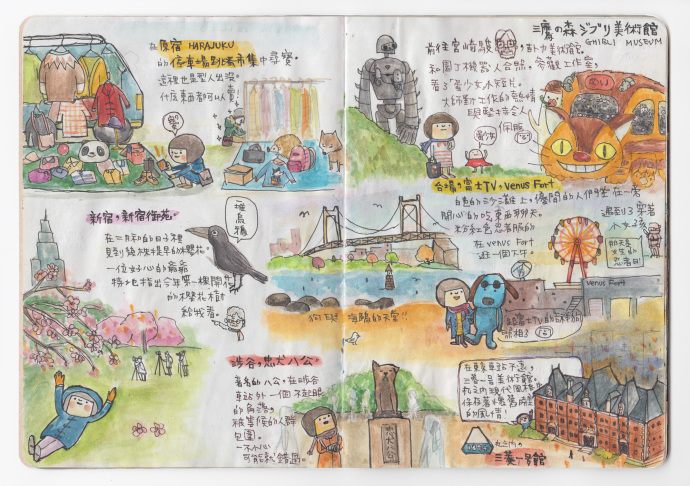
DRAWING BY LINYU YEN, COURTESY THE SKETCHBOOK PROJECT

DRAWING BY LINYU YEN, COURTESY THE SKETCHBOOK PROJECT

Museums, as well as libraries and other community institutions get a disproportionate share of our attention on this blog. When we see a random variation like the following, we cannot help but follow the trail (thanks to Jordan Kisner):

One recent Wednesday afternoon, a man wandered into a library on North Third Street in Brooklyn and asked how he could sign up for a library card. The young woman behind the counter smiled and explained that at this particular library there were no cards—or even traditional books. The Brooklyn Art Library, housed in a Williamsburg storefront with unfinished floors and exposed piping, is, instead, home to the Sketchbook Project, a collection of crowdsourced sketchbooks that is, according to its staff, the largest in the world. The project was founded in 2006, when Steven Peterman and Shane Zucker, two art students living in Atlanta, began mailing blank Moleskines to anyone who wanted one for a small fee, and then archiving whatever came back. Now anyone can pay twenty-eight dollars for a sketchbook, or sixty-three dollars for a digital membership, which means that their books will be scanned in full and archived online in a digital library. Continue reading

Nell Zink, Come To Kerala!

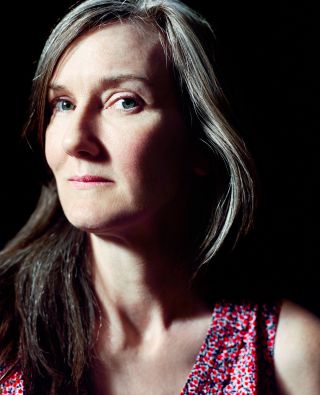
Bricklaying “was more valuable for my intellectual life than my entire college career.” PHOTOGRAPH BY GARETH MCCONNELL

Bricklaying “was more valuable for my intellectual life than my entire college career.” PHOTOGRAPH BY GARETH MCCONNELL

No doubt, Nell will be a good fit among La Paz Group’s global community of artistically and/or conservation-oriented invitees, many of whom you have not likely heard of, some of whom are more famous, but all with unusual talents and interests. Thanks to Kathryn Schulz for another invitation-worthy story: Nell Zink turned her back on the publishing world. It found her anyway.

The kookaburra in the Berlin Zoo is ten thousand miles from home, squat, top-heavy, large of beak, attractive of plumage, and making what is, ounce for ounce, the loudest, strangest sound I have ever heard emerge from a living creature. It begins with a classic evil laugh, bwaaahahahaha, à la Vincent Price in “Thriller,” then the bird throws back its head and lets out a series of hoots, like a plump British woman with an unbecoming but infectious laugh or a parrot that grew up in a frat house, dissolves into giggles, transitions to a chortle, appears to become an entire dinner party going to pieces, then starts to pull it together, O.K., O.K., the guests wiping their eyes and settling down, until out comes a little chuckle and hahahahoik!ha, the bird is cracking up again. Continue reading

Tricksters, Animals, And Narratives We Are Meant To Learn From

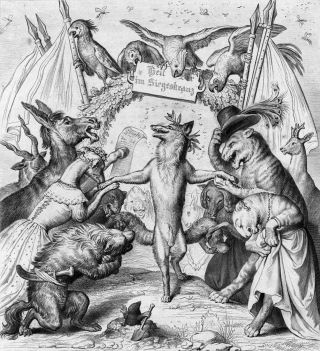
“Reynard” is a defining document of a vast tradition in Western art: the trickster story. CREDIT ART AND PICTURE COLLECTION / THE NEW YORK PUBLIC LIBRARY

“Reynard” is a defining document of a vast tradition in Western art: the trickster story. ART & PICTURE COLLECTION, THE NEW YORK PUBLIC LIBRARY

Thanks to Joan Acocella for illumination of a narrative form we are quite fond of:

…Animal narratives have allowed writers with lessons on their mind to make art rather than just lessons.

Such tales are no doubt as old as animal paintings on cave walls. The earliest evidence we have of them is the beast fable, a form that is said to have come down to us by way of Aesop, a Greek storyteller who was born a slave in the sixth century B.C. Actually, no solid evidence exists that there ever was an Aesop, any more than there was a Homer. As with the Iliad and the Odyssey, we are talking about manuscripts that date from a period much later than the supposed author’s, and were probably assembled from a number of different fragments. In any case, a beast fable is a very short story (the Penguin Classics edition of Aesop renders “The Tortoise and the Hare,” perhaps the most famous of the fables, in five sentences) in which, typically, a couple of animals with the gift of speech learn a lesson from their dealings with one another. This moral is then stated at the end of the fable, and it is usually of a cautionary variety: don’t eat too much, don’t brag, watch out for this or that. As early as the third century B.C., these stories were being gathered together in various editions, usually for children, to teach them Latin (most were in Latin until the late Middle Ages) and some basic rules about life. Continue reading

Twain’s View Of India

We appreciate the sentiment from Mark Twain’s 1897 lesser known but ever interesting Following the Equator and feel obliged to show some India quotes that we can relate to, or at least smile at, as a recommendation for your reading pleasure while joining Raxa Collective in India sometime this year:

pg2895.cover.medium…So far as I am able to judge, nothing has been left undone, either by man or Nature, to make India the most extraordinary country that the sun visits on his round…

…This is indeed India! the land of dreams and romance, of fabulous wealth and fabulous poverty, of splendor and rags, of palaces and hovels, of famine and pestilence, of genii and giants and Aladdin lamps, of tigers and elephants, the cobra and the jungle, the country of a hundred nations and a hundred tongues, of a thousand religions and two million gods, cradle of the human race, birthplace of human speech, Continue reading

Tending Our Fields

We have a strong reaction of affinity with the theme of this op-ed essay in the New York Times from an author, an avid birder, we think highly of:

Matthew The Horse

Matthew The Horse

Anyone over the age of 40 who went to school in Britain will know what a nature table is. Almost anyone younger than that will not because the nature table — the classroom altar or grotto made of child-gathered natural treasure — is no more. From the age of 7 to 11, I was a major contributor to the one in my suburban junior school. I mostly brought old nests like various leafy crowns, but also a squirrel’s drey, a wren’s foot and a goldfinch’s wing. My classmates came with furry catkins in jam jars,  Continue reading

Biophilia Revisited

This slideshow requires JavaScript.

 Biophilia, the word, came to our attention several years ago, but the concept has been part of our personal ethos for decades. We’re particularly invigorated by the multi-faceted (pun not actually intended) way the word can be applied to so many concentrations, from the scientific, to the literary, to the artistic, to the spiritual.

The work of American artist Christopher Marley attracts on numerous levels. His new book inspires on the design front. For more images and information to pique the interest read McKenna Stayner’s piece in the New Yorker here.

About the book

Christopher Marley’s art expresses his passionate engagement with the beautiful forms of nature. Beginning with insects and moving on to aquatic life, reptiles, birds, plants, and minerals, Marley has used his skills as a designer, conservator, taxidermist, and environmentally responsible collector to make images and mosaics that produce strong, positive emotional responses in viewers. Marley has a brilliant eye for color and pattern in different natural objects, and he expertly captures the deep relationships among them. Biophilia (literally, “love of living things”) is a must-have for nature lovers, designers, artists, craftspeople, and anyone looking for visual inspiration in the arts.

Continue reading

Art & Food, Food & Art

9781614284321_custom-458a1838430962f2508b82415502232ea5d3b9a8-s400-c85

This book review, on the salt (thanks NPR, USA) covers two books for the foodie/arts-oriented audience we sometimes find lurking here:

…We all need to eat, and our preferences are intensely personal. Yet food is often overlooked in the biographies of anyone who wasn’t a chef or gastronomic icon.

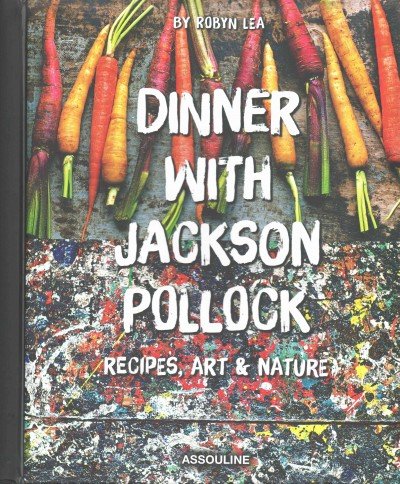
Two new books focusing on the culinary lives of artists — Monet’s Palate Cookbook, by Aileen Bordman and Derek Fell, and Dinner with Jackson Pollock, by Robyn Lea — show this to be an oversight. The artists’ approaches to food provide a new way of thinking about their very different approaches to art, and of understanding the artists themselves.

As Francesca Pollock, the artist’s niece, writes in Dinner‘s introduction, “He painted the same way he cooked: Endlessly using leftovers; keeping and re-using; trying one color or shape and then another. There was never ever any waste. Painting, like cooking, was a way of living.”…

monets-palate_custom-6c7383097b98ea23fd7902df2b0f5ec14718a798-s400-c85

…Food only occasionally appears in Monet’s work, mostly in still-lifes. But though he never painted his private kitchen garden, at 2.5 acres, it was sizable in its own right, and surely at least as much a fixture in his life as its more famous blooming cousin. And Monet himself put a premium on food, according to the authors.

“Almost every franc that he earned, after taking care of his family’s welfare, he would spend on the freshest ingredients for meals and improving the interior and exterior of his house” — originally, a farmhouse and cider press, Bordman and Fell write. Monet, we learn, employed a cook, and his diet included eggs from his own chickens. He was actively involved in directing which vegetables were planted (he liked experimenting with new varieties), and which ones ended up on the dinner table… Continue reading

Prosek, Eels, Conservation

Screen Shot 2015-04-24 at 4.54.32 AM

When we invited James Prosek to Kerala it was in part due to his artistic sensibility with eels, and a year after that invitation we gave that peculiar but enchanting sensibility more attention.  But by then we had already noticed his bird work at the Cornell Lab of Ornithology, which Seth had watched as it went up, and his family went to inspect at the time of his graduation from Cornell. And so while Prosek has a long history with aquatic conservation Raxa Collective had a new view of Prosek that gravitated to his work with birds.

We are now glad to be reminded of his aquatic passions, in a blog post about conservation by Silvia Killingsworth, the managing editor of The New Yorker, where Prosek features as one of several consulted experts on the fate of the “lowly” eel, which turns out to be much more fascinating than expected (do read the post from start to finish for both conservation and foodie reasons):

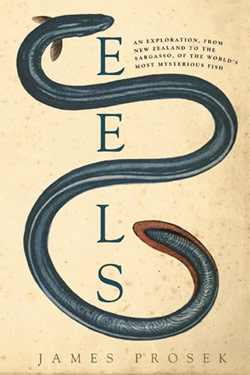
book_eels-lg…Both the Japanese and European species have been listed as endangered by the International Union for the Conservation of Nature.

And yet, according to James Prosek, an artist, naturalist, and the author of the book “Eels,” the American eel will never be listed under the Endangered Species Act. The E.S.A, Prosek told me last week, “works well for creatures that could go down to a population of six hundred, and eels will never get down to that. Maybe a million, and that won’t be enough to sustain collective consciousness”—it won’t sound bad enough to make the public care. Continue reading

Stephan Brusche, Come To Kerala!

Stephan Brusche (@isteef)

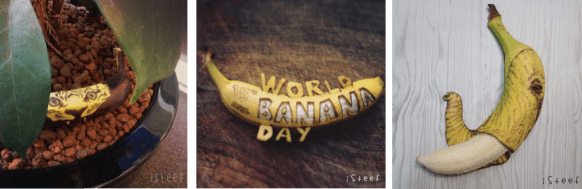
Stephan Brusche (@isteef) From left to right: tiger, WBD, elephant

Hospitality is in our DNA, but we always want to go the extra mile for the those who tickle our creative fancy. In fact, World Banana Day touches us on multiple dimensions, and we thank our newest contributor, Rosanna Abrachan, for bringing it to our attention.

Stephen Brusche is someone who clearly enjoys playing with his food, and scrolling through his gallery it was close to impossible to choose favorites from over 200 fabulously creative examples, crafted with a wink and smile at both the sacred and the profane. We settled on 2 of our iconic Kerala fauna above, but be prepared to lose yourself in the images when you visit his site. Continue reading

Umberto Eco, Come To Kerala!

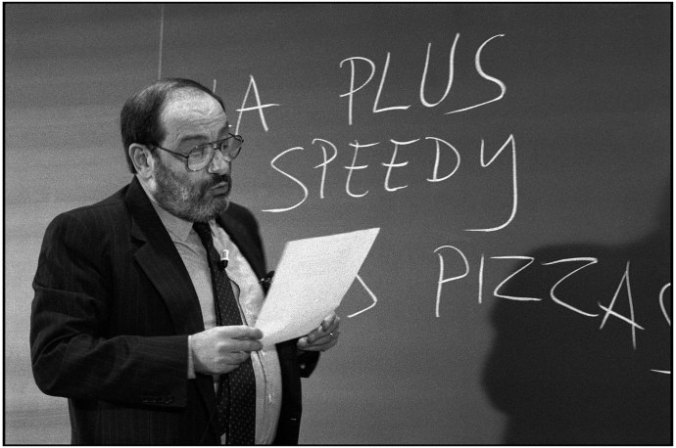
In “How to Write a Thesis,” Umberto Eco walks students through the craft and rewards of sustained research. CREDIT PHOTOGRAPH BY MARTINE FRANCK / MAGNUM

In “How to Write a Thesis,” Umberto Eco walks students through the craft and rewards of sustained research. CREDIT PHOTOGRAPH BY MARTINE FRANCK / MAGNUM

I have excerpted the first two paragraphs, and the last two, of a delightful and delightfully odd book review in order to finally extend an invitation to Umberto Eco that is long overdue. The review is odd only in the sense that the book was first published when I was a sophomore in high school, 20 years before I completed my doctoral dissertation (which I was working on 20 years ago), and is only now appearing in English for the first time, one year after my son completed his undergraduate honors thesis (the best advice we could send him back then was this).

The review is anything but odd, if you have been following our blog for the last four years.  It is about the effort required to understand sufficiently, and to communicate effectively, on a topic you care about–and provides some tricks of the trade that sound geared for university students but apply to members of our collective as well.  We are not in thesis mode at Raxa Collective. What we do is not theoretical, but grounded in the grind of hard work every day in our chosen profession. But we are in constant search mode for thesis-forged talent who know how to express themselves, to join us as interns or as employees (see Rosanna’s post for our latest talent acquisition in this spirit).

Umberto Eco is my favorite author, mainly because of one short book of his collected writings that I read when I was working on my doctoral dissertation. And mainly for that same book I extend to him an invitation to visit with us in Kerala, as our guest. Maybe I did not need the book reviewed below to complete my thesis, but I am sure I would have devoured it if given the opportunity at that time:

“How to Write a Thesis,” by Umberto Eco, first appeared on Italian bookshelves in 1977. For Eco, the playful philosopher and novelist best known for his work on semiotics, there was a practical reason for writing it. Up until 1999, a thesis of original research was required of every student pursuing the Italian equivalent of a bachelor’s degree. Collecting his thoughts on the thesis process would save him the trouble of reciting the same advice to students each year. Since its publication, “How to Write a Thesis” has gone through twenty-three editions in Italy and has been translated into at least seventeen languages. Its first English edition is only now available, in a translation by Caterina Mongiat Farina and Geoff Farina. Continue reading

Inspired By Libraries Without Borders

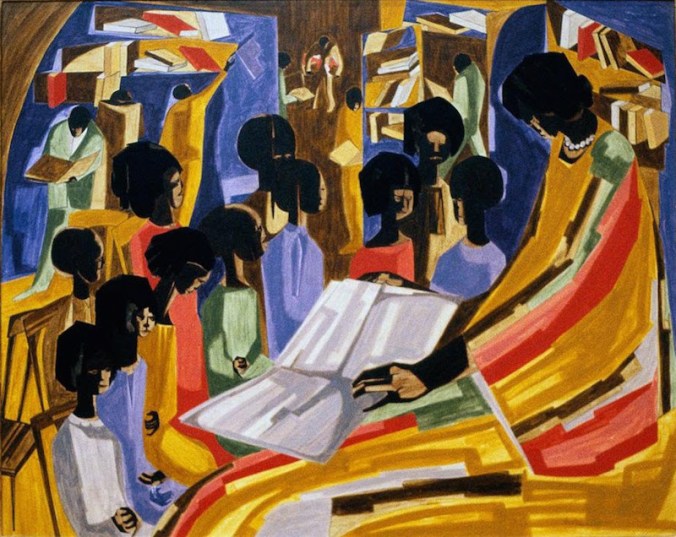
jacob-lawrence-library-1

from a series on libraries by Jacob Lawrence.

What a wonderful surprise, to come across this talk by Kenan Malik, on a topic that has been of interest to us for some time:

I gave a talk at the launch at London’s Institut Français of Libraries without Borders, the charity inspired by Patrick Weil that aims to increase global access to books and libraries. Also speaking were Ian McEwan, Lisa Appignanesi, Barbara Band and Patrick Weil himself. Here is a transcript of my talk.


Let me begin with a story not of a library or a book but of a grand piano. The one grand piano in Gaza, that was discovered still intact in a theatre destroyed by an Israeli missile during last year’s war. A piano that has been restored string by string, hammer by hammer, by Claire Bertrand, a young French music technician who travelled to Gaza specially to bring the piano back to life, in a project financed by Daniel Barenboim. Continue reading

Orcas In Captivity, Reviewed

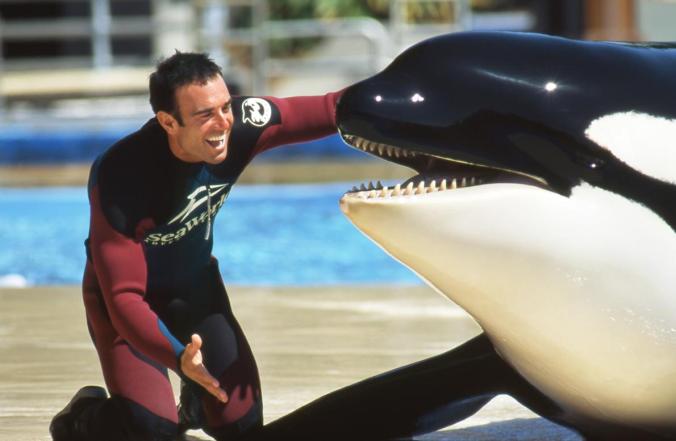
Author John Hargrove interacts with Kasatka during a show at SeaWorld. He calls her “the most dangerous whale in the corporation.” PHOTOGRAPH BY MELISSA HARGROVE

Author John Hargrove interacts with Kasatka during a show at SeaWorld. He calls her “the most dangerous whale in the corporation.” PHOTOGRAPH BY MELISSA HARGROVE

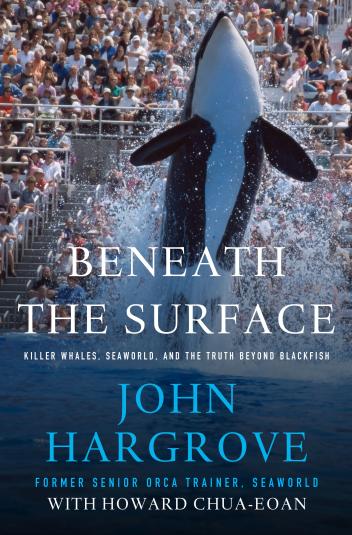
A book we had heard about, finally reviewed in a publication where it belongs to be taken seriously by a global audience of concerned citizens:

Former Trainer Slams SeaWorld for Cruel Treatment of Orcas

Author says the damage to these animals in the name of entertainment and profit is morally and ethically unacceptable.

By Simon Worrall, National Geographic

Continue reading

H Is For Hawk, Reviewed

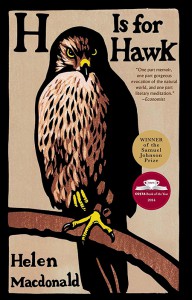
We already posted on this book earlier this month, but there is no question it deserves more attention. This time the attention comes in the form of a book review at the Cornell Lab of Ornithology’s blog, All About Birds from an “insider” (at two levels, including lifelong falconer and someone who edits one of the leading magazine’s for bird-oriented readers):

H_is_for_Hawk_cover450-192x300By Tim Gallagher, editor of Living Bird magazine

Last fall, a remarkable memoir called H is for Hawk, by Helen Macdonald, took the United Kingdom by storm, winning two prestigious awards and rising to the top of the bestseller list. It’s just been released in the U.S. and promises to do the same here. Last fall, our own Living Birdmagazine published a review that highlighted Macdonald’s lyrical writing —but as a lifelong falconer I also give her high marks for providing a window into the minds of falconers and their birds.

Continue reading

Progress, Evolution & Design

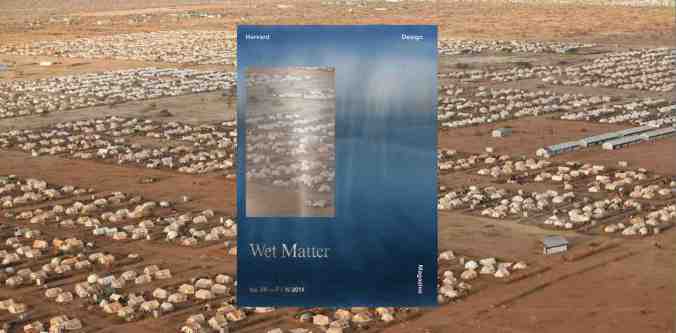
Screen Shot 2015-03-21 at 10.38.33 AM

Thanks to the Harvard Gazette for bringing our attention to this magazine, published twice yearly by the Harvard University Graduate School of Design:

Making print modern

New look for Harvard Design Magazine deepens focus on ‘Wet Matter’

By Corydon Ireland, Harvard Staff Writer

In an age of bits and bytes and pixels and text on screens, Harvard Design Magazine — relaunched in a new format last year ― fervently embraces the thingness of print, the quotidian actuality of paper and ink.

The right wordsmiths were on hand to recast and renew the magazine, which is produced at the Harvard Graduate School of Design.

Continue reading

A Book Our For Our Collective Sympathies

Haunted by her father’s death, Helen Macdonald kept company with a bird of prey. CREDIT PHOTOGRAPH BY CHRISTINA MCLEISH / COURTESY GROVE ATLANTIC

Haunted by her father’s death, Helen Macdonald kept company with a bird of prey. CREDIT PHOTOGRAPH BY CHRISTINA MCLEISH / COURTESY GROVE ATLANTIC

Birds represent something important in our work, and it is not always clear exactly how and why, so every day we try to elaborate it for ourselves as much as for anyone.

If you did not take the moment to watch the video posted yesterday, or read the post from our boys in the Blue Mountains of Jamaica, no matter. Today those are complemented by a book review, of all things, that captures the essence of why we find birds so compelling, and helps us understand why their world has come to play such a vital role in this blog:

…Among those who know their birds of prey, the reputation of the goshawk is half Hamlet, half Lady Macbeth: mad, murderous, unpredictable, the kind of creature whose partners and intimates should brace themselves for trouble. “Spooky, pale-eyed psychopaths,”

Continue reading

Neighbors Unite

Photo credit: Davebloggs007/Flickr

Photo credit: Davebloggs007/Flickr

Many of the RAXA Collective contributors could could easily get behind  the motto: “Book Lovers Unite!”; many could be found with their noses in a book from early childhood to the present day. So when we read about these “pop up libraries” in various parts of the country the only response possible was excitement.

Books are an essential part of culture and the LFL concept of sharing creates an even greater community bond worth conserving.

Three years ago, The Los Angeles Times published a feel-good story on the Little Free Library movement. The idea is simple: A book lover puts a box or shelf or crate of books in their front yard. Neighbors browse, take one, and return later with a replacement. A 76-year-old in Sherman Oaks, California, felt that his little library, roughly the size of a dollhouse, “turned strangers into friends and a sometimes-impersonal neighborhood into a community,” the reporter observed. The man knew he was onto something “when a 9-year-old boy knocked on his door one morning to say how much he liked the little library.” He went on to explain, “I met more neighbors in the first three weeks than in the previous 30 years.” Continue reading

Classics On The Upswing

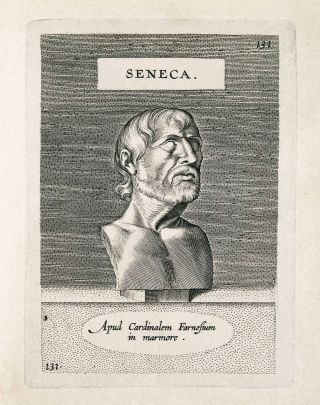
Seneca was venerated as a moral thinker; he was also one of Nero’s closest advisers. CREDIT PHOTOGRAPH FROM AISA / EVERETT So

Seneca was venerated as a moral thinker; he was also one of Nero’s closest advisers. CREDIT PHOTOGRAPH FROM AISA / EVERETT

This book review reminds us (for example where, in the middle of the review, the reviewer irresistibly, simply, says: “These days, Seneca is again on the upswing.”) of James, now firmly planted in the green fields of Harvard University taking his classics education to the ultimate level.

James, for his part, reminds us of our many reasons for paying attention to the classics, having little directly to do with the day to day activities of Raxa Collective except that the classics help us keep it all in perspective:

…If poets and philosophers dream of influencing those in power, Seneca was uniquely positioned to do so. He was a celebrated rhetorician, a satirist, the author of several books of natural history, and a playwright. He was also what today might be called an ethicist. Among his many works of moral philosophy are “De Ira” (“On Anger”), “De Providentia” (“On Providence”), and “De Brevitate Vitae” (“On the Shortness of Life”). Seneca had been Nero’s tutor since the younger man was twelve or thirteen, and he remained one of his closest advisers. Continue reading

Teaching, Reading, Books, And The Art Of Heroic Generosity

teacher-dorchester_wide-e26ec96b4bf01b90583733bad7518f51e86db66b-s1300-c85

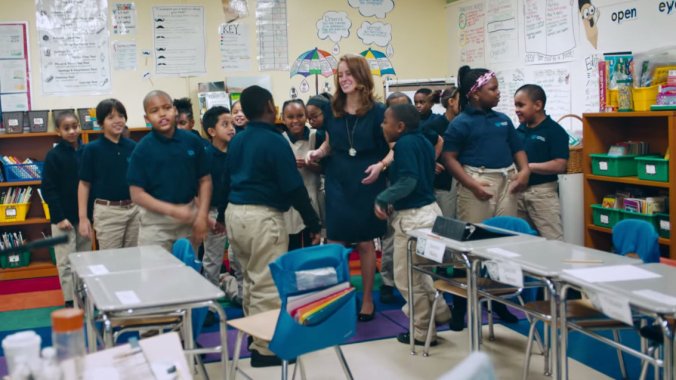
Third-grade teacher Nikki Bollerman, 26, won a contest that gave her students books for the holidays. When she also won $150,000, she decided it should go to her school. YouTube

No matter how much we talk about books, or libraries, or teachers, or reading, we are not sure. We hope we would do the same as Ms. Bollerman. The fact that we are not sure is the real reason why this story is a must share, must read. We like her decision very much and will do our best to follow her lead:

One thing’s for sure: Nikki Bollerman believes in her school and the kids who go there. How else to explain Bollerman, 26, giving a $150,000 windfall to the Boston area public charter school where she teaches third grade?

The story comes to us from member station WBUR, which reports that Bollerman’s generosity got the attention of Mayor Marty Walsh, who met with her and some of her students Monday.

“I want to thank Nikki for your kindness and your humility, and you are certainly a shining example of great things to the city of Boston,” Walsh said. “We are grateful for your hard work and generosity. You have inspired lots of people with your selfless act.” Continue reading

Librarians Fortify The Front Line

9780544535022_custom-376b39afbbf45a91478a9f43c2df0b1cc11e6e4f-s500-c85

Books we love, war not so much. The story told in this book is about books, about librarians, publishers and common folk who believe in books. And who believe that books are important for fortifying people who need heroic capacities.

In an interview with the author, we see publishers and their town square counterparts, librarians, in a light we had not been aware of, showing their contribution to community at a critical moment in history:

…Over the next few years, millions of Americans would leave home to fight in Europe and the Pacific. They had few comforts and little in the way of escape or entertainment — at least not until American publishers got involved.

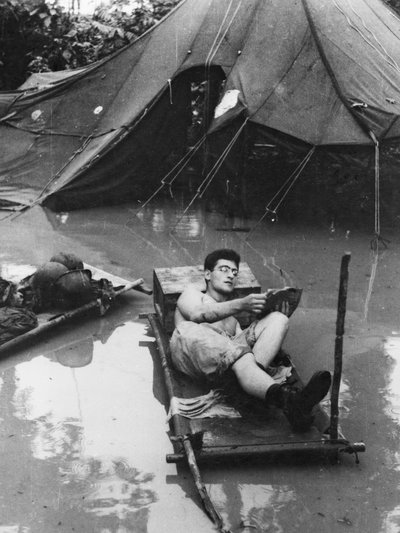
A soldier reads an Armed Services Edition in monsoon conditions during World War II. Australian War Memorial/Courtesy of Houghton Mifflin Harcourt

A soldier reads an Armed Services Edition in monsoon conditions during World War II. Australian War Memorial/Courtesy of Houghton Mifflin Harcourt

“During World War II, American publishers wanted to support the troops,” author Molly Guptill Manning tells NPR’s Renee Montagne. “And so they decided that the best they could do was print miniature paperback books that were small enough that they could fit in a pocket so the men could carry these books with them anywhere.”

Guptill Manning’s new book, When Books Went to War, is a history of these paperbacks, known as Armed Services Editions. They included all sorts of literature — from Charles Dickens and William Shakespeare to mysteries and Westerns — and were the culmination of earlier efforts on the part of American librarians to get usedbooks to servicemen with help from book drives. Well-intentioned though they were, the results of these book drives were mixed, turning up titles like How to Knit and Theology in 1870. So the focus switched to designing and printing books that soldiers actually wanted to read — no easy task since these Armed Services Editions had to be battlefield ready.

Continue reading