Hello Again, Robert Krulwich

D95MNR

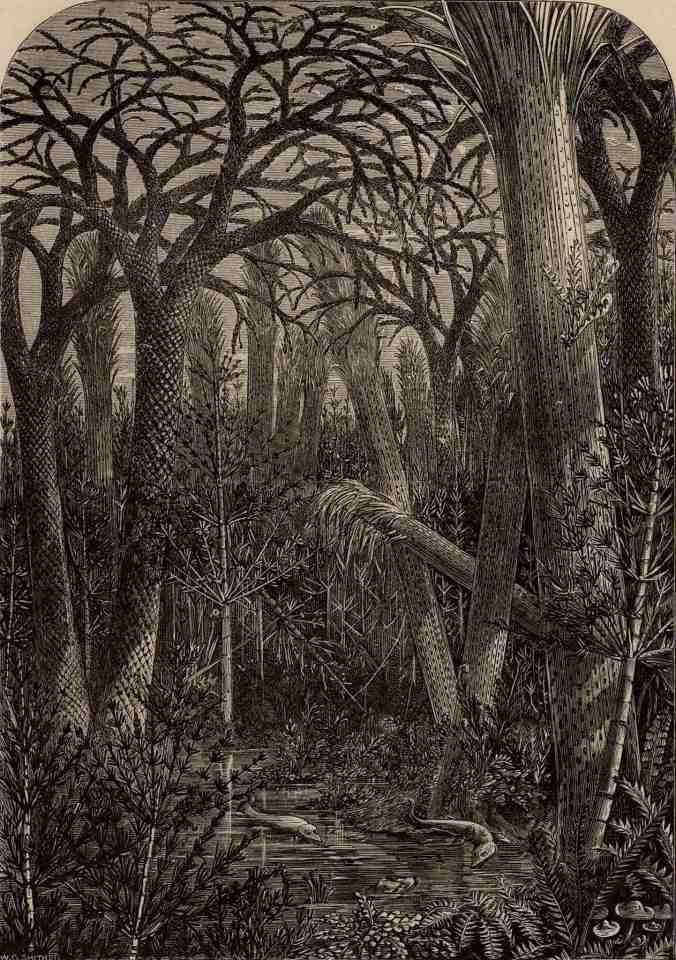
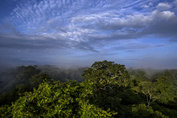
Artist’s reconstruction of a forest during the Carboniferous period. From ‘Science for All’ by Robert Brown (London, c1880). Illustration by World History Archive, Alamy

National Geographic‘s website has enlisted one of our favorite science communicators for its Phenomena section, and we are suddenly aware of how long it has been since we featured one of his ponderings (and excellent illustrations):

… whose trees “would appear fantastic to us in their strangeness,” write Peter Ward and Joseph Kirschvink in their book A New History of Life.

Some of them were giants: 160 feet tall, with delicate fernlike leaves that sat on top of pencil-thin trunks. This was the age when plants were evolving, climbing higher and higher, using cellulose and a tough fiber called lignin to stay upright. Had you been there, you would have felt mouse-sized.

Continue reading

Thank You, Oxford!

thThanks to the Guardian for its ongoing coverage of environmental news, including great attention to Oxford University’s environmental stewardship; also, especially to George Monbiot for his role at the paper as a shaker-upper:

Damian Carrington

But UK’s second biggest university by endowment says it will not bow to campaigners’ demands for full divestment from fossil fuels

The University of Oxford has ruled out future investments in coal and tar sands from its multi-billion pound endowment, but said it would not divest from all fossil fuels as demanded by thousands of students, academics and alumni.

Campaigners welcomed the move as a victory for the fast-growing fossil fuel divestment campaign, as it was the first time the university had made clear its position on the issue.

“Many world leaders have studied under Oxford University’s spires,” said Andrew Taylor, at campaign group People & Planet. “They should be taking notes today. The lesson is: it’s time to phase out coal and axe tar sands.” Continue reading

Bummer Of A Finding

Another day, another news cycle. Another week, another wave of stories on topics we care about, some fun, some inspirational, some downright scary. In science news, a story we find not particularly surprising, but we must share it:

24RAINFOREST-thumbStandardAmazon Forest Becoming Less of a Climate Change Safety Net

By JUSTIN GILLIS

The ability of the Amazon basin to soak up excess carbon dioxide is weakening over time, researchers reported last week.

Offsetting The Perfect Burger

sfs_potato_vindaloo-13---cred-joe-keller_wide-5a785d2066759cd77d2ecb8b9f7d4789ce169255-s1300-c85

Tomato paste gives the Potato Vindaloo its “backbone,” “structure” and “depth,” says America’s Test Kitchen’s Jack Bishop. “‘You probably wouldn’t identify it in the finished dish, but leave it out and you would notice the difference.” Joe Keller/Courtesy of America’s Test Kitchen

Fresh Air, an interview program on National Public Radio (USA), interviewed these same two people originally in 2013, and some members of Raxa Collective can still remember the description, in the podcast version of that interview heard while driving through south India, of grilling the perfect summer burger. And it inspired us to develop the perfect burger for south India, one of the few places in India where beef is available (due to the particular cultural mix of Kerala, in particular).

In the spirit of full circle, we are delighted to announce that Derek, in between Munnar joy rides and beach bliss responsibilities, has accomplished one of the missions we gave him for his time in Kerala, and its name is the Tico Burger (more on which, soon). At the same time, and just in time, to balance out our diets after taste-testing Derek’s burgers the same folks who inspired us to build a better burger are now providing insights on how to offset the carbon and karmic footprints of those burgers with some vegetarian cooking insider magic:

Just because a meal is vegetarian doesn’t mean it can’t be “meaty.” One trick to heighten the depth of flavors in plant-based dishes? Use ingredients that offer a pop of umami, say Bridget Lancaster and Jack Bishop of America’s Test Kitchen, who have released the new cookbook The Complete Vegetarian Cookbook. Continue reading

21st Century Alchemy

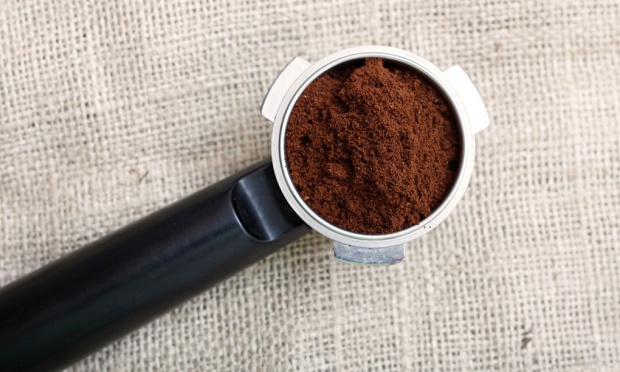
Scientists at the City University of Hong Kong can turn coffee grounds and stale bakery goods into a sugary solution that can be applied to manufacture plastic. Photograph: Alamy

Scientists at the City University of Hong Kong can turn coffee grounds and stale bakery goods into a sugary solution that can be applied to manufacture plastic. Photograph: Alamy

We frequently talk about the recycling on these pages, with an eye toward the developing awareness that the concept is no longer limited to inorganic, static materials. This recent article in the Guardian indicates that plant cellulose based plastic is just the tip of the iceberg in the possible ways to convert the mountains of food waste in many parts of the world into materials with environmental benifits.

Scientists at the City University of Hong Kong have found that they can turn coffee grounds and stale bakery goods – collected from a local Starbucks – into a sugary solution that can be used to manufacture plastic. The food waste was mixed with bacteria and fermented to produce succinic acid, a substance usually made from petrochemicals, that can be found in a range of fibres, fabrics and plastics. Continue reading

Please Do The Needful

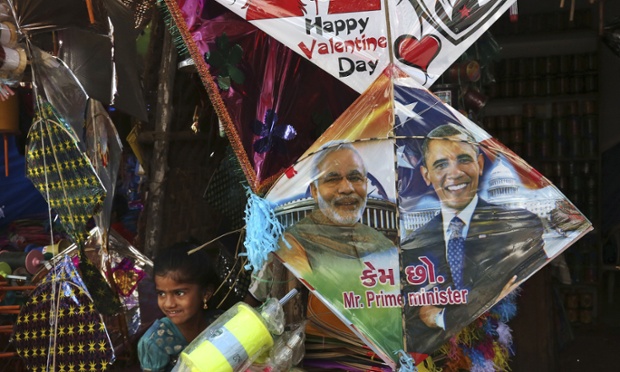
An Indian girl stands near a kite with portraits of India’s Prime Minister Narendra Modi and US President Barack Obama, displayed for sale at a shop ahead of the Hindu festival of Makar Sankranti, also knowns as kite festival, in Hyderabad, India, 12 January 2015. Photograph: Mahesh Kumar A./AP

An Indian girl stands near a kite with portraits of India’s Prime Minister Narendra Modi and US President Barack Obama, displayed for sale at a shop ahead of the Hindu festival of Makar Sankranti, also knowns as kite festival, in Hyderabad, India, 12 January 2015. Photograph: Mahesh Kumar A./AP

Down here in Kerala the air is perfectly clean, and the biodiversity hotspot of the Western Ghats may spoil us into thinking all is well with the environment; but it is not. And the meeting of these two heads of state could do something substantive about it. We hope they do (the needful, as they say in India):

…“The co-operation on clean energy and climate change is critically important,” Ben Rhodes, the deputy national security adviser, told a conference call with reporters.

America is hoping to persuade India, one of the world’s biggest emitters, to commit to an ambitious post-2020 plan for reining in its greenhouse gas emissions ahead of the international climate change meeting in Paris this December. Continue reading

Australian Emissions Drop With New Carbon Tax

Via The Guardian

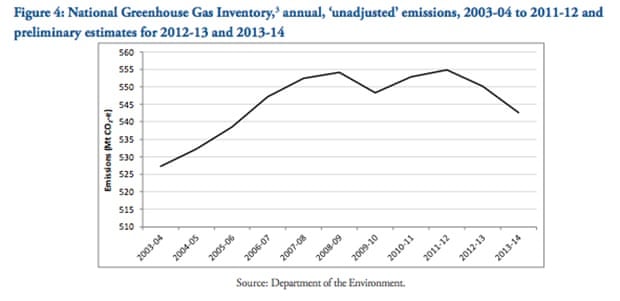
In 2012, Australia introduced a carbon tax, or carbon “price,” with the goal of reducing the country’s greenhouse gas emissions. Then, this July, the Australian government — under a different party than in 2012 — abolished the carbon tax to fulfill an election promise, since they argued that the tax was too much of a burden on homeowners and also discouraging industry. But data released this month by the Department of the Environment shows that Australia’s emissions dropped 1.4% during 2013 (the second year of the tax), which is the highest annual decrease in the country’s emissions within the last decade. Oliver Milman reports for The Guardian:

The latest greenhouse gas inventory showed emissions from the electricity sector, the industry most affected by carbon pricing, fell 4% in the year to June.

Electricity emissions account for a third of Australia’s emissions output, which stood at 542.6m tonnes in the year to June, down from 550.2m tonnes in the previous 12 months.

Emissions from transport dropped 0.4% in the year to June, with gases released by the agriculture industry decreasing by 2.6%. Industrial processes emitted 1.3% less greenhouse gas during the year, although fugitive emissions, such as those from mining, rose 5.1%.

Electricity emissions peaked in 2008 and have steadily decreased ever since, driven by a number of factors such as the winding down of parts of Australia’s manufacturing base and energy efficiency initiatives.

Continue reading

Forests Are Life

23FOREST-slide-O45T-mediumFlexible177We are happy, for the sake of the next generation(s), to read this news:

Restored Forests Aid Climate Change Efforts

Driven by a growing environmental movement, corporate and government leaders are making a fresh push to slow the cutting of rain forests — and eventually to halt it.

Cornell’s Nanoscale Carbon-scrubbing Sponges

© Provided/Genggeng Qi – A scanning electron microscopy image of a pristine silica support, before the amine is added.

We’ve had posts on this blog about carbon output by consumer technology, motor vehicles, and food. We’ve also posted, including quite recently, on carbon storage, often in forests. Less numerous are our posts on carbon output by power plants, probably because good news on technological advances in the field is infrequent (at least relative to the bad news). But scientists at Cornell have recently developed a nanoscale scaffold of silica that comes in the form of powder and could replace the current method of carbon capture called amine scrubbing. Anne Ju reports for the Cornell Chronicle below:

In the fight against global warming, carbon capture – chemically trapping carbon dioxide before it releases into the atmosphere – is gaining momentum, but standard methods are plagued by toxicity, corrosiveness and inefficiency. Using a bag of chemistry tricks, Cornell materials scientists have invented low-toxicity, highly effective carbon-trapping “sponges” that could lead to increased use of the technology.

Continue reading

For Peat’s Sake, Conserve Amazonia

BBC: In Amazonia’s most carbon-dense ecosystems, an estimate 90% is stored underground as peat

A couple of weeks ago, we featured a story from another British news source about the peat success story in Indonesia, where the new president has pledged to tackle his country’s deforestation rate, the highest in the world. President Joko Widodo announced that both rainforest and peatland would be protected under his governance, even if that meant cracking down on the powerful plantation companies.

This week, scientists at institutions in the UK, Finland, and Peru published a paper in Environmental Research Letters calculating that peatlands, rather than rainforest, are the most dense store of carbon in Amazonia. Mark Kinver reports for BBC News:

Writing in the paper, the scientists observed: “This investigation provides the most accurate estimates to date of the carbon stock of an area that is the largest peatland complex in the Neotropics.”

They said it also confirmed “the status of the [Pastaza-Marañón foreland basin in north-west Peru] as the most carbon-dense landscape in Amanozia”.

“We expected to find these peatlands but what was more of surprise was how extensive they were, and how much this relatively small area contributed to Peru’s carbon stock,” explained co-author Freddie Draper from the University of Leeds.

The 120,000 sq km basin accounts for just about 3% of the Peruvian Amazon, yet it stores almost 50% of its carbon stock, which equates to about three billion tonnes.

Continue reading

Reducing The Carbon Footprint Of A Sport

Niels Ackermann for The New York Times

Niels Ackermann for The New York Times

It is not a story told from a conservation perspective, but this New York Times article makes us wonder how many sports might reduce their natural resource consumption as radically as this one does:

PURSUITS

Skiing as It Was Before Chairlifts

Ski mountaineering, Alpine touring or skinning — propelling yourself up the mountain before swooshing back down — is a throwback to the sport’s early days, before chairlifts.

Lima, Climate Change, Key Takeaways

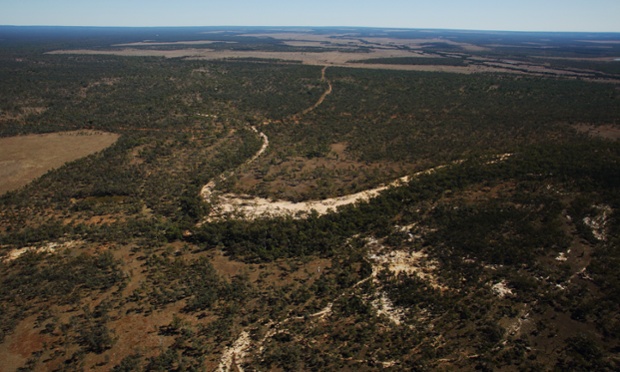
The Galilee basin in central Queensland: ‘it would produce 6% of the carbon necessary to take the planet past a 2C temperature rise, the red line set by the world’s governments’. Photograph: Andrew Quilty/PR

The Galilee basin in central Queensland: ‘it would produce 6% of the carbon necessary to take the planet past a 2C temperature rise, the red line set by the world’s governments’. Photograph: Andrew Quilty/PR

We new that his leaving 350 would not mean any retreat from activism. Proof positive here. Thanks to Bill McKibben and the Guardian for their attention to this week’s meetings in Lima:

The world’s nations are meeting in Lima, near the equator, to pledge and promise about global warming. But the actual worth of those promises can be more accurately gauged in the far north and the far south of the planet, where real decisions in the next months will show whether the climate concern is rhetorical or real.

By now most people know about the northern example: the tar sands of Alberta. Some time in the coming months the new Republican-controlled Congress will demand that Obama approve the construction of the Keystone XL Pipeline. If he vetoes that call and sticks to his principles, it will help keep expansion of the tar sands complex in check. That won’t make up for America’s vast expansion of oil and gas drilling in recent years, but it will send some kind of signal: there is a limit somewhere to how much fossil fuel we plan to extract. Continue reading

Doses Of Truth On Oil Prices, Alternative Energy And Climate Change

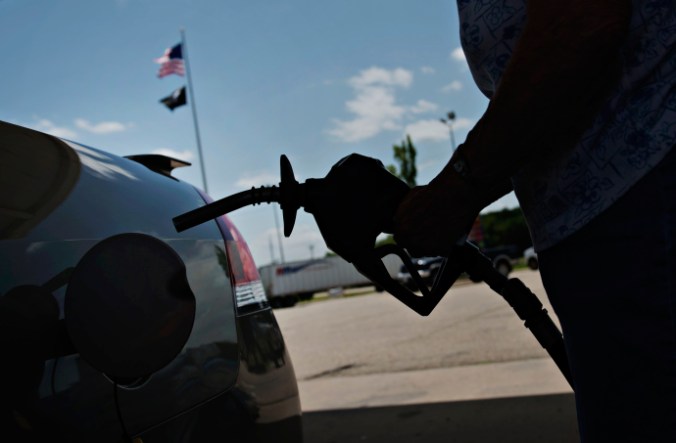
PHOTOGRAPH BY DANIEL ACKER/BLOOMBERG VIA GETTY

PHOTOGRAPH BY DANIEL ACKER/BLOOMBERG VIA GETTY

There is a quarter hour podcast about the Lima climate change talks that is as good as it gets in terms of bringing complex issues to a bearable level of simplicity (spoiler alert: our maven of doom is at her best in terms of realism), and that dose of information pairs well with this dose by Michael Specter, the New Yorker‘s other “tough truths” guy:

Just before the turn of the millennium, I met a man who had recently invested a fortune in wind power. He said he wanted to do all that he could to slow the course of climate change. He was also convinced that, as the world began to run out of oil, alternative sources of energy would offer a unique entrepreneurial opportunity. “Oil prices will fluctuate for a while,” he told me. “But, eventually, they can only move in one direction. Up. Oil is a finite resource and, as supplies dwindle, the costs will have to rise. That will make alternatives like wind power much more attractive.” Continue reading

Carbon Footprint Of Beef

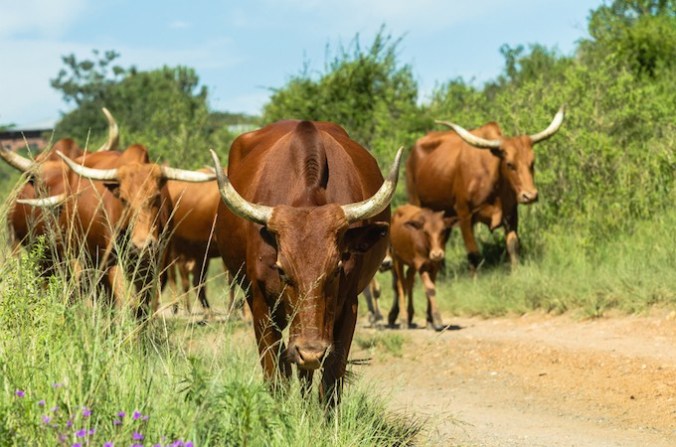
cow-shutterstock_176807426-680x450

One of our most popular posts of all time, Carbon Emissions Series: Vacationers’ Diets, was an eye-opener for many of us 3+ years ago. The 10,000 views of that one post help us understand that readers of this blog care about the food they eat in more ways than one. Thanks to Conservation for this summary:

ACCOUNTING FOR MEAT: THE HIDDEN EMISSIONS IN YOUR STEAK

Each year, the average American chows down on a whopping 120 kilograms of meat. The same is true in New Zealand and Australia. Most Europeans and South Americans dine on slightly more than half that amount of meat each year. Combined that means that as a species, we’re eating some 310 metric tons of meat each year, a 300% increase in fifty years. Meat – which is the primary product of the livestock industry – doesn’t just impact our planet in terms of the quantity of animals slaughtered or the acres of land converted into suitable grazing pastures. It is also a significant contribution to greenhouse gas emissions. Continue reading

15 Years, And Counting

monopoly-man-with-green-wings

Click the image above or the title below to go to the summary, thanks as always to Conservation:

THE LOW-CARBON DEAL THAT’S ALMOST TOO GOOD TO BE TRUE

The economics of slashing carbon emissions look significantly better than they did only a few years ago. Continue reading

Farming, Food & Climate Change

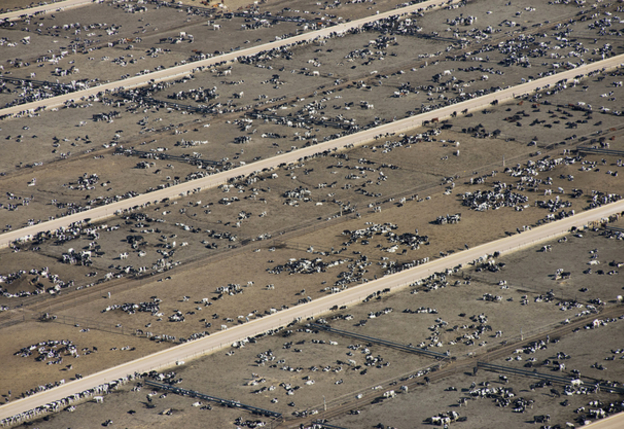
Cattle feedlot, southeastern Colorado. April 2013. 84760. Credit: John Wark

Cattle feedlot, southeastern Colorado. April 2013. 84760. Credit: John Wark

Thanks to Audubon magazine for the interview in their current issue with one of the go-to explainers we most frequently seek out on food sustainability issues:

Food Fight: Reforming the Farm

Celebrated author Michael Pollan talks climate change, and how farming can help stop it.

BY RENE EBERSOLE  Published: November-December 2014

Q: Should we be looking more closely at how the food we eat affects the climate?

A: I think there’s a growing recognition that you can’t really address climate without looking at the food system. Yet exactly how you do that, what that means from a policy point of view, is a lot more complicated than regulating coal-fired power plants.

Agriculture is a large source of global warming emissions. Yet you propose that it can help reverse climate change?

Continue reading

Let’s Consider Meat Free Monday

MFM-LogoAs a former Beatle urges, let’s consider a simple mechanism for doing something other than taking to the streets or publishing an op-ed item–both of which we also encourage if your location and clout allow–in advance of the Climate Change conference. Why this particular mechanism? Well, to start with it is easy. Also, the impact could add up if enough of us participated. You probably already know about meat’s carbon footprint, but here is a message from Meat Free Monday to refresh your memory:

Fact1

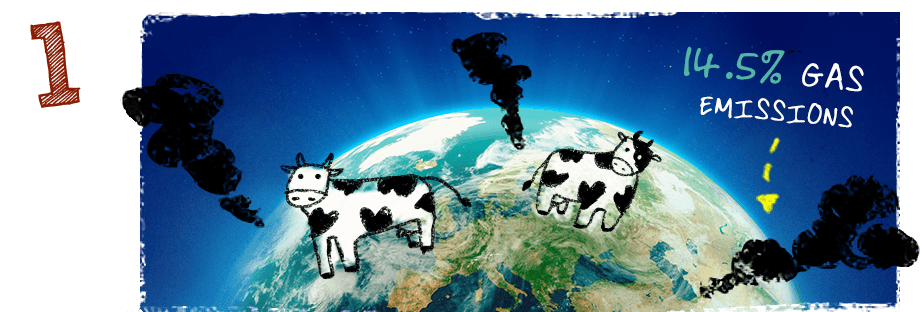
Meat production is responsible for 14.5 per cent of global greenhouse gas emissions, according to the United Nations Food and Agricultural Organization1, with some scientists saying the percentage is higher. Continue reading

Why We Walk

Photo Courtesy of digitaldeconstruction.com

Photo Courtesy of digitaldeconstruction.com

I have been endlessly fascinated by walking. I asked myself Why We Walk while I walked 400 km on the Camino de Santiago. A recent article by Adam Gopnik in the New Yorker has brought me to this question again in a new context. The article talks about what it means to be a pedestrian in the modern world and how the role of walking has changed as it’s become less necessary. The sad thing about walking for pleasure instead of necessity means that it occurs less. Many of us spend our lives in the sitting position: sitting in cars to then go sit at work and then sitting at home after a long day of sitting. I’m generalizing here as I call myself out on my sedentary life. Our bodies are made to walk, so I must ask myself, Why Don’t We Walk?

Roads are not enjoyable to walk in an increasingly auto dependent world. When living in a residential area there isn’t much activity to make walking around something that invites ‘randomness’. Adam Gopnik writes in the New Yorker about Why We Walk. He says,”We start walking outdoors to randomize our experience of the city, and then life comes in to randomize us.” The sidewalks are public space. In the suburbs we have a lot of private space and little public space. I have to wonder how it could affect our psyche to not brush up against the world. I wonder what we take away when we lose the opportunity to have chance interactions in indeterminate public spaces.  I wonder how creative we could be as a culture if the majority of our interactions with strangers didn’t occur over money exchanges. Adam Gopnik talks about the vague excitement and pure chance of walking in New York City.

You could walk anywhere. Saturday all day, Sunday all day, I’d tramp through the lower-Manhattan neighborhoods. The differences, architectural and social, among Tribeca and SoHo and the East Village, to name only contiguous areas, were distinct and vivid and nameable then: cast-iron buildings shading off into old egg- and paper-carton factories sweetly interrupted by small triangular parks, and edging over, as you walked east, into poor-law tenements that were just being reclaimed by painters. I would set off on a Saturday morning and walk all day, and achieve Kazin’s feeling of vague excitement, of unearned release, in a way that I have never felt before or since.

I like this description because it shows the way he was able to interact with the environment around him as a walker. Suburbs that are designed for cars make walking an outdated form of transportation. It’s inefficient and time consuming if you live in a city that’s designed for cars rather than pedestrians. In the suburbs, there aren’t many people dancing in the ‘sidewalk ballet’ as Jane Jacobs puts it. So, I just wonder what a healthier culture there would be if there were more public space for people to live outward facing lives that brushed up against each other.

The article brings up a quote from Frédéric Gros’s book A Philosophy of Walking, “The purpose of walking, is not to find friends but to share solitude, for solitude too can be shared, like bread and daylight.” This quote to me highlights the sort of communion we can have with each other while walking. While I was walking the Camino, I felt that communion with fellow walkers as well as with the landscape. I was sharing solitude with the landscape. I think taking away that walking aspect of communion in our lives further isolates us from nature. Continue reading

Notes from the Garden: Monsoon Season

photo (8)

Burying the garden waste to prepare the land for planting

As it is monsoon season here in Kerala, we gardeners have to take into consideration the way it affects the soil. Today we did land preparation for the heavy rains. We dug holes in the new beds and took garden waste from old banana plants and buried it. The top of the soil had been mulched with manure and weeds were growing on them. We mixed the manure and weeds into the soil. I like the idea of just mixing the weeds in because then the nutrients that the weeds took from the soil can break down back into the soil again. When the heavy rains come, they would have washed the nutrients from the mulch away so this is to help with nutrient erosion. Continue reading

More On Tesla’s Mr. Musk

Photograph by Dario Cantatore/Getty.

Photograph by Dario Cantatore/Getty.

We like him more the more we hear of him, and while we do not know enough to gush, nor to promote his automotive products, we pass along this interesting news as recorded on the New Yorker‘s website:

Yesterday, one of the more interesting people in Silicon Valley did one of the more interesting things that the car industry has seen in a while. Elon Musk, the C.E.O. of Tesla, opened up all of his patents. “Tesla will not initiate patent lawsuits against anyone who, in good faith, wants to use our technology,” he wrote in a blog post. Tesla’s competitors can now freely take advantage of its batterieschargers, or sunroofs. Continue reading