New Tesla Model Test Driven

Samuel Gibbs test-drives a Tesla Model-S. Photograph: Antonio Zazueta Olmos

Samuel Gibbs test-drives a Tesla Model-S. Photograph: Antonio Zazueta Olmos

Its availability is limited to a few places. Its numbers are limited, period. But in the UK it is about to grow a new market, so this review is timely. We are not in the business of promoting automobiles or other consumer products but several La Paz Group contributors have been in the vicinity of the home location of this car and its claims of zero emissions are such that we could not help noting this remarkable thing:

…Inside it’s all premium Silicon Valley technology. Musk likes to think of Tesla as the “Apple” of cars, which might explain why there is what looks like a large iPad complete with Apple-style graphics where the centre console should be. The 17in touchscreen controls almost everything about the car, from the air conditioning and music to opening the sunroof and firing up the heated windscreen wipers. Continue reading


Visualizing Carbon


Carbon, and what to do about it, has been a constant topic of interest to our readers since we began this site. The single most-read post, Carbon Emissions Series: Vacationers’ Diets is on this very topic. But how can we visualize carbon such that we care more about it? Thanks to the website of the magazine Conservation for this link, whose title says it all:

CARBON VISUALS: ANIMATING THE WORLD’S CARS

A short animated film from Carbon Visuals is being used to engage managers around the world about the fundamentals of sustainability, how sustainability is relevant to their role and its importance to business success.

Continue reading

A Minor Detraction From Aging’s Major Detractors

old-tree

Thanks to Roberta Kwok for her ever-concise summaries of remarkable scientific findings on Conservation‘s website, this one following the theme of a companion post with regard to aging organisms:

SCORE ONE FOR THE REALLY OLD GUYS

Aging is generally associated with slowing down. But scientists have found that trees actually grow faster as they get older, making them star players in a forest’s carbon storage. In fact, one old tree can fix as much carbon in a year as the total amount of carbon in a “middle-aged” tree. Continue reading

Pedal Powered Ecotourism

Eco Tourism

Pedal Power! photo credits: Ramesh Kidangoor

At Raxa Collective we believe in conservation and what better example than Cardamom County, a plastic-free resort with rich gardens where we harvest fruits, vegetables and even eggs. Kerala is a beautiful state with many places to discover and there’s no better way to experience our neighborhood than with zero carbon transport.

Continue reading

Really, Charles?

Prince Charles

Prince Charles, who has criticised the global food industry for shipping ‘vast quantities of commodities halfway round the world’. Photograph: Tim Ireland/PA

We have been impressed with him on occasion in the past, so it was with some surprise, and a tinge of nausea, that we read this :

Prince Charles is funding his charities with profits from shipping royal-branded mineral water 6,000 miles to the Middle East in an arrangement that has been described by Friends of the Earth as “completely insane”. Continue reading

Green Citizens, Green Consumers, Fear And Hope At The Aspen Ideas Festival

Thanks to James Fallows for referring this on his blog page on the Atlantic‘s website:

After a brief stage-business intro from me, the first 15 minutes or so are Harvey presenting an overview of how to think about carbon, coal, natural gas, electric grids, extreme weather, and other sources of problems and possibilities. The rest is our discussion, and questions from the audience.  Continue reading

For Wales?

The Oxapampa-Ashaninka-Yanesha UNESCO biosphere reserve in central Peru. The Welsh funds will help the Ashaninka preserve their forests. Photograph: Nicholas Gill/Alamy

“For Wales? Why Richard, it profit a man nothing to give his soul for the whole world. . . but for Wales!” ― Robert Bolt, A Man for All Seasons

When Richard Rich betrayed, he did so for rewards related to Wales. Thomas More, in top shelf literary insult, takes him to task for it by emphasizing the pathos of having betrayed for profits as meager as Wales.

If you have been to Wales, you know it has nothing to be ashamed of in terms of physical beauty.  And as for cultural beauty, Dylan Thomas or Richard Burton could tell Robert Bolt or Thomas More for that matter a thing or two about Wales.  But now, Wales shows a creative streak in this contribution to conservation, perhaps a deeper greatness than other classics in its history. Continue reading

Industrialized Biofuels Part 2: Brazil’s Production

This post continues my discussion of biofuels from Part 1.

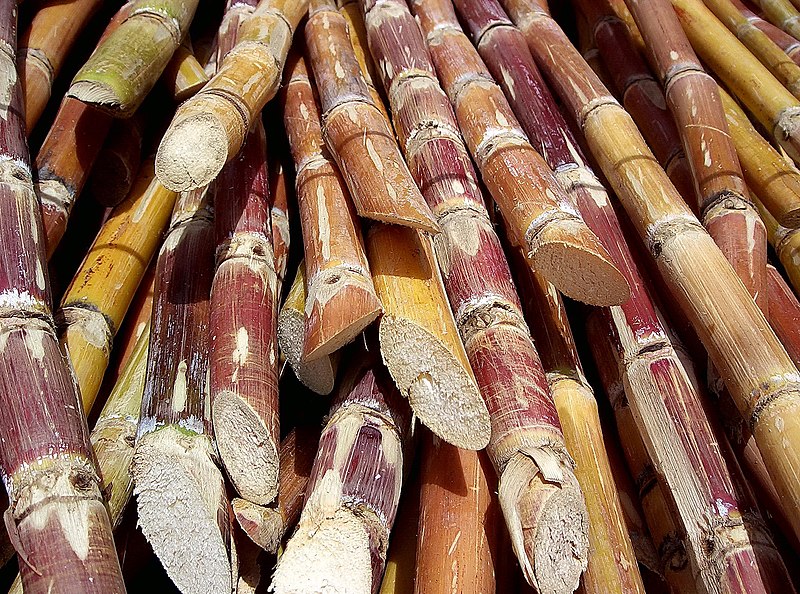
Brazil contains many of the world’s biodiversity hotspots, as well as one of the most important CO­2-sinks in the form of rainforests. As the second largest sugarcane grower in the world, Brazil’s biofuel production relies heavily on sugarcane ethanol, which has one of the highest savings in GHG emissions compared to fossil fuels. However, increasing sugarcane production is not sustainable in the long-term if one of Brazil’s goals is to curtail GHG emissions, since growing more sugarcane means cutting down more rainforest. Instead, second- and third-generation (advanced) biofuels should be considered viable options for replacing sugarcane, or at least strongly supplementing it.

Continue reading

Industrialized Biofuels Part 1: US Production

Image via Renaissance Ronin

The United States plans to produce 70 billion liters of advanced biofuels by 2020. In 2007, the global production of all biofuels roughly matched this amount, and the US used 24% of its corn to produce its share of the ethanol included in those 70 billion liters. Even given this impressive amount of corn used for ethanol, American corn ethanol only accounted for 1.3% of the US’ national liquid fuel consumption. An increase in either corn harvests or ethanol production efficiency is clearly necessary if the US is to meet the 2020 goal with corn alone. Given the significant drawbacks to producing more corn, and the unlikelihood of efficiency increasing enough to meet requirements, it would be more prudent to invest in second- and third-generation, or advanced, biofuels.

These biofuels, such as ethanol made from cellulose, biogas, or hydrocarbon fuels converted from biomass to liquid (BtL) are made from feedstock rich in cellulose like grass and wood. Advanced biofuels have better environmental profiles than what are referred to as first generation biofuels (e.g. ethanol produced from corn or sugarcane) because they generally require less land and are converted from biomass more efficiently—the processes also use less energy and water than ethanol since they do not involve distillation. A biofuel’s emissions depend largely on land considerations, nativity to the region, and feedstock technology. If land was converted from forest or prairie, the feedstock was not native to the region, and the feedstock required excessive fertilizers to grow, then GHG emissions are higher. Continue reading

Carbon Mapping

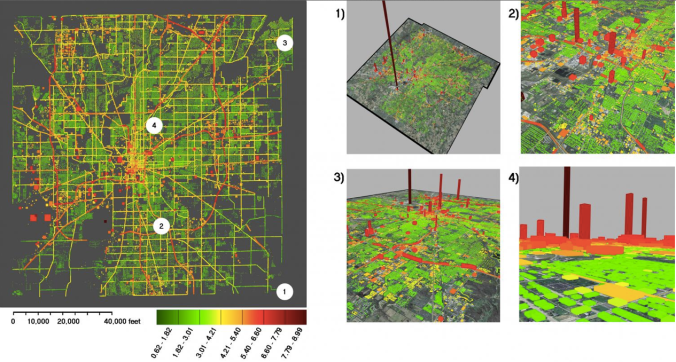
With Hestia, researchers from Arizona State University have a detailed understanding of where CO2 is being emitted from the urban landscape. This map shows where CO2 is emitted across the city of Indianapolis, Indiana, and combines data from sources including factories, automobiles on roadways, homes, and power plants. Credit: Bedrich Benes and Michel Abdul-Massih

Click the image above to read more about this at Phys.org:

Dubbed “Hestia” after the Greek goddess of the hearth and home, researchers presented the new system in an article published October 9 in Environmental Science and Technology. Hestia combines extensive public database “data-mining” with traffic simulation and building-by-building energy-consumption modeling. Its high-resolution maps clearly identify CO2 emission sources in a way that policy-makers can utilize and the public can understand. Continue reading