Bird, Data, Love

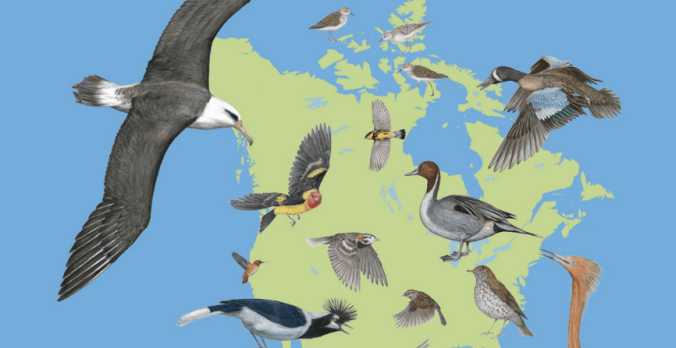
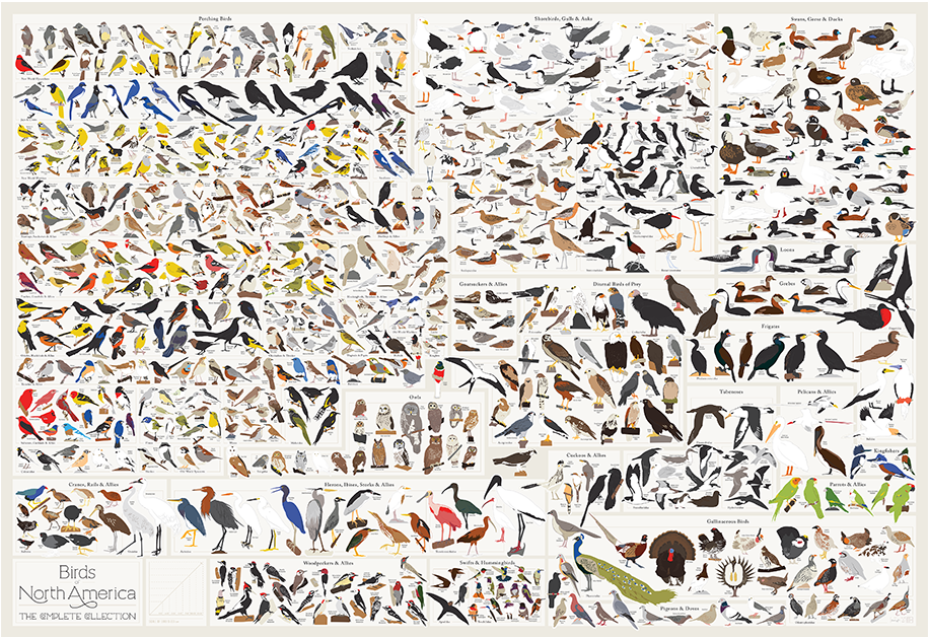
We love this amazing poster from Pop Chart Lab as much as the link to find it.  The site’s zoom function gets you closer to the fantastic detail.

Take a look!

Perhaps our most ambitious taxonomical undertaking yet, this is your field guide to the birds of North America! The product of over 400 hours of intricate illustration work by our talented team of artists, this unabridged aviary features over 740 fair-feathered friends drawn to scale and sorted by species, covering the continent’s avifauna (both native and introduced, as designated by the National Audubon Society and the Cornell Lab of Ornithology) from common sparrows, jays, and owls to rarer birds such as the Greater Sage-Grouse, the California Condor, and the Whooping Crane. An ornithological opus like no other, this classificatory treasure is perfect for amateur and eagle-eyed birdwatchers alike. Continue reading

Why We Use eBird, A How-To Primer Explaining Our Motivations

Chan-Chich-Lodge-logoThis article published by Audubon (click their banner below to go there) continues to provide fresh illumination on the basics of eBird; also on why we have made eBird central to our birding activities for guests in recent years, and why Chan Chich Lodge is collaborating with the Lab of Ornithology this Global Big Day event .

AudubonLogo

Since its launch in 2002, eBird has revolutionized the way birders worldwide report and share their observations. A joint project by the Cornell Lab of Ornithology and Audubon, eBird is a free online program that allows birders to track their sightings, while other birders watch and search in real-time. Articles have been written about eBird with mind-bending titles like, “eBird Changed My Life” and “The Agony and Ecstasy of Surrendering to eBird.” In a front-page science headline in 2013, The New York Times called it “Crowdsourcing, for the Birds,” and concluded that eBird is “a revelation for scientists” and gives birders “a new sense of purpose.” Continue reading

Global Big Day 2017, Belize

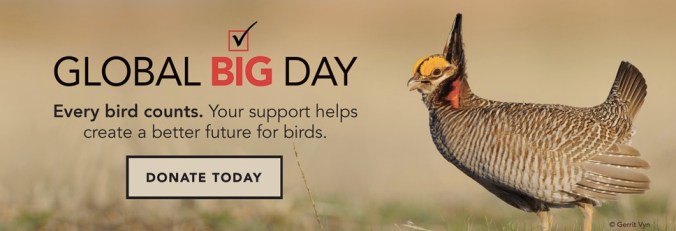
BigDayDonate

You have plenty of options of where to spend the day, but we are hoping to share the entire week leading up to May 13 with lots of old friends of Chan Chich Lodge–not only dedicated birders, but especially them. And not only old friends–we welcome the opportunity to introduce new folks to birding. So think about joining us that week in particular.

In our work around the world in recent years we have tried to support the Cornell Lab of Ornithology’s mission, focused through ebird in this worthy call to action, in as many ways as possible. If you do not know about the Lab, start with what they say about themselves and if it strikes you as relevant click on the banner above to make a pledge on one key initiative:

The Cornell Lab of Ornithology is a world leader in the study, appreciation, and conservation of birds. Our hallmarks are scientific excellence and technological innovation to advance the understanding of nature and to engage people of all ages in learning about birds and protecting the planet. Continue reading

Global Big Day 2017, Neotropical Focus

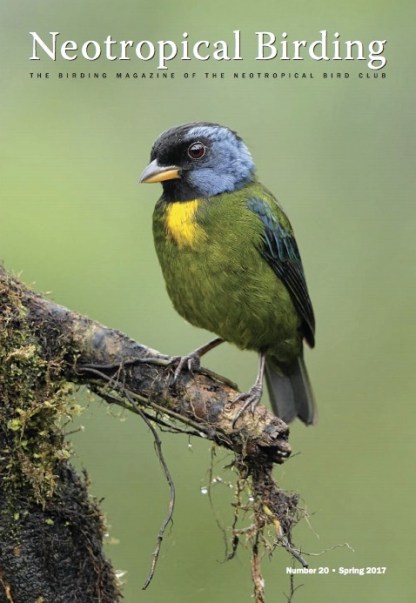
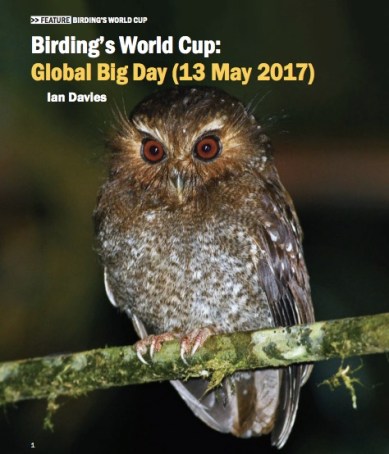
Neotropical BirdingNeotropical Birding’s magazine feature on Global Big Day 2017, which we are looking forward to at Chan Chich Lodge, provides a good primer on the what, how and why of this event; we hope to convince you on the where:

Walking the thin line between madness and brilliance, ‘big days’ (also known as ‘bird races’) are the essence of birding’s competitive spirit distilled into 24 intense, frantic and thrilling hours. Months of planning, poring over spreadsheets and pen-marked maps; days spent scouting out the perfect stops, driving practice routes while ingesting egregious amounts of caffeine; and years of birding experience used to find  the right habitat for each target species, the game is to see or hear as many bird species as possible in a single, incredibly efficient, BIG day.

Neotropical2

Why do this? Why care? These friendly competitions are an incredibly powerful way to engage people around the world, both within the birding community and beyond. Across fields of study and walks of life, there is always an innate human interest in setting records or being a part of something that has never happened before. In addition to the inherent fun, record-setting events provide an outlet to talk to non-birders about conservation issues, ecological concerns, and all the things that make birds so interesting. Continue reading

Preparing For Global Big Day On May 13, 2017

Cornell_Lab_Global_Big_Day_Map-625px

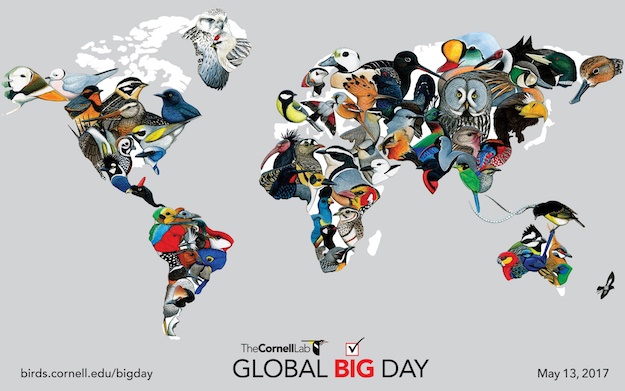
Global Big Day map painted by Luke Seitz, a Bartels Science Illustration intern and member of the Redheads student birding team.

We have about two months to prepare, and this third year of Global Big Day could be epic. When we started participating in this annual event in 2015 our work still mostly focused on the Western Ghats region of southwest India, but we were migrating back to the Mesoamerica region so our attention has been shifting. Now we are all in at Chan Chich Lodge and we want to help ensure that this year Belize is as strong a contributor as possible to the goals of this program:

In our ongoing effort to push the boundaries of a Big Day, we’re inviting everybody around the world to join together and participate in our Global Big Day to support global conservation.

How to Participate

Submit Your Data to eBird on May 13

It’s that simple. If you submit your birds to eBird they count. Learn how to take part. Don’t worry — you don’t need to be a bird expert, or to go out all day long. Even a half hour checklist from your backyard will help. Of course, you are welcome to spend the entire day in the field, but know that it is not required! Please enter your data as soon as you can, preferably by Tuesday, May 16. Continue reading

Merlin Flying Further Afield

We’ve written about this amazing APP on our pages before, and it’s exciting to watch it’s evolution and expansion of both technology and territory.

Our work has yet to expand to Mexico, but birds don’t acknowledge national borders, so the majority of the species in the Yucatan  can be found in all 3 countries that make up the peninsula – Belize, Guatemala and of course, Mexico.

We look forward to having our marvelous guides try it out just for fun!

 Merlin Expands to Mexico

We’ve spent the last few months working to expand coverage of Merlin, and we’ve just released a new bird pack for the Yucatan Peninsula. Research at the Cornell Lab of Ornithology repeatedly points to the Yucatan Peninsula as a vital wintering ground for many of our favorite breeding birds in the United States. It’s also home to many dazzling birds unique to the Neotropics. Continue reading

Great Backyard Bird Count at Villa del Faro

a male Xantus' Hummingbird, endemic to Baja California Sur

a male Xantus’ Hummingbird, endemic to Baja California Sur, photographed during the GBBC

For last year’s GBBC, I was working in Costa Rica, in the Central Valley. This time around, I was on the job in Baja California Sur, Mexico, at Villa del Faro. Over the course of the four days that comprise the Great Backyard Bird Count, I was able to go out three mornings and one afternoon in search for birds.

By the last day, I had seen most of the usual suspects, although I was unable to spot a Pyrrhuloxia, one of my favorite species here in Baja, which is quite shy. In total, however, I saw 38 species around Villa del Faro, which has a hotspot with 76 species, so I saw exactly half the birds recorded here so far (and two of them were only just reported for the first time yesterday).  Continue reading

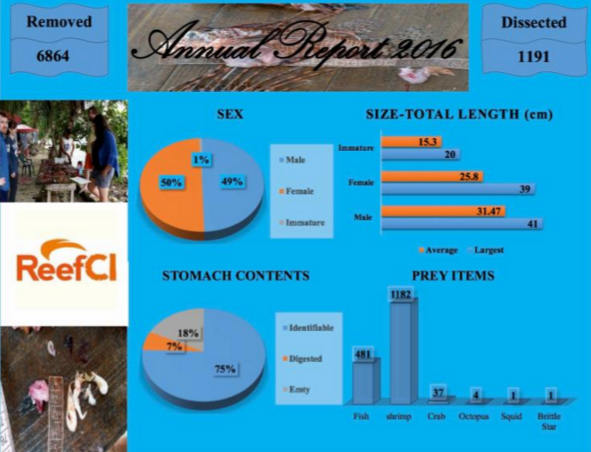
ReefCl Annual Report 2016

The citizen science activities we’ve discussed during this past year go beyond bird counts and uploading data. In the case of the invasive lionfish, participants have to really get their feet wet, so to speak.

In addition to creating a viable income in local fishing communities affected by the lionfish invasion by the developing the market for the meat and the spines, numerous organizations invite volunteers to assist in the eradication process itself. Continue reading

For the Birds: a Message to North American Policymakers


The State of North America’s Birds 2016

The State of North America’s Birds 2016

We continue to laud the importance of eBird on this site, gaining special importance as it becomes more and more clear that wildlife doesn’t acknowledge political borders. The data gleaned from tens of thousands of Canadian, Mexican and U.S. citizen scientists who contribute to eBird indicate that more than 350 species in North America migrate up and down Canada, the U.S.A, and Mexico over the course of a calendar year.

And according to the recently released State of North America’s Birds 2016 report, those three countries—their governments, and their societies—need to step up and do more to preserve our continent’s spectacular and shared natural heritage of birdlife. This report is the first-ever scientific conservation assessment of all 1,154 bird species in North America, and it was only possible because of the tremendous scale and big-data capabilities of citizen-science….

Among the many takeaways from eBird maps and models includes one of relevance to our property, Chan Chich Lodge, located on 30,000 acres of Belizean forest in the Yucatan peninsula.

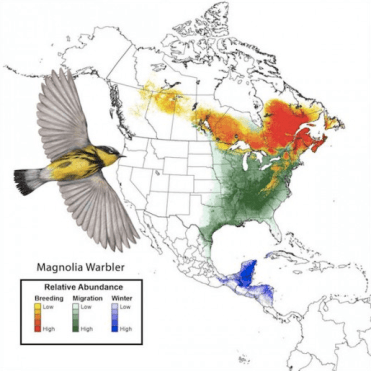
The Yucatan Peninsula is one of North America’s most vital bird habitat regions

The Yucatan Peninsula is one of North America’s most vital bird habitat regions

Not only is the Yucatan rich with endemic birdlife, it’s a critical wintering area for more than 120 birds species that migrate from Canada and the U.S.A. In winter, the entire population of Magnolia Warblers relies on an area of tropical forest in Mexico only 1/10 the size of its boreal forest breeding range, with the Yucatan as the bull’s-eye of their wintering range.

Continue reading
Christmas Bird Count, 2016

Seth’s work at the Cornell Lab of Ornithology, with the Celebrate Urban Birds initiative helped us all get a close look at citizen science in action. Past Christmas counts since then have been an annual tradition in these pages. Thanks to Lisa Feldcamp for a note on this topic with her post Give Kids the Gift of Birding on The Nature Conservancy’s website Cool Green Science:

The annual Christmas Bird Count is one of birding’s most cherished traditions. This year, consider introducing the count to a child. There’s no better time to get a youngster started in birding.

“When I was a kid in a large family of eight kids in Upstate New York, my parents told us we could do anything that cost less than $5; baseball, boy scouts, or birding,” says Tom Rusert of Sonoma Birding. “I joined Junior Audubon with my brothers, not realizing it would be a life sport to enjoy forever. It really is no different than any other sport.” Continue reading

Birding from VdF: San José Estuary

IMG_2485_zpspmm923kl

Since last week, I’ve been based back at Villa del Faro in Baja California Sur, Mexico, where I’ll be co-managing the property with Jocelyn for a good while. In addition to having the opportunity to see what kind of birds show up here in their winter migration, I’m also hoping to have time to check out the surrounding region for other birding hotspots. I’ll do this not only for my own interest, but also because we may get guests here in the future who are bird-watchers.  I’d like to be able to recommend areas based on my own experience, so they don’t have to rely solely on eBird, which helps find certain spots but can’t give you any directions that Google Maps doesn’t have.

Nevertheless, eBird is one of the best ways to quickly figure out what locations within a region are popular for birding, whether because they have lots of species or because lots of birders pass through there (or both). Continue reading

Big Numbers for eBird this Summer

Starting in May, eBird hit a big milestone: 11.8 million bird sightings in that month alone – the same amount of sightings the citizen science database collected in the first five years it existed. Participation in recent years had shot up enough to make that sort of number, and these sorts of maps, possible. Then, on June 17th, the 333,333,333th checklist was submitted to eBird from a participant in Illinois. A third of a billion records submitted by just over three-hundred thousand different people around the world since the Cornell Lab of Ornithology and Audubon partnered to make it possible for people to easily digitize their bird sighting checklists – that amounts to an average of a thousand-and-fifty checklists per eBirder!

At the end of last month, eBird saw another big number, with a million bird photos archived in the Cornell Lab’s Macaulay Library through the new tool allowing users to attach images to their checklists. And this week, the app Merlin got downloaded by its millionth user since it was launched for iPhones in January 2014 (and a bit later on Android phones). But eBird, Merlin, and the Macaulay Library aren’t the only ones reaching milestones this summer. Continue reading

Big Butterfly Count Coming Up in UK

Photo from bigbutterflycount.org

Starting this Friday and continuing through the first week of August, the largest survey in the world for butterflies and day-flying moths will take place in the United Kingdom. We’ve featured lepidopterists and citizen scientists here before, including today and for last year’s event, which involved over fifty thousand people counting more than half a million lepidopterans.  It’s great to see such a simple yet complete chart/app to ID the more common butterflies that people may encounter –– I would have really appreciated something like that for Costa Rica! Read more about the project below:

Why count butterflies?

Butterflies react very quickly to change in their environment which makes them excellent biodiversity indicators. Butterfly declines are an early warning for other wildlife losses.

That’s why counting butterflies can be described as taking the pulse of nature.

Continue reading

A Bird’s Journey Tracked, Mapped & Shared

Screen Shot 2016-05-25 at 5.20.45 AM.jpg

From National Public Radio (USA) today, this should have your attention even if you are not a birder:

We Followed A Snowy Owl From Maryland To Ontario

At the end of 2013, snowy owls started showing up far south of their usual winter range. The big white birds were reported in South Carolina, Georgia, even Florida.

Dave Brinker, an ecologist with the Maryland Department of Natural Resources, had never seen anything like it. Continue reading

Xandari’s 2016 Big Day

A male Red-legged Honeycreeper, the highlight of my 2016 big day

Last year, we shared some details about the Global Big Day, an event that I participated in very casually from Chicago back then, and contributed to more seriously this year, as did the rest of the global birding community, as the data from eBird published today shows. In 2015, 6,158 species were reported on 38,923 complete checklists from 14,787 participants across 140 countries. This year, 6,263 species were reported on 43,848 checklists from 15,953 participants across 145 countries. Every point of comparison displays an increase in participation and effort this time around!

Continue reading

Orchids in the Citizen Science Arena

Burnt orchid (Neotinea ustulata) at Mount Caburn. Photo © Keith Wilson / Flickr through a Creative Commons license, via Cool Green Science for TNC

We’re always learning about new groups of organisms or cultural/scientific projects that are receiving more attention from groups welcoming citizen-provided data to promote increased study and focused conservation efforts: lichens, birdstrees, reptiles and amphibians, pollinators, birds, fish, and a number of Internet-based projects on stars and literature, including birds. In the United Kingdom (why not Costa Rica?), there’s a movement to document the strange flowers that make up the orchid family. Read our post about the same project last year, or check out what Lisa Feldkamp writes about Orchid Observer for the TNC citizen science blog this week:

Frail, exotic, delicate, alluring; orchids call to mind stories of romance, intrigue and obsession. Indeed from the time when “orchid fever” first swept Victorian England people have been driven to steal and even risk their lives in the quest for these gorgeous plants.

Orchids are also notoriously difficult to grow. Though modern technology and growing techniques have made it easier to have an orchid in your home, wild orchids are often adapted to specific climactic requirements and depend on symbiotic relationships to survive.

Continue reading

Ornithological Climate Change Indicators

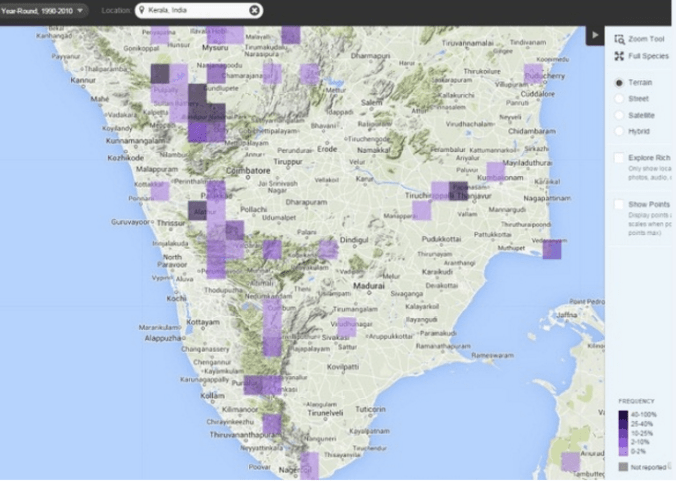
Map showing peafowl-sightings between 1990-2010 (Source: Cornell Lab of Ornithology and the National Audubon Society)

Map showing peafowl-sightings between 1990-2010 (Source: Cornell Lab of Ornithology and the National Audubon Society)

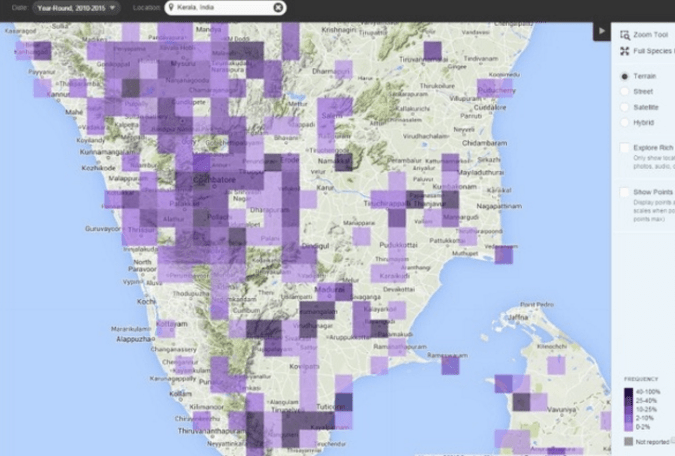
Map showing peafowl-sightings in Kerala between 2010-2015 (Source: Cornell Lab of Ornithology and the National Audubon Society)

Map showing peafowl-sightings in Kerala between 2010-2015 (Source: Cornell Lab of Ornithology and the National Audubon Society)

Few of our readers will fail to notice that eBird and Citizen Science are important elements of the RAXA Collective DNA. Stories related to Kerala and the state’s healthy birding population are equally on our radar.

The folks at India Climate Dialogue recently turned to eBird observations to document changes in climate patterns in Kerala, an important watershed state for the Indian subcontinent using peafowl population as one of the indicators. Especially during mating season, the birds find it difficult to move their trailing feathers in areas of dense foliage, so they’re attracted to drier climactic areas. The eBird data above illustrates their movement into Kerala, meaning more areas are opening up.

High heat in February-March is not unusual in Kerala, and in reality it is this heat trough that pulls the monsoon from Indian Ocean into the Indian subcontinent. The heat epicentre heralds the monsoon and runs like a pilot car through the peninsula, taking the same path that the southwest monsoon will follow a few months later. Since the southwest monsoon starts from the coast of Kerala, it is the state that has to feel the heat first, so that pre-monsoon showers start in May and the monsoon arrives in June. Continue reading

Map the Herps You Spot

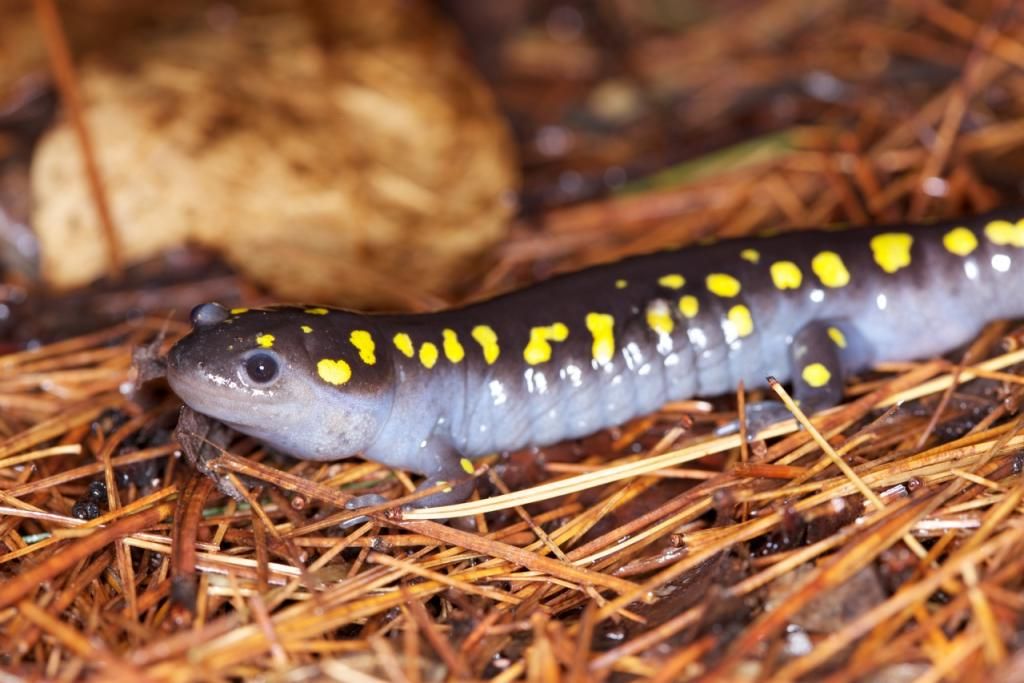
Spotted Salamander by Brian Magnier

In the spring of my penultimate year at Cornell, I took a Herpetology class that introduced me to the world of reptiles and amphibians, or “herps,” as they’re affectionately known. Thanks to that exposure, I was able to enjoy the spring migration of certain salamander species and learn the basics of the main families of frogs, lizards, snakes, and other herps like alligators, crocodiles, and all the other slimy or scaly animals in the classes Amphibia and Reptilia. If I had known of the existence of the citizen science project HerpMapper at the time (it wasn’t released until September of the same year as that salamander migration) I’d have certainly submitted some observations and photos to the organization! From their About page:

HerpMapper is a cooperative project, designed to gather and share information about reptile and amphibian observations across the planet. Using HerpMapper, you can create records of your herp observations and keep them all in one place. In turn, your data is made available to HerpMapper Partners – groups who use your recorded observations for research, conservation, and preservation purposes. Your observations can make valuable contributions on the behalf of amphibians and reptiles.

Continue reading

Birding Apps Re-reviewed by Boucher

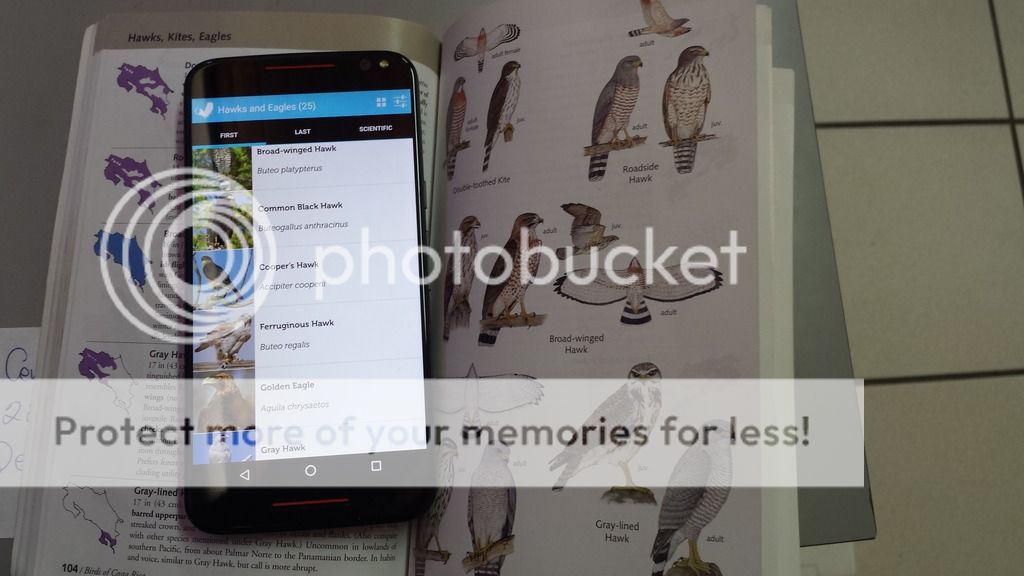
I visit Tim Boucher’s blog on The Nature Conservancy’s website every week or so to see what’s new, and this last check-up I noticed an old post from 2013 that’s been edited to include observations on fresh updates for phone apps that help identify birds, like Merlin, which I’ve covered in the past.

So far I haven’t purchased any bird identification application for my phone, mostly because there are good ones like Merlin and Audubon available for free in the US, but I’ve been considering a $9.99 app for the birds of Costa Rica, made by bird-watching guides both in CR and Panama.

Boucher doesn’t rank the apps in his order of preference, but it looks like from his reviews that he prefers the Audubon and Merlin apps for the fact that they’re free and utilitarian, though Merlin is geared more towards beginners. He’s also pretty positive about the Sibley and Peterson apps, both of which started with physical book versions of their guides.  Continue reading