Skimming the Globe

Stemming from a spontaneous fascination while living in India, I have photographed and written extensively about dragonflies in the past, and as an untrained naturalist, my interest has been mainly focused on dragonflies’ aesthetics rather than their physiology or ecological significance. However, as my interest in holistic ecology and the natural world grows, my thoughts have wandered from dragonflies and mushrooms to a bigger-picture ideology focusing on the connectedness and relationships between organisms within an ecosystem. Those relationships are present across the globe, year-round – regardless of how lifeless a place may seem. Being used to tropical climates unfortunately gives me a predisposition to fear the painful cold of Colorado mountain winters, and I retreat to a less hands-on approach to my research.

While seeking food for thought online, I stumbled upon a TED Talk given in 2009 on dragonflies – which in itself would interest me. But this talk concerns an exceptionally interesting species of dragonfly (though I didn’t realize it when I noticed its swarms in Gavi) – and one that aligns more with my current biological interests than those I held in the past few years (skimming the surface, some might say). Continue reading
Conversation, Conservation, Controversy

We have recommended more conversation, and we mean all kinds, including the occasional heated debate. When it comes to the subject of climate change, we do not feel obliged to air the views of big-moneyed propagators of denial.  When it comes to potential solutions to slow the acceleration of climate change, or mitigate its impact, or such reasonable areas of debate, the doors are wide open, topically speaking.

We hope to learn from citizen scientists, research scientists and practitioners alike so we can become better informed and make better judgements on this complex topic. Take a look at the wording of this memo from the “Sierra Club Grazing Core Team” to Sierra Club staff and volunteers “(particularly those involved with sustainable-energy/climate-change campaigns, and commercial grazing on public lands)” before watching the TED talk above:

Summary

Recent widespread interest in Holistic Management (HM), primarily stemming from Allan Savory’s presentation at the February 2013 Long Beach, CA, TED conference, makes it important that Club members and staff be consistent in their response to calls for application of HM. Savory has received considerable attention for his claim that application of HM to husbandry of ungulate livestock (typically cattle) in the world’s grasslands could sequester sufficient atmospheric carbon to reduce atmospheric carbon concentrations to pre-industrial levels. The Sierra Club’s Grazing Core Team urges the Sierra Club to reject HM as a tactic to reverse climate change for the following reasons: Continue reading

Self-Sufficiency Taken To The Outer Extremes

Before the lights go out on the last New Yorker issue of 2013, one more of several articles we found worth the read, and relevant to our common themes of interest–community-building, innovation, environmentalism, farming, etc.–on this blog, even if we tend to incremental change rather than the radicalism on display here:

Marcin Jakubowski, the owner of a small farm in northwestern Missouri, is an agrarian romantic for high-tech times. A forty-one-year-old Polish-American, he has spent the past five years building industrial machines from scratch, in a demonstration of radical self-sufficiency that he intends as a model for human society everywhere. He believes that freedom and prosperity lie within the reach of anyone willing to return to the land and make the tools necessary to erect civilization on top of it. His project, the Global Village Construction Set, has attracted a following, but among the obstacles he has faced is a dearth of skilled acolytes: the people who show up at his farm typically display more enthusiasm for his ideas than expertise with a lathe or a band saw. Continue reading

Extraterrestrial Citizen Science

Robert Krulwich riffs on (or off) this book in a recent post on Krulwich Wonders titled:

What’s That Clinging To The Towering Wall And Why Doesn’t It Fall Off?

In the spirit of citizen science, of which Krulwich is a master promoter, it makes sense to share this post of his on the same day that we posted about citizen science related to creatures that fly, and creatures that swim. These ones climb, but not on earth as we know it.  While calling them extraterrestrials is not quite accurate, you will get the point:

Maybe you’ve seen this, (it’s gotten around), but I’m still gobsmacked. Totally amazed. We’re in northern Italy looking at the face of the Cingino Dam, and here and there on the vertical stone wall, you’ll see a few dark specks. Continue reading

Borneo, Birds And The Field Method Of Learning Science

This slideshow requires JavaScript.

More than one contributor to this site has been a fan of the Cornell Laboratory of Ornithology for several decades. During graduate school, for example, when Sapsucker Woods provided more than just a walk in the woods.  The Lab’s fan base is global, for good reason, both among casual bird lovers and more serious bird watchers. The Lab became the focus of professional interest to several of us when we began managing lodges in the rain forests of Central America, and we discovered what we had not known while at Cornell: it has the largest collection of field recordings of bird songs in the world.  Guests at our lodges were awed by this resource when it was pointed out to them. The images above reflect more recent appreciation we have for the Lab. Continue reading

Dealing with Invasive Species One Holiday Table at a Time

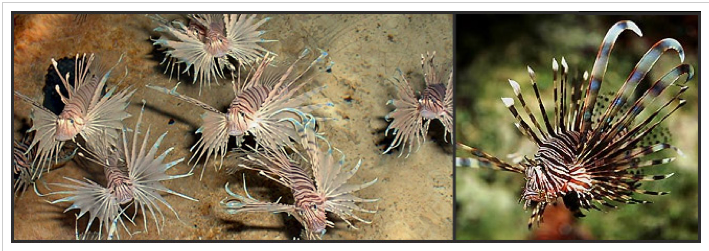
Lionfish (also known as turkeyfish) have venomous spines that can be very painful Photo: NOAA

When I was growing up a common Thanksgiving holiday decoration included a colored paper turkey formed by a tracing of my hand, the fingers forming turkey feathers. While that memory might seem out of left field it makes more sense when you start looking at photos of turkeys parading around a barnyard alongside the many lion fish photos we’ve been publishing in our Citizen Science in Belize series.

This NOAA article about lion fish, or turkey fish as they’re imaginatively calling it, is a perfect “if you can’t beat’em, eat ’em” extension. Continue reading

High Tide in New York City

This slideshow requires JavaScript.

(all photos ©Ken Brown)
In India, as with the rest of the world, sometimes life gets the best of us and we miss out on the cyclical events that have marked time for millennia. Once again we have Ken Brown to thank for both bringing this event to our attention and documenting it so well.
I know it sounds like something from the Discovery Channel, but a truly remarkable event takes place each year when a 460 million year mating ritual is enacted on the beaches of New York City during a full moon high tide. Continue reading

Urban Pollination Studied By Seattle’s Citizen Scientists

Thanks to this coverage commitment we came across the video above and this accompanying explanation:

…Marie Clifford and Susan Waters, graduate researchers at the University of Washington in Seattle, have found a way to get around scarce research funding: citizen scientists. The Urban Pollination Project (UPP), co-founded in 2011, takes Seattle community gardeners and trains them to collect data on local bees. Tapping into citizen scientist efforts, Clifford and Waters can gather data from 35 Seattle community gardens – a scale of research otherwise outside of their resources and funding capabilities. Continue reading

Bringing Biology to Life

We may not be Science Geeks per se, but we’re clearly fans of that type of thing! Not to mention that some of “our own” being deeply involved in Citizen Science projects around the world…

So we say Kudos to the National Science Teacher’s Association for creating curriculum and publishing textbooks that are both real and engaging.

“Observing the life cycle of monarch butterflies and following their remarkable migratory journeys between Canada, the United States, and Mexico … 

“Tracking climate change by recording the dates of first leaf, flower, and fruit of local trees, shrubs, flowers, and grasses …

“Discovering which bird species migrate, where they go, and when …

“Exploring life cycles and population dynamics of frogs, toads, and other animals in nearby ponds … Continue reading

Discovery, Conservation’s Better Half

Wilderness conservation, marine or terrestrial, is difficult. On a good day the challenge might be described as a complex puzzle, which has its pleasures; but on most days it is slogging and increasingly, dangerously warlike.

On the best days, we observe, conservationists have the thrill of discovery. Thanks to the Guardian‘s commitment to reporting on the environment, and specifically for this story that highlights that discovery of species is an ongoing enterprise, one more reason why posts like this, and this, among others are so important in getting us all to do our part:

‘Walking shark’ discovered in Indonesia

Previously unknown fish, Hemiscyllium halmahera, uses its fins to move along the sea bed in search of crustaceans Continue reading

The Internet and Citizen Science

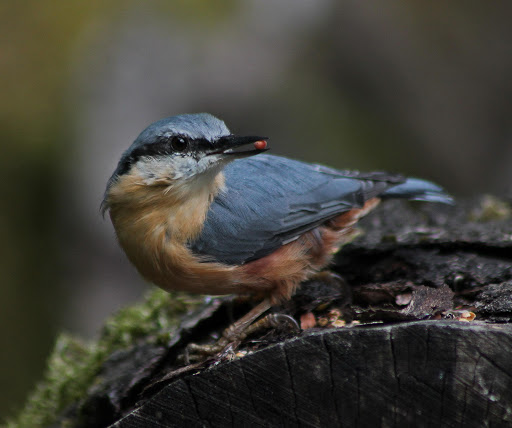
Eurasian Nuthatch by Pieter Colpaert on ProjectNoah.org

For the past two years I’ve been working at one of the Cornell Lab of Ornithology’s citizen science projects, Celebrate Urban Birds, which largely relies on the Internet to disseminate information about birds and urban habitat, to reach new audiences, and to receive the daily data that participants provide by uploading their observations directly onto the CUBs website.

The CUBs science model involves thousands of 10-minute bird observations around North America, and many of them come to the Lab of Ornithology on pen and paper data forms that then have to be scanned in, so internet observations are preferred. Another citizen science project based out of Cornell that I’ve highlighted before, the Lost Ladybug Project, isn’t based on data forms, but on photographs of ladybugs found across the US, focusing in particular on the nine- and two-spotted ladybug. As I  mentioned in my brief post on the Lost Ladybug Project, one of the goals outlined in their National Science Foundation Project Summary is to create “one of the largest, most accurate, accessible biological databases ever developed.”  Continue reading

Citizen Science in Belize: Part 2/2 – If You Can’t Beat’em, Eat’em

Photo by Alexander Vasenin

Lionfish sushi – Photo © World Lionfish Hunters Association (click on photo to visit their website)

In Part 1 of this post I talked about the lionfish invasion that is threatening coral reef and other marine ecosystems throughout the Caribbean, Gulf of Mexico, and Southern Atlantic Seaboard of the United States.  Scientists, environmental groups and governments that are studying the problem have all come to the conclusion that it is probably impossible to eradicate lionfish in the Atlantic – they are here to stay. Continue reading

Citizen Science in Belize: Part 1/2

Photo © ReefCI

Photo © ReefCI

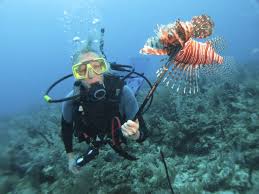
It might seem strange to accompany a posting about marine conservation with a photo of a fish on a spear, but in this case, it is entirely warranted.

I recently returned from the Sapodilla Cayes Marine Reserve in Southern Belize, where I spent two weeks working as a volunteer with ReefCI, a NGO dedicated to coral reef ecosystem conservation. Located 30 miles off the coast of Belize on the southern tip of the Mesoamerican Barrier Reef (the second largest in the world, after Australia’s Great Barrier Reef), the Sapodilla Cayes constitute a unique ecosystem.

Along with other volunteers, I assisted the ReefCI marine biologist with population surveys of conch, lobster, and commercial fish species, as well as coral reef health checks. At least one, and sometimes two surveys were carried out each day. The data collected is provided to the Belize Fisheries Department as well as to other cooperating NGOs.

Now about that fish on a spear. One of ReefCI’s projects is lionfish control. Spears Continue reading

Kitchen Collaboration

Kitchen Confidential juggled with foodies’ fascinations in new and unusual ways, and since then reality television seems to be the appropriate new home for that side show.  Oddly, it began in 1999 with an article in the New Yorker. So it is only fitting that the magazine has been balancing those dynamics with the work of less celebrity-oriented writers ever since.  None better than Bill Buford, who gets out there, and in there, like a citizen scientist for the story (though he is not shy of carny, either). Here what catches my attention is the collaboration, but plenty on the ethos of an artisan, the farm as the garden of eden, and last but not least the role of food in heritage and heritage in food (click the image above to go to the article):

Two years ago, during the summer of 2011, Daniel Boulud, the New York-based French chef, told me he had been thinking about a project that we might do together. We were both in France at the time. I was living in Lyons—I had moved there in order to learn French cooking—and Boulud was visiting his family in Saint-Pierre-de-Chandieu, a nearby village on a wooded ridge in the open countryside. Continue reading

Other Winged Wonders

Birds are the most common feature on this site, for reasons we cannot possibly explain in the prelude to a post about another type of flying creature. Butterflies are certainly underrepresented here, and with this post we will begin to correct that. Four of Raxa Collective’s contributors, and many others who have visited Costa Rica, first learned of butterfly farming due to the good graces of Joris Brinckerhoff and Maria Sabido and that is just one of the reasons to smile thanks to Robert Krulwich’s recent post:

I’ve got a friend, Destin, who has a YouTube channel called Smarter Every Day, where he pokes around with his camera to get extremely intimate looks at small miracles in nature. In this one, about the secret life of baby butterflies, he learns that when it comes time for the caterpillar to turn itself into a butterfly, it doesn’t spin a lot of silk and build itself a shelter (a pupa). I thought that what caterpillars do. But no … take a look at what actually happens. Continue reading

Bird Dust-bathing in D.C. and Shark Tail-whipping in PH

These House Sparrows, one of the sixteen focal species of the Celebrate Urban Birds program, were all dust-bathing together next to the sidewalk near the Washington Monument as I walked past this week. Birds dust-bathe to clean their feathers of oils and parasites, and the behavior is well-documented in this species.

On the other side of the world, just a few days ago, footage was released of previously undocumented (but formerly observed) behavior in Philippine thresher sharks, pelagic predators with a prodigious posterior. A thresher shark’s tail comprises about half of the shark’s total length, and in the video Continue reading

Getting Grilled About Nests

Photo by Sharon Obery, IL

In the past few years at the Celebrate Urban Birds Funky Nests in Funky Places competition we have seen a fair number of nests found by contributors in their grills. And although at first it might seem surprising to learn that so many people are finding nests there (and, as you can see from their captions, the photographers are usually pretty shocked to open up their grill and encounter eggs or nestlings!), if you think a little about what certain bird species look for in a nesting location, grills actually make sense as nest homes. Why? Well, let’s review a couple facts about bird nests.

First off, many species will always nest in a protected hole, or cavity. The most common of these that you could find around your house include (but aren’t limited to) European Starlings, House Sparrows, House Wrens, and Eastern Bluebirds. Next, we should remember that the most important factor for a nest location is its capability to provide shelter and protection from predators. Does it sound like a grill would meet these requirements? Here’s some of their nest-worthy qualities:

Continue reading

Eyes Of Other Animals (#1 of 2)

This slideshow requires JavaScript.

The charisma of whales is normally associated with their size, their ancient history, their apparently gentle approach to life. But it is not only those; the eyes have a role to play in why we love these creatures, among others (more on which in a subsequent post). Thanks to Alex Madrigal and The Atlantic for their attention to this topic:

Both humans and whales are mammals, so our eyes are derived from a common ancestor. Not only can we look at whales and they can look back at us, but we know enough about optics to infer their eyes’ capabilities from their anatomy. Animal eyes can be imagined as technological systems evolved with biological materials.

“We will make the fairly bold claim that it is sensible to approach eyes in essentially the same way that an optical engineer might evaluate a new video camera,” write Michael Land and Dan-Eric Nilsson, the authors of the Oxford University Press treatment of our topic, Animal Eyes.

Their eyes capture light in ways we can understand. Their eyes have a focal length. Their eyes have a maximum resolution.

So, what does the world look like to a whale? Continue reading

Old Facts, New Truths, And Remember Those Great Books?

If you ever owned one of these books, you likely grew up in the USA.  Which means you also likely thought, because of all those “cowboy and Indian” movies you watched, that horses were native to North America.  That may sound like a big logical leap, but there is a point.  Today, a review two old posts on this site helped clear up the history of horses in North America and it has to do with the kind of pre-history that captivated any kid who loved those books above.

After this was posted September 30, 2012 one member of our community (me) who grew up reading all the books above, and seeing all those “Western” movies, missed the opportunity to click through and listen to it.  However, I had been fascinated to learn from this post and then from the amazing book it highlighted, the “truth” about horses in North America.

Continue reading

2012 YouTube Your Entomology Contest

The Entomological Society of America (ESA) is the largest organization in the world serving the professional and scientific needs of entomologists and people in related disciplines. Founded in 1889, ESA today has more than 6,000 members affiliated with educational institutions, health agencies, private industry, and government.

If you have followed our blog you know we are not averse to celebrating the normally less celebrated corners of the natural world.  We are therefore not surprised to learn of this organization, and are pleased to point to its entertaining and informative contest on YouTube. The sample video below won the Open category, and shows a swarm of predatory ponerine ants searching the African savanna for their prey–termites. When they locate a colony, they bite and sting their victims, and then return to the nest with jaws loaded with dead prey.