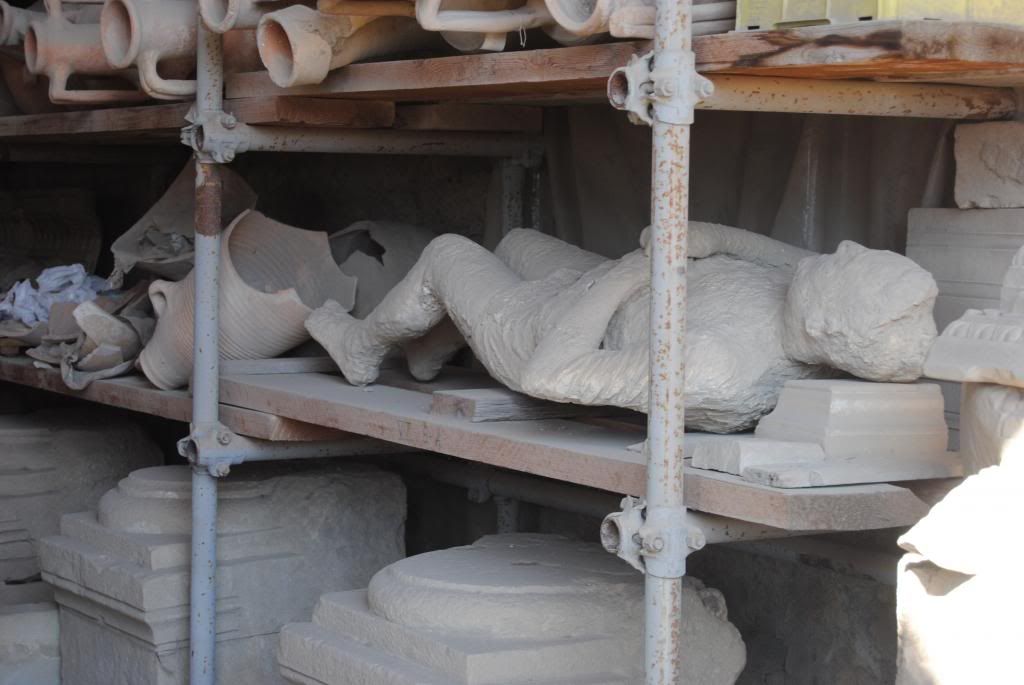
In 79AD, Mt. Vesuvius erupted with disastrous consequences for the residents of nearby Pompeii, Herculaneum, and other cities in the Campania region. Flows of boiling mud and rock rushed down the slopes, clouds of noxious fumes billowed upwards in the wind, and thousands of tons of rock and ash rained down upon the countryside. Pliny the Younger saw the eruption and likened it to a pinus, a pine tree. This may baffle some American readers, who may be accustomed to see pine trees that taper from a wide base to a narrow point Continue reading
Classics
The Hut of Romulus
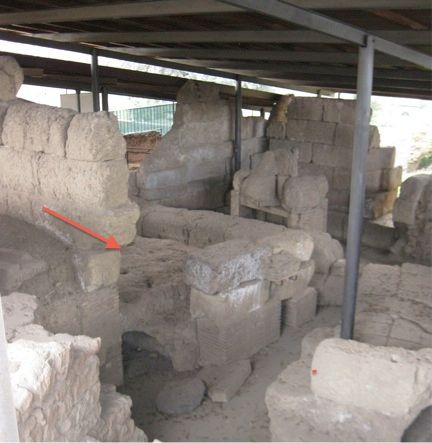
Today, all that remains of the so-called “Hut of Romulus” are the holes you see in the picture above (the slight indentations on the platform where the arrow is pointing). When intact, Romulus’ humble wattle-and-daub dwelling, located in the southwest corner of the Palatine Hill in Rome, might have looked something like this. One might have expected that the passing of nearly three millennia would not have treated well the wood, straw, and twisted bark ties of the hut, but even in its own day the Hut was prone to accidental destruction. One particularly ignominious story has a crow dropping Continue reading
Urban Muse
It does not matter whether you are a farmer, a geneticist, or whatever you do with your time: you will almost certainly be affected in important, unexpected ways after time spent in Paris. Continue reading
For Wales?
The Oxapampa-Ashaninka-Yanesha UNESCO biosphere reserve in central Peru. The Welsh funds will help the Ashaninka preserve their forests. Photograph: Nicholas Gill/Alamy
“For Wales? Why Richard, it profit a man nothing to give his soul for the whole world. . . but for Wales!” ― Robert Bolt, A Man for All Seasons
When Richard Rich betrayed, he did so for rewards related to Wales. Thomas More, in top shelf literary insult, takes him to task for it by emphasizing the pathos of having betrayed for profits as meager as Wales.
If you have been to Wales, you know it has nothing to be ashamed of in terms of physical beauty. And as for cultural beauty, Dylan Thomas or Richard Burton could tell Robert Bolt or Thomas More for that matter a thing or two about Wales. But now, Wales shows a creative streak in this contribution to conservation, perhaps a deeper greatness than other classics in its history. Continue reading
Le Macchine E Gli Dei
The Musei Capitolini Centrale Montemartini is an interesting place, to say the least: it combines Italian machinery of mammoth proportions from the Industrial Revolution with ancient Roman statuary. These statues include the monolithic “Fortuna Huiusce Diei” (“Fortune of This Very Day”), various Greek gods (Venus, Dionysus as pictured above, and others), Roman emperors, famous statesmen, and lesser known wealthy citizens; the machinery, on the other hand, consists in titanic pieces of metal that when whirring generated tens of thousands of horsepower. Continue reading
Taking The Geek Out Of Greek
We have already sung Stephen Greenblatt‘s praises several times, but why stop there? He has done something remarkable, making classicism classy:
Glories of Classicism
FEBRUARY 21, 2013
Stephen Greenblatt and Joseph Leo Koerner
The Classical Tradition
edited by Anthony Grafton, Glenn W. Most, and Salvatore Settis Belknap Press/ Harvard University Press, 1,067 pp., $49.95
Over a thousand pages in length, with some five hundred articles surveying the survival, transmission, and reception of the cultures of Greek and Roman antiquity, The Classical Tradition is a low-cost Wunderkammer, a vast cabinet of curiosities. Take the entry on the asterisk: you learn that this ubiquitous critical sign, named from the Greek for “small star,” originated in Ptolemaic Alexandria, where the great textual scholar Aristophanes of Byzantium and his student Aristarchus of Samothrace used them to mark repeated lines in the Iliad and Odyssey.


