Shopping Shifts

Lifestyles of Health and Sustainability (LOHAS) is a description, a name, a trend we have mentioned plenty of times in so many words, but not previously using this acronmyn. If you have not already seen it, you can expect to see it more now.  We appreciate its blog, which you can sign up for by clicking through from this article in it (click the LOHAS banner image in this post):

…In the improving but not yet booming economy of 2013, Patricia Aburdene, author of the New York Times bestseller “Megatrends 2000” and most recently “Conscious Money” (Atria Publishing; $16 paperback), predicts priorities and values will play a bigger role in shaping spending decisions. Continue reading

From the 2012 Net Impact Conference, Part 3

In my last installment of a trio of posts on the 2012 Net Impact Conference, I want to draw our readers’ attention to a keynote panel that included the CEO of Coca-Cola and the president of Honest Tea. The topic of this panel centered on healthy eating and consumer choices. By way of background, Honest Tea is an organic tea company that was founded by Seth Goldman in 1998. Honest Tea is a poster child of socially responsible innovation: the firm sources herbs/plants from developing countries, supports poor farmers, uses organic ingredients, and provides sustainable product packaging. But in 2011, Coca-Cola bought a majority share of Honest Tea.

Leaders from Honest Tea and Coca-Cola sparred over a variety of issues, but they agreed that consumers were ultimately responsible for their own health.

Continue reading

Changing Business Models

hikers on a mountain

Patagonia’s connection to the wilderness has a big impact on the company’s approach to environmental issues, says Vincent Stanley, vice-president of marketing at Patagonia. Photograph: Daniel Garcia/AFP/Getty Images

From the Guardian‘s Sustainable Business blog:

Patagonia plans global campaign for responsible capitalism

The outdoor clothing and equipment company says we need to develop very different measures of success if we are to prevent environmental collapse

In the true spirit of adventure, mountaineering and surfing company Patagonia reaches one summit and immediately searches for an even tougher peak to climb.

Fresh from taking a pot shot at our consumerist society with its challenging “don’t buy this jacket” advertising campaign, Patagonia now has the whole capitalist system in its crosshairs. Continue reading

Good Goods And Value Proposition

From free-range eggs to green energy, sales of ethical products and services are bucking the economic trend. Photograph: Daniel Berehulak/Getty Images

From free-range eggs to green energy, sales of ethical products and services are bucking the economic trend. Photograph: Daniel Berehulak/Getty Images

Some unusual news in tough times, about consumers spending more even when they have less, if the product speaks good:

Sales of ethical goods and services have increased despite the recession, growing to more than £47bn last year.

Since the onset of the economic downturn five years ago, the value of ethical markets from Fairtrade products and green energy to free-range and sustainable food has grown from £35.5bn to £47.2bn, according to a report produced by the Co-operative Bank.

The annual ethical consumer markets report shows that sales in the sector have grown from £13.5bn in 1999. Continue reading

What Makes the Baya Weaver’s Nest a Baya Weaver’s Nest?

“Pick a nest.”

It was the first day of my architectural design studio class and we were told to pick a nest, any nest. I knew this was going to be a great semester: the first assignment was seemingly random, kooky, and just a little ‘out there.’ I was excited! As an architecture student, I love when things are approached in such a non-traditional way.

I know what you must be thinking: aren’t architects supposed to be designing buildings for people? Why are you looking at bird nests?!

I, too, was confused, but I didn’t question it because I had a really cool nest in mind. Because I spent the summer in India with bird-lover and birder extraordinaire, Ben Barkley, the Baya Weaver Bird, who builds its iconic hanging nests around the backwaters of Kerala, was an obvious choice.

Here are my “comprehensive drawings” of the Baya Weaver Bird that attempt to explain the complex relationships the bird maintains with its surroundings.

2nd Draft of Baya Weaver Nest Comprehensive Drawing (By Karen Chi-Chi Lin)

My 2nd draft of Baya Weaver nest comprehensive drawing (Photograph and drawing by Karen Chi-Chi Lin)

Continue reading

Of Birds and Beans: Part 1 (Birds)

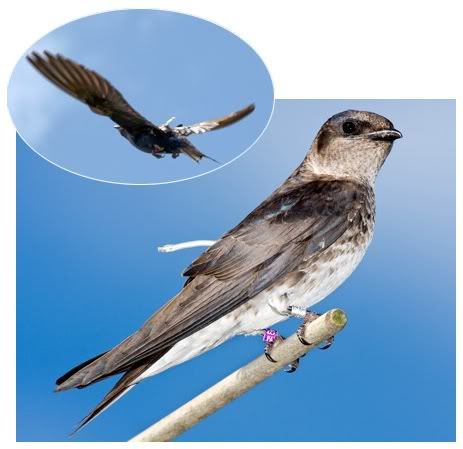
A banded adult purple martin wearing a light logger geolocator. Source: Patrick Kramer and Tim Morton, ScienceMag.

In the time it takes each of us to drink a cup of coffee, acres of tropical forest are cut down. Over the past thirty years, more than half the traditional coffee farms in Latin America have been converted to a newer growing method for higher production. Since the 1960s dozens of migratory bird species from northeastern United States have experienced long-term chronic declines in population size, with few signs of leveling off.

All these events are connected. Deforestation is occurring around the world faster than ever for plenty of reasons, but one of the most widespread and impactful ones is agriculture, and sun coffee (that is, coffee not grown under shade but in huge fields with pesticide, herbicide, and fertilizer assistance) is becoming more common to increase yields in the very same countries where North American migratory birds stay for their winters. But more about sun coffee and its negative ecological impacts later.

Continue reading

The “What’s Different?” Series: Century Plaza, Vancouver

As my first of the trip, I checked into the Century Plaza Hotel & Spa in Vancouver with ears piqued and eyes peeled, self-inducing a sensitivity to visible manifestations of the hotel’s “green” commitment. But nothing about the lobby seemed different from your average hotel: reception, elevator bank, informational television screens, a café, a spa – it all seemed quite deluxe.

Then I arrived in the room. Continue reading

Carbon Emissions Series: Why Hospitality?

In the past two months, I’ve hammered through interview after interview for internships this summer, and sustainable hospitality is a subject that seems to always surface. Along with the standard boiler-plate questions, I noticed that one topic in particular would often be asked about my interest in hospitality: why target sustainability in this industry? Why not sustainability elsewhere? And is the Cornell Hotel School the best place to explore it? I must admit that I didn’t answer the question too well the first few times, but I’ve taken a step back to truly think about my answer.

The hospitality industry's reach is near endless. It is indirectly involved with the GHG emissions of six of the eight major contributors above: transportation, agriculture, commercial services, land use, waste, and power.

Continue reading

Cherry Blossoms in Spring

Cherry Blossoms in Macon

One-hundred years ago, the First Lady of the United States of America, Helen Taft,
and the Japanese ambassador’s wife, Viscountess Chinda, planted two Japanese cherry trees in Washington, D.C. The annual commemoration of this act of good will would come to be known as the “National Cherry Blossom Festival.” In this festival, droves of Americans flock to see the riotously beautiful pink and white blossoms of the Yoshino and Kwanzan cherry trees. Officially, the National Cherry Blossom Festival in Washington, D.C. serves to reaffirm the commitment to enduring friendship between United States and Japan: Continue reading

Linking Locavores

Click the image above for a journalistic description of a utilization of new technology to conserve valuable traditions and provide more efficient access to healthy, tasty food.  Or, after the jump, a short video of the same.

Continue reading

Optimism and Opportunity

Many of my posts reflect my outlook to err on the upside of life’s circumstances.  I try to drown out my inner (and often powerful) pessimism by surrounding myself with positivity and optimism.  I find that this is a careful balance of being hopeful while remaining realistic.  Today, when I was taking a break from my coursework, or the slightly negative part of my day, I watched an encouraging Ted Talk that I think demonstrates hopeful realism.

Johan Rockstrom suggests that the earth is at a point where major transformation must occur.  He optimistically recommends that we use and continue to use crises as opportunities and local initiatives to transform and sustain life.  Also, he makes a realistic statement that climate change is not our biggest problem only a symptom of our land use.

I found this talk engaging and thought-provoking.  I agree that I transformation is soon to happen and I look forward to being a part of it.

Schneider Electric: Saving Energy across Multiple Cultures

Last week in my Facilities Management course at the Cornell Hotel School, Al Nels, Global Account Manager for Marriott from Schneider Electric, presented in class as a guest speaker. His presentation explored the energy-saving capabilities of various systems developed by Schneider Electric, as well as simple tips that hotels often overlook. Among the many insights Nels shared, one in particular stood out to me: the cultural divide between American and European hotel guests—and the steps that Schneider is taking in order to save energy in both areas of the world.

Continue reading

Travel, Writing & Games

This series has always been worth reading, whether you are an American looking through the eyes of a fellow American, or otherwise intrigued by a niche of American perspective that is not quite representative of that culture as a whole.

First things first: sometimes a book, a music recording or other item is only available from the mainstream online retailers such as Amazon or iTunes, but whenever possible we promote the purchase from independent sellers.  So click the image to the right if you want a link to independent booksellers in the USA, provided by the ever-entrepreneurial American Booksellers Association.

Now, the side show: the series editor Jason Wilson is also a contributor to a site we refer to on occasion, and he wrote an interesting item a couple of years ago that began:

Continue reading

Consumption Matters

Either take 63 seconds to view Mr. Clay’s ideas in video form, or read this summary:

Healthy information consumption habits are about more than productivity and efficiency. They’re about your personal health, and the health of society. Just as junk food can lead to obesity, junk information can lead to new forms of ignorance. The Information Diet provides a framework for consuming information in a healthy way, by showing you what to look for, what to avoid, and how to be selective. In the process, author Clay Johnson explains the role information has played throughout history, and why following his prescribed diet is essential in today’s information age.

Continue reading

The Cyberspace Jungle

Today, we are bombarded with information. Millions of bits–photos, text, video–stream by us every second we’re on the web. And we’re always on the web. Mobile devices on 3G (and now “4G”) and lightweight laptops able to access nearly ubiquitous WiFi hotspots mean that the modern age is certainly the information age. And the Internet continues to grow riotously; like a tropical rain forest, millions of unique niches exist, but they are inhabited here instead by users and data. And much like a natural ecosystem, the internet is also inextricably interlinked and interdependent: hyperlinks, reference pointers, and social media make the Internet a pseudo-organic entity that has its gaze turned not only outward (towards expansion) but also inward (towards connections). In its own way, the internet is an oddly beautiful thing. The freewheeling, ever-shifting topography of the web means that from second-to-second it’s never quite the same place.

But for all its seductive beauty and facile utility Continue reading

Ever Clever

Click the image to the left to go to Dan Ariely’s always interesting and insightful blog site, where a recent post highlights a grocery whose shoppers are committed to lifestyles of health and sustainability.  The opener contains the key point:

Jared Wolfe, one of the students working with me, took the following pictures at Whole Foods a few days ago.  They illustrate amazing creativity in defining what the term “a deal” means.

1) Regular price is $1.99 and the Sale price is?   Two of the same item for $5 — which according to Whole Foods’ quick calculation is a savings of $1.02.  Amazing.

Continue reading

Really, Coca Cola?

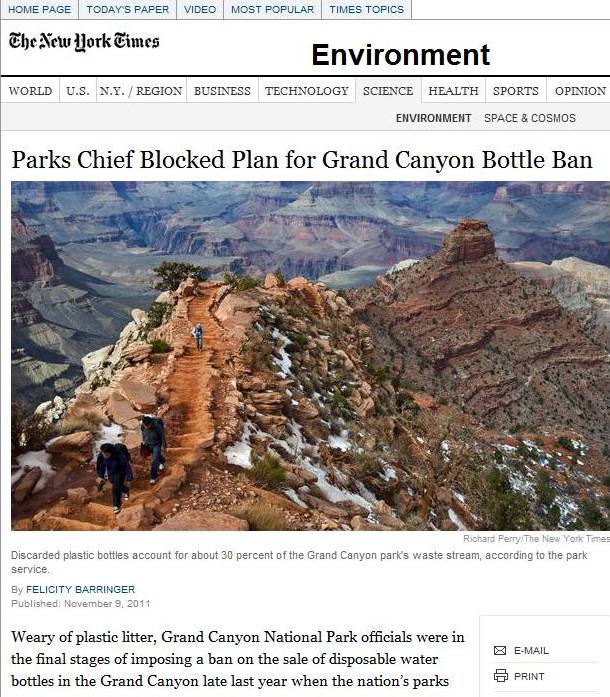
Click on the image above to be taken to the story, which describes a great trash reduction plan in the Grand Canyon National Park that suddenly got scrapped under mysterious circumstances. The circumstantial evidence suggests that Coca Cola was influential, if not responsible, for that canceled plan.  Every day this newspaper seems more worth the subscription price. Continue reading