What Lies Beneath Your Feet

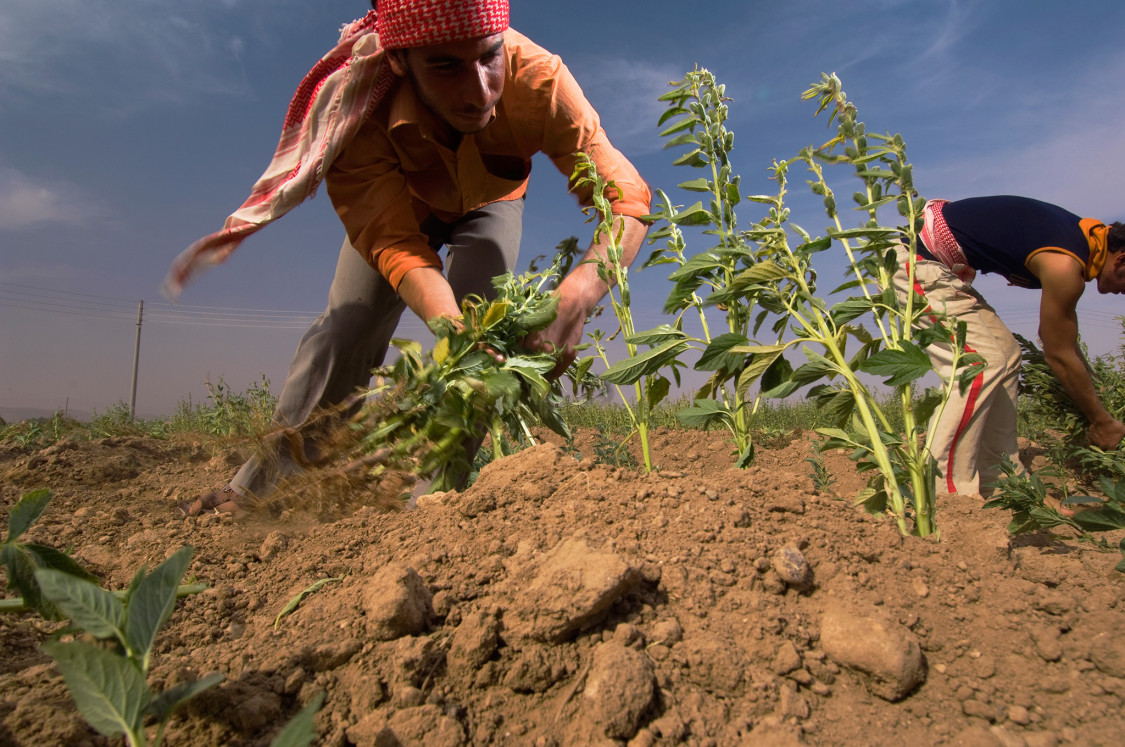
Farmers harvest sesame in Syria. PHOTO: JIM RICHARDSON

Farmers harvest sesame in Syria. PHOTO: JIM RICHARDSON

The 68th UN General Assembly declared 2015 the International Year of Soils. It aims to increase awareness and understanding of the importance of soil for food security and essential ecosystem functions. According to scientists, soil is being eroded faster than that the Earth can replace it. So the next time the words ‘dirt cheap’ come up, think again and take not the soil below your feet for granted.

Dirt is not only rare, but it’s complicated. To the uninitiated, dirt may look like grubby generic mush, but actually it has character, individuality, and a taxonomy all its own. Soil scientists recognize twelve major orders of dirt, each divided into suborders, groups, subgroups, families, and series, according to its various allotments of minerals and organic matter. Each dirt has a pedigree. Furthermore, dirt is proactive. It’s not an inert blanket; it’s a dynamic entity.

Continue reading

When Temples Teach About Forests

Traditional temple gardens, called Nandavanam, are strewn along the banks of the river Tamaraparani that originates in the Western Ghats, India. Each is attached to one of the 150-odd temples in the region, some as old as 1,000 years. PHOTO: Scroll

Traditional temple gardens, called Nandavanam, are strewn along the banks of the river Tamaraparani that originates in the Western Ghats, India. Each is attached to one of the 150-odd temples in the region, some as old as 1,000 years. PHOTO: Scroll

Sacred texts are guides to living while temples and the religious community teach a thing or two about what has been and what will be. But do temple gardens move beyond their aesthetic value and stand for something greater? Yes, their valuable insights into living ecosystems.

Some of these old surviving forest patches are invaluable when it comes to shining a light on what a forest might have been like in the area several thousand years ago, like a relic to an ancient civilisation. Considering the Indian government’s rapid march towards creating new forests to combat deforestation, sacred groves, their histories and regeneration can be a blueprint to such plans. “In short, one could say sacred groves provide a small window into an ecosystem’s past,” said Osuri. “They might even provide a source population and a reference library.”

Continue reading

Notes from a Natural History Museum

Harvard Natural History Museum

I recently had the chance to visit the Harvard Natural History Museum. Despite having lived in Cambridge for nearly a year, and having often thought about visiting the museum when I passed by going to and from my apartment, I had not stopped in until now. What a treat! The collections are full, diverse, and well curated. On this occasion, I spent most of my time in the animal wing, but I plan to return soon to take in the flora and minerals, and spend much more time in choice display rooms (e.g. the absolutely gorgeous Mammals/Birds of the World permanent exhibit: see below for pictures).

A ground sloth skeleton. It is hard to get an idea of the size of this creature from this photo, but it probably weighed several tons while alive!

Continue reading

Rewilding’s Great Rewards

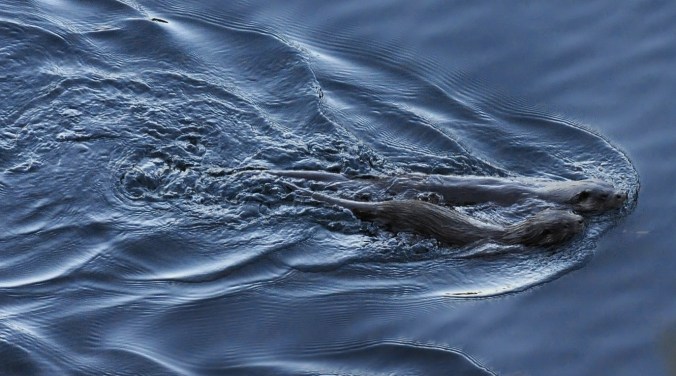
Otters near Shieldaig Island, Loch Shieldaig, Scotland. Photograph: Steve Carter

Otters near Shieldaig Island, Loch Shieldaig, Scotland. Photograph: Steve Carter

Although he may not use the term, George Monbiot believes in biophilia. His devotion to the concept of rewilding is evident in both his actions and his words, and his expressive writing about nature’s resilience and the richness of “ecological interactions” prove the point. His description of a recent trip to the Scottish highlands exemplifies both the draw of nature and his response to it:

As I came over a low ridge, I noticed a disturbance in the water below me, a few metres from the shore. I dropped into the heather and watched. A moment later, two small heads broke from the sea, then the creatures arced over and disappeared again.

After another moment, the larger one – the dog otter – scrambled out of the water with something thrashing in its mouth. He dropped it on to the rocks, gripped it again, then chewed it up. Then the bitch emerged from the sea beside him, also carrying something, that she dispatched just as quickly. They plunged in again, and I watched the trails of bubbles they made as they rummaged round the roots of the kelp that filled the shallow bay. Continue reading

Progress, Destruction & Roads

Nijhuis-Habitat-Fragmentation-320

A new study looks at the worldwide effects of habitat fragmentation. CREDIT PHOTOGRAPH BY GEORG GERSTER / PANOS

From the Elements section of the New Yorker’s website, this note on roads, a clear symbol (and tangible form) of what most of us would count as progress, related to development, is worth a two minute read. Another reminder that roads, like other signs of progress, can also have unintended and irreversible destructive consequences for nature, for habitat that also sustains human life:

The first paved highway across the Brazilian Amazon began, in the nineteen-seventies, as a narrow, hard-won cut through dense rainforest. The road, which connects the northern port city of Belém with the country’s capital, Brasília, twelve hundred miles away, was hailed as a huge step in the region’s development, and so it was: it quickly spawned a network of smaller roads and new towns, drawing industry to the Brazilian interior. But the ecological price was high. Today, much of the Belém-Brasília highway is flanked by cattle pastures—a swath of deforestation some two hundred and fifty miles wide, stretching from horizon to horizon. Across the planet, road construction has similarly destroyed or splintered natural habitats. In equatorial Africa’s Congo Basin, logging roads have attracted a new wave of elephant poachers; in Siberia, road expansion has caused an outbreak of wildfires; in Suriname, roads invite illegal gold mining; and in Finland, so many reindeer are killed by cars that herders have considered marking the animals with reflective paint. Continue reading

Leave The Grizzlies Be, And Just Watch

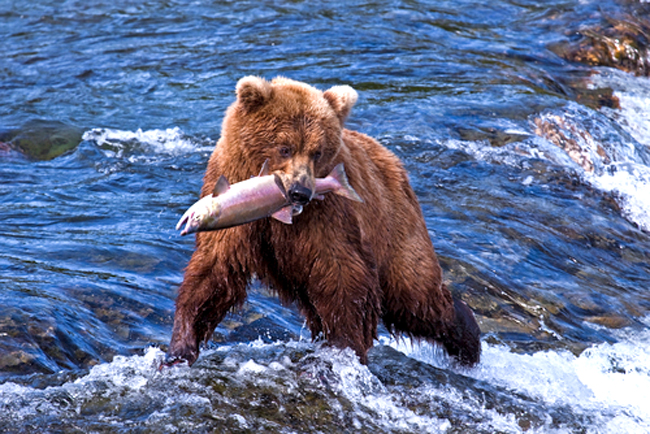
Grizzlies once roamed much of North America, from Mexico to the Yukon and from the West Coast through the prairies. Habitat loss and overhunting have since shrunk their range by more than half. Photo credit: Shutterstock

Grizzlies once roamed much of North America, from Mexico to the Yukon and from the West Coast through the prairies. Habitat loss and overhunting have since shrunk their range by more than half. Photo credit: Shutterstock

We are not opposed to hunting, when it is well regulated. With nature increasingly imbalanced due to habitat loss/change imposed by man, there are times when animal herds are in need of culling, or certain species experience overpopulation relative to their ecosystem carrying capacity. Hunting permits generate much-needed revenues for conservation.  Our favorite case study is one you can read on this site. But we cannot support hunting the largest animals on the planet.  We generally do not believe that licenses to kill the most charismatic of the “big game” will lead to their conservation. Read David Suzuki’s opinion piece and follow the trail where it leads you:

Watching grizzly bears catch and eat salmon as they swim upstream to spawn is an unforgettable experience. Many people love to view the wild drama. Some record it with photos or video. But a few want to kill the iconic animals—not to eat, just to put their heads on a wall or coats on a floor. Continue reading

Menacing Weed or Wonder Plant?

©Peter Chadwick/DK Images

©Peter Chadwick/DK Images

We’ve written about the invasive species water hyacinth on these pages before, discussing its environmental impact as well as its material value for eco-development projects. But we haven’t seen stories such as this one from Conservation Magazine where there’s a positive side to what many people call the “weed from hell.”

The scene at Florida’s Crystal River National Wildlife Refuge in Kings Bay last October would have been familiar to anyone who has ever engaged in the battle to control the spread of invasive plants. Eager volunteers scurried about the shoreline of this manatee wintering ground, carting large plastic bins stuffed with water hyacinth, a notorious aquatic weed that’s caused headaches on five continents. Closer inspection, however, would have revealed the activity to be anything but business as usual: instead of hauling water hyacinth out of the bay, the conservationists were putting it back in—almost 4,300 gallons’ worth by day’s end.

Those volunteers were taking part in a bold pilot project that is the latest chapter in a half-century-long ecological story that reads like a fable. It starts with a well-intentioned campaign to rid Kings Bay of the water hyacinth, an aggressive nonnative species. Next come decades of additional control measures and a tragic downward spiral that transformed these crystal-clear waters into an unpleasant soup of slimy green algae. Then the story takes an unexpected turn, back to its original antagonist. Only this time, Bob Knight, the wetlands restoration ecologist leading this pioneering project, has recast water hyacinth as the unlikely hero. He believes this South American native, if controlled, could help solve the algae problem and return the bay’s ecosystem to a more desirable state. The irony in this approach is not lost on anyone involved. Continue reading

Sustainable Logging Improves Lives

9642829930_d19343c79b_h-680x450

Logging generally does not come high on our priority list for inspirational stories, but we are nothing if not open to new ideas (thanks to Conservation for keeping up us apprised of encouraging surprises), especially when camera traps are involved to verify the facts:

ORANGUTANS MIGHT SURVIVE SUSTAINABLE LOGGING

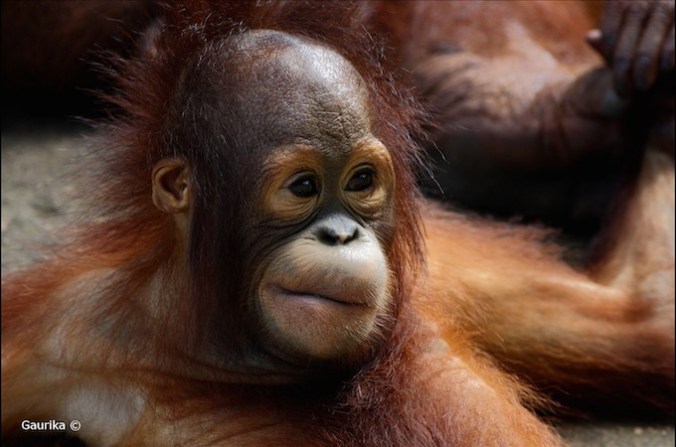
Like for all of its great ape cousins, the rise of Homo sapiens has not been pleasant for the Bornean orangutan, Pongo pygmaeus. The endangered “red ape,” found only in Borneo, is threatened by the continuing loss of its forest home. Hectare after hectare of primary forest is being lost either to logging or to palm oil plantations. Continue reading

We Will Cheer This Until Completion

db757a96-5214-4e59-b0d5-8631d7e250d7-460x276

The proposed marine reserves around the South Sandwich Islands, Ascension and Pitcairn Islands would protect rare and threatened marine life. Photograph: Matthias Graben/Alamy

We write about marine reserves whenever we hear of a new initiative, and try to keep up with the progress of those as we can. The Guardian is reporting here on a new one; if Helena is in, we are in to support this as we can, and will post updates as available:

Conservationists call for UK to create world’s largest marine reserve

Three proposed reserves in UK waters around the Pitcairn Islands in the Pacific, and Ascension Island and South Sandwich Islands in the Atlantic, would more than double the size of the world’s existing marine protected areas

Pressure is mounting on the UK government and opposition parties to commit to creating at least one massive marine reserve in the Pacific or Atlantic to protect rare and threatened whales, sharks, fish and corals ahead of the general election.

Continue reading

Let Nature Do Its Own Work

The Pine Marten, once common in the UK, is a natural predator of the grey squirrel and has successfully reduced their numbers in Ireland. Photograph: Alamy

The Pine Marten, once common in the UK, is a natural predator of the grey squirrel and has successfully reduced their numbers in Ireland. Photograph: Alamy

Not every problem in the natural world has a solution, let alone a simple one; and there is always that law of unintended consequences, but we like the way this proposal sounds as an alternative to other forms of eradication:

Is there anything more stupid than the government’s plan to kill grey squirrels?

I ask not because I believe – as Animal Aid does – that grey squirrels are harmless. Far from it: they have eliminated red squirrels from most of Britain since their introduction by Victorian landowners, and are now doing the same thing in parts of the continent. By destroying young trees, they also make the establishment of new woodland almost impossible in many places. As someone who believes there should be many more trees in this country, I see that as a problem. A big one.

No, I oppose the cull for two reasons. The first is that it’s a total waste of time and money. Here’s what scientists who have studied such programmes have to say: Continue reading

When New Roads Signal Nothing But Danger Ahead

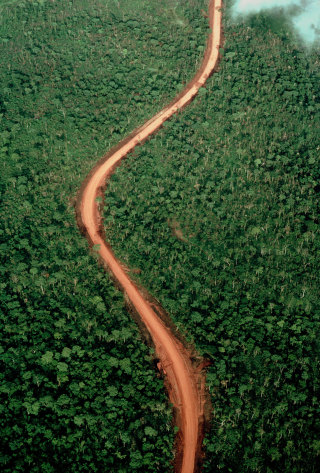
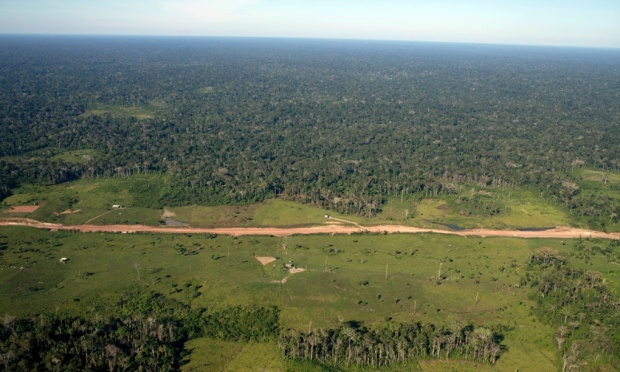
 A newly constructed road goes through the Amazon rainforest outside Rio Branco, the capital of Acre province, Brazil. For every 40 meters or road created, around 600 sq km of forest is lost. Photograph: Per-Anders Pettersson/Corbis

A newly constructed road goes through the Amazon rainforest outside Rio Branco, the capital of Acre province, Brazil. For every 40 meters or road created, around 600 sq km of forest is lost. Photograph: Per-Anders Pettersson/Corbis

Thanks to the Guardian for keeping us up to date with news, no matter how dismal, which in this case raises red flags about the future of our earth’s lungs:

Roads are encroaching deeper into the Amazon rainforest, study says

Oil and gas access roads in western Amazon could open up ‘Pandora’s box’ of environmental impacts

Oil and gas roads are encroaching deeper into the western Amazon, one of the world’s last wildernesses and biodiversity hotspots, according to a new study.

Roads across Bolivia, Colombia, Ecuador, Peru and western Brazil could open up a ‘Pandora’s box’ of negative environmental impacts and trigger new deforestation fronts, the study published in Environmental Research Letters finds.

“The hydrocarbon frontier keeps pushing deeper into the Amazon and there needs to be a strategic plan for how future development takes place in regards to roads,” said the report’s lead author, Matt Finer, of the Amazon Conservation Association.

Continue reading

The Ecological Health Of Oceans In Dire Need Of Support

The news that is fit to print, for better or worse as it impacts our mood and our sense of hope (or sense of doom on occasion), includes this review of the current best knowledge on marine ecosystems by one of our favorite science writers:

Ocean Life Faces Mass Extinction, Study Says
Scientists find what they say are clear signs that humans are beginning to damage oceans on a catastrophic scale, but there is still time to preserve their ecological health.

A Trio of Jamaican Endemics

Jamaica has thirty endemic bird species, which is more than any other West Indies island. Justin, John and I have a good chance of seeing a good handful of those, especially since Cockpit Country and the Blue Mountains are such well-forested and protected areas. Although none of us are the type of birder that pursue “life lists” — a checklist of the thousands of bird species in the world that one has seen — we all use eBird and are definitely interested in seeing and identifying wildlife of any sort.

And if that type of animal happens to be found only in the area that we’re passing through, then that just makes us appreciate the relative rarity a little more. Endemism in a bird species does seem to assign that bird a bit of a higher status for life-listers, for the obvious reason that you have to be able to go to the certain region to find it — you can’t necessarily spot it merely by visiting a different continent, but rather you have to go to the country, or island, or mountain range.

Continue reading

Expeditions In The Interest Of Science, Nature And Conservation

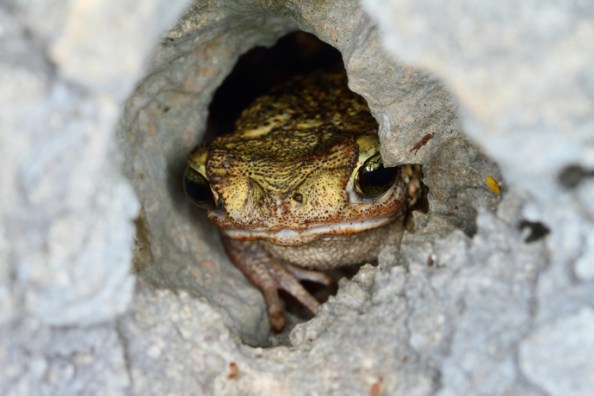
A male toad of an undescribed species hides in the limestone of the southwestern Dominican Republic. CREDIT PHOTOGRAPH COURTESY MIGUEL A. LANDESTOY

A male toad of an undescribed species hides in the limestone of the southwestern Dominican Republic. CREDIT PHOTOGRAPH COURTESY MIGUEL A. LANDESTOY

There is a reason why we highlight birds every single day. They are spectacular in many diverse ways, as well as beautiful in more ways than can be counted, and sometimes smile-inducingly odd; always exceptional ambassadors to the human world from their natural habitats, which are under constant pressure and threat. Birds may seem more charismatic than amphibians but from an ecologist’s point of view they are both extremely valuable indicators of ecosystem health. If you have been following Seth’s posts about the preparation for the Smithsonian expedition he is about to embark on, you will likely agree they would enjoy crossing paths with the team described in this story:

The southernmost corner of the Dominican Republic is dominated by limestone karst, a landscape with the look and feel of a petrified giant sponge. Snakes, small mammals, and fat, furry tarantulas live in the fissures and holes in the karst, as do toads, including one species that is not yet fully known to science. I met this new toad at three o’clock one late-fall morning, in a karst forest off a mining road near the town of Pedernales. I was with Miguel Landestoy and Robert Ortiz, a pair of freelance field biologists who have been friends since their youth, and who still spend much of their time looking for amphibians. Continue reading

A Random Walk Into Science

9781426207211_custom-35a4548b8f07b01d4c9e9152d330cf0d69e5ce53-s400-c85

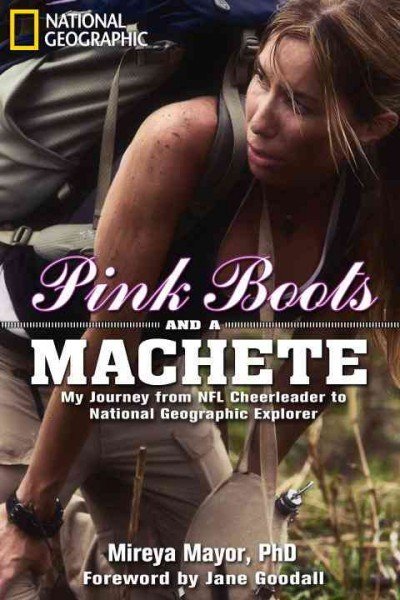
This title of the book to the left, and of the podcast interview (“Trading Pom-Poms For Field Boots”) on the National Public Radio (USA) series called “My Big Break”–and even the opening line belowgive the false impression that this may be a dilettante story; but not at all. It is about discovering science in a classroom and coming to love it thanks to a deep experience in nature:

Mireya Mayor’s life plays out like an adventure film.

She’s a globe-trotting anthropologist, primatologist, wildlife expert and conservationist. As the first female wildlife correspondent for the Ultimate Explorer series on National Geographic Channel, she’s gone diving with great whites, she’s rappelled down cliffs and she was even charged by an angry silverback gorilla.

But some of her fans might be surprised by what Mayor was up to before she trekked around remote regions of the world. Continue reading

Citizen Science, Decades In Development

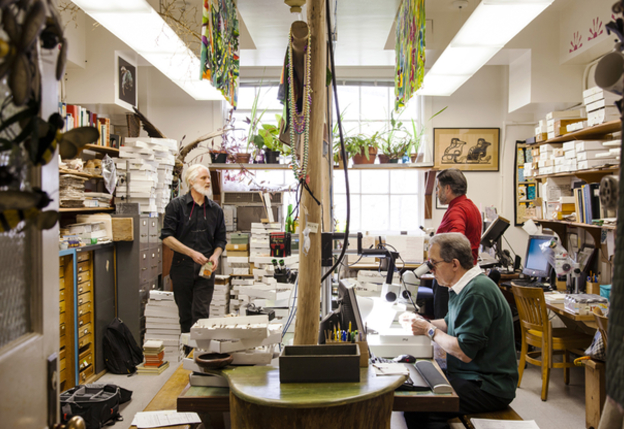
In Droege's lab at the Patuxent Wildlife Research Center, pizza boxes provide storage to thousands of pinned bee specimens. Volunteers Gene Scarpulla (in green) and Tim McMahon peer through microscopes to ID the insects.  Credit: Robert Wright

In Droege’s lab at the Patuxent Wildlife Research Center, pizza boxes provide storage to thousands of pinned bee specimens. Volunteers Gene Scarpulla (in green) and Tim McMahon peer through microscopes to ID the insects. Credit: Robert Wright

We started, before even knowing the terminology, paying attention to citizen science on this blog when we began to understand the parallels with entrepreneurial conservation. And now we link to stories whenever we can that help us better understand it:

Three Generations of Citizen Science: The Incubator

Once Sam Droege gets a research project up and running, he dreams up a new one–and builds it.

BY ANDY ISAACSON

It was a bright, breezy day in late April, the flowering azaleas having finally shrugged off the winter that overstayed its welcome, when Sam Droege sailed onto the grounds of the U.S. National Arboretum in Washington, D.C., behind the wheel of a pterodactyl. It was actually a ’98 forest-green Saturn, which Droege had painted with yellow wings and a red-and-yellow beak that tapered to a point down the center of the hood. A piece of wood, lined with a rusty crosscut saw, had been bolted to the roof: the crest. Little jingle bells, inspired by richly adorned buses in Pakistan, dangled from chains screwed into the rear bumper. Droege still had designs for neon undercarriage lights, and a mosaic of mirror shards to line the car’s ceiling–“but why stop there?” he wondered. It was a work in progress.

Continue reading

Horseshoe Crab, An Awesome Creature Facing Awesome Challenges, Creating Awesome Challenges

imrs

This is not the first time we have read about the various reasons to appreciate the horseshoe crab, though apparently we have only posted on small feature on them before. However, they play a critical role in the livelihood of another creature from a different part of the animal kingdom, as this story in the Washington Post describes:

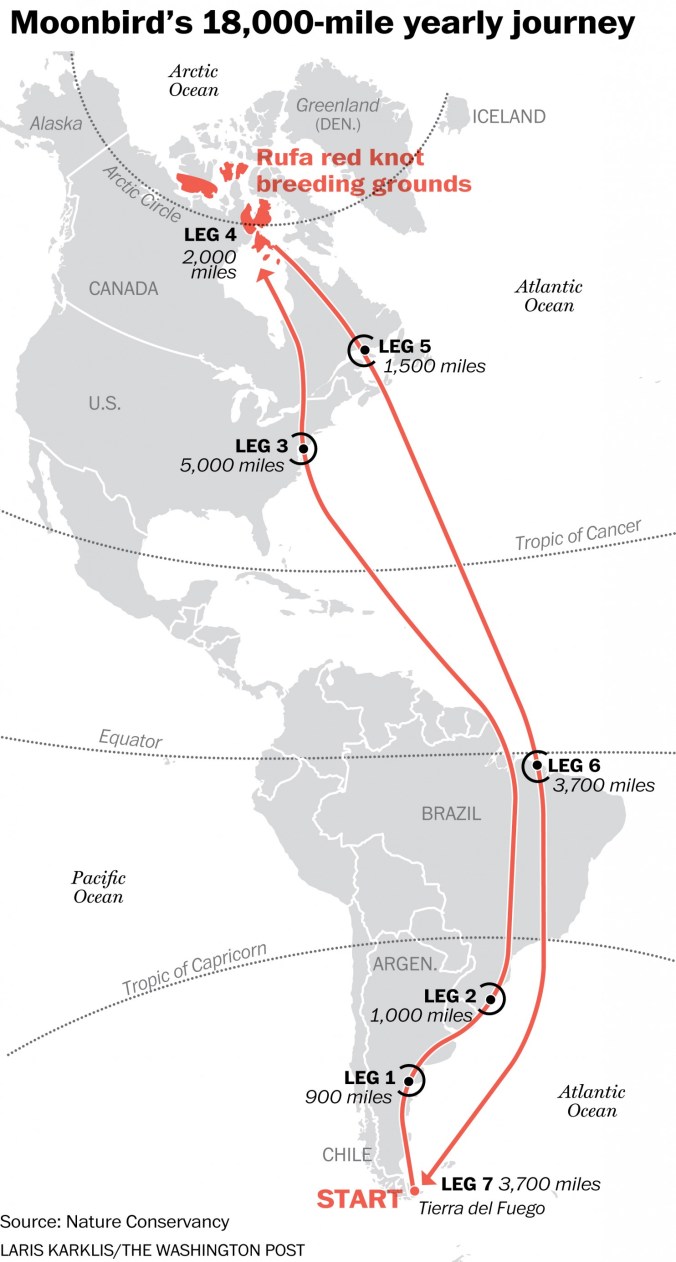
“We had actually attached small devices that tracked their migrations,” explains Niles, “and they made 6 day flights without stopping to get to the Delaware Bay. So they would arrive completely bereft of energy, their weight would be sometimes far lower than their fat free weight, which meant they were burning muscle to get to the Delaware Bay. And the horseshoe crabs were laying eggs in such density that there was no work involved.” Continue reading

Ecological Hero That Happens To Be Charismatic

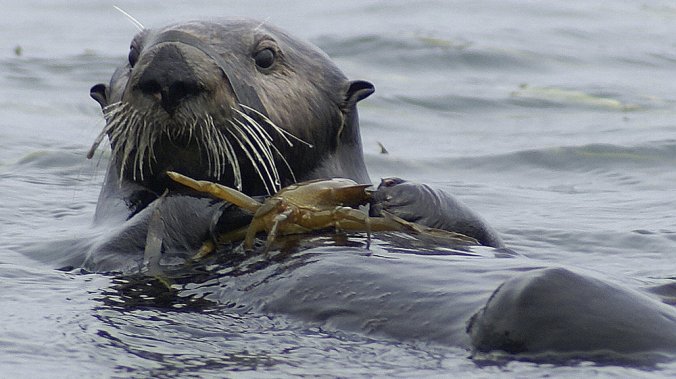
This sea otter, about to eat a crab in the Elkhorn Slough National Estuarine Research Reserve, is cute, sure. But more importantly, it's indirectly combating some harmful effects of agricultural runoff and protecting the underwater ecosystem. Rob Eby/AP

This sea otter, about to eat a crab in the Elkhorn Slough National Estuarine Research Reserve, is cute, sure. But more importantly, it’s indirectly combating some harmful effects of agricultural runoff and protecting the underwater ecosystem. Rob Eby/AP

Listen to this four minute explanation of how important sea otters are, not just for entertainment purposes but for the ecological services they provide:

On the roof of the Monterey Bay Aquarium in Monterey, Calif., in a large plastic tank, a sea otter mother named Abby floats with her adopted pup, known as 671.

For up to nine months, Abby will raise her little adoptee, and when 671 is ready, she will be released into a protected inland salt marsh called Elkhorn Slough, just off Monterey Bay.

That’s where 671 will set to work to preserve the estuary, says Tim Tinker, who tracks otters for the U.S. Geological Survey. Continue reading

Field Ecology At University, Twin Of Our Daily Activities For Guests At Xandari, Cardamom County, And Soon At Zaina Lodge

Screen Shot 2014-10-27 at 6.56.03 AM

Cornell University’s social media outreach often includes topics we cover regularly on this site, this video being a standard example, so we share six minutes on a topic of relevance to several of Raxa Collective’s properties where immersion in learning about nature is our parallel universe equivalent of Professor Agrawal’s approach:

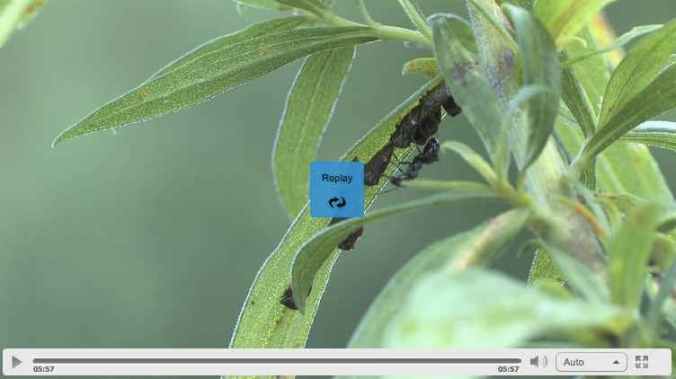
Nature as the Classroom: Goldenrod, Treehoppers and Ants

Classes in field biology are often very defined; go here, do that, measure this and come to this conclusion. Students in Anurag Agrawal’s field ecology course observe treehoppers in a field of goldenrod and devise their own study, then collect data to answer the questions. The approach comes much closer to how real field biology is actually done.

World Wildlife Week: Tigers & Territories!

habitat


As a part of celebrating World Wildlife Week I was sharing information about the importance of saving our Natural Heritage, trying to create awareness among the growing population of nature lovers and wildlife photographers.

In the previous posts I discussed the relationships between healthy ecosystems, the well-being of wildlife and humans.

Here I’ll address another essential element for a healthy tiger population – territories!

Next to food, the most important requirement for a tiger is territory. A male tiger with a territory encompassing those of several females has more mating opportunities. A female in control of a ‘home range’ with abundant prey has the best chance of raising more cubs.

With so much at stake, tigers are fiercely possessive of their turf, and scent-mark and defend their territories from rivals.

There is increased pressure on the Tiger territories from the development front. Environmental and forest clearances have been delinked to allow work on linear projects, such as highways, on non-forest land without waiting for approvals for the stretches that require forest land.

India has ONLY 4.9% of total geographic area established as protected area (PAs). If we are not able to increase this, we need to see how we can at least protect that. But look at this news published in hindustantimes:

In a boost to the real estate sector, the environment ministry may soon allow state governments to take a call on setting up new townships, information technology and developmental parks near tiger reserves, national parks, eco-sensitive zones and critically polluted areas.

The ministry has already issued draft rules proposing delegation of its power to decide on construction projects within 10 kms of wildlife areas and critically polluted areas to the state governments.

Till now, the Centre used to examine such projects to consider their impact on wildlife before giving a go-ahead. But now, the ministry has proposed the “general condition” for construction projects including information technology parks, hotels and offices will “not” apply. Continue reading