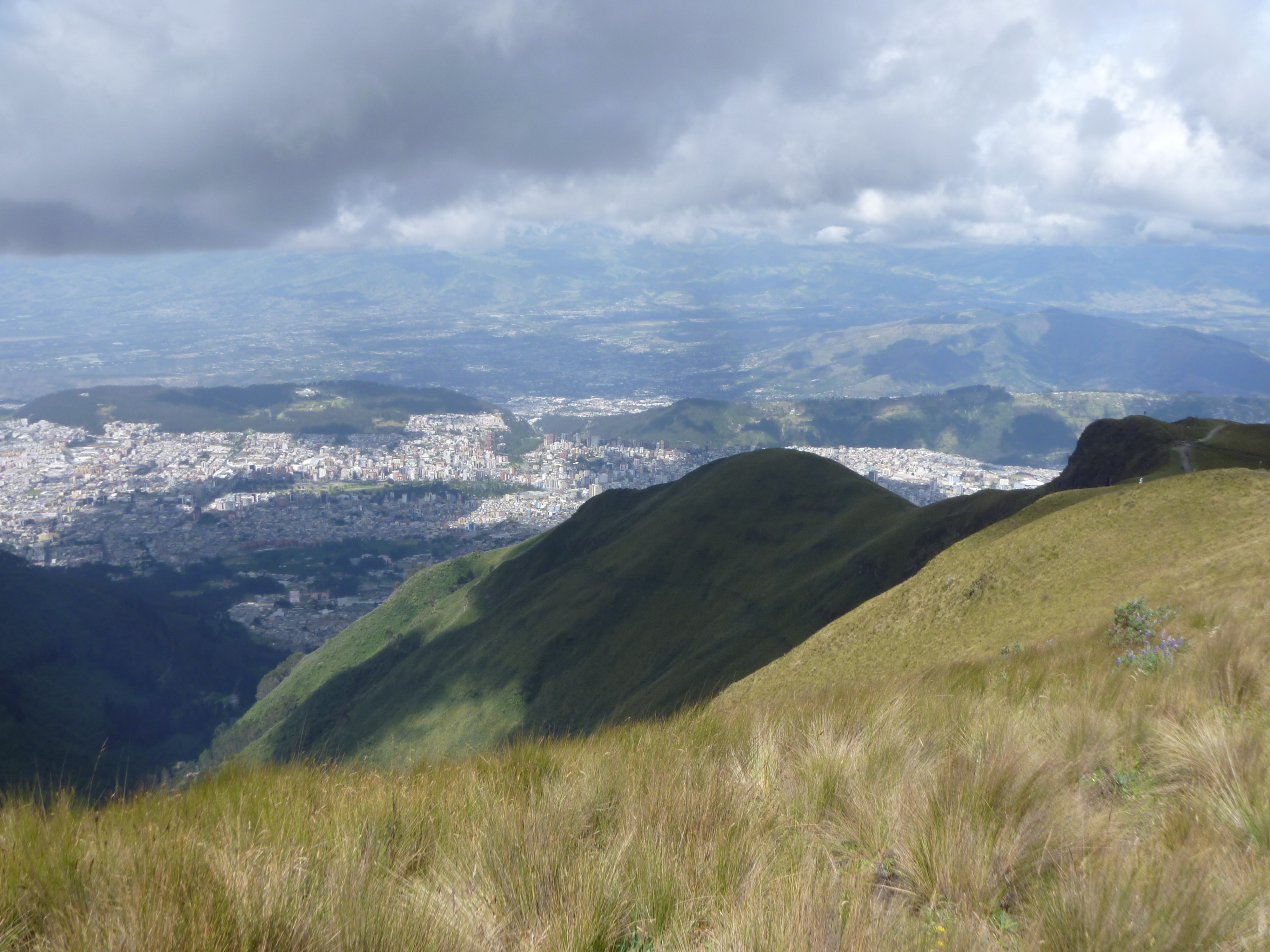
For now, I live in New York City and my brother lives in Quito, Ecuador. A visit to his new apartment last month near Parque Metropolitano, and our subsequent hike up Volcán Pichincha, led to the biggest obvious and most profound difference between Quito and New York: Quito has big mountains and volcanoes and New York doesn’t. Seemingly obvious and superficial (and of course topographical), the reasons started to form in my head while watching the clouds form around me.
Entrepreneurial Conservation
A Lesson on Conservation Tourism- the Case of Nairobi’s Animal Orphanages
Yesterday morning, I attempted to visit the David Sheldrick Wildlife Trust, but thanks to Tripadvisor, my taxi driver couldn’t find the location of the elephant orphanage. Instead, I found myself at the Nairobi National Park’s animal orphanage. Surrounded by a swarm of Kenyan school children (who seemed to be more interested in me than in the wild monkeys), I observed the establishment with slight disappointment. The orphanage seemed more like a mediocre zoo than a safe haven for its animals. I was disappointed with the lack of educational materials, tour guides, or remotely enthusiastic staff. Even as I paid my $15 entry fee (which is quite expensive for Nairobi standards), the clerk was rude and could not provide me with any information; he just scurried me along so he could attract more tourists to the booth.
I proceeded and moseyed around, reading the “Educational” signs that hung on the cages and learning a bit more about some of the animals, like the zedonk (zebra/donkey hybrid) or the cheetah. I was curious as to why some of the animals had been there for so long and why they hadn’t been brought back to the wild. Although I know the Nairobi National Park’s Animal Orphanage must do a lot of good for wildlife rehabilitation, I had trouble seeing tangible evidence of it. Unfortunately, the profitability of tourism had clouded the conservation vision and potential education opportunities that Nairobi Animal Orphanage could offer. Sustainable and nature tourism should educate the tourists not hustle and ostracize them.
Laying aside my disappointment from yesterday, I was able to find the David Sheldrick Wildlife Trust today! Since 1987, The David Sheldrick Wildlife Trust has hand-reared more than 90 newborn elephants and released 150 elephants back into the wild at Tsavo National Park. The charity was founded by Continue reading
Building Blocks of Opportunity
The wooden block is probably one of the simplest and most played with toys. However, this iconic block did something unexpected: it has been promoted amongst the complex toys of this generation and sure to last for many generations. With a little entrepreneurial conservation, Tegu has created a block that surpasses most expectations of a toy. It is educational and stimulates children’s creativity and unscripted play (as I mentioned in one of my previous posts), is heirloom quality, helps the planet and its citizens, and is so much fun that adults sneak off and play with them.
Tegu’s magnetic blocks are built to leave a legacy. They are complex, yet they don’t require any batteries or instruction manuals, just an imagination. The uniqueness of this toy is not just the functional (and inaccessible to children) magnet, but the series of events that follow each block purchase, called the Tegu Effect. Tegu gives every buyer the choice to either donate dozens of trees or donate schooldays for Honduran children. But it is not only the environment and children that benefit; as Tegu grows, the company creates living wage jobs for the Honduran factory workers, and with 65% of the population living currently below the poverty line Tegu offers the people a great opportunity. Continue reading
Wordsmithing: Resort
We do not take the word “resort” lightly. In fact, we have studiously avoided it. Common usage in the past century has gravitated to the sprawling hotel complex associated with mass tourism. But deep down, we love the word and its etymological roots. We hope to liberate it from its lingual prison.
As a noun, this word is defined by the Oxford English Dictionary (hereafter OED) as “something to which a person has recourse; an expedient, a measure.” As a verb it is defined in that dictionary as “recourse to a person or thing for aid, assistance, or the attainment of some end…also from a previous state or condition.”
Raxa, derived from the Sanskrit word (pronounced in that language to sound like “rock-shah”) — defined by the Cologne Lexicon to mean “guarding , watching , protecting , serving” — is a cousin of sorts to the word resort (in its older English usage). So, in the spirit of our commitment to entrepreneurial conservation, we are always on the lookout for innovative resorts by which communities nurture their traditional cultures and are stewards for their natural environments–quite a feat in this modern world, and worthy of celebration. Such resorts are at the heart of our mission–both a means and an end.
How Smart Can Wood Be?
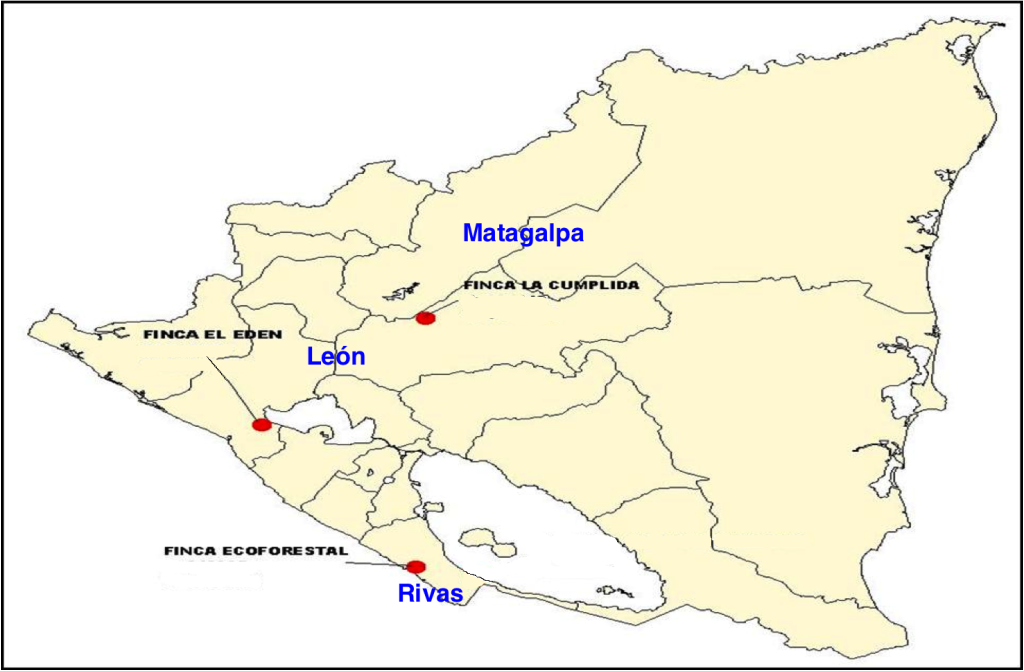
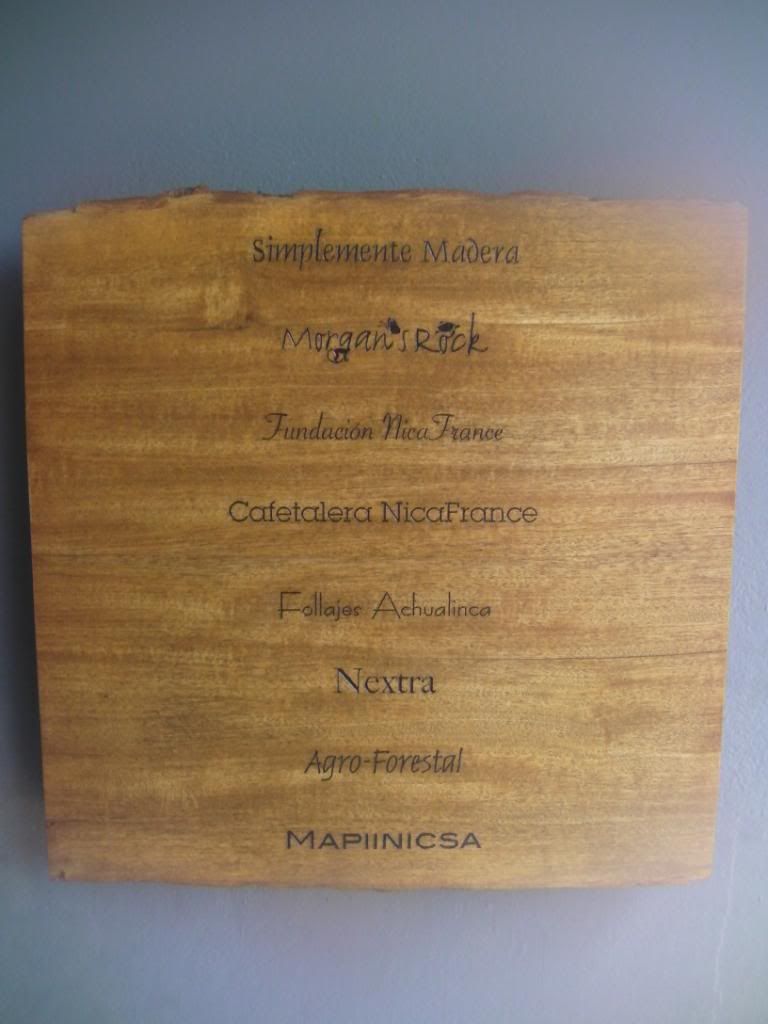
Yesterday I met with Javier López, the forestry engineer for Agroforestal, S.A. This company covers the tree plantations at La Cumplida, Ecoforestal/El Aguacate (Morgan’s Rock’s finca), and El Eden; it is not to be confused with Cafetalera Nicafrancia, which manages the coffee (and the planted trees growing in the coffee fields) at La Cumplida, or MAPIINIC S.A., which administers the forests felled by Hurricane Felix in 2007 at a finca called Rosita.
Javier, often known simply as “Prófe,” [PRO-feh] which translates as “Prof” (a nickname for Professor), has worked to get certification from Rainforest Alliance’s forestry auditor SmartWood (and by association the FSC and RA itself)
In 2009 Agroforestal became certified for forest management. To do so the company had to go through the same continuous improvement process that I described a bit in my post about coffee certification. An initial evaluation is made, and subsequent audits over the next 5 years that the certification is valid provide the certifier with evidence of progress and room for improvement. From what I saw of a couple examples, SmartWood seems to emphasize explicit documentation, which makes sense given the nature of the forestry industry: extractive at its most basic, but also focusing on replanting trees as long-term investments.
Some of SmartWood’s requirements are as simple as Continue reading
A Voice from Africa
Last summer, I interned at Panigram Resort, a socially and environmentally responsible boutique resort located in south-western Bangladesh (currently under development). For 60 days, my fellow interns and I were immersed in the beauty of rural Bangladesh’s vibrant culture, community, and natural beauty. As the sustainable hospitality intern, I worked on a host of project during the summer. For example, I helped develop a local community’s recycling business, oversaw the construction of a bamboo mud visitor center, modeled a carbon footprint calculator, and taught English classes to Bangladeshi children.
Continue reading
Details and Progress
This afternoon I visited my favorite newspaper bag unit in Kumily to check in on the progress since Sunday and to clarify the structure they had set-up on Sunday morning, mostly in Malayalam. Here’s my report, which is heavy on details and light on style.
Each of the producers was previously associated with an Eco-Development Committee (EDC). These committees have been established by the Forest Dept. over the last fifteen years, and are divided by location, or in the cases of the Mannan and Peliyan, by heritage. Current participants represent nine different EDCs: Mannakkudy, Paliyakuddy, Korishomala, Kollampottada (divided into three), Vasanthasena, Spring Valley, and Mullayar. Each has put forth a representative, who will serve to facilitate communication among them. They have, for now and for the most part, elected to retain the division of these committees, perhaps partially out of habit, but certainly for convenience’ sake. EDCs exist in neighborhoods within 5km of the forest’s edge. Though we held the workshop in Vanasree auditorium, just around the corner from Cardamom County and in the same building as the office of the Eco-Development Range Officer, Sanjayan, and some have chosen to continue working there, some from more distant locations prefer to base their operations out of EDC offices nearer to their homes. I don’t know who will administer supplies to these offices, or how, when the operation becomes more complex. The Vasanthasena committee formerly created a newspaper bag unit, and a few of its members have prior experience and know-how. It has been proposed that all the producers unite under the auspices of this group, but they have yet to ratify this motion officially.
Those in attendance on Sunday morning elected three officers to govern the unit: a Convener, a President, and a Secretary. They will receive assistance from two ex officio secretaries and a ‘facilitator,’ all of whom are employed by the Forest Dept. The elected officials alone have access to the finances. Sasi Kumar, one of the ex officio secretaries, currently is charged with maintaining the registers. When I asked what policy regarding the registers they would pursue in the future, Shymala, the ‘facilitator,’ told me they had not yet concerned themselves with the specifics. Abie, who was translating for me, used the phrase “baby steps” to convey the meaning of her answer. Continue reading
The Transparency Paradox
When I lived in Singapore to do an internship aimed at rolling out the sustainability road-map of a major service solutions and facilities management company, my building neighbored “Singapore’s first eco-mall,” a beacon of consumerism just like any other mall, but with one main difference: an exclamation point punctuating its statement of eco-friendliness.
A true comrade of the Earth according to its interior walls and eco-kiosks, this mall was built with technologies that will likely soon become architectural norms. Its urinals are water-free, its windows let in natural light but with minimal heat, its roof harnesses solar power and rainwater, its lighting uses minimal wattage, it is constructed of environmentally safe materials, the list goes on and on… and is painted all over the walls. You get priority check-out if you bring your own bag and priority parking if your car is a hybrid. But for some it’s not clear whether the priority really lies in being an eco-mall, or in making sure you know it’s an eco-mall.
One of the challenges that experts and champions in the field of sustainability and corporate citizenship face Continue reading
Forest Department & Social Entrepreneurship
Well, we’re back from our first day. The reason I came for this internship, originally, was to support and document entrepreneurial conservation. From meeting Diwia when I first arrived a couple months back, to meetings with various levels with the Forest Department’s hierarchy and front line, to today was one of those small arcs of history. The Forest Department’s approach to conservation, leveraging the abundant mix of creativity, entrepreneurship, and energy in the local community, was a testament to the possibility of good governance. One of my first posts when I arrived in Kerala, noting the news accounts about public sector corruption in this country, is balanced today by a more inspiring portrait of what that sector can and does do more than they get credit for.
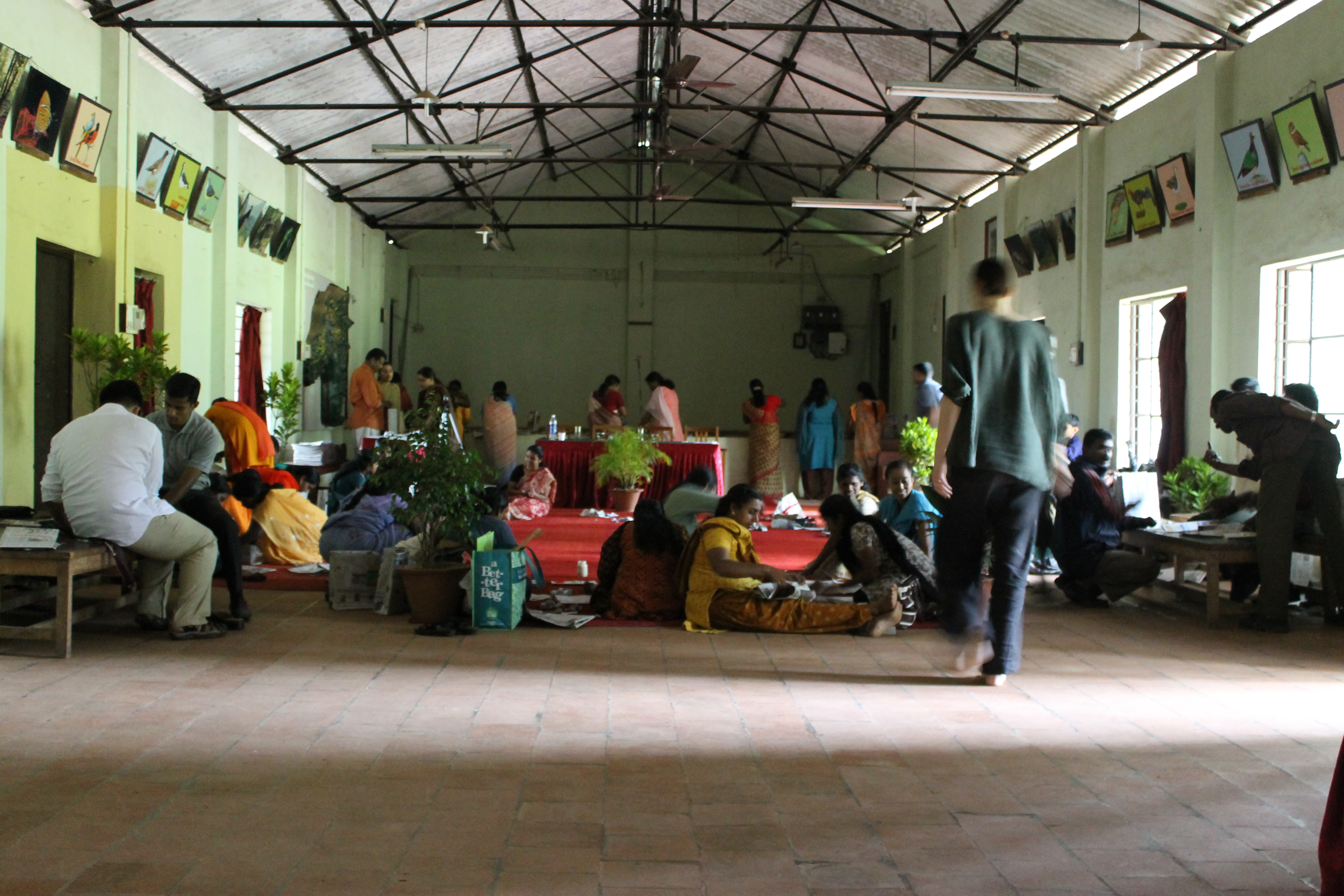
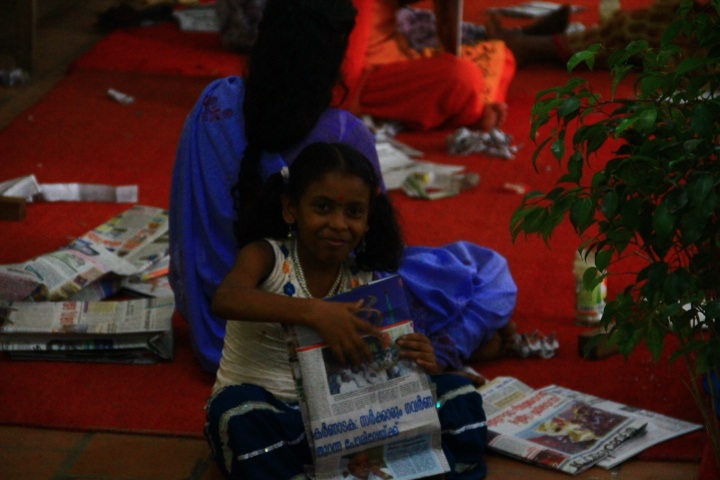
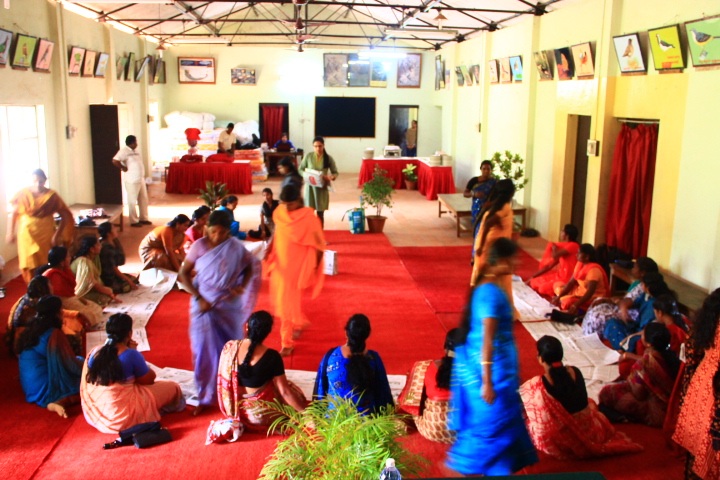
To describe the workshop as a success, I think, would be an understatement. The enthusiasm and enjoyment that infused the work, which no one seemed to tire of, was infectious, and I think everyone is looking forward to tomorrow morning. The fact that only three women said they couldn’t come back for tomorrow (which, I’ll remind you, is Sunday) morning’s session is particularly telling, and I hope the photos posted here are equally so. There were a lot colorful accents to the main event, notably the children who ran around helping their mothers (or made their own bags), the men on the side learning in their own way, and Diwia’s scolding the interns (myself included) and George for making too much noise. It was described as a party and a picnic, but in the end a whole lot of learning went on, and close to 300 bags were made.
Check out this video that Sung and I made this morning (set to the music of a South Korean pop star’s hit song, to honor Sung):
Check back again tomorrow at 11:30 EST for more live updates, and in the meantime read over the day’s happenings!
Forest Department Training and LiveBlog
Tomorrow is an exciting day of great import for the social enterprise we’re assisting the Forest Department with. If you haven’t read our previous entries (here’s Michael’s, here’s Amie’s, and here’s Diwia’s), we’re starting a sustainable micro-enterprise here in Thekkady aimed at employing local (mostly) women and making useful bags out of recyclable and recycled material, namely, excess newspaper. This evening, Diwia Thomas, who began a similar enterprise in Cochin, will arrive to provide a weekend training session that begins tomorrow morning at 10. We’re expecting upwards of 40 women to attend, all with the hopes of being part of this business. She will guide them through and teach them how to make quality bags, as well how to maintain and organize the operations of the business. All our meetings and conversations with Forest Department officials and local women should hopefully pay off tomorrow, and the operation should be on it’s feet by the end of the month.
Given how exciting this is for all of us, we will be hosting a live conversation about what is happening in the training session, hopefully deploying photos and videos to help you, our readers, get a sense of the event. This conversation will take place at coveritlive.com, a free liveblogging service. If you’re not familiar with this format, ‘liveblogging’ is often used for streaming important information about sporting and political events. We think it is also worth applying for this event.
So please join us! Tomorrow morning I’ll post a link, which will lead you here: click here.
We’ll be starting at around 9 AM (11:30 PM EST). If you’re in a different time zone, you can at least catch the beginning and maybe the end. It’s easy to post questions and respond on coveritlive, and the format will work much better with added voices.
See you tomorrow!
Certification of Sustainability
Unlike most of my other posts, practically all the hyperlinks in this post link to an aptly corresponding webpage instead of a picture I took. Also, please note that my previous post on the reserve at La Cumplida has been corrected. You can find the corrections in bold at the top of the post.
*
La Cumplida’s coffee farm is accredited by UTZ CERTIFIED and Rainforest Alliance. These two organizations are worldwide leaders in assessing and monitoring sustainable practices. UTZ is solely concerned with agriculture—coffee, cacao, and tea farms, mostly. The group states that through their standards, farmers see increases in productivity, efficiency, and quality:
Productivity
“In 2007, before being certified, my farm of 2.1 hectares produced 7,000 pounds of parchment. Now, in 2009, I have a productivity of 11,000 pounds. That represents an income increase.” (Cooperativa San José El Obrero, Guatemala)
Efficiency
“Before certification I fertilized 3 times a year with 80 grammes per plant, now I fertilize two times a year and apply 100 grammes per plant; with this measure I saved labor and fertilizers, while farm productivity has not been affected. Savings have been US $39 / ha”. (Cooperativa Anserma, Colombia)
Quality
The percentage of Class 3 & 4, which fetch better prices, has increased above 80% since certification, unlike 2006/2007 when they only produced 26.1% of class 4. (Rianjagi Coffee Farmers Cooperative Society (RFCS), Kenya)
Solar Powered
Over the last couple of days solar panel engineers have been arriving at here in Kumily to gauge the possibility of installing solar panels as well as examining the solar tubing water heating system to increase its efficiency. This involved the measuring and examination of various areas including the open rooftop of the All Spice Restaurant and the wide expanse of organic plantations, including the area cultivating ginger root, turmeric, and two varieties of yam: the typical sweet potato and the elephant yam.
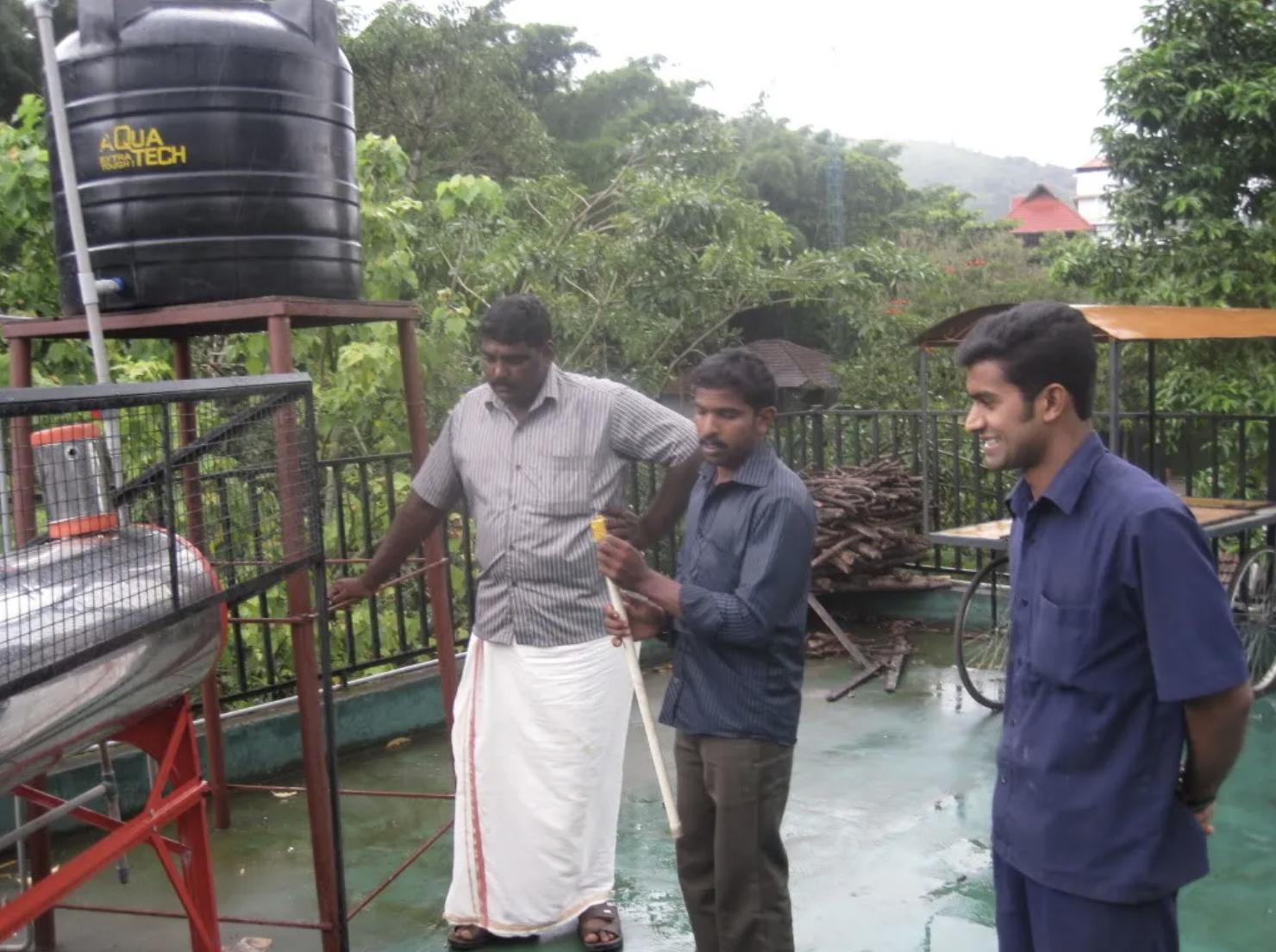
Our team of engineers including Suresh and Santosh listed the various outlets of energy in the resort to help the solar paneling engineers estimate the input that could be provided as a supportive energy source. This included the fans, plug outlets, and the CFL or compact fluorescent lamps that are a very low 6W (watts). The solar paneling engineers mentioned that the last project that they had worked on was quite a large one, which involved a 65kW power source that took approximately six months to complete. As a reference, the nearby 25 meter high power line, which is provided by the Kerala State Electricity Board (KSEB), is an 110kW power source. It has not yet been determined how the space can be utilized here and how much wattage it will be able to harness from the power of the sun because as I’m quickly learning, it is a long and complicated process.
La Cumplida’s Harvest Diversity
Part of the La Cumplida farm diversification involves growing crops apart from coffee. I’ve already mentioned the tree cultivation and bananas, and here I can go into more detail about the wood production and other harvests.
Ferns cover many of the hills in the upper ranges of the finca. Sheltered under black netting to block out the sun, these billions of fronds are handpicked and bundled in different sizes. The vast majority is sent to Netherlands, but other European countries and the United States receive the ornamental plants as well. Why is Netherlands the main customer? Because the country holds the largest flower market in the world at Aalsmeer, has long been the production hub for the European flower industry, and is a major international floral supplier. Many bouquets contain not only blossoms but ornamental leaves as well, and these ferns work well in many arrangements.
Wilfredo led us through the fern fields and told us a bit about its cultivation. One of the problems they have while growing the ferns is fungal disease, which turns them yellow and brown as they die; fungicide and physical culling are necessary to control the spread. About every two months they have new fully matured fronds that can be harvested, bundled up, washed, and bundled again under bags. Then they are boxed and sent under refrigeration to their destination (if I remember correctly, at 7 degrees Celsius). Below is a short and simple video that includes some of this explanation and process.
Patagonian Expeditions
I am joining Raxa Collective’s creative communications here at the request of La Paz Group, for which I have worked in the past—I have no doubt this will stretch me in new and interesting ways just as my last round of work with that team did. Having enjoyed the posts of the other contributors here, I should note that I am neither in Nicaragua, nor India; nor am I an intern. But my goals are aligned with the goals of this site in ways I will try to demonstrate here in my first post. First, I know some of the other bloggers—I was a neighbor to Amie Inman and Milo Inman for the first half of 2010, they in “casa roja” while I was a few steps away in “casa amarilla”. In fact, our homes were within 50 miles of the southern-most tip of land in the Americas. Second, Michael and I have something in common in that I graduated from Amherst College and I know very well what senior year is going to be like for him. More on that another time. The others I have gotten to know only through their writing, but I am glad to be part of a diverse team.
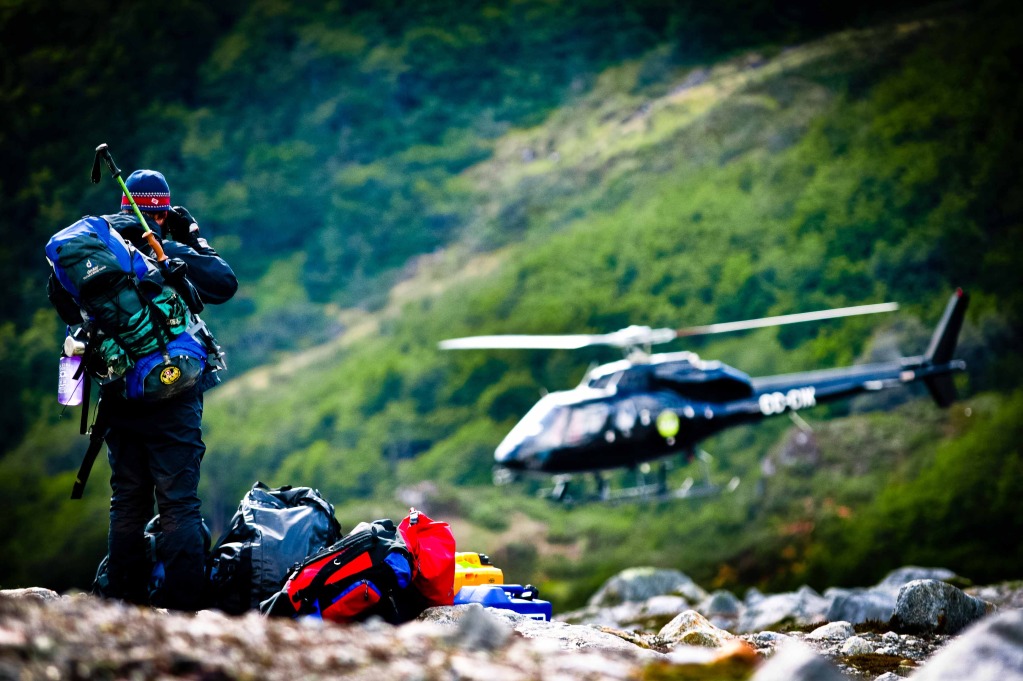
Back to my neighbors in South America now. I arrived in Punta Arenas, Chile, in October of 2009 dirty, teary-eyed from lack of sleep, and a bit frightened of my near incompetent Spanish. These insecurities, however, left me quickly as I realized that I had arrived in Southern Patagonia, ready for adventure as a liaison between LPG and the Wenger Patagonian Expedition Race, a race that is considered by adventure athletes as one of the last true adventure races left in the world. Continue reading
PaperTrail
Guest Author: Diwia Thomas
Two years ago, during the economic crisis that swept over world economies, I encountered many women, in my very own social circles, who found it difficult to keep the home fires burning. Their stories were all different- husband’s who lost their jobs, businesses that had to be shut down due to non-viability, sudden disease that struck the sole breadwinner of the family, etc. Whatever the story, the effect was the same. I felt a strong urge to help them out.
Collecting newspaper from my kith and kin, I taught these women the basics of making a newspaper bag, found customers to buy them and PaperTrail was blazing its own trail.
Why Am I here?
Before I start posting for this blog I thought a self-introduction would help. My name is Sung Ho Paik and some of you might know that a name divided into three parts like that indicates that I am an Asian. I am in fact a Korean. Until I went to the U.S.A. for my high school education, I lived in Korea with my family. I am currently a rising senior at Cornell University studying Hotel management–specifically a Managerial Leadership concentration and Real Estate minor.

You might wonder why someone like me would spend his precious summer time working in an internship (that is, not a regular paid summer job) in Kumily, India. The answer is simple. Because I CARE. Because my education has taught me that the world that I am living in is not just about me. The whole world is somehow all inter-connected. Yes I do believe in the butterfly effect. Not to the extreme but I believe that the amount of land–specifically natural forests–that we preserve reduces the relative amount of pollution in the world. Continue reading
Where Your Espresso Might Come From
Pierre and I went on a tour around La Cumplida’s coffee plantation with Wilfredo. La Cumplida is a huge finca of over 1,600 hectares (this includes 700 ha. for coffee and 600 ha. for protected reserve) situated in the region of Matagalpa, which is very well known for its coffee production. First we went to the processing plant, which is under repair because some of the machines were being too rough on the coffee beans. Despite the fact that none of the machines were currently working, he walked us through the bean process: loading, skinning, washing, and reloading the beans. The drying and roasting takes place at another location. If we had been here any time from October through February, the machines would have been whirring and red beans would come by the truckload to be processed, since over 2000 coffee pickers would be hard at work in the hills, collecting beans.
Below is a video of some of the coffee work we watched. Wilfredo’s explanation of the deshijo is translated in brief three paragraphs below.
Where They Simply Sell Wood
The Simplemente Madera store is full of furniture and wooden objects that are rarely purchased directly from the Managua venue, but more often selected as part of a furnishing package for a whole home. These furnishing contracts, which sometimes include interior design, are mostly for Nicaraguan houses and hotels, but also many projects in the US and Costa Rica, and normally last from one to six months, depending on the scale. Unless the project can fill one of their shipping containers, which are 20 ft2, Simplemente Madera doesn’t send furniture to the US. One of these containers can fit enough material to furnish a three-bedroom house, so the company is mostly concerned with high price-tag clients.
What a US homeowner will normally do is send SM a blueprint of their house and select from a line of products in the SM catalogue (Mombacho is currently the most popular, with natural deformations in the wood). Then the designers at SM will fit the furniture to the house and the style and send the homeowner some sketches. Some people want a more hands-on approach and pay to bring a designer to their house in the US. Simplemente Madera designers also often make custom designs for clients according to their requests.
Simplemente Madera’s Workshop
Here is the second installment of the Simplemente Madera factory tour. Below is a video of the production line in the workshop–watch for the Ocean Green surfboard at the end!
Up next is a written and photographic swing by the Simplemente Madera store in Managua.
Drying Wood at Simplemente Madera
Pierre and I left Morgan’s Rock on Friday to go visit the Simplemente Madera factory outside of Managua. It is a huge facility that receives wood almost entirely from fallen forests on the Atlantic coast of Nicaragua that were destroyed by Hurricane Felix in 2007. We took a tour with one of the quality inspectors, who showed us around the plant and explained every process the wood went through from log to rocking chair (most of these steps are for another post). The following video covers the initial drying the timber must go through to make it the highest quality wood available. The best part of this process is that it is completely sustainable — it only uses open air and scrap wood! Please give the video’s subtitles some time to load, unless you speak Spanish.
Here is an additional picture of the scrap wood and a view of the six closed drying ovens, which are often rented by other woodworking companies to dry their wood, since nobody else in Nicaragua has the drying capacity of Simplemente Madera.