Alternatives To Dairy

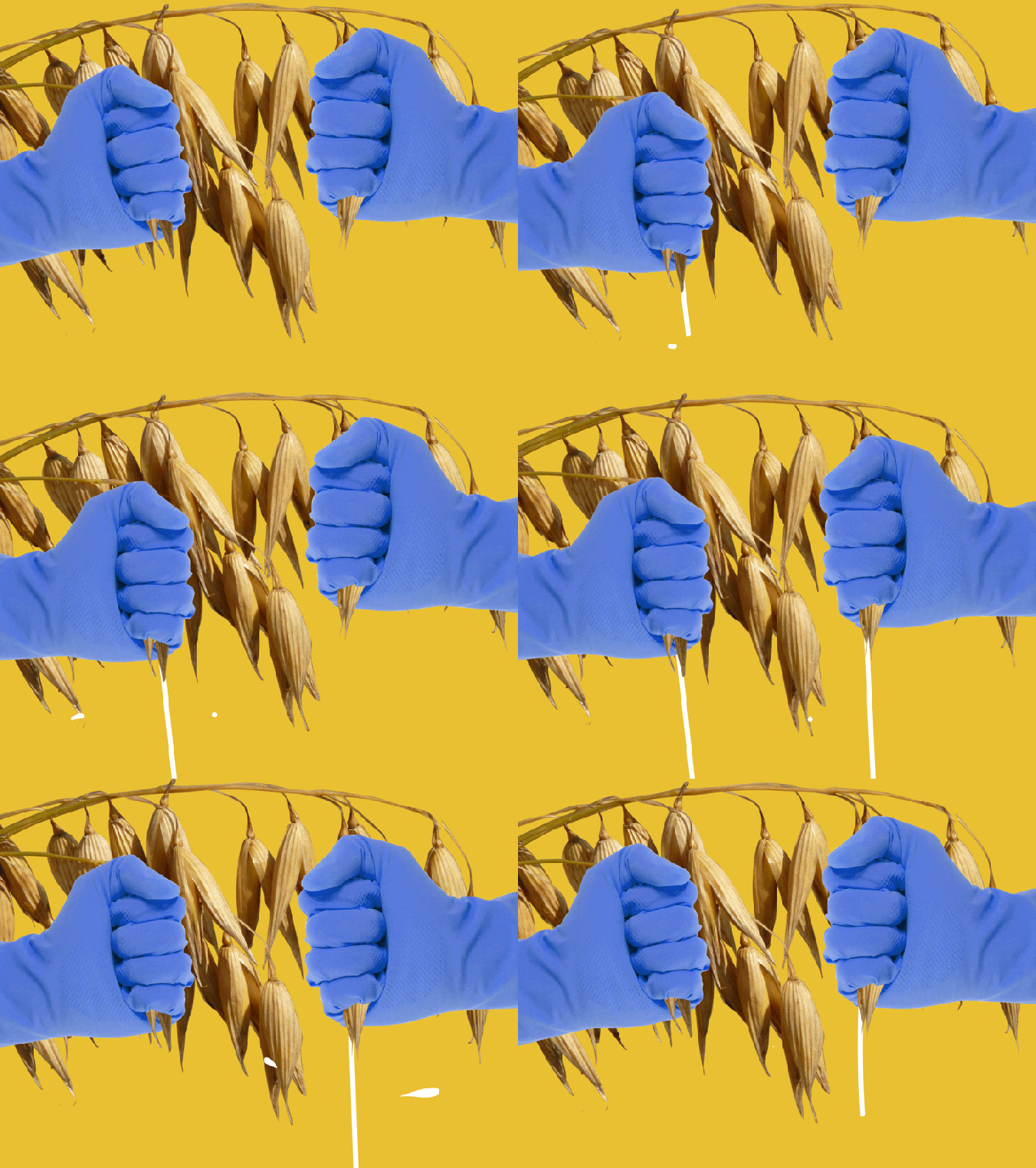
19OATLY-1-master768.gif

Photo illustration by Tracy Ma/The New York Times; Alamy (hands)
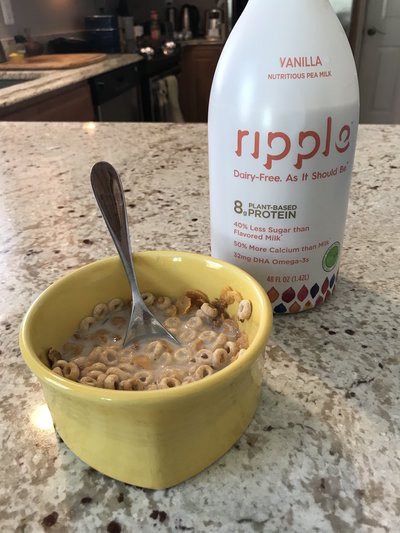
ripple-cereal_vert-25580ec96d4795beae7106681f5f2dc412d7886d-s400-c85

Ripple’s pea-based milk contains 8 grams of protein per cup, the same amount as in a cup of cow’s milk.
Whitney Pipkin/NPR

This article on the subject of a new pea-based dairy alternative–not just milk for coffee or cereal but also thicker items like Greek-style yoghurt–reported by National Public Radio (USA), reminded us of the great gif showing the milking of oats. Which reminded us to read that article too. Both worth a read:

When did finding something to put in your coffee get so complicated?

For the lactose-intolerant or merely dairy-averse, there are more alternatives to good ol’ American cow’s milk than ever. First there were powdered “creamers,” with their troublesome corn syrup solids. Then came soy, which may come closest to the real thing in nutrients and consistency. Grocery stores now stock an army of nut milks — almond, cashew, hazelnut, macadamia, you name it — which can be too grainy, too thin or frankly too flavorful. Pea milk? Sounds like a kindergarten taunt. Coconut and rice milk are basically water. Hemp milk? For the birds … and the hippies. Continue reading
Enlisting Enzymes for Ecoefficiency

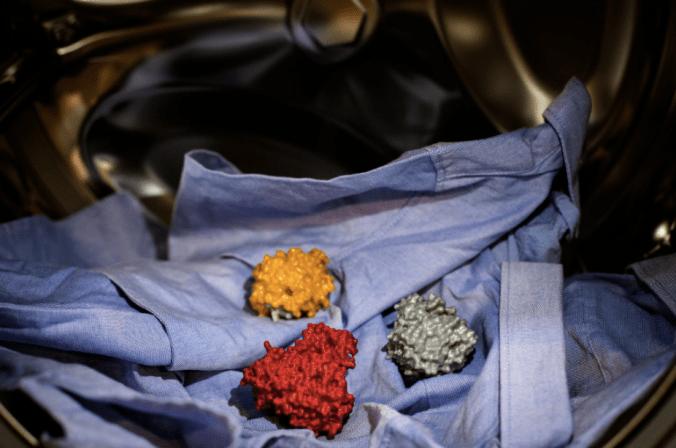
Models of stain-fighting enzymes, displayed on clothes in a washing machine. Credit Carsten Snejbjerg for The New York Times

We’ve been highlighting mycological innovation since the early days of this site, and our enthusiasm has yet to wane. The range of fungi-power will never cease to amaze.

Fighting Climate Change,
One Laundry Load at a Time

A Danish biotechnology company is trying to fight climate change — one laundry load at a time. Its secret weapon: mushrooms like those in a dormant forest outside Copenhagen.

In the quest for a more environmentally friendly detergent, two scientists at the company, Novozymes, regularly trudge through the mud, hunting for oyster mushrooms that protrude from a fallen beech or bracken fungi that feast on tough plant fibers. They are studying the enzymes in mushrooms that speed up chemical reactions or natural processes like decay.

“There is a lot going on here, if you know what to look for,” said Mikako Sasa, one of the Novozymes scientists.

Their work is helping the company develop enzymes for laundry and dishwasher detergents that would require less water, or that would work just as effectively at lower temperatures. The energy savings could be significant. Washing machines, for instance, account for over 6 percent of household electricity use in the European Union.

Enlisting enzymes to battle dirt is not a new strategy. Over thousands of years, mushrooms and their fungi cousins have evolved into masters at nourishing themselves on dying trees, fallen branches and other materials. They break down these difficult materials by secreting enzymes into their hosts. Even before anyone knew what enzymes were, they were used in brewing and cheese making, among other activities. Continue reading

Poo-Power Innovations

Guardian Graphic

Biomethane is an age-old concept in much of what is frequently called the “developing world”, so it’s difficult to overstate the irony of “1st world” adoption. That said, it’s heartening to read of more projects aimed at maximizing poo’s full potential.

From stools to fuels: the street lamp that runs on dog do

A long winding road climbs into a gathering dusk, coming to an abrupt dead end in front of a house. Here, a solitary flickering flame casts out a warm glow, illuminating the nearby ridge line of the Malvern Hills.

Below the light sits a mysterious green contraption resembling a cross between a giant washing machine and a weather station. This is the UK’s first dog poo-powered street lamp, and it is generating light in more ways than one.

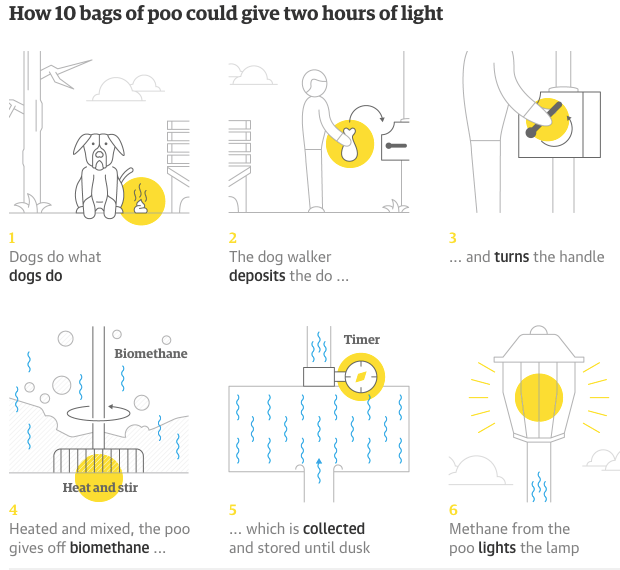
The idea seems simple enough: dog walkers deposit the product of a hearty walk into a hatch and turn a handle. The contents are then broken down by microorganisms in the anaerobic digester, producing methane to fuel the light, and fertiliser…

…Humans have used animal dung as fuel since the neolithic period, and have known how to get flammable gas from decaying organic matter since the 17th century. Small-scale anaerobic digesters are commonplace in many developing countries, while larger plants producing heat and electricity from animal manure and human sewage have long been used in the west.

Yet the energy in most excrement still goes to waste.  Continue reading

Carbon Engineering, Bill Gates, And Long-Shot Answers To Climate Change

171120_r30938

Carbon-dioxide removal could be a trillion-dollar enterprise, because it not only slows the rise in CO2 but reverses it. Photo-Illustration by Thomas Albdorf for The New Yorker

If you read the caption to the photo above, and then the first sentence of the story it headlines, you could come away with the thrilling sense that there is an entrepreneurial opportunity associated with climate change. There is something reassuring about the fact that Bill Gates has made some bets in this realm. Pasted below is also the last paragraph of the story. We recommend reading the whole long-form reporting that goes in between:

Can Carbon-Dioxide Removal Save the World?

CO2 could soon reach levels that, it’s widely agreed, will lead to catastrophe.

Suddenly, Lyft

Lyft1.jpgWhen I decided to delete that app it was without hesitation. I wanted to avoid sanctimony, but the point of making a show of my resolve was a simple message, i.e. that manners matter. Even though that app had been extremely useful to me over the past year, it was not so useful that I could ignore its founder’s behavior once I finally paid attention.

So now I am paying attention, and need a new app. And where better to start looking? I liked the message of that story, for reasons akin to my boyhood preference for Bjorn Borg over John McEnroe. I believe in disruption and I believe in winning, but if one is going to develop new rules of the game, then they should definitely be better rules that lead to better behavior. Continue reading

Blue Heart of the Planet

The United Nations Ocean Conference is underway to support the implementation of Sustainable Development Goal 14: Conserve and sustainably use the oceans, seas and marine resources for sustainable development.

The importance of collaboration between public and private sectors to brainstorm innovative solutions to environmental issues is becoming increasingly clear, as is the reality that states and local governments will be the stronger voices for climate activism.

The health of the planet and our oceans are interchangeable, and Sylvia Earle has been the spokesperson for that truth for decades.

Take the extra 18+ minutes to listen to her 2009 TED Prize Talk here.


Community, Collaboration & Conservation in Mozambique

Thanks to contributor Phil Karp for sharing this great example of how peer-peer knowledge exchange can help to replicate and scale up innovative solutions.

For communities, by communities

Experience from around the world shows that managing fisheries and marine resources works best when responsibility is placed in the hands of local communities. This is particularly true in low-income countries, where there is often limited capacity and infrastructure for fisheries management and conservation.

Locally Managed Marine Areas (LMMAs) are areas of ocean managed by coastal communities to help protect fisheries and safeguard marine biodiversity. Found throughout the world’s tropical and subtropical seas, and encompassing diverse approaches to management and governance, their sizes and contexts vary widely, but all share the common theme of placing local communities at the heart of management.

Continue reading

If You Happen to Be at the Smithsonian – But You Don’t Have to Be

Science, entrepreneurship, conservation and innovation converge at this amazing open source summit with events in multiple Smithsonian locations ranging from New York City, Washington DC and Panama City.

Frequent contributor to this site Phil Karp, will participate in a forum on Restoring Nature. The synergy of forum subjects with our interest in wild foods and our work in conservation focused hospitality makes us wish we were there.

What’s Working in Conservation

Earth Optimism celebrates a change in focus from problem to solution in the area of global conservation with an unprecedented gathering of thought leaders, scientists, environmentalists, artists, civic leaders and international media.

The global conservation movement has reached a turning point. Continue reading

Kerala’s Stars Redux

We published this post in the early period of this site, but the beauty of the subject and the timeliness of the season begs its redux…

The colorful stars that begin to grace Kerala buildings in December from homes, to businesses, to places of worship have humble beginnings despite their current flashy status.  The were originally a simple white 7 point star that correlated with the beacon leading to the Christmas manger.

Many of these folded and cut paper stars are the handiwork of a group of women in a fishing villages around the southern Kerala city of Kollam. Continue reading

Solar’s Silicon Future

p04bw5z3

Thanks to the BBC for this story:

Why Apple And Google Are Moving Into Solar Energy

Silicon Valley’s biggest companies are investing in renewable energy in a serious way – a sign, perhaps, of rapid changes in the energy market.

By Chris Baraniuk 14 October 2016

Most people think of Apple as a company that makes phones, computers and smart watches – not an energy provider. But in August all of that changed when the firm was given permission to sell energy from a Californian solar farm that it acquired last year. Continue reading

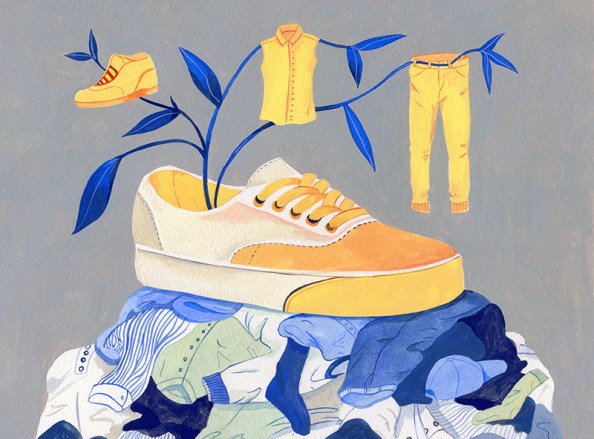
Upcoming Circular Model in Clothing Industry

1_web_72dpi_landscape_800

All photos from Yale E360

Clothing is a daily necessity (a vanguard nudist might disagree with that statement). Every day after getting out of bed we change into a a set of clothes before stepping out of our homes because it is a daily habit that we have adopted even before we had the ability of dressing ourselves when we were babies. This practice we have developed, when you add up clothing that gets worn out and must be replaced, is very costly to the environment considering people in the U.S. dispose of about 12.8 million tons of textiles annually, which amounts to about 80 pounds per person.

Growing cotton, the most-used fabric in fashion, requires water and agricultural chemicals. (Organic cotton is an exception.) While cotton is grown on just 2.4 percent of the world’s cropland, it accounts for 24 percent and 11 percent of global sales of insecticides and pesticides, respectively, according to the World Wildlife Fund. The Sustainable Apparel Coalition — an alliance of retailers, brands, and nonprofits — has been working for about five years to measure and reduce the industry’s environmental footprint.

Recycling has become a rallying cry in the apparel industry, with H&M as its most vocal evangelist. The Swedish firm launched a 1-million euro contest to seek out ideas for turning old clothes into new, invested in Worn Again, a company that is developing textile recycling technology, and enlisted hip-hop artist M.I.A. to produce a music video called Rewear It that aims to “highlight the importance of garment collecting and recycling.” With Nike, H&M is a global partner of the Ellen MacArthur Foundation, whose mission is to drive a transition to a circular economy — that is, an industrial system in which everything at the end of its life is made into something new, in contrast to today’s economy, where most consumer goods are produced, used, and then thrown away.

Continue reading

Connecting the Dots

In our business we often use words like synchronicity and synergy to illustrate the amazing frequency of “right time-right place” meetings and connections. In the summer of 2011 one of the original interns (and creators of this site) came to work with us in Kerala. In search of a project, we introduced him to Diwia Thomas to brainstorm a social entrepreneurship collaboration. That process led to an amazing joint venture paperbag making workshop with the Kerala Forestry Department.

The very first post I wrote on this site was about Diwia Thomas and her company Papertrails. It just so happens it was published exactly 5 years ago. It also just so happened that this morning my Facebook feed included the news that Diwia had been honored with the Unique Times’ Young Women Business Excellence Award 2016. Continue reading

Agripreneurship

A wonderful aspect of both young people and entrepreneurs is their ability to find creative solutions to apparently insoluble problems. The two overlap beautifully within the Global Forum on Agricultural Research (GFAR) and the Youth Agripreneurs Project (YAP), where the goal is to pilot innovation to help rural communities world wide.

Kulisha, which is the verb ‘to feed’ in Swahili, the national language of Kenya, is a proposed project that addresses both the problem of creating a sustainable food source in Kenya and the extractive fishing methods of coastal trawlers. Aquaculture is an important food industry in East Africa, but the method of using fish meal from wild caught anchovies is destructive on all levels. Kulisha’s goal is to produce sustainable fish feed in Kenya made from black soldier fly larva.

Our idea, Kulisha, will provide a low-cost, high-quality sustainable fish feed made from black soldier fly larvae. We will sell dried insects to these rural fish farmers to replace the anchovies they are using to mix their own. In addition, we’ll produce a nutrient-rich fertilizer as a by-product from raising the insects which will be sold at a low cost to local crop farmers. It is our long term goal to formulate and sell our own feed. Continue reading

Building an Empire, A Fish at a Time

When Mama Sylvia started fishing 27 years ago, all she had was a small canoe, which she paddled with an oar. PHOTO: BBC

When Mama Sylvia started fishing 27 years ago, all she had was a small canoe, which she paddled with an oar. PHOTO: BBC

We talk about sustainable development. Often, the definition is relegated to the environment domain alone and does not cover social and human capital. The United Nations has identified gender equality as one of the key Millennium Development Goals, validating the fact that every small victory is a step forward for the larger good. Like Mama Sylvia’s story.

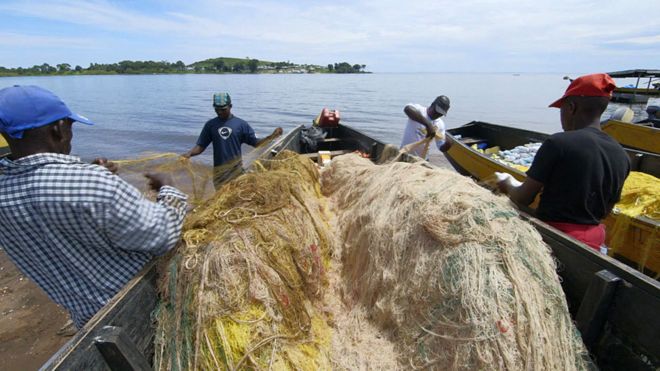
Gertrude Nabukeera, or Mama Sylvia as she is usually known, stands with her arms resting on her hips as she supervises a handful of men unloading the catch from a fishing boat. It’s early in the morning and the boats are bringing their night’s catch in at the Nakatiba landing site, on the island of Bugala in Lake Victoria, Africa’s largest expanse of fresh water. More than 400m long and lined with motor-driven boats, this landing site is owned and run by Mama Sylvia.There are concrete stalls from which she sells the catch of the day, and to the right an icebox the size of a freight container in which she stores the fish.

It’s unusual for a woman to be the boss of a fishing business in Uganda, or anywhere else for that matter, but even more surprising is the fact that she herself was once a fisherwoman – one fisherwoman among many, many fishermen.

Continue reading

Waste Less, Want Less, Lean In, Pop Up

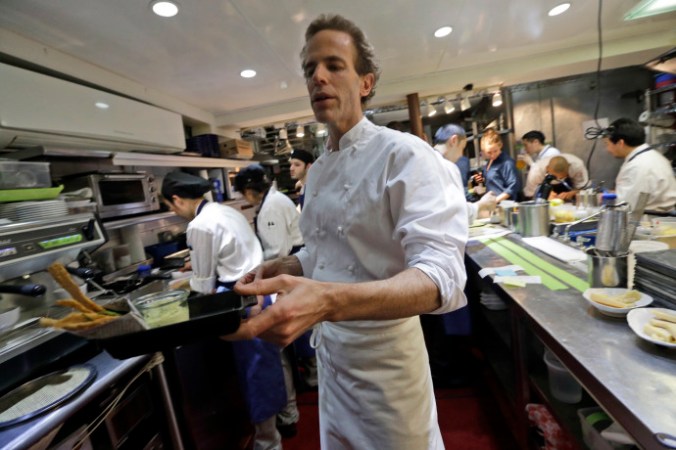
In this Thursday, March 19, 2015 photo, chef Dan Barber hands a waiter an order of fried skate wing cartilage with smoked whitefish head tartar sauce at WastED in New York. Dishes using scraps and other ignored bits comprise the menu at chef Dan Barber's WastED, a pop-up project at one of his Blue Hill restaurants intended to shed light on the waste of food. (AP Photo/Mary Altaffer)

In this Thursday, March 19, 2015 photo, chef Dan Barber hands a waiter an order of fried skate wing cartilage with smoked whitefish head tartar sauce at WastED in New York. Dishes using scraps and other ignored bits comprise the menu at chef Dan Barber’s WastED, a pop-up project at one of his Blue Hill restaurants intended to shed light on the waste of food. (AP Photo/Mary Altaffer)

Thanks to Hannah Goldfield for this post:

The other night, as I ate a salad at Blue Hill, in the West Village, a server approached my table with an iPad. “Have you seen this?” she asked. “Chef wanted you to see this.” By “Chef,” she meant Dan Barber, the man behind Blue Hill and Blue Hill Stone Barns, a sister restaurant and farm upstate. By “this,” she meant a photograph of a dumpster, into which a chute was depositing an enormous quantity of multi-colored scraps of fruit and vegetables—the runoff from a commercial food processor. The experience felt something similar to being shown a picture of what would happen to a sad-eyed old horse if you didn’t save it from the glue factory. Sitting in a small, enamel casserole dish in front of me were fruit and vegetable scraps that Barber had rescued, just like the ones in the photo. Arranged in an artful tangle, bits of carrot, apple, and pear were dressed with a creamy green emulsion, studded with pistachios, and garnished with a foamy pouf that turned out to be the liquid from canned chickpeas, whipped into haute cuisine. Continue reading

Big Goals About Basic Things

In response to this successful project, the Gates Foundation recently approved a two-year grant to Kohler to design and fabricate five closed-loop flush toilet systems for field testing in developing world locations that do not have adequate sanitation. Kohler

Some of the things many of us take for granted in the “developed” world – access to toilets and clean drinking water among them, are daily challenges for many living in the “developing” world. India’s new prime minister set a challenge for a Clean India by 2019, which will include 100 million toilets across the country. The goals coincide well with the Bill and Melinda Gates Foundation’s Reinvent the Toilet Challenge, and Kohler’s production of a closed loop toilet system design created by Caltech University that is already coming on line in test areas in India. Continue reading

Water, Blobs, And The Future Of Thirst-Quenching On The Go

Skipping Rocks Lab

Skipping Rocks Lab

Thanks to one of the many sister websites of the Atlantic, this story about the future of packaged water:

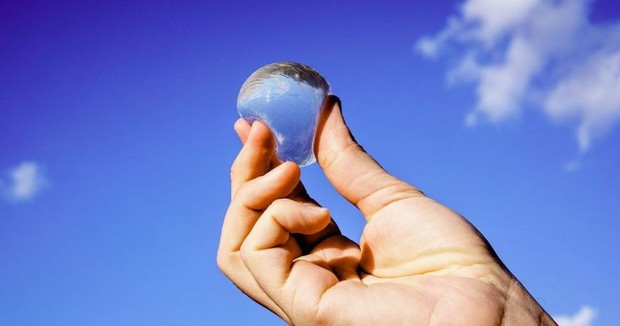
In the future, rehydrating on the go might not mean chugging from a bottle, but inhaling a gelatinous, edible blob that looks like water floating on the space station. Continue reading

Menacing Weed or Wonder Plant?

©Peter Chadwick/DK Images

©Peter Chadwick/DK Images

We’ve written about the invasive species water hyacinth on these pages before, discussing its environmental impact as well as its material value for eco-development projects. But we haven’t seen stories such as this one from Conservation Magazine where there’s a positive side to what many people call the “weed from hell.”

The scene at Florida’s Crystal River National Wildlife Refuge in Kings Bay last October would have been familiar to anyone who has ever engaged in the battle to control the spread of invasive plants. Eager volunteers scurried about the shoreline of this manatee wintering ground, carting large plastic bins stuffed with water hyacinth, a notorious aquatic weed that’s caused headaches on five continents. Closer inspection, however, would have revealed the activity to be anything but business as usual: instead of hauling water hyacinth out of the bay, the conservationists were putting it back in—almost 4,300 gallons’ worth by day’s end.

Those volunteers were taking part in a bold pilot project that is the latest chapter in a half-century-long ecological story that reads like a fable. It starts with a well-intentioned campaign to rid Kings Bay of the water hyacinth, an aggressive nonnative species. Next come decades of additional control measures and a tragic downward spiral that transformed these crystal-clear waters into an unpleasant soup of slimy green algae. Then the story takes an unexpected turn, back to its original antagonist. Only this time, Bob Knight, the wetlands restoration ecologist leading this pioneering project, has recast water hyacinth as the unlikely hero. He believes this South American native, if controlled, could help solve the algae problem and return the bay’s ecosystem to a more desirable state. The irony in this approach is not lost on anyone involved. Continue reading

Lovely Things Pedaled To A Place Near You

trailhead650

Several contributors to this site descend from a man from the mountains north of Sparta, who sailed from Greece to New York City more than a century ago, and had a pushcart that earned him enough money to return to his village and become a prosperous olive farmer.

Good things come in, and from, pushcarts. We like the bike design as much as anything else in the photo above, and speaking of aesthetics the last photo below will help understand why we absolutely had to post this. As for pedal-powered treats on wheels, we will do something to extend the reach of 51 in Fort Kochi, so stay tuned… Thanks to Ecowatch.com for this:

Riding your bike to work is gaining momentum as more cities adopt or expand bike-sharing programs, but what about ordering your morning latte or lunch from a bike? With more and more food bikes popping up in cities across the country, finding more meals on wheels (without the truck) might soon be an option. Continue reading

Authenticity And Its Discontents

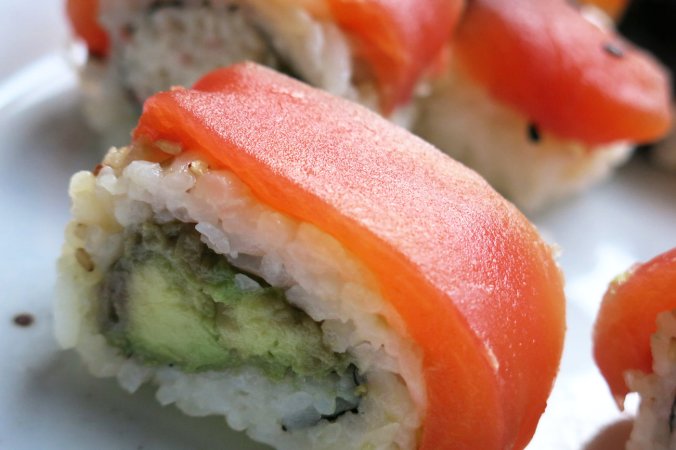
Chef James Corwell's nigiri sushi rolls made with Tomato Sushi, a plant-based tuna alternative, in San Francisco. Alastair Bland for NPR

Chef James Corwell’s nigiri sushi rolls made with Tomato Sushi, a plant-based tuna alternative, in San Francisco.
Alastair Bland for NPR

I am realizing more each day how complex the notion of authenticity is. It is often, I see with increasing frequency, a cliche thrown casually into descriptions and promotions of this or that. Are there times when something other than authenticity is appropriate, even for an organization such as ours that promotes offering travelers authentic experiences of various cultures around the world, including local cuisine?

This story has me thinking (thanks to National Public Radio, USA and its program called “the salt”) that if foodies can make the leap from literal authenticity to a more complex notion of authenticity, for the sake of the environment as well as for broadened pleasures of the palate, it may serve as a model for how to approach seemingly intractable challenges facing the planet (in the case of this story, fisheries collapse but also the broader challenges of collapse), including the ever-changing cultures that make our planet worth traveling:

It’s a dead ringer for Ahi tuna sashimi. It cuts into glistening slivers that are firm and juicy. And it’s got a savory bite.

But this flesh-like food is not fish. It’s made of tomato, and it’s what San Francisco chef James Corwell hopes could be one small step toward saving imperiled species of fish, like bluefin tuna.

“What I want is to create a great sushi experience without the tuna,” Corwell tells The Salt.

To make this Tomato Sushi, he skins and removes the seeds from fresh Roma tomatoes. Then he vacuum seals them in sturdy plastic bags and cooks them in hot water for about an hour — a technique called sous-vide. Continue reading