Cockpit Country Circumnavigated

a view from the fringe of Cockpit Country out over the plains by Seth

After a week and a half of trekking and camping out of our crappy little rental car with about four inches of clearance, John, Justin and I have completed our preliminary clockwise perimeter of Cockpit Country.

the locals in Accompong show us the start of a trail

a strangler fig lifts a karst boulder off the ground

Parking at the head of every trail into the interior that we found on our 1959 map of the area–some of which are incredibly listed as secondary highways on our 2012 road map of the country–we’ve set up a routine of hiking down trails and back all day, camping for the night, and driving out the next morning.

Continue reading

Aerial Insectivores

Cockpit Country

Cockpit Country

As we head west along the southern portion of Cockpit Country from Barbecue Bottom Road and Albert Town, we’re noticing a big difference in the amount of aerial insectivores we’re able to see while out hiking every day.

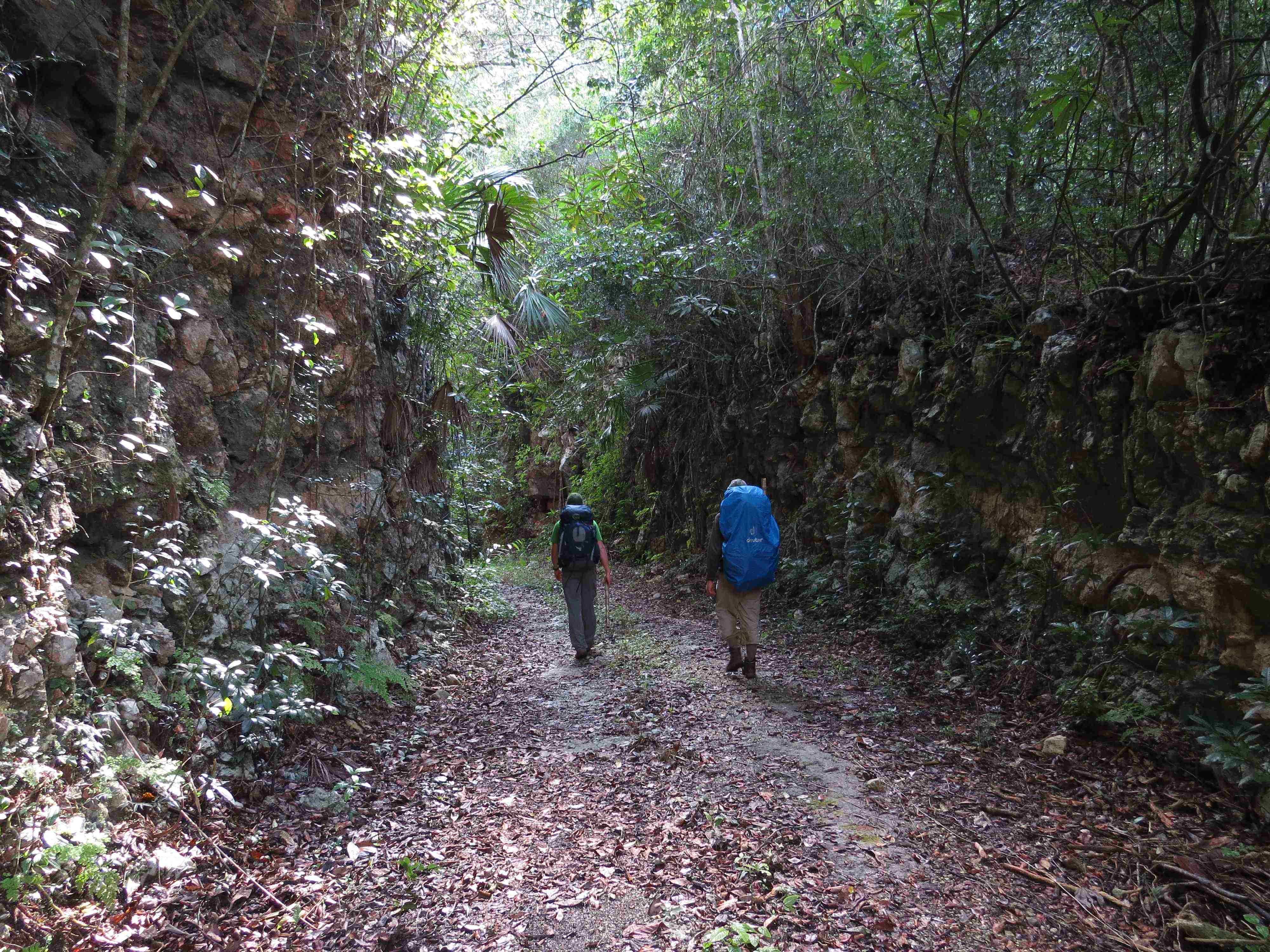
Justin and John on the trail from Windsor to Troy

During our initial excursions into the bush, we were taking densely wooded trails that required constant vigilance of the path in front of us due to shifting stones, twisting roots, and strong ground vines. In some of the worse areas we needed machetes to clear vegetation and big fallen trees, and even when we had time to look up at the skies they were often covered by thick canopy.

Continue reading

Jamaican Hummingbirds

Red-billed Streamertail (male) by Seth

During the first week of our time in Jamaica, all of us were able to see the three species of Jamaican hummingbirds, although none of us had gotten a really good look at the prize: a male Red-billed Streamertail. Male Red-billed Streamertails are iridescent green with a black cap and two extremely long tail feathers that flutter behind the birds when they flit around. The birds move quite quickly and are often in and out of your field of view in a flash, but their call is relatively loud–as is the hum from their wings–so with practice you can locate them eventually.

Jamaican Mango by Seth

Jamaican Mangos are the largest hummingbird in the country and very recognizable given their flashy purple plumage and strongly decurved bills. From what I’ve noticed they perch for fairly long periods scanning their territory for intruders (most hummingbirds do something like this all the time), and this offers good photo opportunities. Continue reading

Northern Cockpit Country Complete

One of our camps

Justin, John and I have been in Jamaica almost two weeks, and the “Sharpied” names on our Rite in the Rain notebook covers have already faded off, our shirts smell soberingly of rotting onion, and our feet are eager to be released from their boots at any opportunity. At one point John had over a hundred tick nymphs on his body––the actual count was 163––but we won’t talk any more about that.

Barn Owl startled out of an abandoned house

We’ve seen over sixty species of bird in our twelve days here, and only one of them has been a swallow: the Cave Swallow. In general, aerial insectivores like swifts and swallows have been quite scarce, which is really surprising since we’re going through huge swaths of great habitat.

Barbecue Bottom Road with John and Justin by Seth

Barbecue Bottom Road with John and Justin

Continue reading

Expedition Update

Expedition Group – From L to R: Seth, Justin, Bobo, no name donkey, John. Photo credit: Dango, a friendly local

We’re back from a three day and two night excursion into Cockpit Country along the Troy-Windsor trail. We went out with Bobo and his donkey with no name, and made it what we think added up to about twelve miles down the old, overgrown trail. Several times we had to chop through fallen trees that the donkey couldn’t go around or over, and this took up quite a bit of our time.

Photo of rotten tree we cleared by John

Eventually we hit a patch that would have taken a full day to clear so we left the donkey behind with the idea of setting out for a few hours and then coming back. Continue reading

First Days in Jamaica with Smithsonian Expedition

This slideshow requires JavaScript.

John, Justin and I have been at the Windsor Research Center for a day and getting ready for our first five or six day trip through Cockpit Country. Every single Jamaican we’ve met so far has been super friendly and helpful. We won’t be able to update as much as we’d like but hopefully every week we can send out one quick post. If you don’t hear from us though, it’s likely just because there’s some wind hitting the leaves that are reflecting the signal that the antenna here picks up and plugs into the desktop they use at Windsor. Continue reading

Expeditions In The Interest Of Science, Nature And Conservation

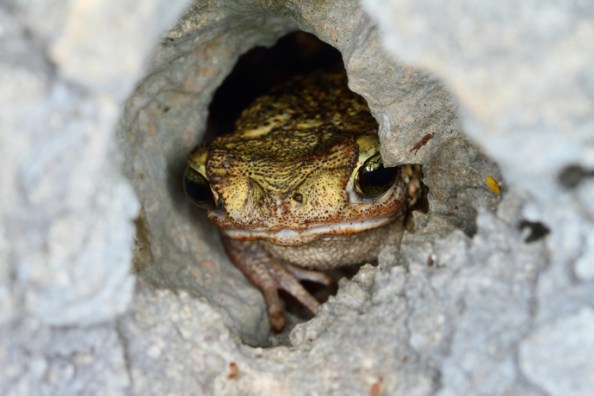
A male toad of an undescribed species hides in the limestone of the southwestern Dominican Republic. CREDIT PHOTOGRAPH COURTESY MIGUEL A. LANDESTOY

A male toad of an undescribed species hides in the limestone of the southwestern Dominican Republic. CREDIT PHOTOGRAPH COURTESY MIGUEL A. LANDESTOY

There is a reason why we highlight birds every single day. They are spectacular in many diverse ways, as well as beautiful in more ways than can be counted, and sometimes smile-inducingly odd; always exceptional ambassadors to the human world from their natural habitats, which are under constant pressure and threat. Birds may seem more charismatic than amphibians but from an ecologist’s point of view they are both extremely valuable indicators of ecosystem health. If you have been following Seth’s posts about the preparation for the Smithsonian expedition he is about to embark on, you will likely agree they would enjoy crossing paths with the team described in this story:

The southernmost corner of the Dominican Republic is dominated by limestone karst, a landscape with the look and feel of a petrified giant sponge. Snakes, small mammals, and fat, furry tarantulas live in the fissures and holes in the karst, as do toads, including one species that is not yet fully known to science. I met this new toad at three o’clock one late-fall morning, in a karst forest off a mining road near the town of Pedernales. I was with Miguel Landestoy and Robert Ortiz, a pair of freelance field biologists who have been friends since their youth, and who still spend much of their time looking for amphibians. Continue reading

Stories from the Field: The Western Ghats In Search of the Bright-headed Cisticola


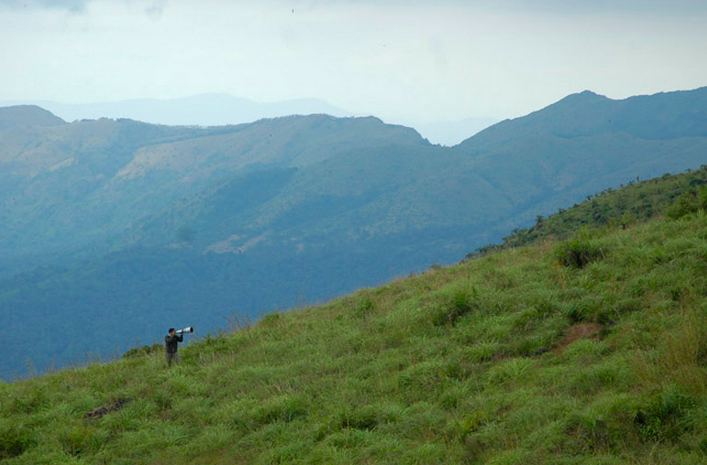
Habitat of the Bright Headed Cistola. That’s me trying to capture one! photo credit: Yathin

I always wanted to visit the Western Ghats and was looking for an opportunity to do so. The weather was a bit cloudy and was drizzling, so we were a bit worried about the weather in Kemmangundi, a hill station in the Chikkamagaluru district in the state of Karnataka. But what the heck, rain or shine, we decided to go ahead with the trip.

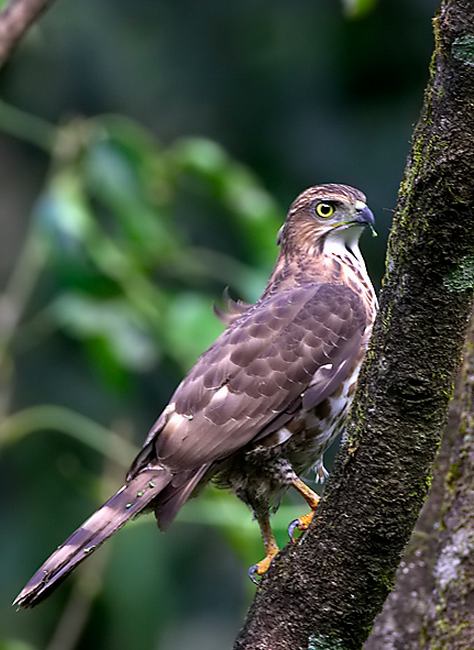
Crested Goshawk

The next morning we were all set to go and capture the brilliant Bright-headed Cisticola. After all, that was the reason for the trip. We decided to visit the same place where Yathin had shot it previously. We took it easy and shot at what ever moved in the sholas. I was a lucky to get an accipiter which we thought was the Besra. But it was later confirmed as Crested Goshawk. Continue reading

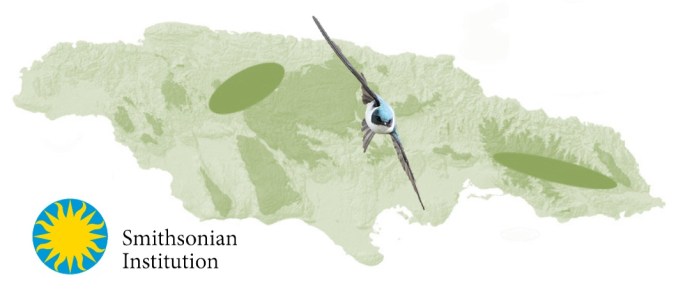
Golden Swallows, Jamaica Expedition

Article BannerIt was in 1844 that English naturalist Philip Henry Gosse arrived in Jamaica for his first time. Gosse would ultimately spend 18 months on the island, where he became fascinated in studying the local birdlife he found there. After returning back to London, he went on to publish a book entitled, “The Birds of Jamaica,” in which can be found the first formal descriptions of many birds still cruising about the Caribbean landscape today. The encounters he had with one bird in particular inspired Gosse to write the following:

This exceedingly lovely little Swallow, whose plumage reflects the radiance of the Hummingbirds, is found, as I am informed by Mr. Hill, in the higher mountains formed by the limestone range of the very centre of the island, as in Manchester, and St. Ann’s. It is not until we ascend this central chain, that we meet with this sweet bird, occasionally in the more open dells, but principally confined to the singular little glens called cockpits.

In this passage Gosse speaks of the Golden Swallow, a small passerine that has only been historically known from two islands, Hispaniola and Jamaica.  And while populations of this species continue to persist in several mountain ranges of Haiti and the Dominican Republic, the beautiful bird that Gosse describes in his Jamaican travels has not been seen on that island for more than 25 years.

Continue reading

If You Happen To Be In Denmark

We have been paying a lot of attention to Iceland in the last year, and we do not expect that to change very soon. At least not until May of this year.  But we will always consider the two poles of the planet worthy of our time and investigation. There is an excellent exhibition website separate from the museum’s website pages about this exhibit whose last month has just begun:

ARCTIC

September 26 2013 –  February 2 2014

Louisiana’s major, multi-faceted autumn exhibition explores a wonderful, fragile, frightening and powerful world. ARCTIC is a story about dreams, destiny, adventure and beauty. It is a tale of fear, fascination, desire, downfall, and survival in spite of everything. A quest for a location, real and imagined, that through the centuries has stirred up strong drives and emotions, fascinating and attracting artists, scientists, writers and adventurers alike.  Continue reading

Borneo, Birds And The Field Method Of Learning Science

This slideshow requires JavaScript.

More than one contributor to this site has been a fan of the Cornell Laboratory of Ornithology for several decades. During graduate school, for example, when Sapsucker Woods provided more than just a walk in the woods.  The Lab’s fan base is global, for good reason, both among casual bird lovers and more serious bird watchers. The Lab became the focus of professional interest to several of us when we began managing lodges in the rain forests of Central America, and we discovered what we had not known while at Cornell: it has the largest collection of field recordings of bird songs in the world.  Guests at our lodges were awed by this resource when it was pointed out to them. The images above reflect more recent appreciation we have for the Lab. Continue reading

Wildlife Sanctuaries of India–Bandhavgarh National Park

Sita, National Geographic

Sita, National Geographic

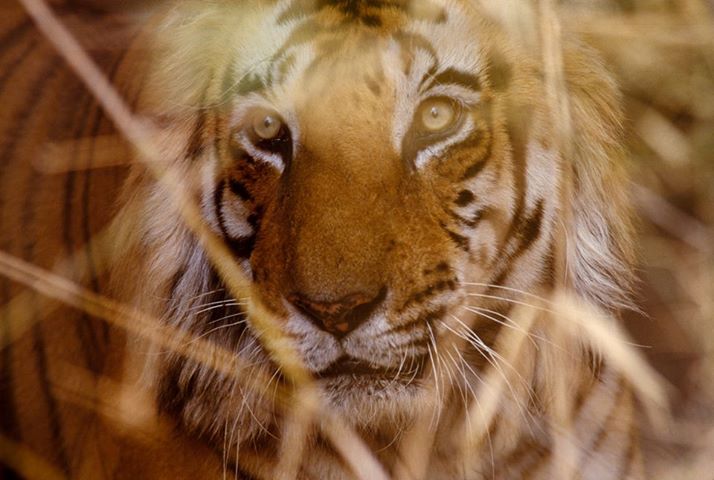
If you are really, really desperate to see tigers in their natural habitat, maybe you should try visiting Bandhavgarh National Park in the Umaria district of Madhya Pradesh since it has the highest concentration of tigers among all the national parks in India! With an area of 105 sq km open to tourists and a buffer zone of 427 sq km, Bandhavgarh National Park is home to almost 50 Bengal tigers.

A female tiger named Sita, who also appeared on the cover of National Geographic and is the most photographed tiger in the world, also lived in Banhavgarh. In fact, most tigers in the reserve today are thought to be descendants of her and a male tiger named Charger. Continue reading

A Thesis Hypothesis

Shutterstock

This week, the time has come for me to officially lay out some of the terms of my honors history thesis that I have been writing about for a few months now. Although this “hypothesis,” or explanation of what I expect to argue, won’t set my focused topic in stone, it will certainly be instrumental in guiding me at least in a broad sense as I move forward with writing this semester, and it will also help show my advisors what path I plan to take. Without further ado, here is my thesis hypothesis in a 400-word nutshell. Continue reading

Journey to the Center of the Earth, Via Iceland

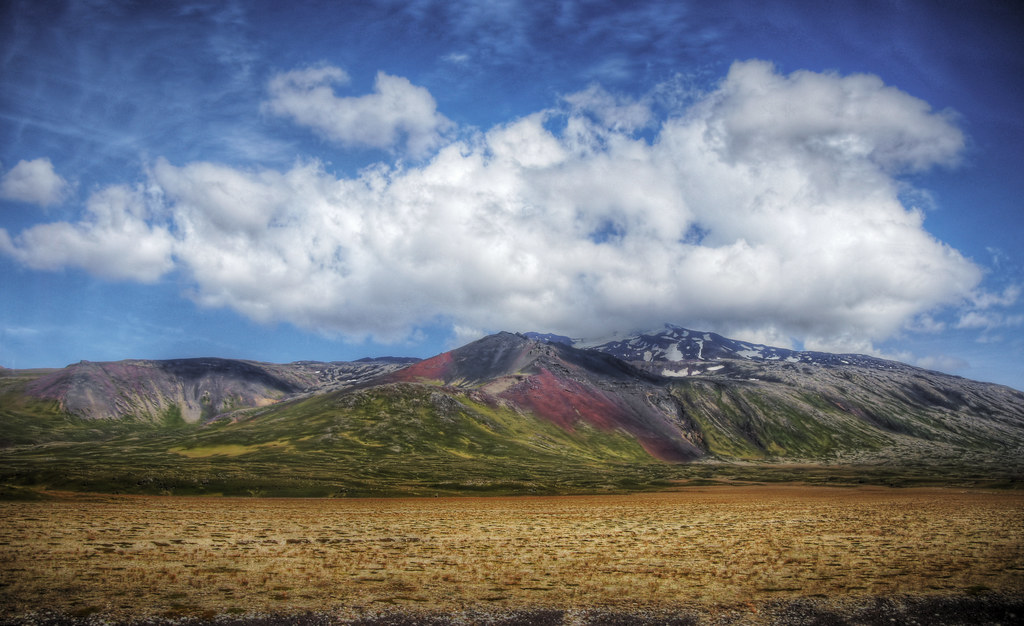
Snæfellsjökull, Iceland. Photo © Mariusz Kluzniak

When I explain my honors thesis subject to those who ask about it, not a few of them ask if I plan on looking at Jules Verne’s classic science fiction novel, since the volcanic entrance to the cavernous depths of the world in his story is ‘Snäfell,’ in western Iceland. For some , Journey to the Center of the Earth might be their only popular source of information on the country, since it is perceived as so remote, and, in many American minds at least, the Nordic countries can all get mixed up in a Scandinavian mélange of fjörds and vikings and skyr.

Snæfellsjökull, Iceland. Photo © Manny on BiteMyTrip.com

To Verne’s credit, therefore, he has put Iceland on the map for many people over the past century and a half (his book was first published in France in 1864, and was translated by 1871). To his discredit, however, he never visited Iceland himself, and instead relied primarily on two French works on Iceland written about scientific expeditions made there in the late 1830s. Continue reading

Europeans And Indians, The Early Days

Screen Shot 2013-07-21 at 12.19.40 PM

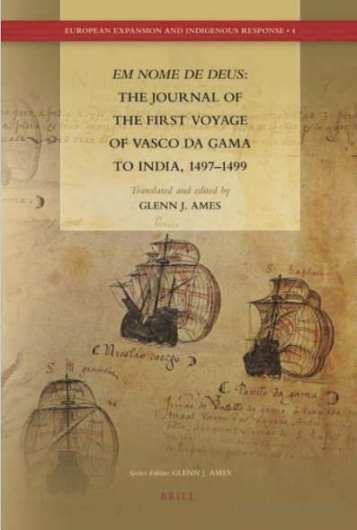
In several past posts about historically interesting interactions between Europeans and Indians, the New World variation on that story was invoked to make a point, mainly with an eye toward environmental history. Today’s Hindu has an article that draws on the history contained in the journal to the left about (Old World) Vasco de Gama’s first experience in (Older World) India, specifically the Malabar Coast and what is now the state of Kerala. Click the image to go to the source of the book, and here to go to the Hindu article:

The hero of the first Portugese contact on Indian shores is a degradado, or Portugese convict and exile, not Vasco da Gama.

One of the greatest navigators from the Age of Discoveries, da Gama, appointed by Dom Manuel, King of Portugal, for his “energy and high spirits” refused to take the initiative to go ashore on the morning of May 21, 1498. Instead, da Gama chose to wait in the depths of his ship, Sao Gabriel, while the convict Joao Nunes stepped out into the monsoon showers off the western coast of Kozhikode to meet, much to his amazement, a pair of multi-lingual Tunisian merchants. Continue reading

National Geographic Over the Years

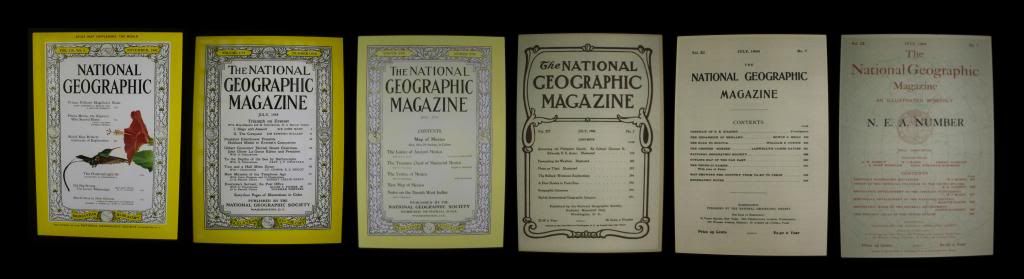
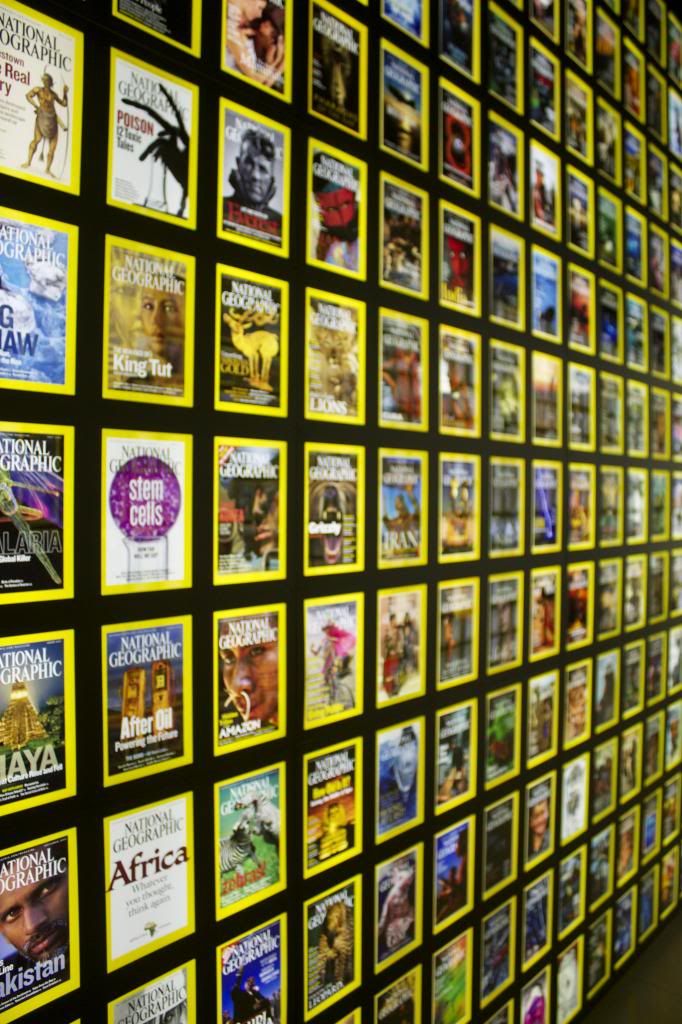
NatGeo’s magazine covers over the years, stitched together from individual photos I took at the National Geographic Museum in Washington, D.C.

As National Geographic celebrates its 125th year of journalism, it is interesting to see how small things, like the magazine covers and the information they conveyed, have changed. In the photo above, the November, 1960 issue (far left) was priced at $1.00; the July, 1954 issue (second from left) at 65¢; and from then backwards each magazine was a whopping 25¢. Today’s magazines don’t disclose their individual price, but a yearly subscription at $15 is not too shabby considering it was $8/yr in 1960, up from $6.50 in 1954.

The July, 1954 issue’s first featured article is titled, “Triumph on Everest,” and the last, “Everyone’s Servant, the Post Office”; July, 1898 (far right in the photo above), on the other hand, saw “American Geographic Education” and “The Geologic Atlas of the United States” as the first and last articles.

Continue reading

The Upsides Of Downside Exploration

The Shinkai6500 deep-sea submersible

The Shinkai6500 deep-sea submersible. Photograph: Jon Copley

Told in the first person, we appreciate Jon Copley’s account of his most recent amazing work, and the Guardian’s coverage of it:

Five kilometres, or 3.1 miles, is not a great distance on land – the length of a pleasant stroll. But five kilometres vertically in the ocean separates different worlds. On 21 June I had the opportunity to make that short journey to another world, by joining Japanese colleagues for the first manned mission to the deepest known hydrothermal vents, five thousand metres down on the ocean floor. Continue reading

Mapping Iceland

In my last post on the subject I mentioned that portions of Iceland on contemporary maps all the way up to the early 20th century remained blank. The main culprit for explorers, travelers, and cartographers was the great glacial region of Vatnajökull, at 3,139 sq. mi (8,130 sq. km) the largest glacier in Europe, and now a national park in southeast Iceland. Terrible snowstorms, heavy rains, unreliable ice, and poor local knowledge of the frigid plateau contributed to the failure of multiple expeditions by many men into the interior of the “Glacier of Rivers,” and during the late 1800s it became clear that there was frequent volcanic activity in the area as well.

1906 geological map by Icelandic geographer/geologist Þorvaldur Thoroddsen, who is credited with being the first to map the interior of the Icelandic Highlands in 1901, which is when this map was first published. The different colors represent different compositions of the island, such as basalt, liparite, volcanic ash, etc.

Continue reading

Exploring Iceland

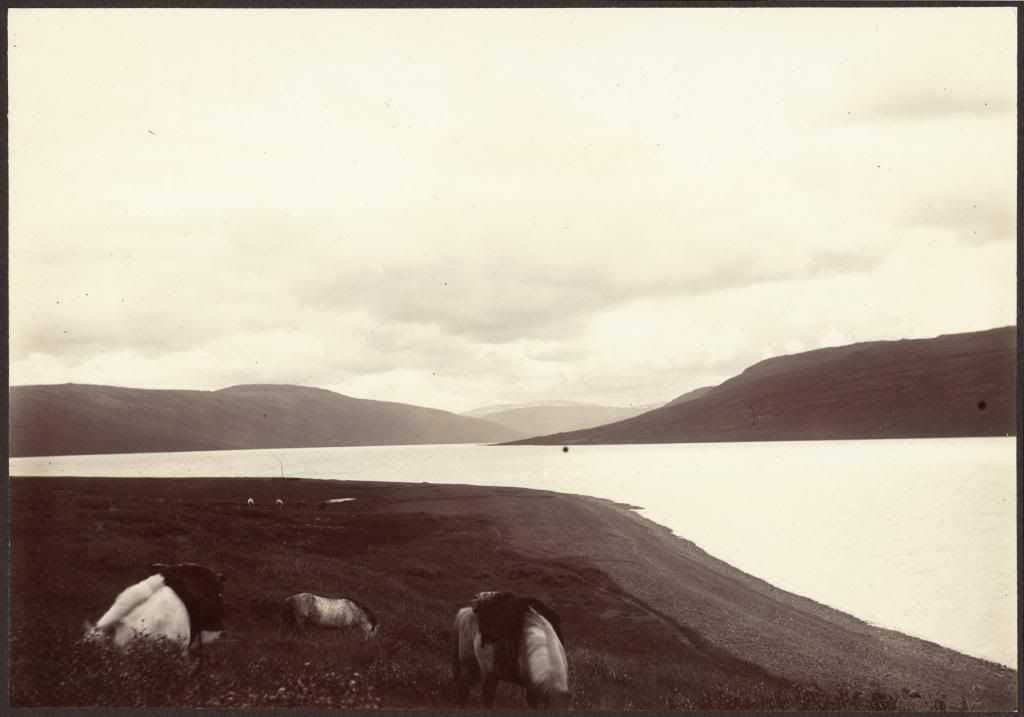
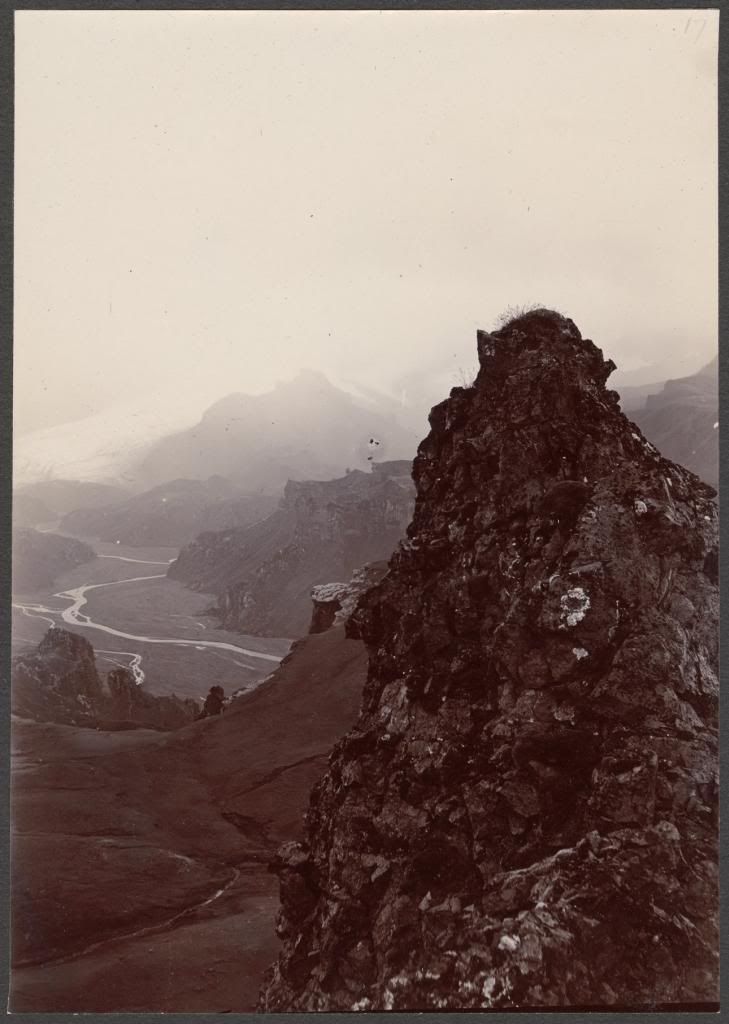
The head of Skorradalsvatn. Collodion print ca. 1900 by Frederick W. Howell. Bequest of Daniel Willard Fiske; compilation by Halldór Hermannsson at the Fiske Icelandic Collection of Cornell University.

Þórsmörk. Head of Krossárdalur. Collodion print ca. 1900 by Frederick W. Howell. Bequest of Daniel Willard Fiske; compilation by Halldór Hermannsson at the Fiske Icelandic Collection of Cornell University.

It was mentioned a week or two ago that Iceland is in the air. For me, Iceland is on my mind, in my laptop, hidden throughout the Cornell libraries, and scattered about my room. After a couple essays for an environmental history course last year and some preliminary research for finding an honors thesis topic in the history major, I discovered that, thanks primarily to Cornell University’s first librarian, we have one of the largest collections of Icelandic material in the world. Since one of my projects for the environmental history class had shown me that Iceland was an interesting place to examine more closely, I did some more research and found the topic of European travel there during the eighteenth and nineteenth centuries engaging enough to choose as an honors thesis subject.

One of the places in Europe with the most spaces left blank by cartographers through the eighteenth and nineteenth centuries, Iceland’s inner regions were not fully mapped until 1901. Continue reading

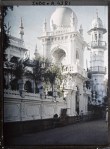
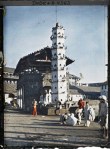
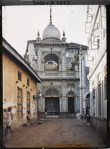
“Shipwrecked pictures” from the Albert Khan museum : can our community help identify these photographs ?

Back in 1912, french millionaire Albert Kahn hired Stéphane Passet to be a photographer for the monumental project Archives of the planet, an iconographic memory of societies, environments and lifestyles around the world. From 1909 to 1931, Albert Kahn  commissioned photographers and film cameramen to record life in over 50 countries. The Archives of the planet were a collection of 180,000 metres of b/w film and more than 72,000 autochrome plates, most of which are held at Museum Albert Kahn in Boulogne, close to Paris.

Autochrome was the first industrial process for true colour photography. When the Lumière brothers launched it commercially in June 1907, it was a photograhic revolution – black and white came to life in colour. Autochromes consist of fine layers of microscopic grains of potato starch – dyed either red-orange, green or violet blue – combined with black carbon particles, spread over a glass plate where it is combined with a black and white photographic emulsion. All colours can be reproduced from three primary colours. Some of the autochrome pictures available today are however unidentified, some happen to be of Bombay. Who among you in the Raxa Collective community can help locate these sites?

Continue reading