Scotland, Land Of Butterfly Resurgence

5151

For a second day in a row, a butterfly story catches our attention. Small stories of unexpected good fortune are always welcome:

Rare butterfly spotted in Scotland for the first time since 1884

Elusive and endangered white-letter hairstreak discovered in a field in the Scottish borders could become the 34th species to live and breed in the country Continue reading

Elephants, Orangutans, Rhinos & Tigers–What Are They Worth To Us?

4256n.jpg

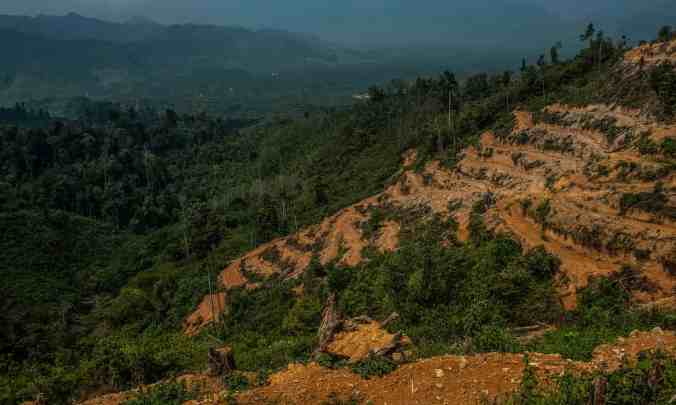
Deforestation in the Leuser ecosystem, one of the last homes to Sumatran elephants, orangutans, rhinos and tigers. Photograph: Sutanta Aditya/Barcroft Images

Thanks to the Guardian:

Pepsico, Unilever and Nestlé accused of complicity in illegal rainforest destruction

Palm oil plantations on illegally deforested land in Sumatra – home to elephants, orangutans and tigers – have allegedly been used to supply scores of household brands, says new report Continue reading

Wildlife Protection And Unintended Consequences

15tb-wolves02-master768

A wolf from a den within Yukon-Charley Rivers National Preserve in Alaska. A study found that limiting the population of wolves outside the preserve affected those within its boundaries. Credit Drew Rush/National Park Service

Mention Alaska, and we are in. Wolves, ditto. An academic publication called Wildlife Monographs? You had us at Alaska and wolves:

Protected Wolves in Alaska Face Peril From Beyond Their Preserve

Within the 2.5 million acres of the Yukon-Charley Rivers National Preserve in central Alaska, wolves and other majestic animals are protected. But animals like wolves do not respect lines drawn on a map. And a recent study suggests that efforts to limit populations of these predators outside those borders is having negative effects on wolves living within the preserve. Continue reading

Snorkeling in Cabo Pulmo

We’ve mentioned Cabo Pulmo here several times in the context of marine conservation, as well as from a personal visit. Although I still haven’t had a chance to go out on a scuba diving expedition here, a couple weeks ago Jocelyn and I were able to accompany some Villa del Faro guests on a snorkeling trip outfitted by Cabo Pulmo Sport Center, which is run by members of the Castro family mentioned in the posts linked above. The tour took two hours, but I’ve condensed the experience into almost fifteen minutes of video that I took on a rented GoPro:

Continue reading

Cactus Tales

On Seth’s invitation, I am honored to have a chance to contribute to the group. I have a biology background, but am now retired and have an interest in photographing birds. I use point and shoot cameras, starting two years ago with a Canon SX60HS, graduating to a Sony RX10iii this year. I teach classes in bird photography with these cameras. My interests are in telling a story of birds in a small ecotype such as a pond, or in this case one plant species, a cactus, the cardon of the deserts of Northwest Mexico. These photos were taken over two trips to the Baja California Sur Cape Region, and the majority were on one cardon that was outside the bungalow I was staying at in Cabo Pulmo, Mexico while having my morning coffee.

Pachycereus pringlei, also known as Mexican giant cardon or elephant cactus, is a close relative of the Saguaro of the desert southwest. It is the tallest cactus in the world, lives for several hundred years, and has a fungal-bacteria symbiotic relationship that allows it to grow on bare rock. For birds, it is the perch of choice for everything from hawks to wrens, a source of abundant food,  a prolific producer of fruit and used by all woodpeckers for their nesting holes. On larger cardons it is not uncommon to see several bird species on a cactus at once and most birds whose territory includes a cardon will touch it several times a day for a song, a snack, and good luck.



Rewilding, Panthers & People

Filkins-The-Return-of-the-Florida-Panther.jpg

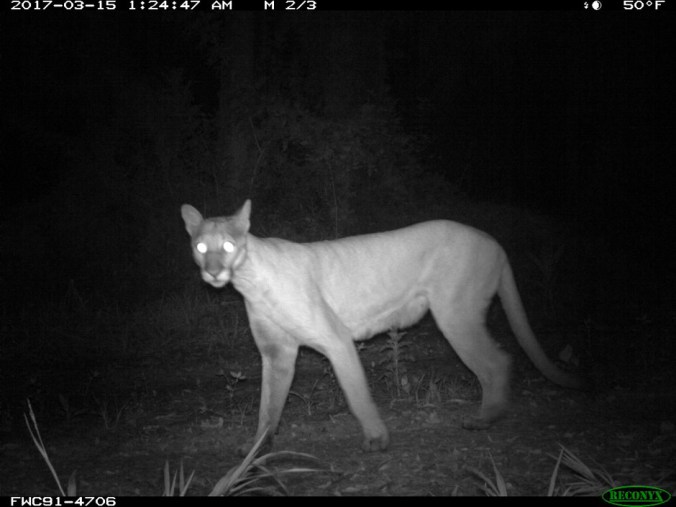
As Florida panthers have begun to multiply, they’ve been forced to search for new home ranges. PHOTOGRAPH COURTESY FLORIDA FISH AND WILDLIFE / FLICKR

Rewilding is a topic I started linking to as a matter of solidarity. While based in south India, I had plenty of exposure to residual evidence of the complicated–sometimes resplendently beautiful and other times brutally tragic–relationship between mankind and wild animals as played out over millennia, and still evolving. So I have kept an eye open for these stories, and have posted so many times on the topic that it might give the impression that it is a thing. As if it is happening more or better than it is really happening. But it is happening so I will keep the links coming.

Now I am in Belize most of the year, where the man-cat relationship is also millennia old, and as constant challenge as ever. But I am seeing it from well within the confines of Chan Chich Lodge and its surrounding hundreds of thousands of acres of healthy cat habitat. I know there are big cats in the USA, but not enough. That is why this story is a thrill. Dexter Filkins, never yet cited in these pages but whose reporting I depend on for other kinds of stories, was not a byline I expected to see on this story, but thanks to him for it:

For years, the Florida panther, a majestic creature that lurks in and around the forests of the ovbnm,./, has teetered on the edge of permanent disappearance. Closely related to the mountain lion, the panther once roamed across much of the South, but the ever-advancing modern world pushed it into a tiny corner of Southwest Florida. By the late nineteen-seventies, fewer than thirty survived.

Since then, the panther has been coming back, helped by a government- and privately backed expansion of its habitat. Florida panthers are now thought to number around two hundred. Indeed, there are so many big cats in the Everglades that they are venturing out in search of new territory. Continue reading

Gallon Jug’s Bird Friendly Coffee

CoffeeConsvtn.jpg

I am back at Chan Chich, with one goal before I start focusing on my plan to go to graduate school. A recurring theme in my work for La Paz Group, especially at Xandari, has been the intersection of birds and coffee. And now I have some months to think about how this may relate to what I will study in graduate school. One of the programs I am considering applying to is the Masters in Environmental Management at the Yale School of Forestry. Can I link what I have learned while working to what I would study there? If so, maybe I could link that to what I do after grad school.

This other post today reminds me of the value of geeking out from time to time. Most of my attention to coral reef comes from Phil Karp’s posts on this platform and I admit to preferring stories featuring real people and their entrepreneurial approaches to conservation. But science is the other best friend of conservation. Today my attention is turning to coffee, in advance of the arrival this week of an intern coming from Cornell University’s College of Agriculture and Life Sciences.

Just one of the many topics for an intern, with science and research on her side, to help us tackle over the next ten weeks, bird-friendly coffee has been on been on my mind since last year but I have been waiting for the perfect moment to focus. Nothing like the arrival of an intern to focus your mind. And so today in my task-oriented wanderings I came across this website (click the banner above), which I loved immediately for sharing this news on capsules, but the rest of the site is a great resource for present purposes as well:

A short round-up of coffee news.

Farmers, Loggers & Biodiversity

5184 (1)

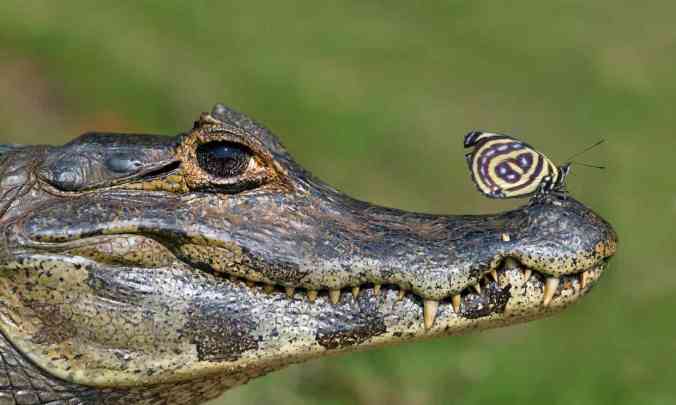
Serro Ricardo Franco is in one of the world’s biggest and most diverse ecological reserves. But reality on the ground is different, putting many animals at risk, such as Yacare caiman and giant river otters. Photograph: Angelo Gandolfi/Getty Images/Nature Picture Library

Sometimes, sitting in a glass house, reading the news makes me want to throw a stone. The glass house where I live includes a farm in an extremely biodiverse area. It is surrounded by nearly half a million acres where logging happens. But there is farming, as you can read about in the news below, and there are plenty of better ways of farming; there are loggers like those in the news below, and there are forests where extraction happens according to standards such as those set and enforced by the Forest Stewardship Council.

Instead of throwing a stone, I get up every day and make sure the glass around here is as transparent as possible, because we can demonstrate a better way of supplying food, of harvesting wood, and doing so with the protection of wildlife in constant view. Meanwhile, I do read the news from elsewhere and continue to share it here (thanks to the Guardian’s Jonathan Watts in Vila Bela da Santíssima Trindade for this one):

Wild Amazon faces destruction as Brazil’s farmers and loggers target national park

The Sierra Ricardo Franco park was meant to be a conservation area protecting rare wildlife

To understand why the Brazilian government is deliberately losing the battle against deforestation, you need only retrace the bootmarks of the Edwardian explorer Percy Fawcett along the Amazonian border with Bolivia.

During a failed attempt to cross a spectacular tabletop plateau here in 1906, the adventurer nearly died on the first of his many trips to South America. Back then, the area was so far from human habitation, the foliage so dense and the terrain so steep that Fawcett and his party came close to starvation.

He returned home with tales of a towering, inaccessible mesa teeming with wildlife and irrigated by secret waterfalls and crystalline rivers. By some accounts, this was one of the stories that inspired his friend Arthur Conan Doyle to write The Lost World about a fictional plateau jutting high above the jungle that served as a sanctuary for species long since extinct elsewhere. Continue reading

Sound, Noise & Wilderness

lead_960c

I’m sorry, what was that? Ints Kalnins / Reuters

Sound is often profound. Noise often annoys. Thanks as always to Ed Yong, touching on a topic we have been sensitive to for some time now:

A Not-So-Silent Spring

Even America’s protected areas are being subjected to harmful levels of noise pollution.

If a tree falls in the forest, and there’s no one around, the National Park Service will still hear it. Continue reading

Happy Plants?

04GARDEN1-master768.jpg

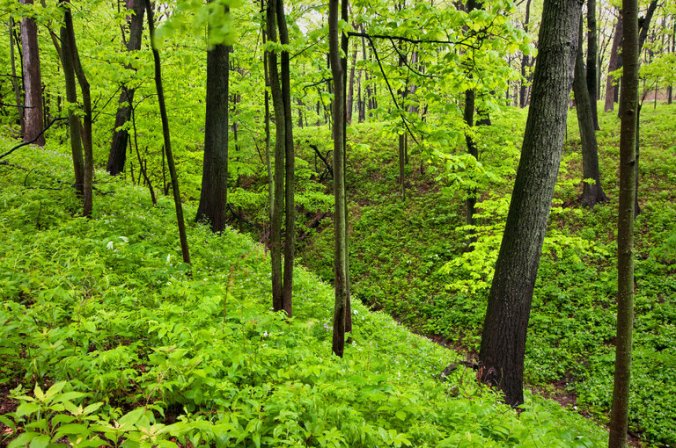
A dense carpet of woodland perennials. Thomas Rainer, a landscape architect, calls plants “social creatures” that thrive in particular networks. Credit Mark Baldwin

Thanks to the landscape architect Thomas Rainer, and the author, for these observations:

Thomas Rainer and I have both been doing the botanical thing for decades; we know, and use, many of the same plants — and even much of the same horticultural vocabulary. But what he and I see when we look at a butterfly weed or a coneflower, or what we mean when we say familiar words like “layering” or “ground cover,” is surprisingly not synonymous. Continue reading

Song of the Sloth Bear

Much of our efforts on this site go to honoring the efforts of conservationists, in the form of scientists, activists, and writers. A special appreciation go to the photographers, filmmakers and artists whose work brings nature into the lives of many who may not normally be exposed to the incredible biodiversity of our world.

Longtime contributor Sudhir Shivaram is one such photographer, and we appreciate his  introduction to this lovely film Daroji by Sugandhi Gadadhar currently in final deliberation at the 2017 Wild & Green Shorts Film Festival, Montana.

Daroji is a short film for children, introducing them to wildlife, specifically those from in and around Daroji Sloth Bear Sanctuary in Karnataka, India. Bindu, a female Indian Sloth Bear, tells the story of different families, including her own, and shares a friendly note with her audience, suggesting that man and animal can co-exist in harmony.

We wish Ms. Gadadhar the best of luck!

Recommended By Guests At Chan Chich Lodge

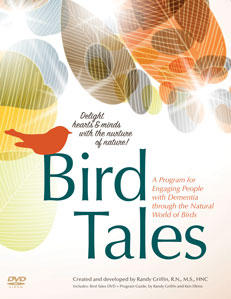
bird-tales-kitWhen guests of Chan Chich Lodge told me last evening about their local Audubon Center in Connecticut (USA), my first thought was a memory of the Audubon Center in my hometown, also in Connecticut, and how essential it was to the decisions I made to do what I do today.

Then they mentioned Bird Tales, and I had never heard of anything like this before, but it made so much sense to me I thought I should excerpt the description here and point it out to the many bird-centric visitors to our platform here (click the image to the left to go to the website of the Center that created the program):

…Initially working with four facilities operated by Transcon Corporation, our Audubon Center Bent of the River Education Program Manager, Ken Elkins, incorporated Audubon at Home environmental principles into the goals of these facilities to improve the quality of life for their residents. Continue reading

Clean Water Should Not Be Politicized, But When It Is We Love Trout Unlimited More Than Ever

10wood-master768

Leigh Guldig

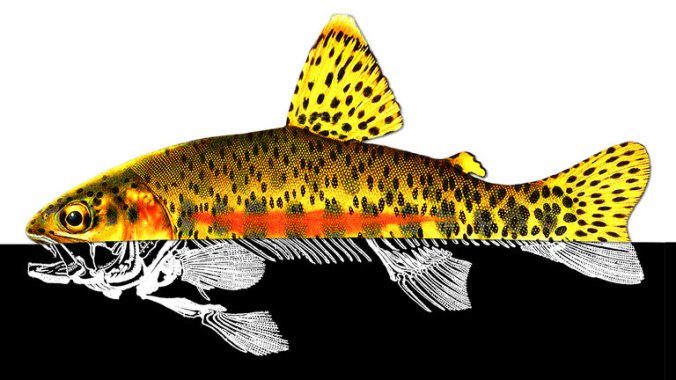
Please take a few minutes to read what follows to the end, and share it as far and wide as you can. Our thanks to Chris Wood–president and chief executive of Trout Unlimited, which needs and deserves our support for exactly the reason stated below–for writing, and the New York Times for publishing this clear statement:

THE eastern brook trout, whose native haunts in the Appalachians are a short drive from my home in Washington, is a fragile species. It requires the coldest and cleanest water to survive, and over the past two centuries, its ranks have been decimated by all that modern society could throw at it. Today it lives in a fraction of its historic range.

One reason? Thousands of miles of prime brook trout streams have been polluted by poorly regulated historic coal mining, and what has been lost is difficult to bring back. Groups like Trout Unlimited have worked with partners to restore more than 60 miles of wild trout streams damaged by acid mine drainage in Appalachia. But it is hard, painstaking work — it has taken the better part of two decades and millions of dollars, and the fact is that it would take many lifetimes to revive all the streams in need of resuscitation. Continue reading
Saving Snow Leopards

08TB-snowleopard1-master768.jpg

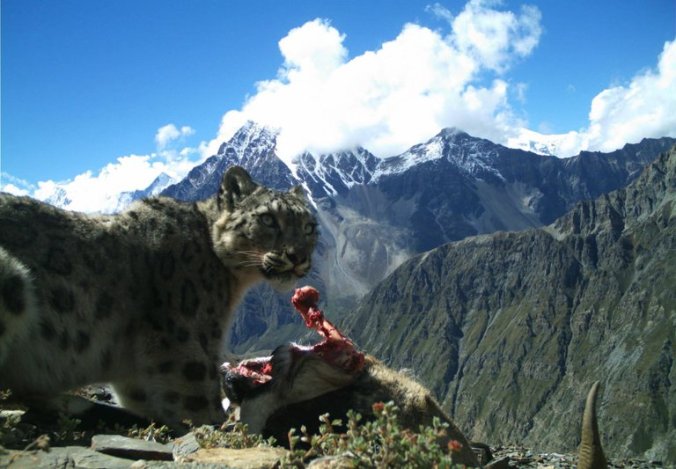
A snow leopard in the Himalayas eating its prey. Credit Madhu Chetri

The New York Times’ always-appreciated Science section, once a Tuesday feature, has been joined by many features made possible by the wonders of modern technology, and the news organization has also responded creatively to the competition made possible by all that wondrous technology. This article by Nicholas St. Fleur is a good example of why we check in on the Trilobites feature of the website daily:

How Do You Save Snow Leopards? First, Gather Their Droppings

Pigs Provisioned Properly

upright-pig-pic-b5c25a6787d8fc308e0fc996c3b484ec28d0f195-s1400-c85.jpg

This wild hog from Hawaii was raised at the National Wildlife Research Center in Fort Collins, Colo. Feral pigs in the wild tend to eat anything containing a calorie — from rows of corn to sea turtle eggs, to baby deer and goats. Rae Ellen Bichell/NPR

We appreciate the excellent science produced by employees of the federal government of the USA, both the theoretical and applied problems they tackle depending on their specialty. Thanks to those who deal with creatures like this, who have in common with their feline counterparts in some locations the misfortune of bumping up against human interests. Figuring them out and accommodating them humanely seems a worthy scientific cause:

Scientists Get Down And Dirty With DNA To Track Wild Pigs

by Rae Ellen Bichell

In the foothills of Colorado’s Rocky Mountains, a gravel road leads to a 10-foot-tall fence. Type in a key code, and a gate scrapes open. Undo a chain to get behind another. Everything here is made of metal, because the residents of this facility are experts at invasion and destruction. Continue reading

Lion Lost, Los Angeles

Puma2.jpg

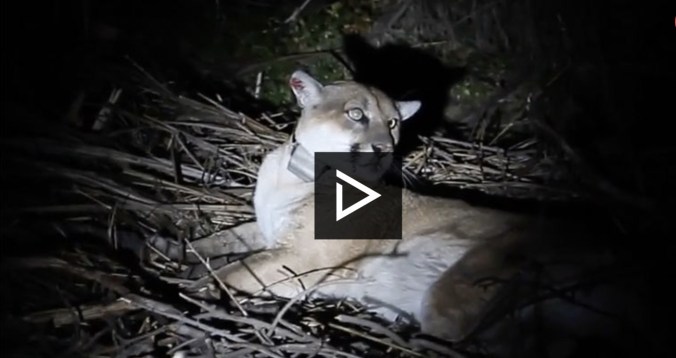
In case you did not see it yesterday, take a look at this when you have the time to read it in full. For now, over a quick coffee, click the image above to go to a video, 5:30 minutes long, to understand what the National Park Service is doing on behalf of this majestic lost cat:

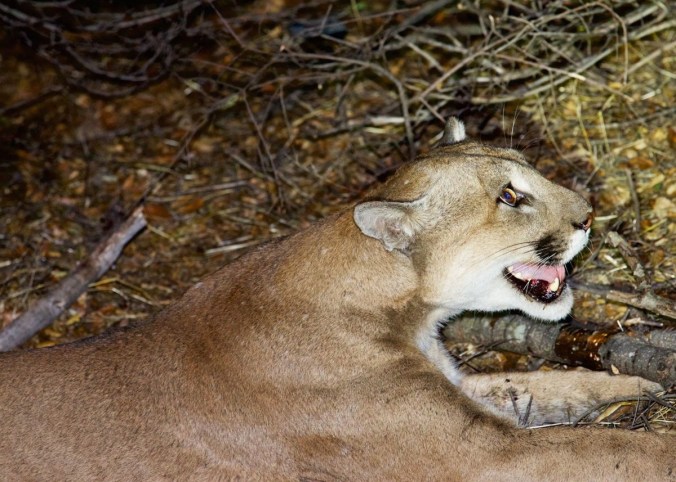
The carnivore biologist Jeff Sikich captures and examines a mountain lion in the Santa Monica Mountains. Courtesy National Park Service

Puma, Puma, Puma

170213_r29424-1200x857-1486067005

A lion known as P-45 has killed scores of domestic animals—and attracted passionate fans. Courtesy National Park Service

I favor a walk in the woods where pumas feel naturally at home. That said, the world has been changing faster than we like, and faster than pumas can adapt. We have had so many wildcat stories in these pages since we started in 2011, it is impossible to count at this point; also not possible to link back to one that matches the content of Dana Goodyear’s wow piece in the upcoming issue of the New Yorker:

LIONS OF LOS ANGELES

Are the city’s pumas dangerous predators or celebrity guests?

It was drizzling and gray, late fall, on the old Rickards Movie Ranch, high in the Santa Monica Mountains, in rural, red-state western Malibu. Continue reading

Bison, Back Big

Thanks to Lisa Feldkamp at Cool Green Science for Bison, Pioneers of the Prairie, Return to Kankakee Sands:

Over the past 20 years The Nature Conservancy in Indiana has been converting 6,700 acres of row-crop agriculture at Kankakee Sands into a diverse prairie. The goal – to restore key prairie habitat and connectivity for wildlife. Continue reading

If You Happen To Be In The USA

audubonzip

Thanks to Audubon, as always, for taking us somewhere else, if only for a moment. Forget the events around you long enough to click the banner above; consider the native foliage you might plant when weather permits: Continue reading

Flying Squirrels & Moonlight Gliding

flying-squirrel-2

Alexander V. Badyaev

We had not known of bioGraphic until just now, and want to shout out to the source before anything else. Our thanks to the California Academy of Sciences, who we look forward to hearing from more in the next few years, for the service that bioGraphic provides to all of us. Vigilance, informed by science, will be more important than ever. You know what we mean.

calacadscience

bioGraphic is powered by the California Academy of Sciences, a renowned scientific and educational institution dedicated to exploring, explaining, and sustaining life on Earth.

This recent story in bioGraphic seems like as good an option as any to link you to. We realize now that we have not posted any stories on the flying squirrels of the Malabar coastal region where we have been based since mid-2010, so glancing at this creature in the western USA habitat first seems a fine reminder of a pending task. Thanks for this story and photographs by Alexander V. Badyaev:
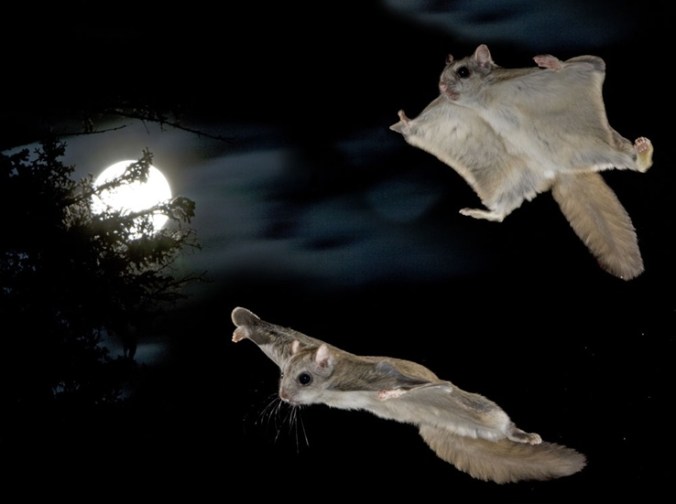
After listening all day to relentless warnings of “severe winter weather” and poring over equipment manuals to determine the lowest operating temperature for various pieces of photographic gear, I decided to stick with the plan. A few hours and several miles of snowshoeing later, I was hard at work in the diminishing February twilight, setting up lines of strobes and high-speed cameras along gaps in the tree canopy that framed a forest lake at the edge of Montana’s Bob Marshall Wilderness. I knew this lakeshore to be a primary movement corridor for a resident female northern flying squirrel (Glaucomys sabrinus), and based on observations from previous nights, I expected my nocturnal subject to launch herself across the lake sometime between 2:20 and 2:50 a.m. Continue reading