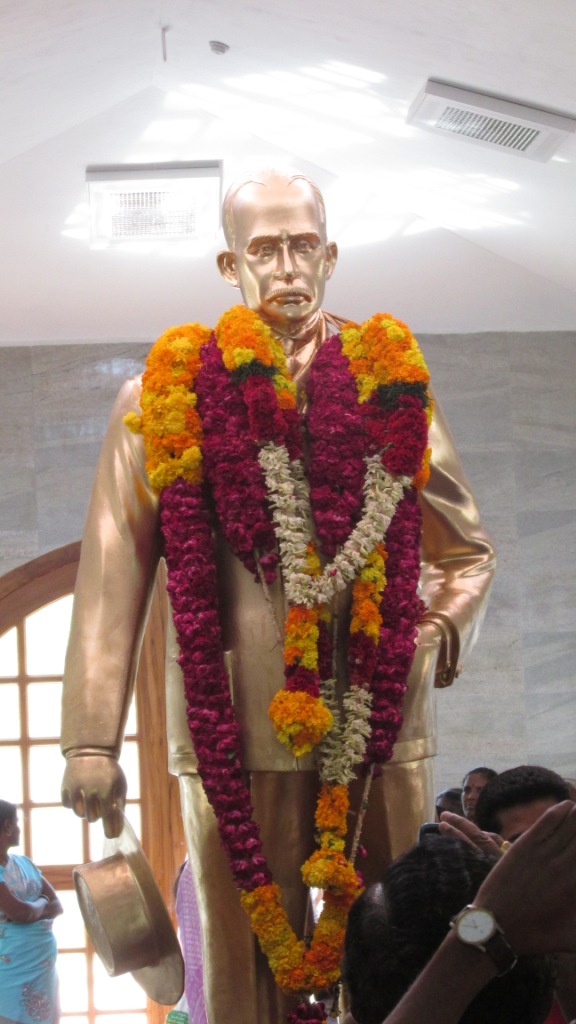
The government of Tamil Nadu recently honored Colonel J. Pennycuick, the architect of the Mullaperiyar Dam which had been built in 1895. The chief minister of the state commissioned a small memorial building which includes a statue of Pennycuick and a rare collection of photos taken during the dam construction. Continue reading
History
Voyager’s Dilemma

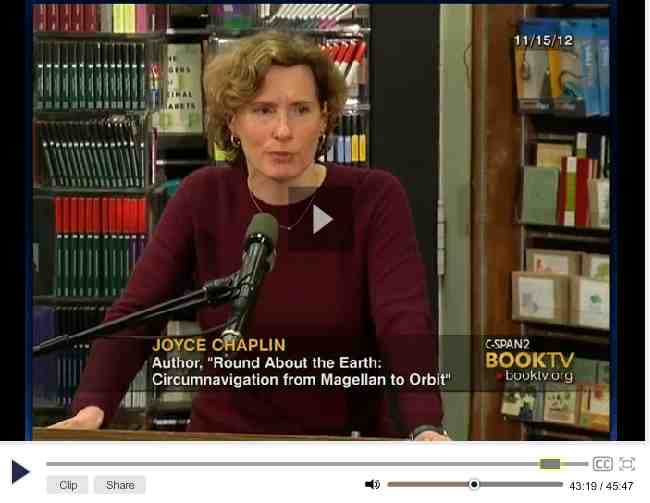
Harvard University Professor Joyce Chaplin talked about her book, Round About the Earth: Circumnavigation from Magellan to Orbit, in which she presents the history of the circumnavigation of earth, going back to the days of Portuguese explorer Ferdinand Magellan. Professor Chaplin spoke at Harvard Book Store in Cambridge, Massachusetts.
Three of our most viewed posts since starting this site in mid-2011 have to do with the intersection of travel (in all its various forms) and sustainability so when we saw this video and the related book reviews we could not help thinking it might resonate with readers who have enjoyed those three posts. One challenge for the modern voyager is an inverse of the same as that to a hospitality-providing organization such as ours going forward: how do we get there and back with the smallest footprint possible? It is not the same question Magellan was asking but some of the “voyage issues” have not changed over the centuries. Click the image above to go to the video, and here for a review of the book in the LA Times:
A trip on a 140-foot sailboat helped inspire Harvard professor Joyce E. Chaplin to write “Round About the Earth: Circumnavigation From Magellan to Orbit” — and that may explain the enthusiasm she brings to the many-stranded narrative. At the very least, it underlies her sympathy for sailors on small boats heading into rough, unknown seas.
This history, the first of its kind, is a lively charge through 500 years of worldwide exploration (and beyond). Chaplin sets to the task by carving that time span into three parts. Continue reading
Quagmire
In his environmental history of the Mejong River Delta in Vietnam, David Biggs analyzes the influential trend of forced—and often failed—attempts to control the water and earth of the landscape, with various effects on local populations. Looking back even farther than the mid-19th-century colonization of the area by the French, Biggs considers the traditional identities of human “improvements” of the delta such as dikes, canals, and dams essential to habitation and agriculture. The imposed land and water use projects enforced by the French colonists, with their newer, large-scale technologies, expanded what Biggs calls the colonial grid, which colonial officials endeavored to push beyond inhabited areas in ways often contrary to Vietnamese custom or ecological wellbeing.
Canal-digging, road-building, railroad-setting, river-dredging, forest-clearing, and swamp-draining, all part of the colonizing and pioneering process, were frequently carried out without fully considering the ecological and political effects such “nation-building” would have on the Vietnamese people and landscapes, or their relationships to each other. Although the environmental consequences for these earlier projects are not quite as severe as his case studies, Paul Josephson might label these activities as milder brute force technologies—if not these earlier efforts then perhaps those pushed forth by American agencies later in the 1960s and 1990s. The planting of methods tried and tested in quite different locations from the Mekong River Delta, and the frequent disregard or ignorance of the diverse intricacies in ethnic groups or soil and water types, impacted how effective the colonial and post-colonial programs of hydroagricultural reform were. Unlike Johnson, however, Biggs does not represent these technologies as overwhelmingly or constantly negative for the environment. Continue reading
Mayan-Like Patterns

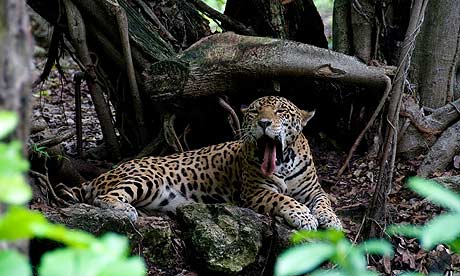
A jaguar – a symbol of Mayan royalty – is endangered but roams free in the Maya Biosphere Reserve, Guatemala. Photograph: Larry Larsen/Alamy
We make frequent links and comment on topics meant to raise awareness about innovative, fun and sometimes loony efforts—from the humble to the grand– to avert environmental collapse. The dangers are real enough that we assume readers get enough of the doom and gloom elsewhere, so that we can focus our efforts on evidence of potential solutions, and encourage collective action.
The photo above accompanies a story in the Guardian worth a read, to put in perspective why it is that the Mayan calendar doomsdate hoopla, or at least some of the accompanying history, was worth a bit of attention:
…Today, much of the Mayans’ ancient homeland is a 7,700-square mile protected area in Guatemala called the Maya Biosphere Reserve. With an area greater than the states of Connecticut and Rhode Island combined, the reserve protects the largest remaining forest in Central America. Beneath the canopy, monumental vestiges of temples and palaces attest to past splendour. Similar magnificence is found in the reserve’s wildlife. The jaguar, once a symbol of Mayan royalty, still roams free in one of Central America’s last wild places. Continue reading
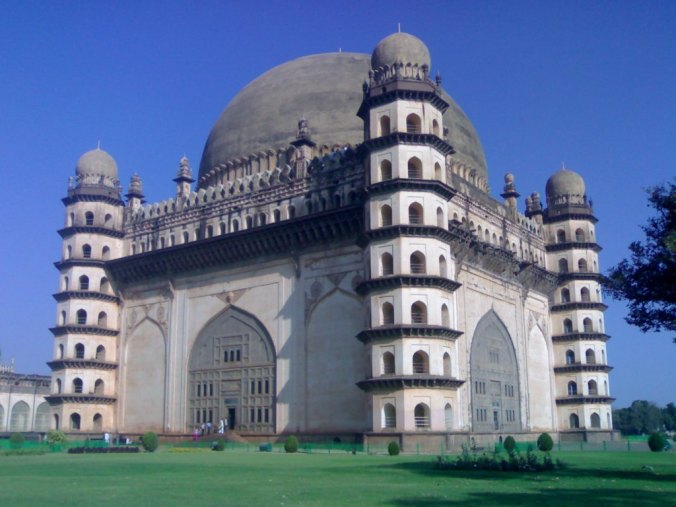
Gol Gumbaz – Bijapur, Karnataka
Photo credit: Ramesh Kidangoor
Gol Gumbaz is the tomb of Mohammed Adil Shah, located at Bijapur in Karnataka state. Built in the 17th century, this renowned example of Deccan architecture took close t0 30 years to complete. The significant feature of the structure is its central dome which stands without the support of pillars. The Gol Gumbaz is the second largest dome in the world of this type. It is particularly known for its central chamber, or “Whispering Gallery”, where every sound is echoed multiple times.
Treatments of the Frontier
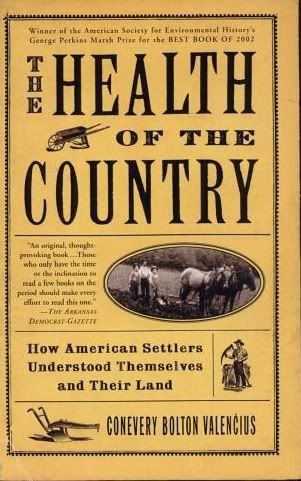
Whether merely traveling or settling down to start new lives, American emigrants to the Western frontier held certain beliefs about the “salubrity,” or health, of the land and how it could affect their own wellbeing. Such is the subject material of Conevery Valenčius’ book The Health of the Country, which explores the realm of eighteenth-century settlers as they struggled to cope with new and changing environments—primarily in Missouri and Arkansas.
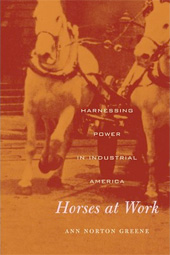
Like Ann Greene in her book about horses that I reviewed last week, Valenčius does not discuss environmental degradation or change on a scale anywhere close to some other authors I’ll refer to in future posts (partly due to the limited temporal scope of the work but also given the text’s narrower subject of “medical geography”), but both The Health of the Country and Horses at Work share the distinction of being a creative sort of environmental history that readily utilizes some of this new field’s best characteristics: use of interdisciplinary evidence and modes of analysis, reconstruction of past landscapes through culture (e.g. myth, law, perception) and science, and concentration on the two-way discourse between man and nature.
Heroes In Green Clothing
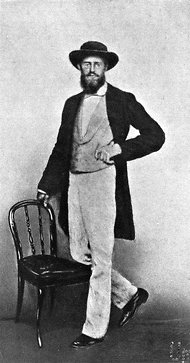
We pay homage from time to time to the forefathers of our own interest in the more modern entrepreneurial conservation. Here is a lesser known, but no less important, figure in that pantheon. Click the image to the left to go to the full story:
Ask a room full of conservation biologists who they like more, Darwin or Wallace, and Alfred Russel Wallace will win every time. While Darwin is respected, Wallace is revered. More than 800 new species have been named for Wallace, and for Darwin, around 120.
Thursday, Nov. 7, marked the 99th anniversary of Wallace’s death and started the countdown to 100th-anniversary celebrations in Britain, Mexico and Malaysia. Continue reading
Horsepower In Context
By now we all know the importance and value of recycling, right? Right. Except when wrong. So, to be clear in case my occasional thoughts of science writing as a career go somewhere: I am in a course that requires my written reflection on some amazing books and articles related to environmental history. Raxa Collective, whose blog I have been contributing to since mid-2011, has asked me to recycle some of that work for the sake of its readers. Agreed. I hope we are all right, alright?
First, one thing I am learning in university is that it is never too late to review literature. Some posts on this site point to evidence in favor of that idea. Ann Greene’s Horses at Work is just a few years old (whereas Swerve is a review of poetry from millennia past) but is already part of a canon: it made the cut for this course. Continue reading
Le Clos Montmartre: One Of Many Well-Kept Parisian Secrets
Because most of the 180 or so members of our organization are based in Kerala, we try to share information every day about the nature, culture and general awesomeness of south India. But some of us have lived elsewhere, and have fond memories of those places. So why keep secrets? Thanks to the website L’Atelier Vert, which is Continue reading
Mysore Palace
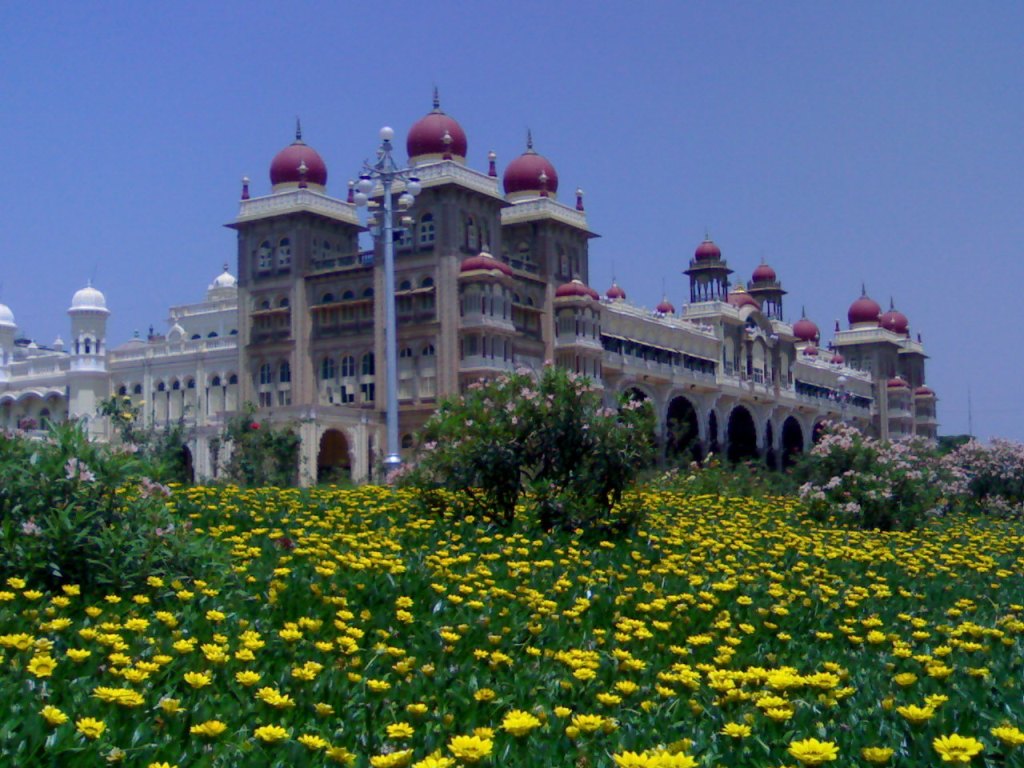
Located in the heart of Mysore City, Mysore Palace is one of the biggest and most spectacular palaces in the country. The original palace was built by the Wodeyar Kings during 14th century. The wooden structure was demolished and reconstructed many times over the centuries. The current palace, commissioned in 1897, is built in the Indo-Saracenic style, blended with Hindu, Muslim, Rajput and Gothic styles of architecture with stained glass, chandeliers and elaborate grill work imported from all around Europe.
Orion Nature Quarterly’s Online Evolution
From a magazine we appreciate for its 30+ years of awesome long form non-fiction writing on important issues related to nature, as much as its audio-visual contributions on the same, in the item featured here:
Photographer Douglas Gayeton explains the genesis of his giant-sized, mural-like photos designed to protect from corporate marketing the meaning behind the words we use to describe sustainability. The project began as a language experiment in Tuscany, Italy.
Citizen Science, Old School

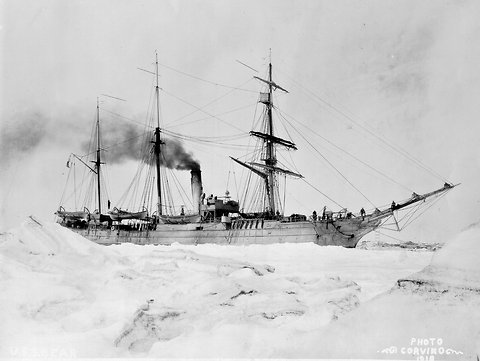
Coast Guard Museum NW. Citizen scientists have been invited to help transcribe logbooks from legendary American vessels like the Bear, which plied Arctic waters for four decades for the United States Revenue, the precursor of the Coast Guard.
An interesting historical take on a newfangled trend (click the image above to go to the source):
For many years now, volunteers working from home —people like you— have been able to help scientists with important problems.
In the first wave of these “citizen science” projects, people simply lent their computers to help solve problems that could be farmed out in pieces to thousands of machines. Continue reading
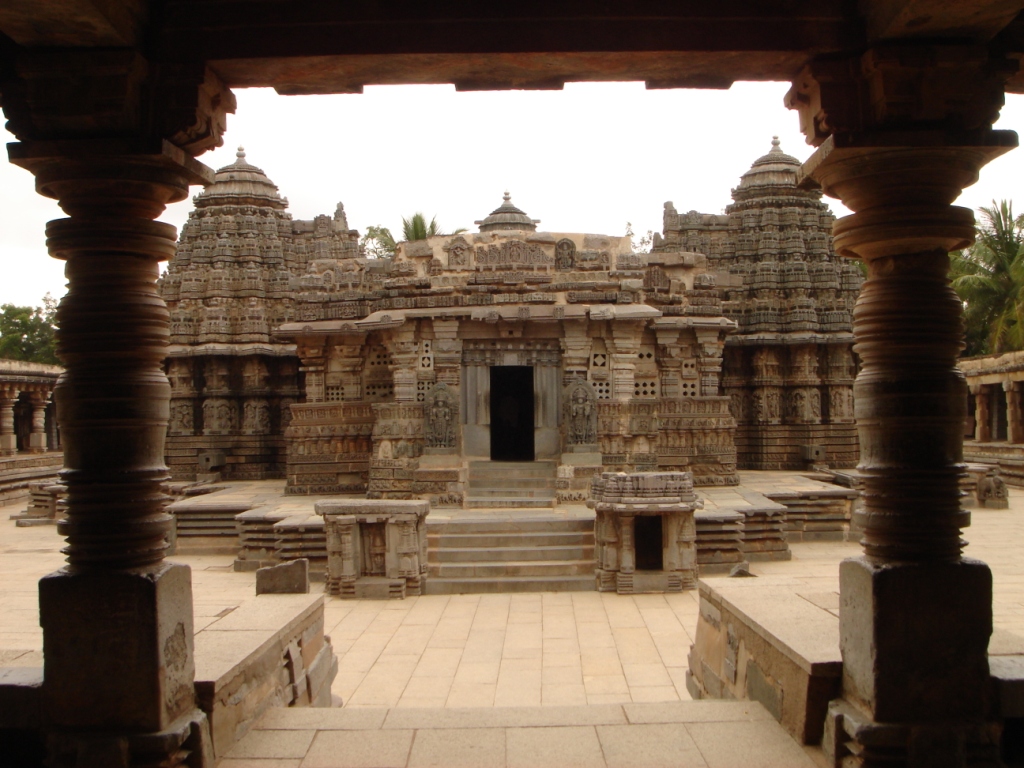
Chennakeshava Temble – Somnathpur
Built in 1268 A.D., Chennakeshava Temple is located in the Mysore District of Karnataka. This temple is famous for its elaborate artisanship. The temple stands on a raised, star-shaped plinth in the middle of a spacious enclosure containing sixty-four cells.
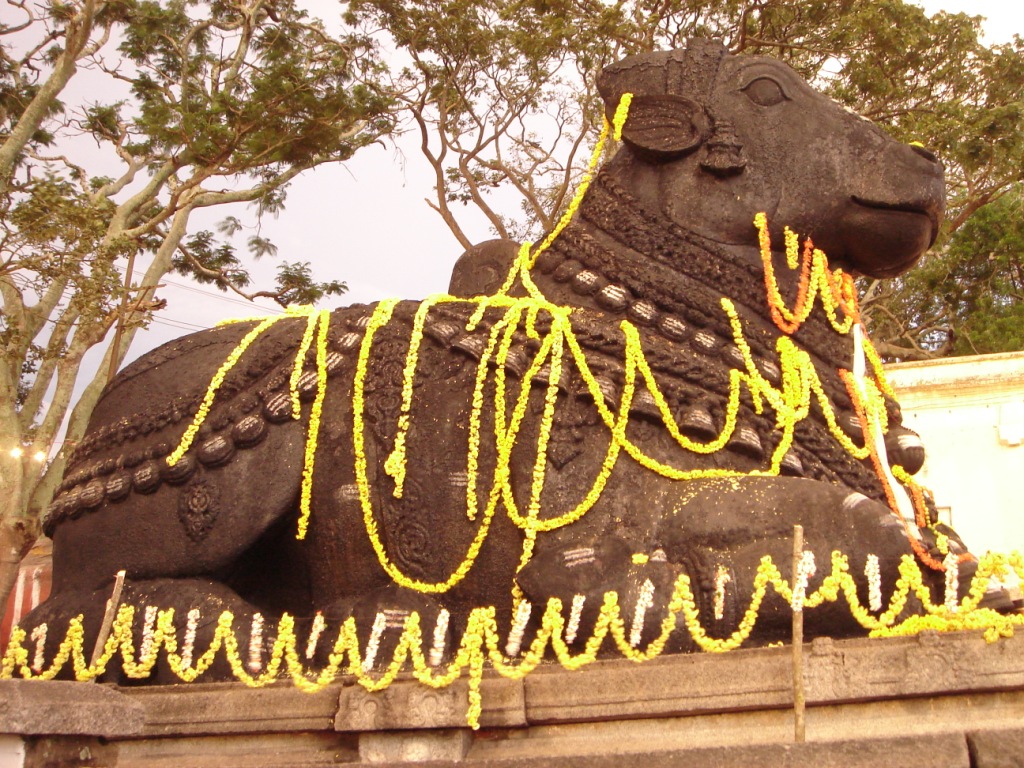
Nandi Bull of Mysore
Nandi Bull is one of the landmark tourist attractions of Mysore. The over 350 year old statue represents Lord Shiva’s vehicle and was created during the reign of Dodda Devaraja. The Nandi is the third largest in all of India, carved out of a single piece of a rock 15 ft height and 24 ft width.
Mysore City Market
With more than 100 years of history, Mysore city market is well knitted in the heritage of Mysore, which is the imperial city of Royal Palaces. This market is a good sample of a traditional Indian market; colourful, noisy and vibrant. Continue reading
Bioluminescence To Commemorate Columbus In The New World

Dimitri Deheyn/Scripps Institution of Oceanography
Columbus may have seen fireworms like these glow green just before making landfall in the Americas.
From today’s Green Blog on the New York Times website a note in honor of Columbus Day (and doctoral student discoveries) click the image above to go to the story:
…At 10 p.m. on Oct. 11, 1492, Christopher Columbus saw a glimmer in the distance as he stood on the deck of the Santa María. The faraway flash was “so small a body that he could not affirm it to be land,” Columbus wrote, referring to himself in the third person. Continue reading
Accidental Discovery Of A Great Photographer
For more on the book, click here. To listen to a podcast of the interview with the author, click here:
Photographer Edward Curtis started off his career at the tail end of the 19th century, making portraits of Seattle’s wealthiest citizens. Continue reading
Animals We Know, Way Back When
Mammoths and saber-toothed cats may be the most famous beasts of the Ice Age. But they shared the prairie with horses and camels, too—both of which evolved in North America and crossed the ice bridge into Eurasia, before disappearing here. Matthew Kohn (Distinguished Professor, Department of Geosciences Boise State University Boise, Idaho) and Christopher Hill (Associate Dean, Graduate College Associate Professor, Anthropology Boise State University Boise, Idaho) talk about the lesser-known fauna of the Ice Age.
Did Rachel And David Ever Meet?
This particular question clearly does not matter, but if we celebrate Rachel Carson’s contributions and their longevity (not to mention their impact on the next generation) and David Attenborough’s contributions over roughly the same period, it seems reasonable to wonder whether they ever met considering they shared common interest in the wonders of the earth and concern for the its health: Continue reading
Rachel’s Place In The Eco-Pantheon
Click the illustration above to go to a great article in this past Sunday’s New York Times Magazine by Eliza Griswold about the historic significance of Rachel Carson’s book:
“Silent Spring” was published 50 years ago this month. Though she did not set out to do so, Carson influenced the environmental movement as no one had since the 19th century’s most celebrated hermit, Henry David Thoreau, wrote about Walden Pond.