Community, collaboration and conservation are the categorical things–ideas, actions, examples–that we most like to talk about on this site and point to with links elsewhere. Still, perhaps half of the posts here would be hard pressed to fit into those categories in any literal sense. This little item below, for example. Two guys talking about cultural differences in mathematical expression. Go figure.
Ideas
A Learning Laboratory (Stop Motion Video!)
Yesterday, Jonathon, Siobhan, Milo, and I moved into one of the new Raxa Collective properties under development. As the four of us huddled silently under our covers, the backwaters of Kerala’s nighttime accompanied Jonathon’s ghost stories…
Instead of spooky tales, though, today I want to share with you another story Jonathon narrates, Raxa Collective presents “A Learning Laboratory.” It’s a short video, Jonathon (narrator), Sunnie (illustrator), Siobhan (director), and I (producer) put together with the help of all the staff and summer interns to highlight some of the best anecdotes of how Raxa Collective’s Cardamom County ecolodge has acted as a “learning laboratory” for its staff, international trainees, and summer interns.
Enjoy!
Aesop’s Wisdom
 From Science (click the image to the left for the full story) a short piece about the wisdom of not being too rational:
A thirsty crow comes across a pitcher partly filled with water but can’t reach the water with his beak. So he keeps dropping pebbles into the pitcher until the water level rises high enough. A new study finds that both young children and members of the crow family are good at solving this problem, but children appear to learn it in a very different ways from birds.
“There is no better designer than nature.”
Color is quite possibly the most strategic tool a designer can use to breathe life into a concept.
And it comes as no surprise to the RCDT that used effectively and responsibly, color can transform an existing space more powerfully than any other single alteration. But it is important to realize that color does not exist as an object in itself; rather color is the relationship between light and an object, producing a condition that is unique and inherent to a specific material. As pure white light from the sun reaches a material’s surface, various light frequencies are either absorbed or reflected causing our visual perception to interpret the surface as a certain color. Thus color is actually a very scientific narrative between light, a surface, and our eyes.

This post could delve very deeply into the science of color and those factors that cause us to perceive what we do, but the scenery of India is far too inspiring to diminish it to wavelengths. Instead I dedicate this post to the basic and simple application of color, what it is, and why it is one of the things that makes India one of the most beautiful places on our earth. Continue reading
Top 3 Words to Avoid When Talking Shop with Architects
We are working in Cochin and sometimes I feel like I am speaking two different languages. I’m not talking about struggling with mixing English and Malayalam. I’m not talking about scratching my head each time I encounter an Indian head shake/nod (“Wait- was that a yes or a no?”). I’m talking about the client’s language vs. the architect’s language.
This internship really is a “living laboratory.” I am getting a chance to sit on the client side and discuss ideas with the architects that will push Raxa Collective’s vision forward. Crist and Amie have worked with the design team side by side on each project and I am starting to understand how they think, how to make sure my drawings, renderings, and presentations can be clearer, and more. Sitting in on these design meetings in which the architect and clients discuss, propose, discuss, present, discuss, discuss, and discuss some more, I realize…
It’s like talking shop at an auto repair.
Underdog Dynamics
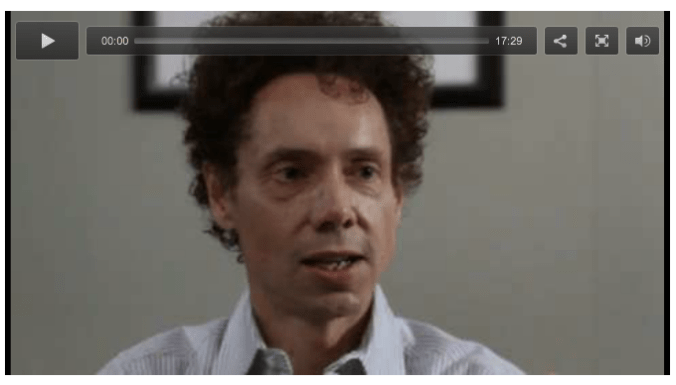
As unabashed preferrers of the underdog, this is a topic on which we have opinions, feelings, and even some experiential knowledge; but not many facts or figures, per se. When a writer like Gladwell claims to have documented the art and science of the underdog, we will take note (even after Steven Pinker’s convincing surgical strike on Gladwell and the arguments on both sides after that strike) Click the image above for video of Gladwell previewing his new book:
What should the strategy of the weak be when facing the strong? Does being an underdog—whether as a team a country or an individual—help foster creativity? Why should people at the top of their fields quit their jobs and try to reinvent themselves?
Complex Ideas Made Simple
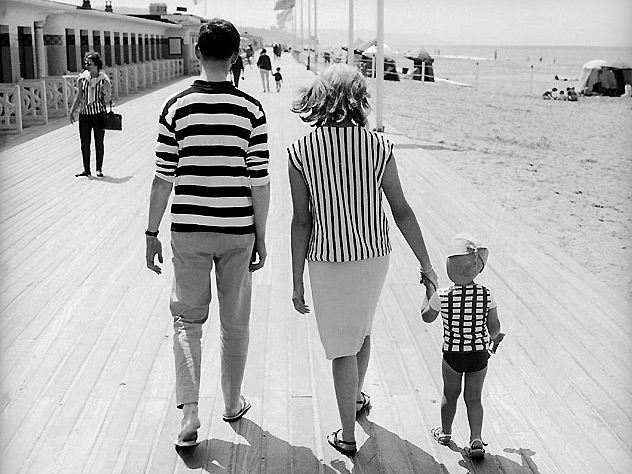
Maths in Deauville, Normandy (Rene Maltete)
Click the image above for a Krulwich confection. While nominally about the challenge of understanding genetics, it is actually a reminder that when we celebrate the oddball, often underdog approaches to challenging ideas or situations, we sometimes oversimplify in the interest of clever/cute and sometimes in the spirit of brevity (which Shakespeare called the soul of wit, and Dorothy Parker called the soul of lingerie).
Evolution’s Malcontents
 Click the image to the right for an accessible discussion of one strain of debate within the field of evolutionary biology:
The best way to distinguish between Professor Dawkins’ waking and sleeping states is probably on the basis of how contentious he is at a given time. Nevertheless, I’m compelled to say something for two reasons. First, this particular fight happens to be taking place right in my proverbial (and professional) wheelhouse; second, I’ve just finished my annual re-reading of Michael Crichton’s Jurassic Park duology.
Many Stripes. Many Tales. Few Tigers.
When I decided to come to Kerala this summer for my internship, I got most excited not entirely about my work, but really about seeing a tiger. I can’t even remember the last time I went to a zoo, but I know deep in my closet I have a dusty photo of me and a tamed tiger from Thailand. At this time, seeing a wild tiger was actually more of a WILD idea. Since I’m working next to the Periyar Tiger Reserve, a home to approximately 40 tigers and many other animals, I’m practically neighbors with them and awaiting a miraculous moment to see a tiger before my trip to Delhi.
As a Korean descendent, I must introduce you all to some Korean culture and explain why I’m writing a blog post that is dedicated just to tigers. I’m sure a lot of my Korean folks will agree that tigers and Koreans go way back. My relationship with tigers started when I was 3 years old when my grandmother told me a story about a tiger that smoked using bamboo pipes. My reaction was: “Really? Tigers smoke, too?”

Source & Credit: Picture of a Tiger at SamChunSa (삼천사) at BookHanSan (북한산)
Eye Heard You
Lately, I have been noticing how much I rely on and draw value from eye contact. Maybe due to my weak hearing I tend to evaluate my conversations by observing others’ body language, specifically eye contact and supporting facial reactions. I am surprised to find that I can accumulate a range of feelings simply from looking at these small features; I can be made to feel entirely stupid, worthless, and a time wasted, or I can feel encouraged, wise, and joyful to share my thoughts. I guess this can support the old phrase, “a picture is worth a thousand words.” The manner in which I maintain eye contact matters and can convey much more than the words I am speaking. It makes me wonder how my message would be perceived if only my eyes were seen and my words were heard.
Before my mind over-evaluates this communication feature, I pause to promise myself to be mindful to the conversation my eyes and other facial features are having with someone instead of only that of my words. I know according to Eleanor Roosevelt that I can only make someone feel inferior or poorly if he/she allows me that crude act. However, I never want to put someone in a position to be made to feel negatively by my actions, both in words and other supporting communication. So, in the words of John Sinclair, “The eyes of Texas are upon you,” and will, to the most often and to the best of their ability, be encouraging others to reach their great potential.
Merged Publications & Happy Museums
Neither had been on our radar before, but with a bit of investigation, we congratulate Satish Kumar on his decision to merge them (click the image below to go to the new site hosting both publications):

A quick sampling of articles led here and to the conclusion that our site will be following this publication for news of a non-conformist nature: Continue reading
Lingual Limits & Elegant Etymology
Kahneman Fest

Portrait of Daniel Kahneman, author of Thinking, Fast and Slow, and winner of the 2002 Nobel prize in economic science. New York, NY, April 17 2012.
Click the image above to go to the interview, in Der Spiegel, in which our intellectual superhero finally explains why familiarity feels so good:
Of course, there are other mechanisms of advertising that also act on the subconscious. But the main effect is simply that a name we see in a shop looks familiar — because, when it looks familiar, it looks good. There is a very good evolutionary explanation for that: If I encounter something many times, and it hasn’t eaten me yet, then I’m safe. Familiarity is a safety signal. That’s why we like what we know.
Stories In The Service Of Science Education
Andrew Revkin’s contributions to the New York Times, via Dot Earth, make a subscription to their website worthwhile; add in video with Daniel Kahneman addressing the National Academy of Sciences, and the value skyrockets. 68 minutes and 51 seconds later, you will know more about what you do not know; and likely appreciate the way that knowledge reached you.
We have pointed to evidence of this scholar’s general awesomeness, also to his 2011 book and to an event quite some time ago all without any video demonstration of his combined intellectual and communication capacities. Click the image below to go to Revkin’s coverage, which includes the video of a surprisingly accessible lecture.
Nature’s Other Side

Click the image above to go to an article, not for the faint of heart, about why encounters with real, wild nature are more valuable than those most of us have, which are increasingly sanitized, gentle and unreal:
…Ecologically speaking, this sanctified nature is not nearly enough. “We live more and more in an enchanted illusion of what nature is, which I think is counterproductive to conservation,” says the Cornell University biologist Harry Greene. It’s the back half of that statement—counterproductive to conservation—that contains surprises… Continue reading
The Big Idea

You may or may not have attended university. Maybe you studied science. Or wish you had. Or will. Still, nothing prepares you for the big idea, presented with charisma that is as impressive as the idea. Click to the right (Krulwich wonders) to see this idea laid out courtesy of one of our favorite science communicators:
Here it is, in a nutshell: The logic of science boiled down to one, essential idea. It comes from Richard Feynman, one of the great scientists of the 20th century, who wrote it on the blackboard during a class at Cornell in 1964.
Shouting Out
As usual, thanks to The Guardian’s coverage of important issues we see the above video and comments on an important milestone: Continue reading
Beholder’s Eye
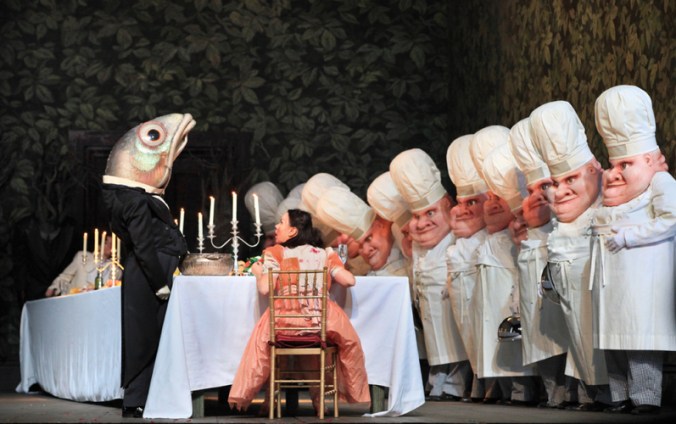
Robert Krulwich has more to say on topics we referred to in several links and observations about dwindling fisheries. Is it just a matter of perception?
Yes, there are more and more people on the planet, and yes, there are fewer and fewer fish in the sea, but do we really notice? After all, fish live in water and we live on land; so we don’t mingle that much. If fish were sparrows, we might see a dramatic decline, but who misses what they don’t see in the first place?
Click the image to go to the full line of reasoning.
Report To Greco
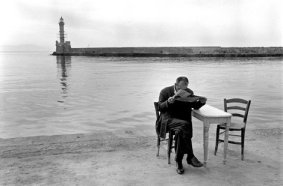
Man reading, Chania, Crete, 1962 (Costa Manos/Magnum Photos)
Click the photo to go to the recent post titled “Do We Need Stories?” in the blog site of the New York Review of Books. It starts out:
Let’s tackle one of the literary set’s favorite orthodoxies head on: that the world “needs stories.” There is an enormous need,” Jonathan Franzen declares in an interview with Corriere della Sera (there’s no escape these days), “for long, elaborate, complex stories, such as can only be written by an author concentrating alone, free from the deafening chatter of Twitter.”
Selective Pantheon
The Guardian, more than most newspapers, investigates and reports stories of historical-scientific “cabinet of curiosities” value that match our interests on this site. This slide show below is an example, and is worth a visit.
It is a side show, actually, from a story the paper covered titled “How a book about fish nearly sank Isaac Newton’s Principia” (also worth a visit) and had the subtitle “Poor sales of lavishly illustrated book forced Royal Society to go back on promise to finance publication of Newton’s Principia;” so if pictures intrigue you visit their site and read the captions for each image.
 Organikos