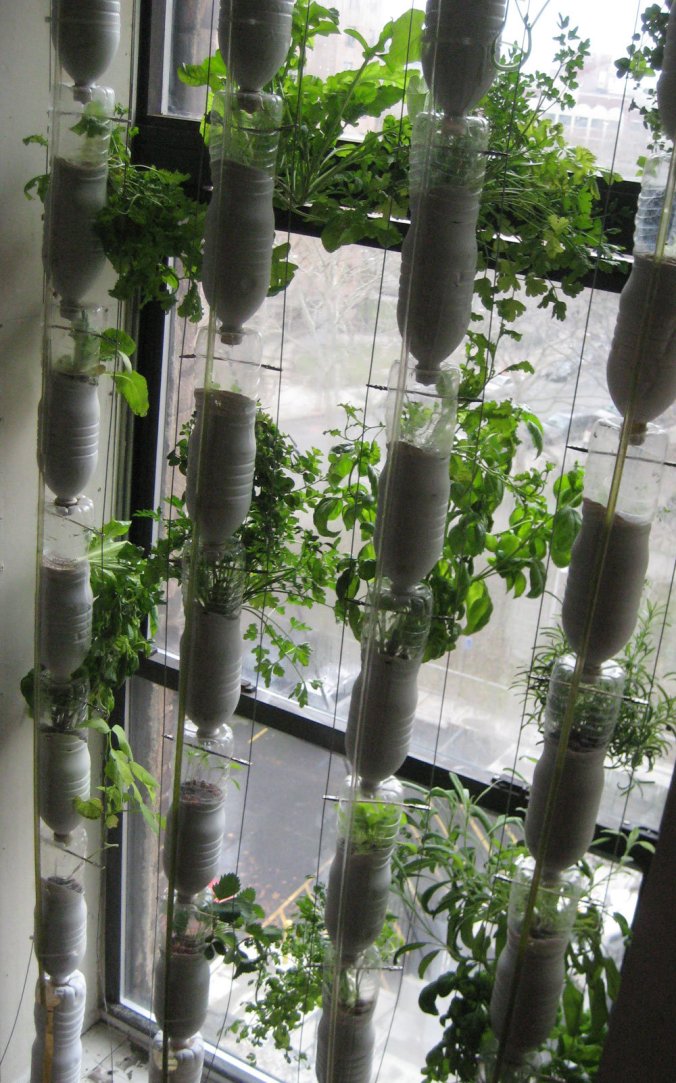
Windowfarms: More on Urban Gardening

farm_custom-2a86023b839fde19ab5b5cdd1b444eed2eceb533-s1100-c85.jpg
In one of my earlier posts, I discussed some of the basics of hydroponics, one of the less popular but more efficient forms of urban gardening. Today I won’t discuss the technical aspects of hydroponic gardening, but display an example of an entrepreneurial venture taking advantage of the underdeveloped market. Most people with hydroponic gardens are either aficionados or professionals – very few grow soil-less produce casually.

Windowfarms, an American open-source project concerning itself with urban agriculture, not only offers the blueprints for solar window-contained hydroponic gardens, but also the option of purchasing a kit of varying dimensions (for those less comfortable with the technical specifications). In addition to its mission of reducing urbanites’ carboon footprints by enabling them to grow their own produce, Windowfarms are being used to educate schoolchildren on the benefits and ease of urban farming.

K-12 Growth

Last month I wrote about the Dunwoody Community Garden, and commented on my surprise at its seemingly exponential rate of growth and improvement. I also promised to check out Dunwoody High School’s (DHS) current involvement with the community garden, and I can finally deliver on that one:

Grow Dunwoody is a community enterprise designed to bring gardens directly to Dunwoody’s schools. According to Danny Kanso, a senior at DHS, the purpose of the program is

to integrate hands-on learning into science, wellness, and special education, to produce renewable classroom and community resources, and to instill sustainable practices and values within our student body.

Continue reading

The Structure Of Relevance

In bringing stories of community, collaboration and conservation to these pages, we try to rhyme as much as we try to reason.  The rhyme can come in visual format, for example with photos like these, or like these; combinations of photos and video like these and like these.  We also share plenty of rhythmically-accompanied visuals as well as links out to items that seem to be in the general spirit of what we do when we are not contributing here.

But writing about our activities with meaning, in words, is what we hope to do best on this site. Writing (and reading) are just as important as the visual and aural cues we bring attention to, and our Contributors are committed to writing as an art form.  So it is worth noting the master of long form journalism on some fundamental ground rules of telling a story well.  John McPhee interviewed in The Paris Review:

Structure is not a template. It’s not a cookie cutter. It’s something that arises organically from the material once you have it. In “The Encircled River” I go to Alaska, and make that trip, and soak up that world. And when you’re up there, the most impressive thing is the cycles of that world.

Continue reading

“Go Green, Young Man (or Woman)…!”

When Horace Greely (well, actually John B. L. Soule) said “Go West, young man, and grow up with the country!” he was speaking from the perspective of limitless possibilities. The Lewis and Clark Expedition had helped map out the west and many young men, and later women, answered the call.

With wilderness in peril, that same entrepreneurial spirit has opened up a new world of empowerment and possibilities for later generations. The California Conservation Corps and Southwest Conservation Corps have teamed with the non-profit Veterans Green Jobs in a win-win program to support both the country’s military veterans and the country’s national parks. Continue reading

Water Harvesting & Accumulated Wisdom

As Gourvjit pointed out in an early post, Cardamom County is in the process of revamping its water management systems.  The search is still on for learning resources.  Besides an accent and wit that are mesmerizing, this man’s stories and visual accompaniments are stunning.  Learning is sometimes a simple matter of respecting elders.  Especially those who are so at ease on a stage as big as this one.

From Sea to Sand

There seems to be no limit to the spirit of creativity!  Art often represents a “call and response” relationship to the natural world.

Water is elemental.  Earth and wind follow.   Are these the mechanics of life?

Honey, Hope & Future Cod

Milo’s post yesterday is of special interest to various initiatives we support related to food.  We will have much more to say on bees (and honey), but for now, it gets us thinking. Combined with Seth’s recent post, touching on the subject of overfishing (do read Mark Kurlansky’s books related to food, in addition to Cod), provide a reminder to stop and take a breath.  In a world full of challenges that daunting, how do we keep our wits about us?  How do we remain, fundamentally, hopeful?  An answer, but not necessarily with explanation, can be found sometimes in art (defined as you choose).  If we do not solve the tragedy of the commons with fisheries, might we still hope for a beautiful future for marine life that looks something like this?

Copyrights & Creativity

After a bit more investigation, without even getting any lawyer friends involved, it becomes clear that there is plenty of thought going into the question of how Alan Lomax might own some of Jay-Z’s stuff.  This simplifies the history for us:

Nature’s Art

Our relationship with the natural world has shifted considerably along with our technological advances.

The drawings in Lascaux morphed into Egypt’s hieroglyphs; into Greece’s elaborately painted frescos and urns; into the Renaissance’s Nature morte. 

Photo by Milo Inman

But the more precise the depiction became, the more likely it was that the animal in question had to meet its demise in order to be immortalized. Continue reading

Lomax Legacies

Creative effort always deserves credit, and on occasion deserves valorization.  The fellow that drew this chart definitely deserves credit:

He has done his homework, both musically and legally, to deliver a punchy sermon with good graphic and multi-media accompaniment. His moral question for us to wrestle with:

grateful as I am to Alan Lomax for recording and disseminating so much great folk music, I remain baffled as to why he was allowed to copyright it. Our creative heritage deserves better stewardship than our current laws provide.

Continue reading

Nature Trumps

Following the line of thought in my previous post concerning the technological reproduction of biological processes, I was somewhat astounded when I read here that in the quest for efficient MAVs (micro air vehicles), nature has once again surpassed all engineers’ attempts to successfully manufacture functional diminutive aircraft. I write about this not because of its significance as a military breakthrough (which is no doubt the main purpose of the field of research), but because of the evidence it offers that nature trumps artifice.  Whether by divine design or simply millions of years to evolve the most efficient biological machines possible, nature (in all ways, shapes, and forms) is itself our greatest resource – in all fields.

“I just want to say one word to you. Just one word….Plastics” *

Yes, Plastics.  That ubiquitous, universal petroleum product that no one but a Hottentot can pass a day without touching.

It’s impossible to conceive of a world completely devoid of plastics, but we certainly can conceive of alternatives to at least some of its uses.  Forums such as Fortune’s Brainstorm Green bring together innovators and day dreamers with tangible results.

Eben Bayer and Gavin McIntyre, co-founders of Ecovative Design, aren’t much older than Benjamin Braddock *  was when he received that erstwhile advice. Continue reading

Don’t Honk To Change The Rules

Guest Author: George M. George

Driving in Kerala sometimes makes me wonder whether Dante failed to describe an essential part of that descent into the inferno.

A recent advertisement for a major automotive company actually made this statement: Make Your Own Rules.

Oh. Thank you so much. It seems that most drivers here have in fact made their own rules and do not care how the ‘game’ is played as long as they win. So it is imperative that when you get here you opt for a slower, safer drive to your destination by asking your driver to go easy on the right pedal.  If you do so, you will actually enjoy the scenery, of which there is plenty.  But, you will still have the sonic thrill of your life. Continue reading

The Gadus Commons

William Bradford, governor of Plymouth Colony in Massachusetts for much of the first half of the 1600s, from whom North Americans  have inherited the notion of  communal Thanksgiving (and incidentally my grandfather 26 generations removed) noted:

The major part [of the Pilgrims] inclined to go to Plymouth chiefly for the hope of present profit to be made by the fish that was found in that country (Cod; 67).

Fast forward a few centuries.  Bottom trawling, longlining, and gillnetting during the 19th and 20th Centuries were probably the most responsible for cod’s population decline in North America. Faced with the same great abundance that had helped bring settlers to Cape Cod, huge fishing companies acted rationally to maximize their own gain, taking advantage of the bountiful commons, and this led to ruin. With the near disappearance of cod came the absence of herring, capelin, humpback whales, and squid. Continue reading

Wordsmithing: Market

Amie has written about market in various contexts, making use of both its verb and noun form.  In our day to day activities, we are motivated by entrepreneurial conservation, by which we mean market-oriented solutions to complement the efforts of NGO, philanthropic and governmental efforts to preserve ecosystems and maintain the vitality of cultures.

We abhor all things fundamentalist, so the cliche of the University of Chicago notion of markets is not one we cling to (nor is the cliche apt anymore; see their contributions in the realm of behavioral economics to get a sense of where this great institution is heading in terms of hegemonic ideas).  The same goes for the fundamentalism that has prevailed in the world of conservation–a belief that markets cause environmental problems but cannot provide solutions.  So, in the spirit of tamping down fundamentalism of all kinds, we might look at the marginalia of this word’s definition, rather than OED‘s definition itself, as we otherwise systematically do:

Proverb: you may know how the market goes by the market folks.

We adapt this, in our daily work, to mean: let’s be realistic while we attempt creative, fun approaches to serious problem-solving.

The Passions of Nature

Events around the globe provide examples of Mother Nature flexing her proverbial muscles, humbling the strongest among us with her power and reminding each of us who is boss.

But if “hell hath no fury like a woman scorned” we can also remember that same potency is the very stuff of life itself.

Big Ideas, Inclusive

We’ve made a few references to Big Ideas–first to raise the gauntlet and recently intending to drop it. One paragraph from this article set our discussion in motion:

But if information was once grist for ideas, over the last decade it has become competition for them. We are like the farmer who has too much wheat to make flour. We are inundated with so much information that we wouldn’t have time to process it even if we wanted to, and most of us don’t want to.

David Carr, writing about how Steve Jobs has changed the landscape of multiple businesses, has added a nice twist to the discussion by noting how ideas can become outsized when they take shape as things in a particular way: Continue reading

Cool, Cool Water

Our quest to find new, ever-more effective ways to live well and responsibly (simultaneously), if not Big Ideas, sometimes leads us to counter-trendy moments of truth.  It feels right to discuss sustainable development using the language that has been in circulation for 25 years or so:

meet the needs of the present without compromising the ability of future generations to meet their own needs

Yet, it was a refreshing splash of water on the face, a dash of realism, to read the last line of this brief profile:

…Lassoie’s personal belief that no one wants to sacrifice their present condition for the condition of future generations.

“I’ve never met anybody anywhere who would sacrifice their children for their unborn grandchildren,” he said.

Read the article to understand the context, and you may find yourself thinking about returning to graduate school if you consider this kind of conundrum (truly good statements contrasted with realistically true statements) fascinating, as we do.  Finding this profile was an extension of our investigation into the resources at Cornell University related to sustainable development and conservation, which previously led us here.

A “Travel” Book That Moved Me

If you have already read his more famous books, and enjoy his writing, you will wonder why this one is not considered among Umberto Eco’s most important.  He does not even mention it in one of the best interviews he has granted in the English language.

Strange. My being in India now is at least in part due to this book. For the work we do it is an illuminating text, in an Eco-intuitive, not everything is as it seems kind of way. If I made a list of top 10 choices for the one book to take on one of those desert island strandings, this would be on it.

If Willie Says So

The ideas are all ones we agree with: food transparency, corporate social responsibility, activism, etc.  We do not know much about this company, but if Willie lends (or even sells) his credibility to them, we are inclined to support their campaign: