Hit Record

I like Joseph Gordon-Levitt.

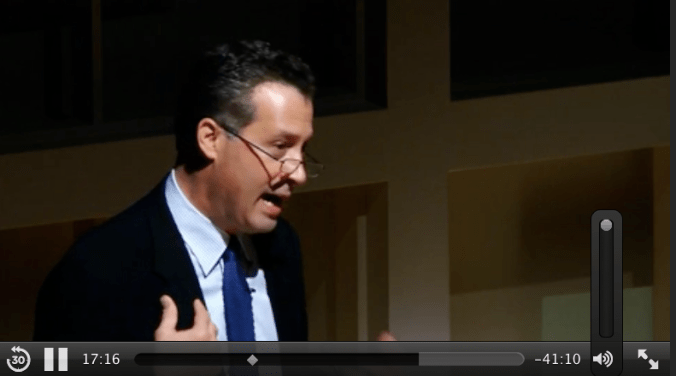
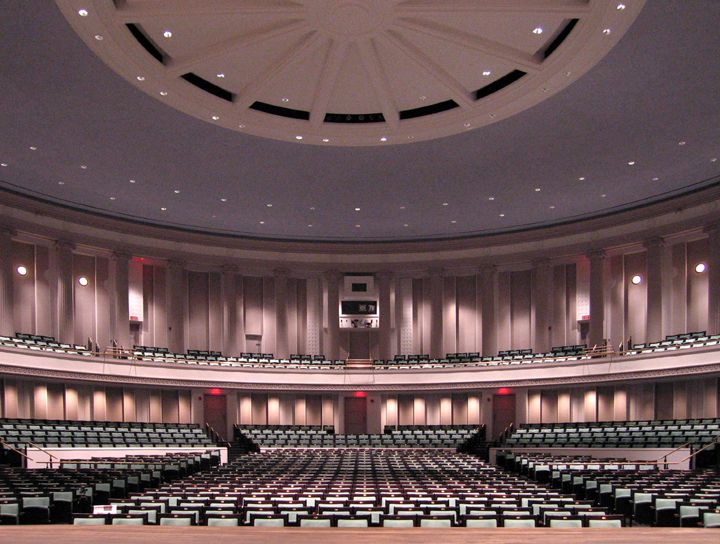
“I feel like, Socrates, or something,” said actor Joseph Gordon-Levitt while looking out at the crowd framed by the round and columned architecture of Bailey Hall.

That’s why, several months ago, when I learned he was coming to do a show in Bailey Hall at Cornell, I committed to waking up early and facing the failing web servers to buy two of over a thousand tickets that were to sell out in less than half an hour, making the show the fastest to sell out at Cornell in a while. And I only bought two because that was the limit per student — by the time I got through to the webpage only balcony seats were left. Continue reading

Brand Bubble Bursting

crist

P.T. Barnum (perhaps apocryphally) is often quoted as having said that a sucker is born every minute.  Damien Hirst, who has parted many people with their money for things that have his “brand” attached, and now boasts an estimated $350 million personal fortune as a result, could be Exhibit A in Barnum’s argument.  This guy has sold some remarkable clothing to quite a few emperors.

Yes, these are highly subjective matters, and if you want to call Hirst an artist you have every right to do so.  But he makes his own case for being something other than an artist in any meaningful sense of that word, and he makes it difficult for the average person from “outside the art world” to take the “art world” seriously.  Is the market catching up with this slick marketer?  Click the image above for the graph and short blurb version, or for the long form journalistic pin prick in the big bubble click here:

For all his celebrity, Hirst’s stock in the art market has experienced a stunning deflation. According to data compiled by the firm Artnet, Hirst works acquired during his commercial peak, between 2005 and 2008, have since resold at an average loss of 30 percent. Continue reading

Crowd-sourced Project Finance 101

Recently, I happened upon the pitch above and was at first thrilled to see yet one more alternative approach to raising awareness and appreciation for nature: good production values and the style is quirky and fun.  The Kickstarter pitch came midway through and then my thoughts started wandering. Continue reading

Caleb Crain & Collaborations (Literary, Historical, Cetaceous) That Feed The Mind

Several of us at this site have been fans of the historically-inclined long form journalism of Caleb Crain since reading this book review several years back.  It started there with whales (for us), but certainly did not end there (for him).  Click the image above to go to the reading of Moby Dick Chapter 4, or here to read more about the concept of this collaborative “program” that he is participating in:

In the spring of 2011, artist Angela Cockayne and writer Philip Hoare convened and curated a unique whale symposium and exhibition at Peninsula Arts, the dedicated contemporary art space at Plymouth University, under the title, Dominion. Inspired by their mutual obsession with Moby-Dick Continue reading

Chocolate & Nobel Prizes

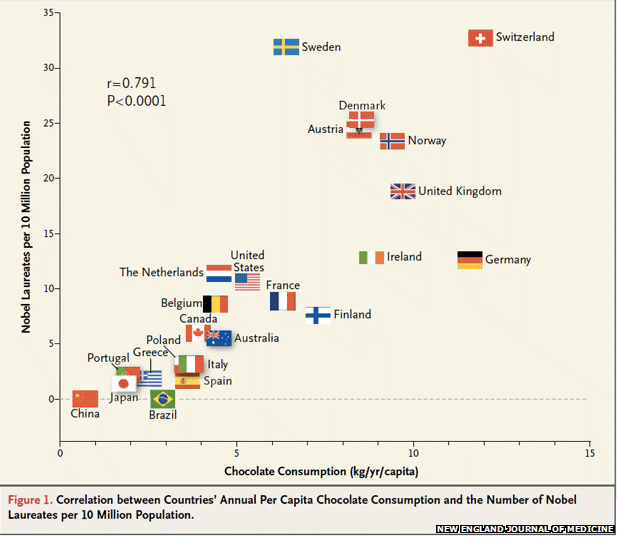
Most reporting on this recent scientific finding had a fun spin, for obvious reasons.  But was it Ig-worthy work?  While only subscribers to the New England Journal of Medicine can access the study directly, the most serious review (and the most entertaining illustration) of its significance is here:

In the study, Messerli explains:

“It seems most likely that in a dose-dependent way, chocolate intake provides the abundant fertile ground needed for the sprouting of Nobel laureates.  Continue reading

Ambience, Raxa & You

Photograph by Michiko Nakao accompanying “The Discreet Charm Of Ambient Music” from the New Yorker website’s Culture Desk

Raxa Collective, an affiliation of conservation-oriented enterprises employing 180+ people serving 25,000+ travelers each year, looks from some angles like it is in the resort business.  It is.  But it also is not.  Among its several founders there was much discussion at the outset along the lines of: does the world really need another of those?

Not really.  So it is not a resort business any more than it is a conservation NGO (which it is also not, but from some angles it might look like one), a learning laboratory (which it is and is not) or a distribution channel for ornithologically-inclined photographers (ditto).

If there were to be a book called Resort Confidential it would be an insider’s view of all that should change in the resort industry globally.  We would hope to write a seminal chapter in that book.  We would not want to write the whole book.  We love company.

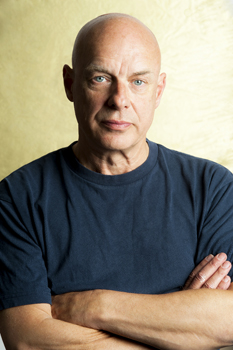
One inspiration is Brian Eno. A reminder of this is in Joshua Rothman’s review of Eno’s pioneering role in the evolution of, and his most recent contribution to, ambient music. Excerpting that review, it could be said that we hope to accomplish with our activities at Raxa Collective what “Lux” accomplishes musically:

…Ambient music isn’t like pop music. It doesn’t want the spotlight, or to conscript your body and mind. Instead, it aims to transform and divide your attention in more subtle ways…At the ideal, low volume, you’re aware of the music. But you’re equally aware of the way that it frames the other sounds you’re hearing and making: the traffic in the street, your own breathing, the keys on the keyboard, the creaks in the floorboards, the rustle of your clothes when you move. You’re also more in touch with the small inflections in your own moods. Each key change, and each new instrument, with its new timbre, is an opportunity to measure the difference between the feeling of the music and your state of mind. “Lux” is fascinating as music. But it also makes the world more fascinating. It’s a catalyst for consciousness and self-awareness…

Loving company, we invite you to sample.
Art From The Insanely Curious

Artists of many varieties stay mum about their craft and intent, perhaps for reasons best captured in these words. Whether you are interested in the arts or not, the individual pieces in this video installation provide a unique view into the process of creativity–a subject any of us can make use of, or simply appreciate. Click the image above for the video.

If You Happen To Be In Liverpool

Click the image above for more information on the exhibition. In case you cannot make it there in person, click the link below to see Doug Aitken’s films:

Tate Liverpool: Exhibition 15 September 2012 – 13 January 2013. Films from Doug Aitken – The Source will be published in the Channel each week… Continue reading

Horsepower In Context

By now we all know the importance and value of recycling, right? Right. Except when wrong. So, to be clear in case my occasional thoughts of science writing as a career go somewhere: I am in a course that requires my written reflection on some amazing books and articles related to environmental history. Raxa Collective, whose blog I have been contributing to since mid-2011, has asked me  to recycle some of that work for the sake of its readers.  Agreed.  I hope we are all right, alright?

First, one thing I am learning in university is that it is never too late to review literature. Some posts on this site point to evidence in favor of that idea. Ann Greene’s Horses at Work is just a few years old (whereas Swerve is a review of poetry from millennia past) but is already part of a canon: it made the cut for this course. Continue reading

If You Happen To Be In New York

The moderator, in particular, is a favorite food writer of mine so I must suggest this if you are a passionate participant in the food world, professionally or as a consumer:

Join food-world luminaries including Bill Buford, Will Guidara (co-owner of Eleven Madison Park), and Maguy Le Coze (owner of Le Bernardin) at 92YTribeca on Thursday, November 15, for a discussion with author and Financial Times restaurant critic Nicholas Lander in celebration of his new book, The Art of the Restaurateur. The panel, moderated by Buford, will discuss the role of the restaurateur in the age of the celebrity chef. Tickets are $18.

Humans Read Stories For Perspective

We are anchored, as an organization, around experiential learning and action, not only for our interns but also in/for the communities we are part of.  But this bias itself is informed by the opportunities many of us have had, through education, living in cultures other than those we were born into, access to libraries, or work experience early in life, to read our way to better understanding.  We have plenty of diverse posts on this topic. In a couple of minutes, the video above sheds light on why this post, and a few follow-ups by one of our first contributors, set the bar for what we see on a good day: with the aid of good literary perspective, we can describe our experiences in a way that benefits others.

An Award, In A Word: SafetyNet

Safetynet won this year’s James Dyson Award and is explained on the website of that award program:

Function

The goal of the SafetyNet system is to make commercial fishing more sustainable by significantly decreasing the numbers of non-target and juvenile fish caught during the trawling process. Escape Ring devices form a part of this system, and are currently the focus of the development work. The rings tackle the problem of

Continue reading

Humans Tell Stories For A Living

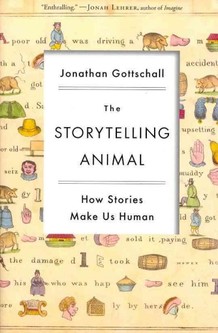
A great conversation with the author of this book is podcast here thanks to PBS and its contributors.  In the current issue of American Scientist, a review:

Gottschall clearly considers it safe to say that storytelling has something to do with helping us navigate our social worlds, since we are such thoroughly social animals: “We are attracted to fiction not because of an evolutionary glitch, but because fiction is, on the whole, good for us. This is because human life, especially social life, is intensely complicated and the stakes are high.”

Continue reading

New York Public Library Is Privileged

If you have an interest in books and especially their role in libraries, as we do here because of their educational and cultural contributions to communities, you could not have ignored the stories of this man‘s shift from leading Amherst College to his present role at the New York Public Library.  Looking at NYPL’s history, from the 19th Century to more recent times it seems on occasion more like a tool for the aggrandizement of wealth and privilege than a public institution.  But not so, or not entirely so.  Speaking to research librarians in an hour-long gentle provocation, NYPL’s President and CEO frames its role in a manner any modern library lover must be willing to speculate on:

Research libraries have long been considered the intellectual hub of a community, whether it’s a university or a city. With the shift to digital content, network-based services, and globalization, research libraries have been challenged to adapt in unprecedented ways. Some even question their ongoing importance.

Orion Nature Quarterly’s Online Evolution

From a magazine we appreciate for its 30+ years of awesome long form non-fiction writing on important issues related to nature, as much as its audio-visual contributions on the same, in the item featured here:

Photographer Douglas Gayeton explains the genesis of his giant-sized, mural-like photos designed to protect from corporate marketing the meaning behind the words we use to describe sustainability. The project began as a language experiment in Tuscany, Italy.

Writer’s Craft

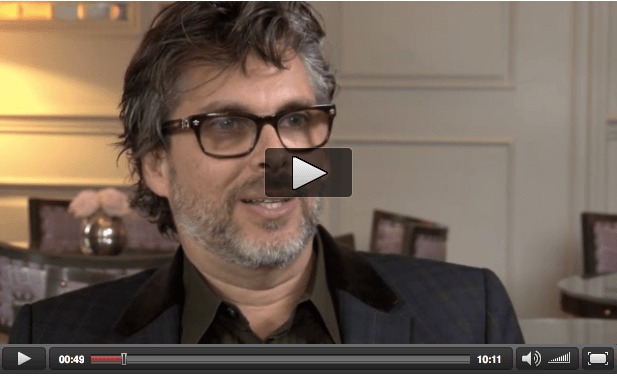
There will never be a need for Chabonologists in the way there are Dylanologists.  The market for anyone-ologists is created by artists (novelists, poets, song-writers included) who cannot or will not talk about their work. Capable and willing artists seem to be the exception rather than the norm so we celebrate them when we find them. Chabon is a superb conversationalist, and is on on the road talking about his book. Thankfully he spent some time with the Guardian‘s great Sarfraz Manzoor describing the inspirations behind Telegraph Avenue.  Click the image above to go to the video.

Every Day Moments, Poetically Described

If you did not know his poetry already, here is as good an introduction as any.  If you knew his work but had not seen or heard him, this is worth the few minutes he commands of your attention.  And if you thought poetry was in decline as an art form due to decreased interest in a multi-media-saturated modern world, you may have been right; or wrong.

Favored Food Journalism

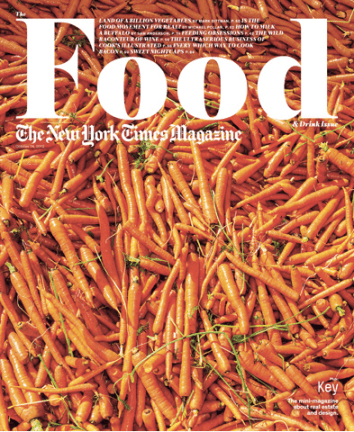
One of our favorite annual food-related publishing traditions has come to pass, again.
Mark Bittman (“California’s Central Valley is our greatest food resource. So why are we treating it so badly?”) has an excellent contribution.

And Michael Pollan (“Is this the year that the food movement finally enters politics?”) covers a topic that, four years ago, got us thinking he might be tapped for a [Hope + Change] Cabinet position.

Both of these are worth the click (among your 20 free clicks per month if you are not a subscriber) and the read time:

1.  Vote for the Dinner Party

2.  Everyone Eats There

What Makes the Baya Weaver’s Nest a Baya Weaver’s Nest?

“Pick a nest.”

It was the first day of my architectural design studio class and we were told to pick a nest, any nest. I knew this was going to be a great semester: the first assignment was seemingly random, kooky, and just a little ‘out there.’ I was excited! As an architecture student, I love when things are approached in such a non-traditional way.

I know what you must be thinking: aren’t architects supposed to be designing buildings for people? Why are you looking at bird nests?!

I, too, was confused, but I didn’t question it because I had a really cool nest in mind. Because I spent the summer in India with bird-lover and birder extraordinaire, Ben Barkley, the Baya Weaver Bird, who builds its iconic hanging nests around the backwaters of Kerala, was an obvious choice.

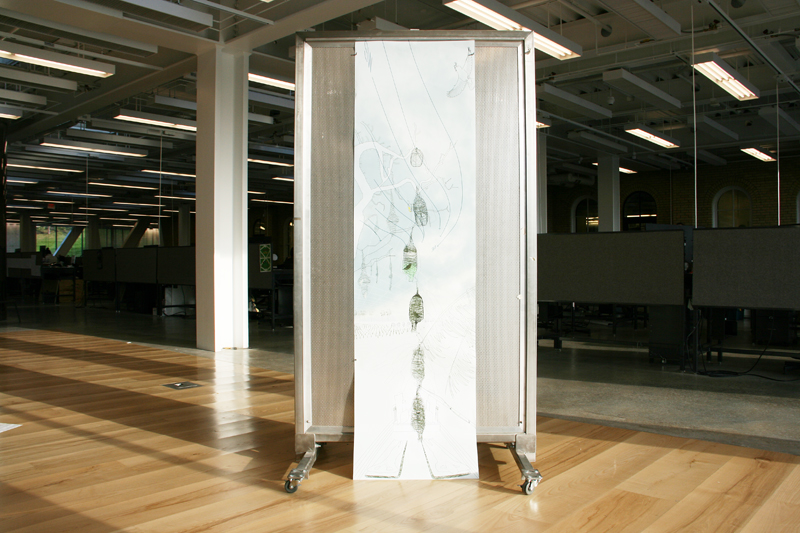
Here are my “comprehensive drawings” of the Baya Weaver Bird that attempt to explain the complex relationships the bird maintains with its surroundings.

2nd Draft of Baya Weaver Nest Comprehensive Drawing (By Karen Chi-Chi Lin)

My 2nd draft of Baya Weaver nest comprehensive drawing (Photograph and drawing by Karen Chi-Chi Lin)

Continue reading