The Universe is a Circle; Except When It Isn’t

Collaboration is dear to our hearts, whether it be interpersonal, international or intercollegiate, not to mention intercorporate to coin a phrase.  I couldn’t help but recall our posts on Elif Bilgin and Sush Krishnamoorthy when I came upon this video and read the bio of Shixie (Xiangjun Shi), the creative force behind it. Kudos to Brown University and RISD for having such an impactful program!

When I left home for college in the US, I was fortunate to be selected for the very first class of a new Dual Degree program, presented by Brown University and Rhode Island School of Design. WIthout predecessors, and in trusting embrace of Brown’s open curriculum, I was pretty much able to design my own education. Continue reading

Reading, Libraries & Good Citizenship

'We have an obligation to imagine' … Neil Gaiman gives The Reading Agency annual lecture on the future of reading and libraries. Photograph: Robin Mayes

‘We have an obligation to imagine’ … Neil Gaiman gives The Reading Agency annual lecture on the future of reading and libraries. Photograph: Robin Mayes

Libraries still have enough friends that we do not yet count them out, but the challenges they face are undeniable. Thanks to the Guardian‘s coverage of one prominent writer’s address on this important topic:

Neil Gaiman: Why our future depends on libraries, reading and daydreaming

A lecture explaining why using our imaginations, and providing for others to use theirs, is an obligation for all citizens

It’s important for people to tell you what side they are on and why, and whether they might be biased. A declaration of members’ interests, of a sort. So, I am going to be talking to you about reading. I’m going to tell you that libraries are important. I’m going to suggest that reading fiction, that reading for pleasure, is one of the most important things one can do. I’m going to make an impassioned plea for people to understand what libraries and librarians are, and to preserve both of these things. Continue reading

If You Happen To Be In New York City

New York University’s Institute For The Study Of The Ancient World is hosting an exhibition that speaks to those of us who love maps and the ideas they represent in historic as well modernistic terms. (GPS-guided navigation systems, we love you, but this is about your ancestors). Those ideas can be as simple as “Getting From Here To There, In Hindsight,” which might have been a subtitle to this exhibition:

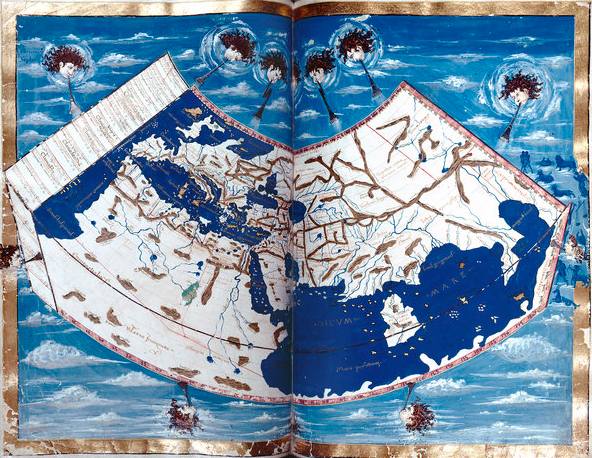
Measuring and Mapping Space will explore the ways in which ancient Greek and Roman societies understood, perceived, and visualized both the known and the unknown areas of their world. It brings together more than forty objects, combining ancient artifacts with Medieval and Renaissance manuscripts and printed books that draw upon ancient geographic treatises. Together, they provide a fascinating overview of Greco-Roman theories of the shape and size of the Earth, ancient methods of surveying and measuring land, and the ways in which geography was used in Roman political propaganda. A specially designed multimedia display examines the increasing importance of modern technologies in mapping the ancient world. Continue reading

Happy Birthday, Mahatma, And Thanks Also For The Mangos

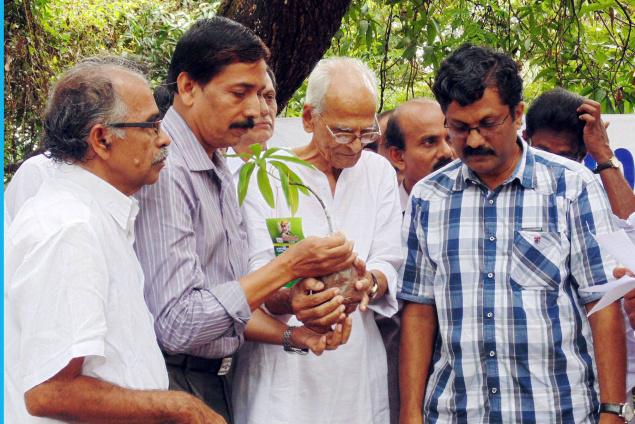
The freedom fighter Appukuttan Poduval handing over mango tree grafts cultivated from shoots of the historic mango tree planted by Gandhiji at Payyannur in 1934.


Nonviolence. India. Artisanal salt. Artisanal everything else. Among the many reasons to celebrate his birthday today, Raxa Collective is pleased to have learned and is happy to share:

Planting saplings grafted from twins detached from a Malgoa mango tree planted by Gandhiji at Payyannur nearly eight decades ago is a novel way of celebrating Gandhi Jayanthi. Continue reading

Hermes, Circa 1979

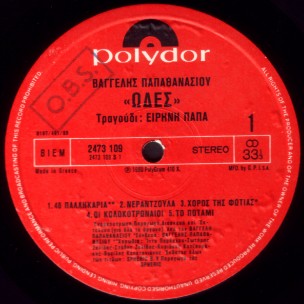
OdesLPLabelAt Easter time, 1979, my mother and I traveled back to Vourthonia. Musical soundtrack can accompany an occasion in life, just as in film. Vangelis, in collaboration with Irene Pappas, had just released the soundtrack for that visit.  Click the image to the left to read a bit about the album; better yet find the music and listen.

The lamb had been over the fire since morning, and was now on the table. Feta, salads, and the best olives in the world were there too. That music was playing from the open doors of an old VW Beetle parked near where we were sitting–my mother, many villagers, and me. That god gave safe passage. Continue reading

Photographic Wonder

Marvin Heiferman. Photo: Alex Welsh/WIRED

We know that one day, hopefully not too far off, the wunderkind of La Paz Group’s photographic contributors will get his gear fired up and we will be displaying his latest wonders here again. We hear that his hiatus in Ithaca, NY since about one year ago has run its course, full of fascinations, back-looking reflections, photographic recapitulations, and even small distractions. Onward, westward, as ancestors of his did in previous centuries. More from Milo soon, we hope.

Meanwhile, on the topic of photography and wonders, Wired offers an interview to illuminate what might not otherwise be obvious at first glance:

For his book Photography Changes Everything, Marvin Heiferman spoke to experts in 3-D graphics, neurobiology, online dating, the commercial flower industry, global terrorism, giant pandas, and snowflake structure to understand the infinite ways imagery affects our everyday lives… Continue reading

Urban Muse

This slideshow requires JavaScript.

It does not matter whether you are a farmer, a geneticist, or whatever you do with your time: you will almost certainly be affected in important, unexpected ways after time spent in Paris.   Continue reading

Impossible, Past Tense

There are already more than a million views of this, in what looks like one day’s time (but may be a hoax and may be old news, but does not look like either as this is posted, so we hope to add to the hype if we are correct).  Thanks to the folks at The Verge for this story:

A Canadian duo and their Kickstarter-funded, pedal-powered helicopter have won one of the longest-standing challenges in the history of aviation — keeping a human-powered aircraft hovering up in the air at height of at least 9.8 feet, within a 32.8 by 32.8-foot square, for 60 seconds minimum. The challenge, known as the Sikorsky prize, has withstood at numerous failed attempts since it was established in 1980, 33 years ago, even with a $250,000 bounty. But it was finally bested earlier in June by the Atlas, a gigantic human-powered helicopter designed by Cameron Robertson and Todd Reichert, aeronautical engineers from the University of Toronto, who cofounded a company AeroVelo. Continue reading

Smiling, Thinking Of Math As Language

Planning our work with communities in diverse locations, language is a challenge, a puzzle. We are constantly on the lookout for new ways of thinking about how to resolve this puzzle, so when we hear this fellow speak on the topic, it makes us smile. Nothing to do with conservation, but everything having to do with community and collaboration at a very fundamental level, we thank Open Culture for bringing this wonderful recording to our attention:

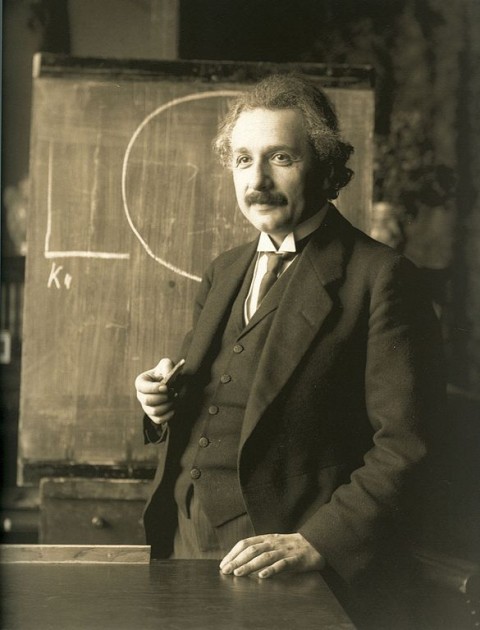
The essay is called “The Common Language of Science.” It was recorded in September of 1941 as a radio address to the British Association for the Advancement of Science. The recording was apparently made in America, as Einstein never returned to Europe after emigrating from Germany in 1933. Continue reading

Birthday Present For Mr. Tesla

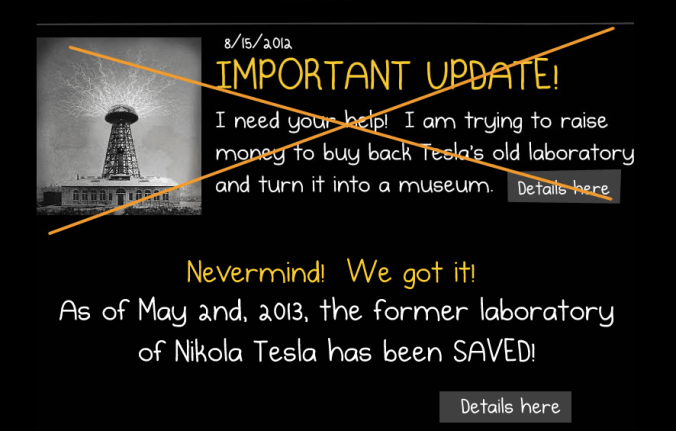
Last August we recommended reading to the end of Mr. Inman’s mischievously hilarious tribute to Nikola Tesla, partly because every bit of it was great, but the end asked for attention to an initiative that rang true to us: the conservation of patrimony related to this exceptional man.  A couple months ago, when we saw on Mr. Inman’s site that the initiative had succeeded we decided to investigate further before celebrating this. Now, in honor of Tesla’s birthday, seems like a good time to highlight it.  Click the image above to see the results.  There have been some birthday tributes to Tesla elsewhere and we share one of those as well. Continue reading

Conservation Is Sometimes The Story Of Change

Click above to go to the location where Cornell University is hosting this brief video by a fellow alum of several Raxa Collective contributors:

Can shopping save the world? The Story of Change urges viewers to put down their credit cards and start exercising their citizen muscles to build a more sustainable, just and fulfilling world. Continue reading

Seasteading, Self-Reliance Utopia, And Our Shared Future

An article recently published in n+1 examines a utopian futurist form of an idea that seems oddly symmetric with Seth’s posts about the history of exploration using Iceland as a case study. Looking back, we see much in common with explorers, pioneerspilgrims and adventurous thinkers of all sorts.  Looking forward, we are inclined to embrace smart, creative, enthusiastic group efforts to resolve seemingly intractable challenges. Especially when they involve living on boats. We recommend reading the following all the way through:

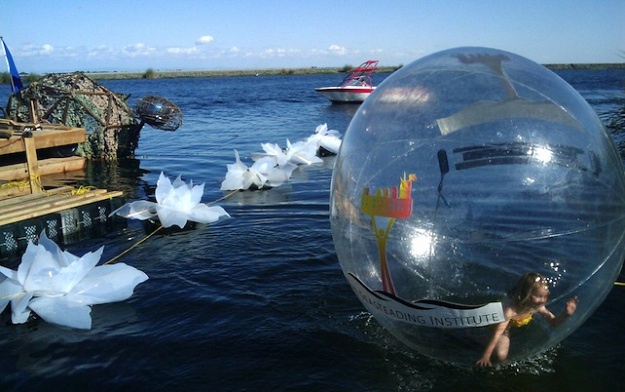
To get to Ephemerisle, the floating festival of radical self-reliance, I left San Francisco in a rental car and drove east through Oakland, along the California Delta Highway, and onto Route 4. I passed windmill farms, trailer parks, and fields of produce dotted with multicolored Porta Potties. I took an accidental detour around Stockton, a municipality that would soon declare bankruptcy, citing generous public pensions as a main reason for its economic collapse. After rumbling along the gravely path, I reached the edge of the Sacramento–San Joaquin River Delta. The delta is one of the most dredged, dammed, and government subsidized bodies of water in the region. It’s estimated that it provides two-thirds of Californians with their water supply.  Continue reading

Creative Uses Of Intelligence, Intelligent Uses Of Creativity

How smart are they? Do they drink alot of coffee?  Find out by clicking the image above, or reading the following from the article accompanying that video:

…Google X seeks to be an heir to the classic research labs, such as the Manhattan Project, which created the first atomic bomb, and Bletchley Park, where code breakers cracked German ciphers and gave birth to modern cryptography. After the war, the spirit of these efforts was captured in pastoral corporate settings: AT&T’s (T) Bell Labs and Xerox (XRX) PARC, for example, became synonymous with breakthroughs (the transistor and the personal computer among them) and the inability of each company to capitalize on them. Continue reading

False Starts, Heroic Conclusions

ESSAY: A Different River Every Time
What is ‘smart’ and how does it fit our consciousness? Is there just one way to it? Are smarter people happier, richer? The answers may not always be that obvious. by SANDIPAN DEB

…Which, of course, brings us to that common capitalist question: “If you’re so smart, why aren’t you rich?” There is something abhorrent about this query. Of course, Mukesh Ambani is super-smart, but so was Jagadish Chandra Bose, who invented wireless communication at least a couple of years before Guglielmo Marconi, who received the Nobel prize for the breakthrough (It is now established that Marconi met Bose in London when the Indian scientist was demonstrating his wireless devices there, and changed his research methods after that meeting). Bose also invented microwave transmission and the whole field of solid state physics, which forms the basis of micro-electronics. Bose’s contributions are all around us today, from almost every electronic device we have at home to the most powerful radio telescopes in the world. But he steadfastly refused to patent any of his inventions, or to license them to any specific company. Some 70 years after Bose’s death, the global apex body, Institute of Electrical and Electronics Engineers, officially acknowledged Bose to be the father of wireless communication.

This is an excerpt whose catchy question pervades an essay worth reading in full. Intelligence, specifically smart Indian people, is the subject of a whole special issue of Outlook magazine. We have pondered amazing people from India on occasion in the past, and if the brief tale above intrigues you then see this post about Tesla versus Edison, but for now Continue reading

On Language, Travel And Imagination

The snow-covered mountains and punctual trains of Montreux, Switzerland, summon childhood train sets, and the daydreams that accompanied them. (Harold Cunningham/Getty)

The snow-covered mountains and punctual trains of Montreux, Switzerland, summon childhood train sets, and the daydreams that accompanied them. (Harold Cunningham/Getty)

If we failed to get you reading him here, shame on us. If you choose to ignore this short piece of his, well, you have only yourself to answer to. He has had a running series of blog posts on the Atlantic‘s website dealing with the frustrations and wonders of language acquisition as an adult, a phenomenon several of us at Raxa Collective can relate to perfectly well.  He captures some of the many benefits of the process and the outcome, especially the collaborative part, in short order here:

When I was about 6 years old, I started collecting model trains with my father. We would assemble the track in the attic, put a foam mountain with a tunnel over the top, and, through the magic of a transformer, watch the trains make their rounds. My dad took me to train shows, and for my birthdays back then, I always got train sets or trestles. I had books on model trains, and books on actual trains. Both kinds showed pictures of big mountains parted by trains, small towns bisected by trains, and trains adorning white Christmas-scapes. Continue reading

Iceland In The Air

Lopez Williams, courtesy of FSG.

Lopez Williams, FSG

Our daily scanning of magazines, blogs, news websites, etc. for inspiration led us to the conclusion recently that Iceland has captivated a lot of minds.  We do not know why, but it is popping up everywhere.  For example, this portion of a wonderful post on Paris Review‘s website about a recent event at Scandinavia House:

…It’s a young crowd, trendy, expectant, giddy even, though I’m surprised to see so many empty seats. It turns out Scandinavia House closed their RSVP list weeks earlier, almost immediately after announcing the event, grossly botching the numbers and no doubt needlessly turning away scores of would-be attendees. But it’s no matter to those of us here—in fact it makes the evening feel all the more intimate. Continue reading

Getting It Done, With Attitude

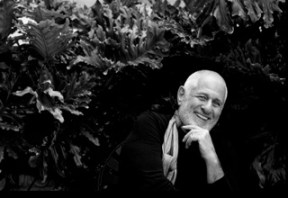
Richard_Saul_Wurman2

Harvard Magazine writes about a man we have appreciated since hearing him interviewed on a show whose podcasts with some of our heroes we have mentioned in previous posts.  It is easy to perceive Wurman as a world class pain in the neck. Listen to the end of that podcast and you learn that he is self-aware of this. For those who know ourselves to come across as unreasonable, contentious, etc. Wurman is an inspiration worthy of the pantheon:

Described by Fortune magazine as an “intellectual hedonist with a hummingbird mind,” Wurman created and chaired the TED conference from 1984 through 2002, bringing together many of the world’s pathbreaking thinkers to share their ideas and spark discussion.  Continue reading

Willfully Contemplating

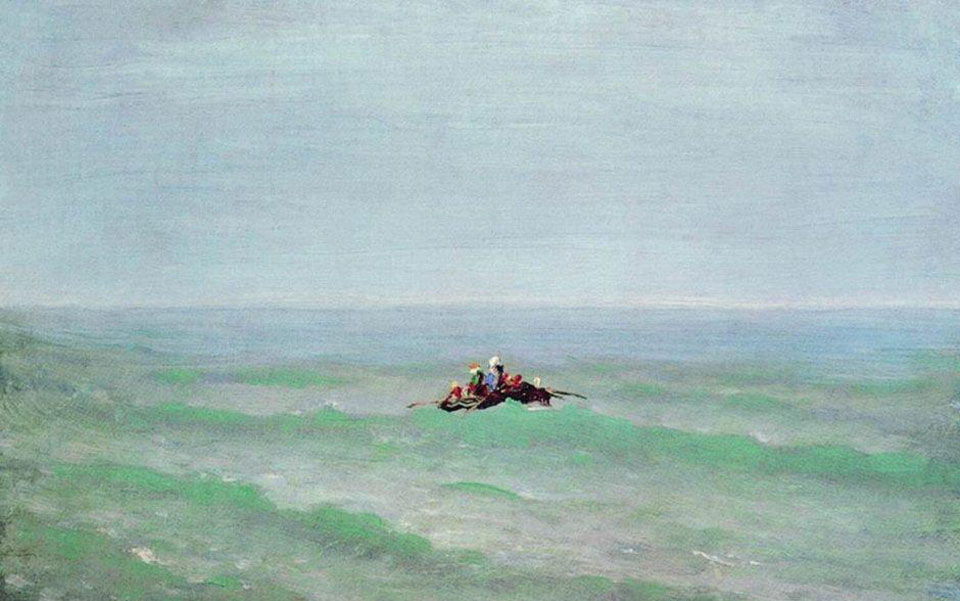
A Boat in the Sea by Arkhip Kuindzhi, c.1875. Oil on canvas.

A Boat in the Sea by Arkhip Kuindzhi, c.1875. Oil on canvas.

We tend to favor action as a general rule on this site, but without contemplation where would we be? Two choice paragraphs from a recent philosophical musing in one of our newly favored  and now reliably interesting online publications:

…After three years, I was no wiser than when I started. Did we choose freely? Or were we just victims of larger historical, social and biological forces? It was impossible to tell. What I did realise was that philosophers had been struggling with such questions for thousands of years, but were no closer to understanding the answer than they were when they started out. Continue reading

Tidy Up

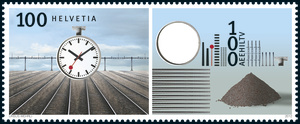
© Die Post  Swiss Post has asked Ursus Wehrli to create a tidied up stamp – the stamp is NOW available at every Swiss post office.

© Die Post Swiss Post has asked Ursus Wehrli to create a tidied up stamp – the stamp is NOW available at every Swiss post office

There is an entertaining video from five years ago of this comic artist presenting his “work” and a book review from 18 months ago on Trendland that is worth a look because it presents an excellent sampling of Ursus Weherli’s images, and you can decide relatively quickly whether you want more or not (one purpose of a book review, well fulfilled in this case:

Organizational skills aren’t usually something you look for in an artist, but in Ursus Wehrli‘s case, they’re definitely something of value…

His most famous image is likely this one below, but the stamp above commissioned by Swiss Post shows an evolution of sorts, which you can see after reviewing the images in that book review.  It also shows an idea, a concept, on a roll.  Where did it come from?  Where is it going?

theartofcleanup2

Continue reading