Naturalist Inmates

Click the image above to go to the website for this unusual linking mechanism and here in particular for the history of the program:

We connect prisons with nature.

Our mission is to bring science and nature into prisons. We conduct ecological research and conserve biodiversity by forging collaborations with scientists, inmates, prison staff, students, and community partners. Equally important, we help reduce the environmental, economic, and human costs of prisons by inspiring and informing sustainable practices.
What Box?

This slideshow requires JavaScript.

From the innovators who get paid to think outside the normal boundaries, and who brought us the disposable cup above, the website explains what they do in general and what they did in this case:

Sardi Innovation is an Outsourcing Business Innovation Center. 

Cookie Cup, “Sip the cofee then eat the cup” The cookie cup is made of pastry that is covered with a special icing sugar that works as an insulator making the cup waterproof and sweetening at the same time.

Cookie Cup [has collected] very  important Awards in Ecology, Marketing, Business Strategy and Design sectors.

Yasuni Model Of Conservation

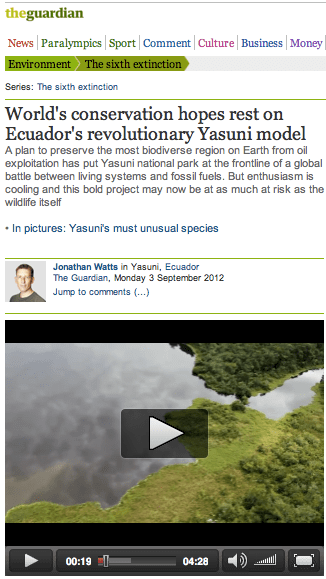
Click the headline to go to the story:

In their first hour in Yasuni’s Amazonian forest, many people will see more creatures than they have seen in their entire lives, including some that have yet to be documented by science. To paddle up the Ayango creek that leads from the traffic and pollution of the Napo river into the most biodiverse region on Earth is to encounter a wall of noise, frequent bursts of colour and unimaginable combinations of life.

A tiger heron flaps lazily past our canoe, electric blue Morpho butterflies jolt the eye, spiders the size of an adult’s hand sit on branches, and kingfishers flash past. On a mud bank, a lizard suns itself, while high up in the tree canopy, we catch glimpses of flying monkeys and grunting Hoatzin “stinky turkeys” – prehistoric survivors with claws that grow into wings…

Eine Kleine Teslacoilmusik

Thanks to the Boston Museum of Science’s Theater of Electricity for this application of Tesla genius.  We should not be surprised if, by now it may have been patented and commercialized elsewhere by some outpost of the Edisonian tradition. So what. The Tesla tribe moves in mysterious ways, and eventually prevails.

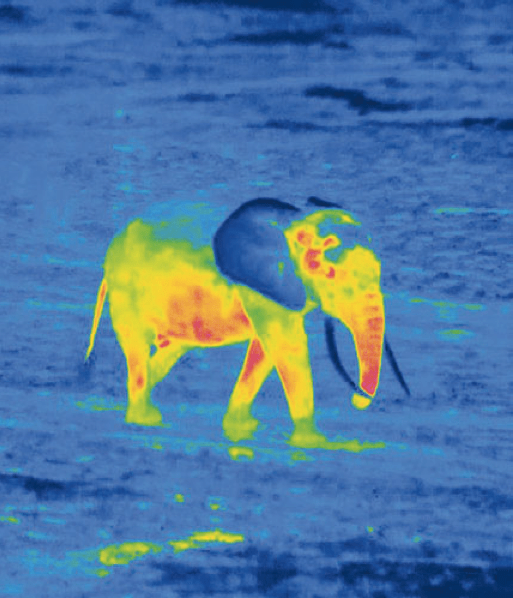
Infrared Elephants

Click the image above for the story called “Forest Elephant Chronicles” in this month’s American Scientist, about new technology for understanding elephant behavior in the wild:

…What inspired your team to try thermal imaging?

Acoustic monitoring has allowed us to study elephant behavior, without bias, over 24-hour cycles. Their activity cycle is nearly equally distributed day and night, but they prefer to enter forest clearings at night. This is where we can observe the elephants directly. We suspect that different types of interactions occur at night because the types of calls differ then. But we have only the beginnings of an understanding of what the acoustic signals mean. We need to investigate this with visual observation. Also, important behaviors may not have identifying sounds associated with them, and we need to know what these are….

Continue reading

Support Plan Bee

Click the image above to see more about Plan Bee and their tools for connecting bee-keepers in urban and rural areas around the world (strongest in their home base, the UK but awaiting your participation elsewhere):

Our Plan Bee campaign aims to address the decline in pollinators such as bees, butterflies and moths.

Continue reading

Rethinking Good & Evil

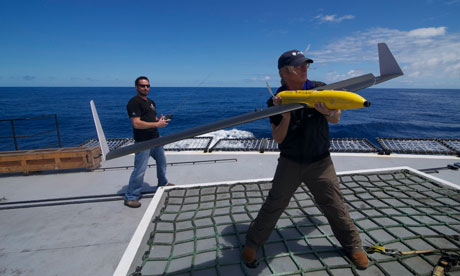
Activists launch a long-range drone from the deck of the Steve Irwin to locate a Japanese whaling ship. Photograph: Observer

If cormorants can possibly be defined as evil, can drones be re-redefined in the opposite sense in which we commonly think of them–namely related to death and destruction, including innocent “collateral damage.”  Click the image above to see what these environmental activists are doing with drones:

They are better known as stealthy killing machines to take out suspected terrorists with pinpoint accuracy. But drones are also being put to more benign use in skies across several continents to track endangered wildlife, spot poachers, and chart forest loss. Continue reading

A Learning Laboratory (Stop Motion Video!)

Yesterday, Jonathon, Siobhan, Milo, and I moved into one of the new Raxa Collective properties under development. As the four of us huddled silently under our covers, the backwaters of Kerala’s nighttime accompanied Jonathon’s ghost stories…

Instead of spooky tales, though, today I want to share with you another story Jonathon narrates, Raxa Collective presents “A Learning Laboratory.” It’s a short video, Jonathon (narrator), Sunnie (illustrator), Siobhan (director), and I (producer) put together with the help of all the staff and summer interns to highlight some of the best anecdotes of how Raxa Collective’s Cardamom County ecolodge has acted as a “learning laboratory” for its staff, international trainees, and summer interns.

Enjoy!

Understanding Social

It is not every day that a publication comes out of left field into your life and illuminates something so interesting and important.  Take a look at this article in the Columbia Journalism Review.  The issues are huge.  The characters are a mix of the usual suspects and the unusual innovators:

Jonah Peretti was 29 and had already earned a reputation as something of a wise guy. He had been a technology teacher at a New Orleans private school when he was admitted to a graduate program at MIT. His plan was to study ways networks might foster communication among teachers, but got sidetracked midway through his master’s thesis. In 2000, Nike was inviting customers to create footwear with personalized wording. The company had been criticized widely for selling sneakers made by desperately poor people in impoverished countries. Peretti, tall, skinny and bespectacled, submitted his request: He wanted his sneakers emblazoned with the word SWEATSHOP. Nike declined. At which point, Peretti did a clever thing: he e-mailed.

Collective Outcomes

Click the image below to go to the story:

An agricultural engineer, Pinto studied the islanders’ farming practice, compared crops and set up a scheme supported by Fase to carry out an expert appraisal. His ideas were well received and at the end of the first year the community decided to change the design of the macapis, the tubular cages used to catch prawn. The gap between the slats was enlarged to a centimetre, enabling baby prawns to slip through, thus improving stocks.

Collective work … on the Amazon estuary near Macapa. Photo: Gary Calton

The Upside of Empire

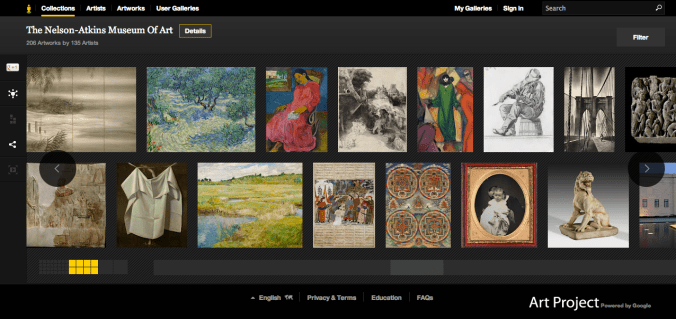
For art lovers nothing quite tops the experience of standing before a favorite painting, sculpture or tapestry, far from the madding crowds, soaking in the aura of history.  But few of us have the luxury of being able to visit the “Hermitage” in the morning and the Musée d’Orsay in the afternoon, not to mention the connections that would enable a personalize tour with the curator.

Over the past year Google has put its technological powerhouse behind a project that brings over 30,000 pieces of art from 151 museums in 40 countries into the home of anyone with a computer and an internet connection. Continue reading

Conducting, Captured

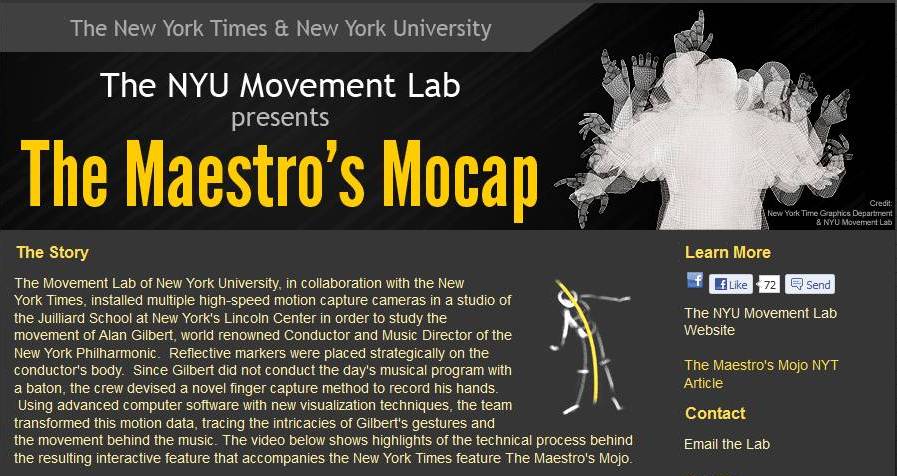
Since we began here last year, we have had some interns, volunteers and employees who graduated from some great programs at some great universities.  But NYU’s Mocap program is unlike any of those programs at any of those universities.  And we do not have anyone on our team who can do this.

Continue reading

Aranmula Kannadi – An Ancient Indian Metal Mirror

Aranmula, an ancient village in the district of Pathanamthitta on the banks of the famous Pamba River, has a special history of Kerala’s traditional arts. For centuries Indians have been experts in Metallurgy; Delhi’s ancient Mayuran Iron Pillar, and forged Damascus steel are part of an artisanal culture in South India that stretches back more than 2000 years. The Aranmula Kannadi (metal mirror) technology is part of this history.

Continue reading

Yoga & Evolution

A few months ago there was an article in The New York Times that apparently caused a ruckus (click the image to the left to read The Guardian‘s coverage of that aftermath) in the Western yoga community.  Maybe it is because I am not a member of the Western yoga community that, when I read the article originally I thought:   Brilliant.  Eastern tradition meets Western science.  Evolution.  Improvement.

Today I had a reminder about that article, and my response to it, while listening to this podcast.  The journalist (a Pulitzer-toting science writer who also has practiced yoga for more than 40 years and recently published The Science Of Yoga) writing that article says something about half way through that rings true: Continue reading

The Emperor’s New Silk

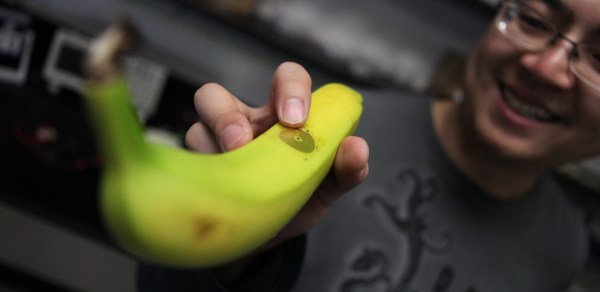
“We see a huge market for food,” Hu “Tiger” Tao, a postdoc at Tufts University told Co.Exist. “People are always looking forward to some kind of sensor that’s easy to use and gives you information about spoilage.”

Continue reading

Linking Locavores

Click the image above for a journalistic description of a utilization of new technology to conserve valuable traditions and provide more efficient access to healthy, tasty food.  Or, after the jump, a short video of the same.

Continue reading

Canopy Capture

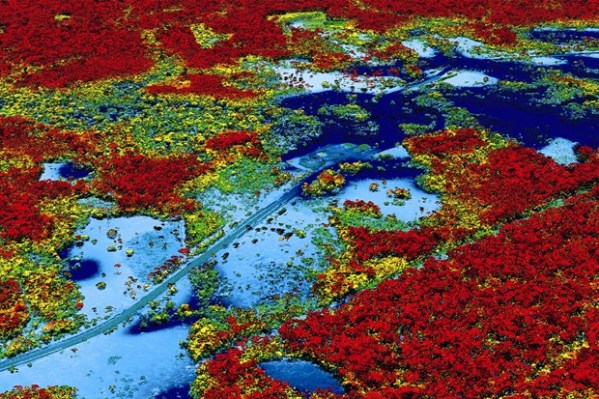
Click the image above to go to a story covered in Wired about a novel approach to mapping threatened rainforest, using existing technology in an innovative manner:

A small, twin-propeller plane flies over the Amazon rainforest in eastern Peru. The scale of the vegetation is extraordinary. The tree canopy stretches as far as the eye can see — an endless array of broccoli florets bounded only by haze and horizon. Greg Asner, 43, has seen the rainforest from this vantage point many times before, but he still stares out of the window in rapt fascination.

Continue reading

Connecting The Madeleines

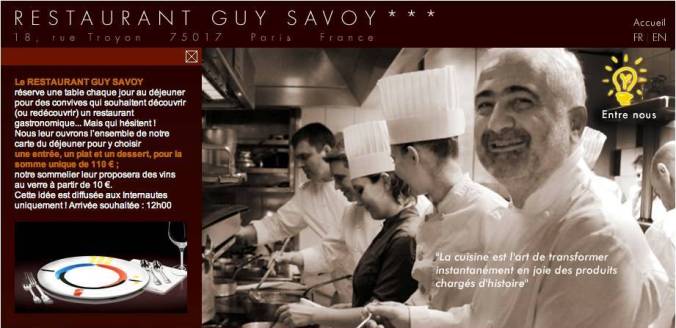
The young man working his way through the kitchen brought to mind a young man of about the same age, three decades earlier. I had the good fortune, in my early adulthood, to work in a restaurant owned and operated by a man who is one of the great chefs of his generation.  I did not work in the kitchen, but in the dining room, from 1983-1985. It provided the most important education of my life, which is saying a lot because I eventually earned a Ph.D. and even that did not top the learning earned in Guy Savoy’s restaurant.

Continue reading

Travel, Writing & Games

This series has always been worth reading, whether you are an American looking through the eyes of a fellow American, or otherwise intrigued by a niche of American perspective that is not quite representative of that culture as a whole.

First things first: sometimes a book, a music recording or other item is only available from the mainstream online retailers such as Amazon or iTunes, but whenever possible we promote the purchase from independent sellers.  So click the image to the right if you want a link to independent booksellers in the USA, provided by the ever-entrepreneurial American Booksellers Association.

Now, the side show: the series editor Jason Wilson is also a contributor to a site we refer to on occasion, and he wrote an interesting item a couple of years ago that began:

Continue reading