First Few Days at Tomás de Berlanga: Part 1

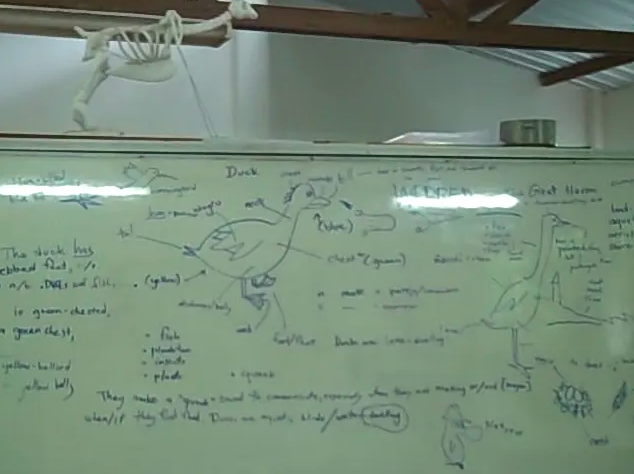
Snapshot of whiteboard on Friday afternoon

Although I have not yet posted as promised about the birds I saw in Mindo, I have to describe my week so far on Santa Cruz before I forget the details and delay the sequence of more current and relevant events too much.

I arrived at school early Monday morning to start working at the Tomás de Berlanga school (named for the man who first discovered the archipelago). I was to temporarily take the place of an English teacher who was still waiting for her visa renewal on the mainland, or “el Continente,” as Galapageños call it, and teach English to two classes.

For the upper levels of the school, classes are on a block schedule of eighty minutes periods, and my two classes were of intermediate English level 7th-9th graders and 10th-12th graders. Each group was of ten to twelve students that had all been born on one of the islands or el Continente, and some of whose parents speak English.

My goal for this first day was to spend the classes gauging the students’ English proficiency, their interest in birds, and especially their knowledge of Santa Cruz’s avifauna. One of the ways I did the former was via an exercise that one of the other English teachers, Eduardo, recommended: put a sentence on a piece of paper and cut it so each word is separated, mix them up, and give them to groups of students to put back together. I thought this was a great idea, so I took some time to think of sentences that might have several ways to be composed (both to ease the process for students but also to see if there were any trends towards certain structures).

Continue reading

A Road Less Traveled

Guest Author: Denzel Johnson

The positive thinker regards life as an adventure where the rewards are in the risks and the pleasure in responding to the challenge.

A card printed with that quote has sat in my wallet since setting off last year for my journey through Latin America. I convinced myself that my philosophy as a traveller should somehow reflect these words and the card was meant to encourage me to step off the beaten track and venture where others wouldn’t consider a destination.

Having recently just spent a good portion of my gap year in solo travel through South America, I not only found myself on my own but always more positively challenged because there was no one else I could rely on. Continue reading

나는 한국말을 해요 (I speak Korean)

Ok, maybe that’s a little white lie. I don’t really speak Korean – you can thank good old Google Translate for the post title – but I’m on my way! My interest was piqued back in first year when my phonology lecturer mentioned the language, since it has a unique alphabet in which the shapes of the written letters actually represent the shape your mouth makes when you sound them out! Isn’t that amazing?!

Thanks to wright-house.com for a great article on why Korean looks the way it does.

Well, call me a language freak, but I just had to learn more. It took me a while (read: two years) to take the plunge, but when my friend Kim posted this on my Timeline yesterday (girl, you know me so well…), I decided. I have so much time on my hands and it’s driving me nuts, so today I finally started making use of the university’s language centre: I trammed it in to the centre, grabbed a bagel and a lemonade for good measure, then showed up at the library and got Korein’! Continue reading

Poisson d’Avril

It was unlike me to have missed acknowledging the Vernal Equinox last week but please note that it wasn’t forgotten.  In much of the northern hemisphere spring began sprouting all over the place, sometimes unseasonably early, and the first day of spring was observed in all its glory in Crist’s Holi series.

So I’m being careful not to miss April 1st and in the spirit of that celebration am sharing some of artist Ken Brown‘s collection of turn of the century (the 19th to the 20th that is!) French fantasy postcards that celebrate “Poisson d’Avril”, the French equivalent of April 1st or April Fools’ Day. Continue reading

Wordsmithing: Tribal

Western travelers to Kerala at first can be startled by the frequent use of this word, which has been replaced by the word indigenous in other parts of the world, but whose noun form has special mention in OED:

A member of a tribal community (usu. in pl.). Chiefly Indian English.

1958    New India: Progress through Democracy iii. vi. 378   Illiteracy is almost universal among tribal peoples.‥ Tribals are being trained as teachers.

1964    Economist 18 Apr. 261/1   More are arriving daily, among them Christian and Buddhist tribals.

1979    South China Morning Post (Hong Kong) 28 Dec. 3/1   Teams of mountain tribals are to join the search for three Singapore Air Force Skyhawks which disappeared over the northern Philippines eight days ago.

The word has no “tone” to it, at least not perceptible to foreigners living in Kerala.  Continue reading

Language Akin To Species

…words and other language units change systematically as they are passed from one generation to the next, much the way genes do. Charles Darwin similarly argued in 1871 that languages, like biological species, have evolved into a series of related forms….

Continue reading