Flower Garden Banks Lionfish Invitational

I have posted previously about the lionfish invasion and the threat that it poses to marine ecosystems in the Western Atlantic. In an earlier post, I noted that there is increasing evidence that regular removals can be effective in controlling lionfish infestation, allowing native fish populations to recover. Removals are being undertaken via organized efforts such “lionfish derbies” and other forms of sanctioned fishing tournaments as well as via market approaches that create commercial incentives to harvest the fish.

While marine protection agencies are generally supportive of these efforts and are indeed engaging in removals themselves, they lack the data and evidence needed to make informed decisions about the optimal mix of approaches and the level of effort and resources needed to effectively control the invasion. I recently had the opportunity to participate in a research expedition aimed at helping to address this gap. I was fortunate enough to be selected to join 29 other volunteer citizen scientists, professional/semi-professional spear fishers, and marine scientists for a fish survey and lionfish culling effort in the Flower Garden Banks National Marine Sanctuary. Situated about 100 miles off the coast of Texas, the sanctuary is home to a unique ecosystem with almost 300 species of fish, 21 species of coral, and several other invertebrate species. Lionfish are being observed with increasing frequency within the sanctuary, a cause for concern by the sanctuary’s managers. They have previously undertaken periodic culling of lionfish, but the recent effort was the first time that removals were undertaken in a systematic fashion. Continue reading

Conservation, Scotland Style

Monitors and a fisherman check lobster traps. Credit Andrew Testa for The New York Times

Monitors and a fisherman check lobster traps. Credit Andrew Testa for The New York Times

We like his simplicity, his tenacity, his practicality; most of all we appreciate the outcome:

Scotsman’s Mission Ends in a Fishing Bay Restored

HOWARD WOOD, round-faced and jolly, was happily counting the lobsters being pulled, measured and tagged out of the coastal waters he has worked for years to protect. One weighed close to four pounds, its huge right claw dwarfing its left, which was growing back after what must have been quite a battle. Continue reading

Support Needed for Lionfish Jewelry Workshop

© Seavenger’s Trident Super Dive Store

For the past several years, I have been involved in helping to develop markets for lionfish jewelry as a way of addressing the threat posed by this invasive species, which is severely compromising the health of coral reefs throughout the Caribbean by eating reef-dwelling fish. Belize is home to the second largest barrier reef in the region, and its lobster and conch fisheries could really benefit from a break of overexploitation, so encouraging lionfish fishing in any way possible will promote reef recovery.

My last post, in fact, was about my trip to northern Belize last summer, when I collaborated with two local NGOs in Belize to train women from a coastal community on how to create lionfish jewelry. This August, I will again be joining one of these groups – Blue Ventures, for a lionfish jewelry workshop for women from other areas. As you can see from the pictures here and in my previous posts, lionfish fins, tails, and spines are beautiful; they’re also relatively low-cost to transform into jewelry. These parts of lionfish were previously discarded, but when kept and transormed into jewelry the value of landed lionfish catch increases by up to 40%, creating additional incentives for fishers to target and remove lionfish Continue reading

Thanks Ed, This One Is For Our Go-To Marine Ecosystem Colleague

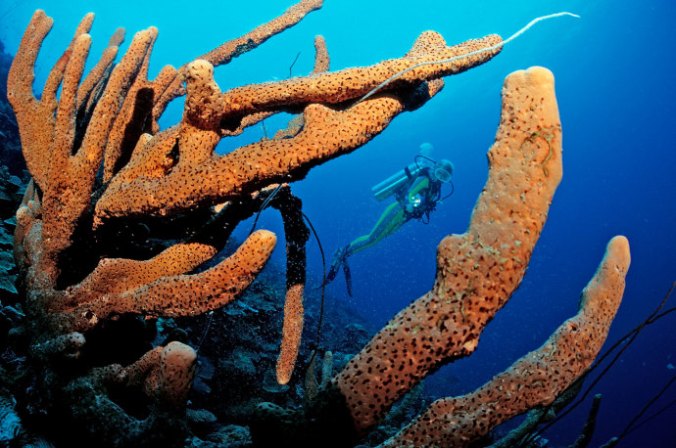
By ignoring sponges, we blind ourselves to a wondrous hidden biology and get a misleading view of evolution. CREDIT PHOTOGRAPH BY REINHARD DIRSCHERL/ULLSTEIN BILD VIA GETTY

By ignoring sponges, we blind ourselves to a wondrous hidden biology and get a misleading view of evolution. CREDIT PHOTOGRAPH BY REINHARD DIRSCHERL/ULLSTEIN BILD VIA GETTY

In the words of the FM disc jockeys of our youth, we send this one out to Phil:

In the final exams for our undergraduate zoology degrees, my fellow-majors and I were given an assortment of petri dishes, each of them containing an animal. Our task was to classify the creatures to the phylum level. Now, more than a decade later, I can conjure up only two of the test dishes. The first contained a dead cockroach (phylum: Arthropoda). The other contained a rock in a thin layer of water, with a green, slimy film on one of its faces. Midway through the allotted time, the invigilator observed aloud that many of us seemed to be trying to classify the rock. It was, he assured us, a rock. The unspoken corollary: we should perhaps focus instead on the slime. Continue reading

Action, Louder Than Words, Easier Said Than Done

Screen Shot 2015-04-23 at 5.15.09 AM

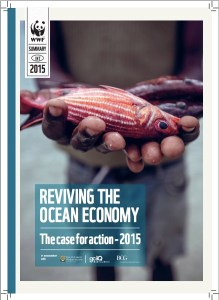
WWF today released a report at once alarming (the photo on the report cover to the right, put in context, is a visual gateway to reporting on par with writings of the gloom maven, which we cannot get enough of) and at the same time inspiring (the photo below of a young girl participating in mangrove restoration hints at the hope for the future), which is motivation enough to read it. The key word is action. Action we must take. And for our part we are committed to sharing as broadly and deeply and as often as possible on actions considered, actions taken, and the result of actions. Click the image to the right to download a low resolution pdf copy, or at least read the summary below from the WWF website:

The value of the ocean’s riches rivals the size of the world’s leading economies, but its resources are rapidly eroding, according to a report released by WWF today. The report, Reviving the Ocean Economy: The case for action – 2015, analyses the ocean’s role as an economic powerhouse and outlines the threats that are moving it toward collapse.

The value of key ocean assets is conservatively estimated in the report to be at least US$24 trillion. If compared to the world’s top 10 economies, the ocean would rank seventh with an annual value of goods and services of US$2.5 trillion.

Mangrove restoration. Mangroves store carbon and provide over 100 million people with a variety of goods and services, such as fisheries and forest products, clean water, and protection against erosion and extreme weather events. The rate of deforestation of the planet's mangroves is three to five times greater than even the average global forest loss.

© Jürgen Freund / WWF. Mangrove restoration. Mangroves store carbon and provide over 100 million people with a variety of goods and services, such as fisheries and forest products, clean water, and protection against erosion and extreme weather events. The rate of deforestation of the planet’s mangroves is three to five times greater than even the average global forest loss.

Continue reading

Understanding The Lost Decade Of Young Turtles

Turtles in the study were less than two years old; they can take 10-20 years to reach sexual maturity

Turtles in the study were less than two years old; they can take 10-20 years to reach sexual maturity

Thanks to the BBC for this story:

‘Lost’ sea turtles don’t go with the flow

A tracking study has shown that young sea turtles make a concerted effort to swim in particular directions, instead of drifting with ocean currents.

Baby turtles disappear at sea for up to a decade and it was once assumed that they spent these “lost years” drifting.

US researchers used satellite tags to track 44 wild, yearling turtles in the Gulf of Mexico and compared their movement with that of floating buoys. Continue reading

Largest Marine Reserve, 2015 Edition

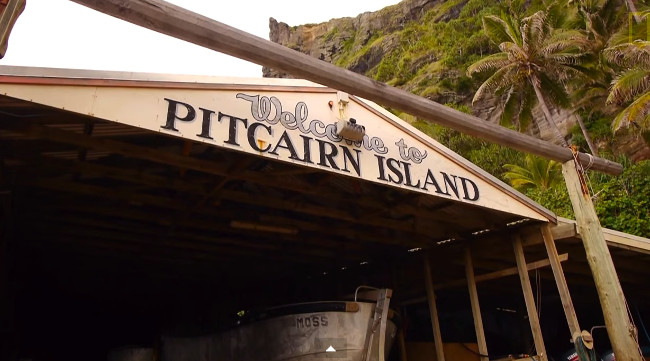
Pitcairn’s residents implored the UK government to protect the area, which is threatened by illegal fishing.

Pitcairn’s residents implored the UK government to protect the area, which is threatened by illegal fishing.

We hope they keep getting formed in larger and larger swaths of territory, and we will celebrate every time the ante gets upped this way:

British Prime Minister David Cameron’s government announced the creation of the world’s largest contiguous ocean reserve on Wednesday, protecting 322,000 square miles around the remote Pitcairn Islands in the South Pacific. To put that in perspective, that’s three and a half times the size of the United Kingdom and bigger than the state of California, according to National Geographic. Continue reading

All Hail This Whale Tale

Gray whale off the coast of Baja. Photo by Joe McKenna via Creative Commons

Gray whale off the coast of Baja. Photo by Joe McKenna via Creative Commons

Mr. Zimmer, whom we have been unintentionally neglecting as a source recently, has caught our attention again.  May we never tire of whale tales:

In May 2010, a whale showed up on the wrong side of the world.

A team of marine biologists was conducting a survey off the coast of Israel when they spotted it. At first they thought it was a sperm whale. But each time the animal surfaced, the more clearly they could see that it had the wrong anatomy. When they got back on land, they looked closely at the photographs they had taken and realized, to their shock, that it was a gray whale. This species is a common sight off the coast of California, but biologists had never seen one outside of the Pacific before.

Continue reading

Green turtle links Costa Rica’s Cocos Island with Ecuador’s Galapagos

Sanjay

Sanjay the green sea turtle is equipped with satellite tags before being released into the ocean. (Courtesy of PRETOMA)

To this day, scientists have tracked three different turtles that have traveled between two of the most fragile and important island ecosystems: The Galapagos Islands in Ecuador and The Cocos Island in Costa Rica. We are just starting to understand the importance of these breeding grounds and their interconnectivity with turtle migration and reproduction.

One normal migration for turtles, one giant discovery for humankind.

With his 14-day journey from the waters of Costa Rica’s Cocos Island National Park to the Galapagos Marine Reserve in Ecuador, “Sanjay,” an endangered green sea turtle, established the first direct migration link between the two protected areas.

Sanjay was one of three green sea turtles tagged by scientists from the marine conservation groups Turtle Island Restoration Network and PRETOMA during a 10-day research expedition. Using a $4,000 satellite tag, biologists from the organizations were able to map Sanjay’s exact migration.

“It’s truly remarkable. Sanjay knew where he was headed, Continue reading

Coral Manipulation

Coral garden in Indonesia. Credit: Global Environment Facility via Flickr (Creative Commons License)

Coral garden in Indonesia. Credit: Global Environment Facility via Flickr (Creative Commons License)

We’re keeping an eye on the health of coral reefs in the Caribbean with the help of RAXA contributor Phil Karp, who has been writing specifically about the impact of invasive lionfish on the marine ecosystem.  In this piece for Conservation Magazine, Sarah DeWeerdt discusses the option of taking a more active role in improving the health of corals through acclimatization:

The past several decades have been tough on the world’s coral reefs. Warming waters, ocean acidification, invasive predators, and toxic runoff have hammered these iconic hotspots of underwater biodiversity.

In response, conservationists have developed coral ‘gardens’ where young corals are reared to help rebuild damaged reefs. But some scientists worry that existing restoration strategies won’t match the pace and magnitude of the threats these animals face.

In a paper published February 2 in the Proceedings of the National Academy of Sciences, biologists from the Australian Institute of Marine Science and the Hawaii Institute of Marine biology propose a more radical approach, which they call assisted evolution.

Continue reading
Better Buying, Canned Tuna Edition

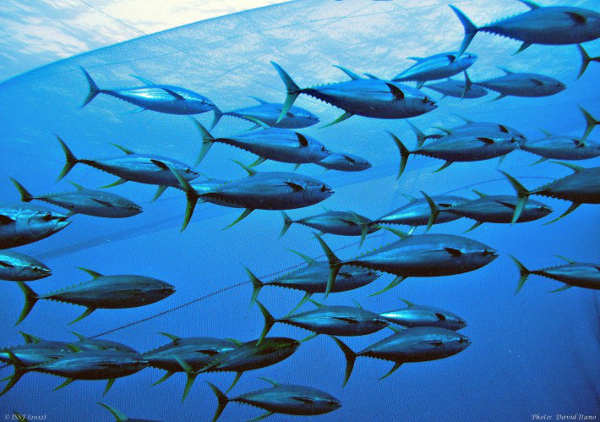
Seafood companies are responding to the public’s increased interest in whether fishing practices deplete tuna populations. Photo credit: David Hano/International Sustainable Seafood Foundation

Seafood companies are responding to the public’s increased interest in whether fishing practices deplete tuna populations. Photo credit: David Hano/International Sustainable Seafood Foundation

Thanks to Ecowatch for the updated primer on better canned tuna shopping criteria:

Canned tuna is one of the world’s most popular packaged fish, but it has also long been controversial. Between issues of overfishing resulting in fishery depletion and bycatch that threatens other species including the much-publicized incidental capture of dolphins by tuna fishermen, it has gotten a bad name. With the increased awareness of the harm tuna fishing can cause, companies have stepped up to try to reassure consumers that they are paying attention to the health of our oceans. Continue reading

Whales Need To Eat, Just Like The Rest Of Us

1000 (1)

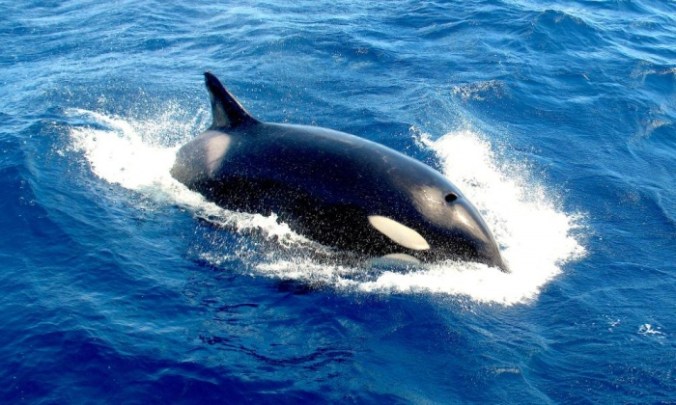
The Guardian‘s Environment section gets us thinking, today, about the unfortunate qualifier–killer–to the name of this amazing animal. All of us non-vegetarians are killers, right? We just hide that fact as conveniently as we can. The spectacular fashion in which this particular marine mammal satisfies its appetites is something to behold:

Even before our boat left the shelter of Bremer Bay boat harbour, in south-west Western Australia, shortly after dawn on the first day of the region’s 2015 killer whale season, it felt like we were already at the edge of the world.

I was there to see a tiny place, far out to sea, that marine scientists and environmentalists regard as one of the most special ocean ecosystems anywhere in Australia’s commonwealth waters.

We would motor more than 65km offshore to a location not much bigger than a few football fields, where the ocean is 4.5km deep and weather conditions are almost always treacherous. Where we were going there was a not a single distinguishing feature or landmark – just a GPS point.

More than anything, though, no one yet knows for sure why each year, during February and March, life from around the Southern Ocean converges on that relatively minute speck in the ocean wilderness. Continue reading

We Will Cheer This Until Completion

db757a96-5214-4e59-b0d5-8631d7e250d7-460x276

The proposed marine reserves around the South Sandwich Islands, Ascension and Pitcairn Islands would protect rare and threatened marine life. Photograph: Matthias Graben/Alamy

We write about marine reserves whenever we hear of a new initiative, and try to keep up with the progress of those as we can. The Guardian is reporting here on a new one; if Helena is in, we are in to support this as we can, and will post updates as available:

Conservationists call for UK to create world’s largest marine reserve

Three proposed reserves in UK waters around the Pitcairn Islands in the Pacific, and Ascension Island and South Sandwich Islands in the Atlantic, would more than double the size of the world’s existing marine protected areas

Pressure is mounting on the UK government and opposition parties to commit to creating at least one massive marine reserve in the Pacific or Atlantic to protect rare and threatened whales, sharks, fish and corals ahead of the general election.

Continue reading
Marine Reserves, Unexpected Effects

fish-680x450

Marine reserves have been of interest since the first months of this blog in 2011 and are still a mainstay of our incoming and outgoing newsfeeds. Much of our recent interest in the intersection between marine biology and conservation has been focused on invasive species since 2013, due to the super series penned by Phil Karp, most recently added to last week. Thanks to Jason G. Goldman and Conservation for this summary of a special topic within this intersection:

Most marine reserves are optimized for reef fish. These are fish that are born, live, reproduce, and ultimately die in a small area – sometimes on just a single reef. Where there is connectivity across a large area, it’s usually while the fish is in its larval stage. Once it matures, it stays put.

It’s a fitting strategy for conserving fish that live on coral reefs, rocky reefs, or in kelp forests, but does it do much to help those species that are more migratory? These are animals, like the Gulf of Mexico’s gag grouper, that spend their childhoods in one place, a nursery habitat like a mangrove, estuary, or kelp forest, and then migrate to live out their adult years in an adult habitat, like a reef or along the continental shelf. Continue reading

Fighting Invasive Lionfish – Update

I’ve posted previously about the lionfish invasion that is threatening coral reef and other marine ecosystems throughout the Caribbean, Gulf of Mexico, and Southern Atlantic Seaboard of the United States. Availability and dissemination of information about the invasion was recently given a big boost through launch of the Invasive Lionfish Web Portal The portal is a collaborative effort of a number of partners, led by the Gulf and Caribbean Fisheries Institute. It is a great resource, providing links to a range of information about the invasion, including journal articles, videos, photos, recipes, a Twitter feed, etc..

Another recent development has been the release of a draft United States National Invasive Lionfish Prevention and Management Plan. Developed by the U.S. Government’s Aquatic Nuisance Species Task Force, the plan is intended to help coordinate the actions of the various government agencies and other stakeholders involved in dealing with the invasion. While such a plan is long overdue, and in that sense is welcome, I’m quite disappointed that the plan largely ignores, and indeed implicitly discourages, an important element of an effective strategy for addressing the invasion – namely the use of market-based approaches.

As I’ve indicated in my previous posts, the Atlantic lionfish invasion is a unique problem that requires innovative solutions. Continue reading

The Importance of Whale Poo

Whales often feed at depth but return to surface waters to defecate. Their faecal plumes fertilises the surface waters and help plankton thrive. Caption: The Guardian. Photograph: Reinhard Dirscherl/Getty Images

We’ve posted about ambergris before, but this article by The Guardian‘s George Monbiot covers a completely different type of significance when it comes to cetaceans’ excrement. Here’s more from Monbiot:

I can hear you muttering already: he’s completely lost it this time. He’s written a 2,000-word article on whale poo. I admit that at first it might be hard to see the relevance to your life. But I hope that by the time you have finished this article you will have become as obsessed with marine faecal plumes as I am. What greater incentive could there be to read on?

In truth it’s not just about whale poo, though that’s an important component. It’s about the remarkable connectivity, on this small and spherical planet, of living processes. Nothing human beings do, and nothing that takes place in the natural world, occurs in isolation.

Continue reading

Digging Deeper, Getting To No

Casa Dominique is an ecolodge on Lanzarote's northern coast. Julie Genicot, a French trekking guide, has lived in Lanzarote since her grandparents opened the Casa Dominique when she was a child. She worries that offshore oil drilling might ruin the natural environment she grew up in. Lauren Frayer/NPR

Casa Dominique is an ecolodge on Lanzarote’s northern coast. Julie Genicot, a French trekking guide, has lived in Lanzarote since her grandparents opened the Casa Dominique when she was a child. She worries that offshore oil drilling might ruin the natural environment she grew up in. Lauren Frayer/NPR

We cannot possibly say that Spain does not need more oil. But we can say that before going to the Canary Islands there should be more effort to use the sun and wind, as at least one European country with less direct sunlight per year than Spain has successfully done. Spain should dig deeper on the alternative energy front before drilling in the sea. Go, Julie, go! Thanks to National Public Radio (USA) for bringing this story to our attention:

An oil rig now floats offshore in one of Europe’s top winter beach destinations — Spain’s Canary Islands. For the first time, Spain has authorized offshore oil drilling there. It’s hoping to reduce its dependence on foreign oil. But the project has prompted massive protests by local residents and environmental groups like Greenpeace.

Julie Genicot is a French trekking guide who’s lived in Lanzarote, one of Spain’s Canary Islands, ever since her grandparents opened an ecolodge there when she was a child.

“We have all the elements. It’s very windy, we have tides, the sun. It’s a very energetic place,” she says, looking out her windows across sand dunes in a protected natural park, backed by the Atlantic Ocean. “You have earth, the fire — we’re surrounded by volcanoes. And the wind, the sea — it’s very powerful.” Continue reading

Sea Snakes, Rhinos, And The Close Observation Of Two Tragic Commons

rhino-snake-680x450

Thanks as always to Conservation, and in this case to Jason G. Goldman for the excellent summaries of scientific findings each week. There is not much happy news in this story, but nonetheless it is critical reading because of the detailed observation of the scientists:

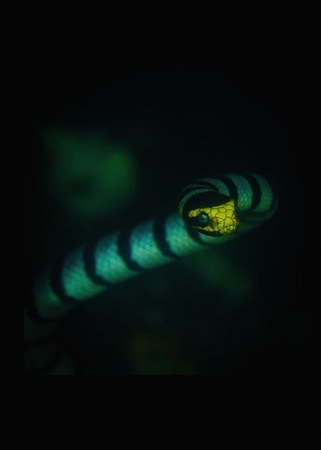
Each month, hundreds of squid fishing vessels return to port in Vietnam loaded not just with squid, but also with sea snakes harvested from the Gulf of Thailand. Each month, the seven major snake processing facilities move an average of 6,500 kilograms of sea snakes, which are sold for between $10 and $40 per kilogram, depending on species. By comparison, squid sell for between $7 and $20 per pound, making sea snakes the more lucrative catch.

In the most recent issue of the journal Conservation Biology, Vietnam Academy of Science and Technology researcher Nguyen Van Cao and colleagues argue that the harvest of sea snakes from the Gulf of Thailand is perhaps the world’s largest systematic exploitation of marine reptiles in the world, but it’s one that is woefully ignored or, at best, underscrutinized. Continue reading

Awesome Oceans, Awesome Curator, Awesome Book

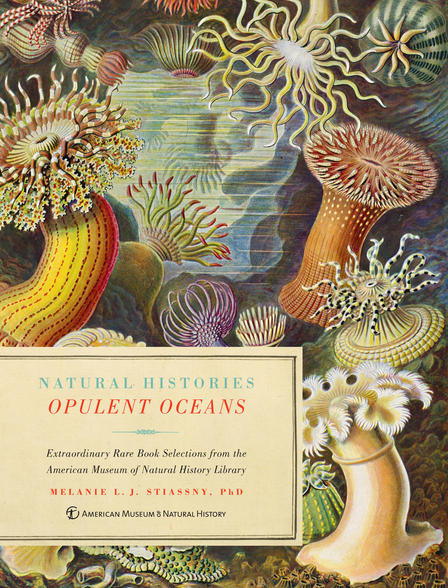
opulent-oceans_imagelarge

The American Museum of Natural History is a favorite childhood and parenthood hangout of many of the readers of these pages and visitors to places where Raxa Collective does its work. Our sense of awe about the natural world often starts in an urban institution like this one. No surprise, its curators are awesome in their own right. Here is one example from the AMNH blog a few weeks back:

Q&A with Curator Melanie Stiassny

This month marks the publication of Opulent Oceans:Extraordinary Rare Book Selections from the American Museum of Natural History Library (Sterling Signature, 2014), the third in a series showcasing the spectacular holdings of the Rare Book Collection in the Museum Library. Written by Curator Melanie L. J. Stiassny, the book includes essays about pioneering biologists who studied marine life. (And like the preceding volumes—Natural Histories (2012), which inspired the current exhibition, and Extraordinary Birds (2013)—it also showcases a variety of scientific illustrations that brought new discoveries to a growing audience of experts and laypeople alike.)

We recently spoke with Dr. Stiassny, who is Axelrod Research Curator in the Department of Ichthyology, about her experiences researching the book. Continue reading

Courtney, Come To Kerala!

3D0A6730-web

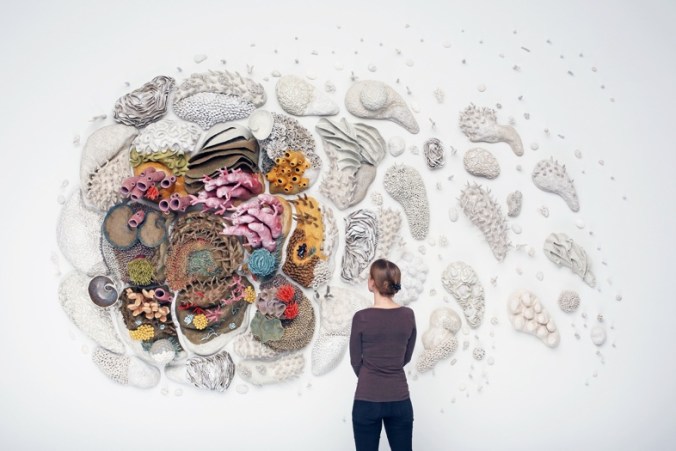
We lean to the idea that art can be a nobler calling than other ways of making a living, even in unusual circumstances. After reading the morning news today, one could be forgiven for continuing to think that art is essentially a commercial endeavor, which we would rather not believe in spite of all the evidence:

AUCTION1-thumbStandardThanks to Giacometti, Sotheby’s Hits Its Highest Total Ever at Fall Opening

But thanks to Courtney Mattison for hewing to a different road, for which our doors will be open if she chooses to visit: Continue reading