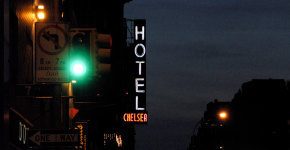
PHOTOGRAPH BY ELI REED/MAGNUM
Amie and I lived around the corner from the Chelsea Hotel during the second term of Ronald Reagan’s presidency. At that moment in our lives, newly married and full of that kind of hope, we nonetheless observed with concern the culture of the USA changing radically around us. New York City, in particular seemed an epicenter for the demonization of “welfare queens” (Reagan terminology) and homeless people (of which there was a sudden massive increase due to various social safety nets being eliminated, a result of the “Reagan revolution”), while the values associated with speculative money, and cronyism, were ascendant.
It seems to me in hindsight that it was the moment when entrepreneurial capitalism receded as a driving force of the culture, giving way to a strong strain of some other form of capitalism. A much darker, or at least shadier, form that culminated in the economic tragedies of recent years in the USA, including contagious sub-strains that made their way to Europe and can be seen in the Greek tragedy today.
Reading that the Chelsea Hotel is g0ing “boutique” is at first depressing, but then not; it is a reminder of how New York City has been transformed by the new rules of capitalism; yet encouraging, even if the Chelsea Hotel’s role as an institution will be lost, because some of its core values remain intact as residents live out their terms there. The heartless strain of capitalism that bred and multiplied in the 1980s, which we have thought monstrous, has forced us to look for answers, which in turn has led us to the entrepreneurial conservation concept that animates our work, daily. The dragon sometimes teaches:
At a moment when the once beautifully entangled fabric of New York life seems to be unravelling thread by thread—bookstore by bookstore, restaurant by restaurant, and now even toy store by toy store—it might be time to spare a thought or two for the Chelsea Hotel. At the hotel on Twenty-third Street, famously rundown and louche—the Last Bohemia for the Final Beatniks, our own Chateau Marmont, where Dylan Thomas drank and Bob Dylan wrote “Sad-Eyed Lady of the Lowlands” and Leonard Cohen wore (or didn’t; people argue) his famous blue raincoat, and Sid Vicious killed (or didn’t; they argue that, too) Nancy Spungen—the renovators and gentrifiers have arrived. The plastic sheeting is everywhere, the saws buzz and the dust rises. In a short time, the last outpost of New York bohemia will become one more boutique hotel. Continue reading →












 Everyone has done it before, probably by accident or perhaps by

 Organikos