Citizen Science in Belize – Update – If You Can’t Beat’em, Wear’em

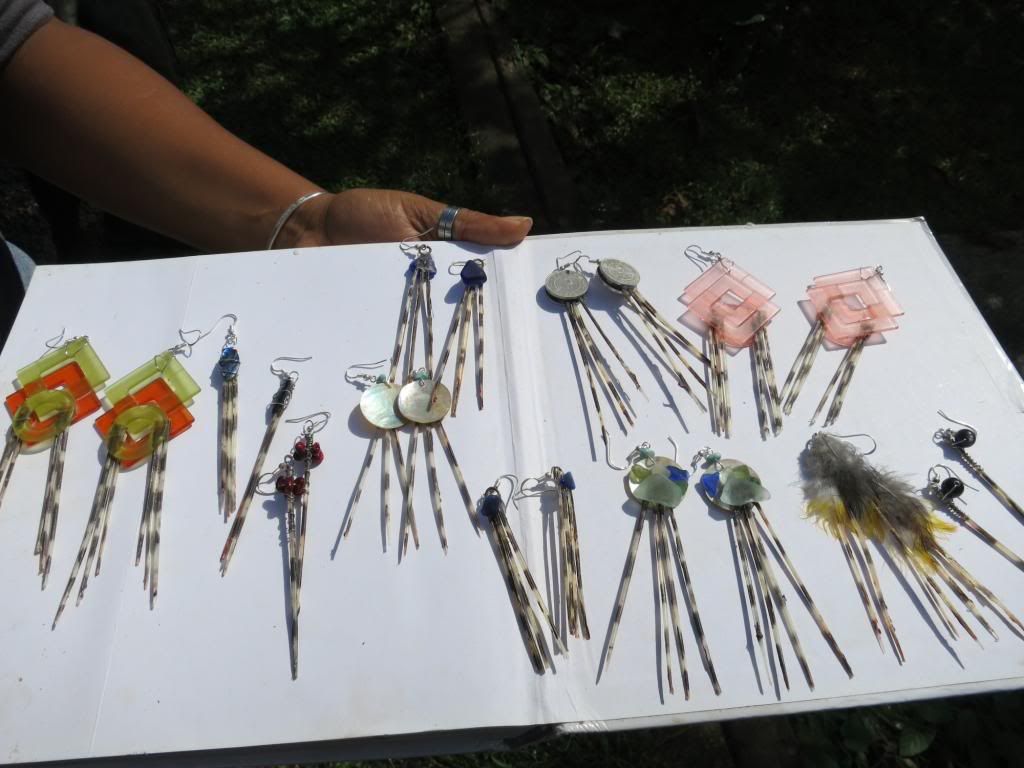
Lionfish spine earrings crafted by Palovi Baezar, Punta Gorda, Belize. Credit: Polly Alford, ReefCI

In earlier posts about my volunteer experience in Belize with ReefCI, I talked about the lionfish invasion that is threatening coral reef and other marine ecosystems throughout the Caribbean, Gulf of Mexico, and Southern Atlantic Seaboard of the United States, and noted that, at least for the foreseeable future, human intervention, particularly the establishment of a commercial fishery for the species, appears to be the only solution to keep the invasion under control.

I mentioned the idea of lionfish jewelry as a possible way of increasing the economic return to fisherfolk who may otherwise be reluctant to go after lionfish given the difficulty of catching them (the fish must be harvested by spearing or hand netting rather than through traditional methods such as lines or nets). I’ve been pleased to learn that at least one artisan in Belize has picked up on the idea, using some of the lionfish spines that I collected while I was there. She has already crafted some beautiful earrings (see photo above) and is working on other jewelry items as well as decorative mirrors. Elsewhere, jewelry crafted from lionfish tails and fins is being sold online, and through a retail outlet in Curaçao.  Continue reading

Citizen Science in Belize: Part 2/2 – If You Can’t Beat’em, Eat’em

Photo by Alexander Vasenin

Lionfish sushi – Photo © World Lionfish Hunters Association (click on photo to visit their website)

In Part 1 of this post I talked about the lionfish invasion that is threatening coral reef and other marine ecosystems throughout the Caribbean, Gulf of Mexico, and Southern Atlantic Seaboard of the United States.  Scientists, environmental groups and governments that are studying the problem have all come to the conclusion that it is probably impossible to eradicate lionfish in the Atlantic – they are here to stay. Continue reading

Citizen Science in Belize: Part 1/2

Photo © ReefCI

Photo © ReefCI

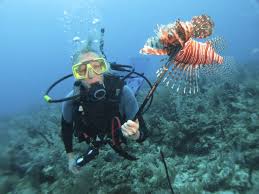
It might seem strange to accompany a posting about marine conservation with a photo of a fish on a spear, but in this case, it is entirely warranted.

I recently returned from the Sapodilla Cayes Marine Reserve in Southern Belize, where I spent two weeks working as a volunteer with ReefCI, a NGO dedicated to coral reef ecosystem conservation. Located 30 miles off the coast of Belize on the southern tip of the Mesoamerican Barrier Reef (the second largest in the world, after Australia’s Great Barrier Reef), the Sapodilla Cayes constitute a unique ecosystem.

Along with other volunteers, I assisted the ReefCI marine biologist with population surveys of conch, lobster, and commercial fish species, as well as coral reef health checks. At least one, and sometimes two surveys were carried out each day. The data collected is provided to the Belize Fisheries Department as well as to other cooperating NGOs.

Now about that fish on a spear. One of ReefCI’s projects is lionfish control. Spears Continue reading

Smithsonian In Deep Water

This slideshow requires JavaScript.

New (to us) thanks to the Smithsonian and its supporters:

The Ocean Portal is part of the Smithsonian Institution’s Ocean Initiative. Together with the National Museum of Natural History’s Sant Ocean Hall and the Sant Marine Science Chair, the Ocean Portal supports the Smithsonian’s mission to increase the public’s understanding and stewardship of the Ocean. Continue reading

Recommissioning, Stronger Attention To Our Oceans

This slideshow requires JavaScript.

Folks we respect and admire, not retiring nor shrinking from the challenges, but rethinking what’s next, state their case here on opening day:

‘Outstanding opportunity for change’ – Global Ocean Commission launches

The Global Ocean Commission, an independent body of international leaders, launches today (12th February) with the aim of reversing degradation of the ocean and restoring it to full health and productivity.

Chaired by former Costa Rican President José María Figueres, South African cabinet minister Trevor Manuel and former UK Foreign Secretary David Miliband MP, the Commission brings together senior political figures including former Heads of State, Foreign Ministers and Finance Ministers from around the world, alongside business leaders and development specialists. Continue reading

From West to East: A Road Trip Journal (Part 2)

Carl on McClures Beach

This is the second in a series of posts on a summer trip; see the first here.

In the afternoon we were off, driving up the west coast without any real plans; we knew we wanted to be in Seattle in four or five days, but that intervening time period was ours to spend as we wished. From a quick glance at the map, we thought that Point Reyes, a national coastline a few hours north of the bay area, Continue reading

Diving with Scuba Iguana

Scuba Iguana trips start from the office on Charles Darwin Ave. either going north in a taxi to Itabaca Canal or taking a boat at the Scuba Iguana dock behind the office. All boat rides ranged from 35 to 120 minutes, and were generally pretty smooth. On the way, we could see Common Noddies, Blue-footed Boobies, Elliot’s Storm Petrels, Galápagos Shearwaters, and on North Seymour I saw a Red-billed Tropicbird twice! If I remember correctly, some Nazca Boobies were sitting on the coast of Floreana as well.

Continue reading

Ocean Health Index

Click the logo to the left for the site of this useful index:

From the many millions who count on ocean fisheries for their livelihoods to the uncounted lives saved by intact coral reefs during the 2004 Asian tsunami, people all over the world depend upon healthy oceans. But how healthy are our oceans?

Continue reading

Galápagos Sea Lions

I just got back from Isabela Island, where I was able to snorkel with a sea lion as playful as the ones in this video (taken, once again, by the ScubaIguana guide Quike Morán), and play with it alone in the relatively shallow waters of Tintoreras (named for the reef sharks that can often be seen there; tinto is red in Spanish; you get the point).

I tried to mimic the swirling, bubble-blowing, and alternating fast and slow approaches as I played with the juvenile sea lion, and was rewarded with a dance even longer than that seen in the video. Continue reading

My First Dives in Galápagos (2/2)

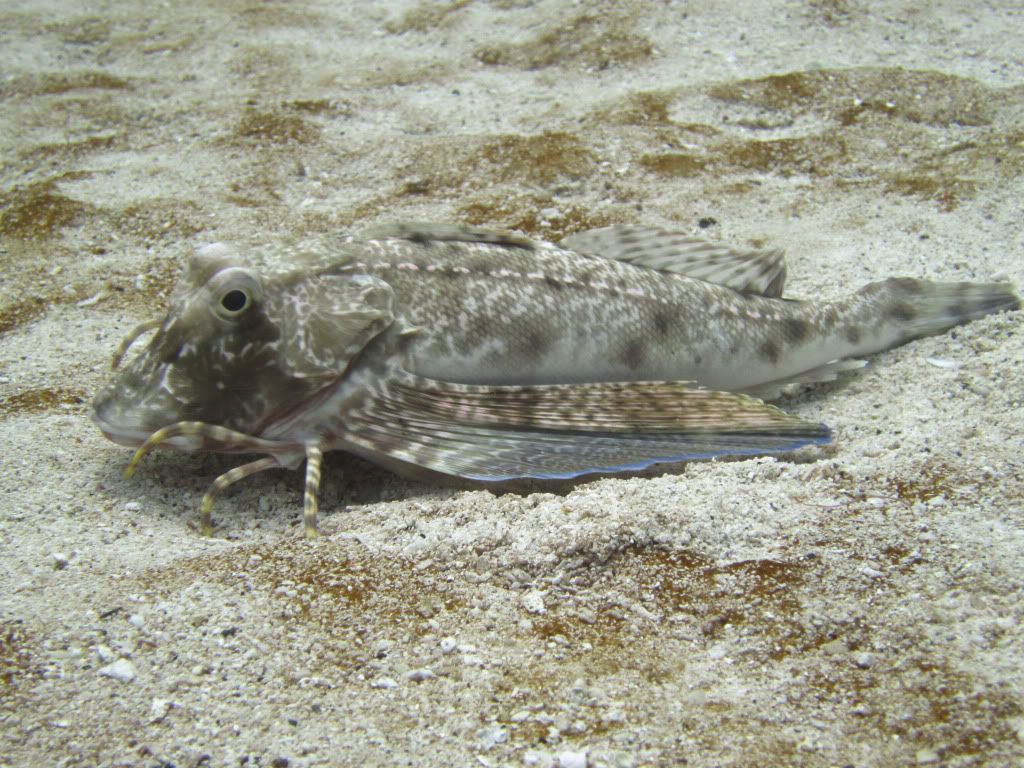
Six legs and two sail-like fins! What?!

My last post shared a video of some of my scuba trips and a few images of two absolutely bizarre ocean species: the Red-lipped Batfish and the Galápagos Searobin. I had no clue that any such creatures existed in nature, or at least not under the light of the sun no more than 15 meters below surface level. Once again, Quike Morán of Scuba Iguana took the pictures and video with a point-and-shoot digital camera in a plastic waterproof case, and the two dives featured here were at Seymour Island and Mosquera Island, north of Santa Cruz.

My First Scuba Dives in Galápagos (1/2)

Last week, I had my first, second, third, and fourth dives since I got my CMAS diving certification in 2007 in Croatia. I saw two of the weirdest organisms I’ve ever encountered in the flesh (to be named in the next post), and was also able to fulfill one of my longtime wishes: to be underwater with any aquatic mammal!

I leave for a camping trip on the island of Isabela today, so for now my two brief and scheduled posts will be limited to a couple photos and the video that will be in each! All images and videos were taken by Quike Morán, my Scuba Iguana guide.

Thank You Australia!

Click the image to go to the coverage:

Australia has created the world’s largest network of marine reserves and will restrict fishing and oil and gas exploration in a major step to safeguard the environment and access to food.

The area will cover 3.1 million square kilometres (1.2 million square miles) of ocean including the entire Coral Sea, and encompass a third of the island continent’s territorial waters.’

The Great Barrier Reef is one of the areas that will be protected through the marine reserve network. Photograph: Doug Steley B / Alamy/Alamy

The Catch

In a post last August, Seth referred to the problem of over-fishing as an example of a complex set of challenges constantly facing societies, simply stated as how we cooperate to solve problems.  Overfishing is not a new problem, and like many challenging ones seems to be getting more and more daunting, with no solutions in sight no matter how far and wide we search.  Click the image below for a well-written documenting of one facet of this problem.  It may leave you in need of a lighter treatment of the future of fish

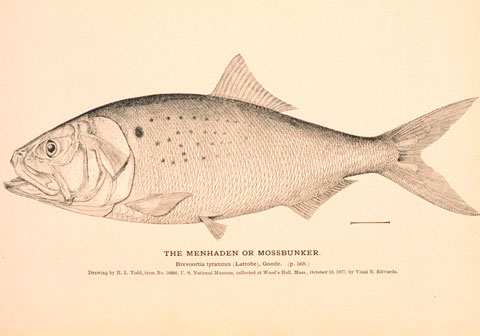
Harvested by the billions and then processed into various industrial products, menhaden are extruded into feed pellets that make up the staple food product for a booming global aquaculture market, diluted into oil for omega-3 health supplements, and sold in various meals and liquids to companies that make pet food, livestock feed, fertilizer, and cosmetics. We have all consumed menhaden one way or another. Pound for pound, more menhaden are pulled from the sea than any other fish species in the continental United States, and 80 percent of the menhaden netted from the Atlantic are the property of a single company.

Drifters

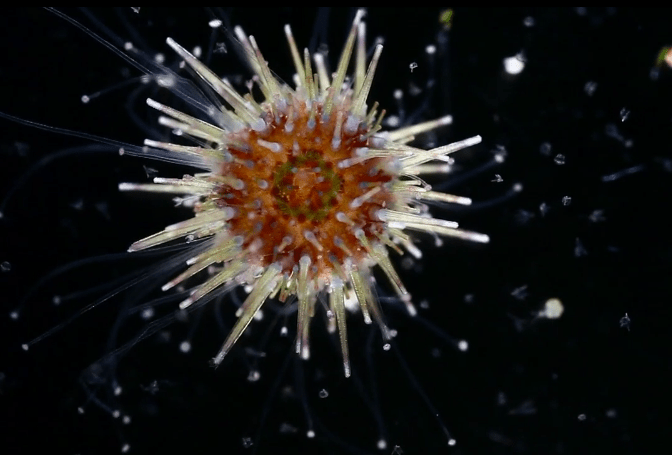
Despite its “Science Fiction Trilogy” sounding name, The Plankton Chronicles is a series of short, compelling educational videos made in conjunction with Tara Oceans Expeditions (a scientific expedition to “sail the seven seas” collecting plankton samples to understand and hopefully mitigate the effects of climate change) and the Observatoire Oceanologique de Villefranche-sur-Mer.

Viewed as a set, they invite the viewer into the kaleidoscopic world that exists in a teaspoon of seawater as well as the open oceans.  Click on the image for a macro lens glimpse. Continue reading

Why Is Mimicry Funny?

In Latin it’s called Thaumoctopus mimicus, but I’d call it The Master. It’s Meryl Streep in octopus form. There are ocean animals that can change shape, imitate plants, rocks, flora, and I’ve blogged about some of them. But this octopus is special. It seems to study other creatures and then imitate them, copying their moves and their bodies. It can do sea snakes, lion fish, flatfish, giant crabs, seashells, stingrays, jellyfish and weird beings that have no name, and maybe no earthly existence. Is it imagining? I don’t know, but no scientist has ever seen a shaggy sprinting bipedal crab — until our octopus decided to be one.

Click the banner above to go to the remainder of Robert Krulwich’s blog post on this wonder.  A bit more on the same after the jump (click the image to go to the original)… Continue reading