When Alarmism Is Required

Greenpeace_IllegalLoggingBrazilIndigenousLands_web.jpg

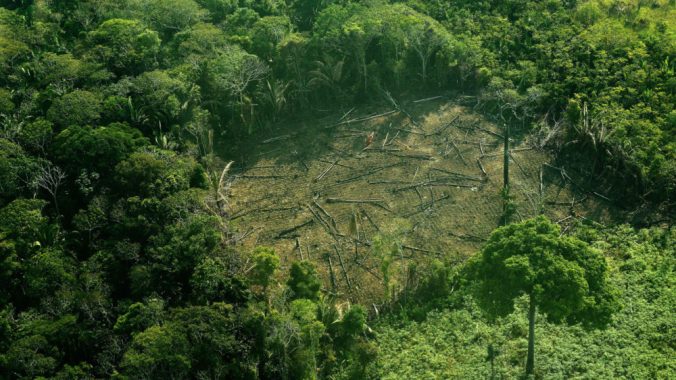
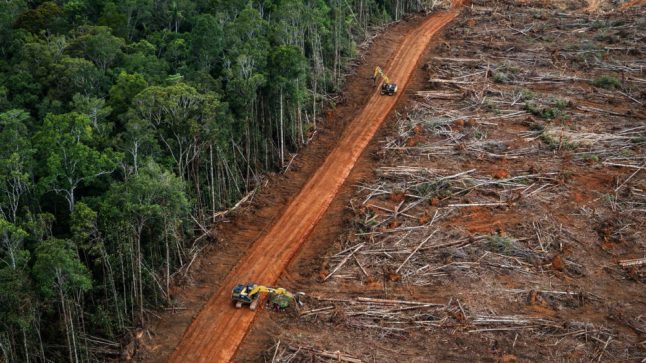
An illegal logging in the Alto Turiacu indigenous territory in Brazil’s Maranhão State in 2015. FÁBIO NASCIMENTO / GREENPEACE

Trust, a kind of social glue, keeps us from having to think nonstop about worst case scenarios. We trust that those with authority, whether intellectual or political, will use it responsibly. Thinking about this recently, I have been adjusting where I have least and greatest trust that responsible environmental actions are taken. Today I have made an adjustment on the former. The USA’s political leadership has been at the forefront of my thought when it comes to least responsible, least trustworthy actions. Philip Fearnside, an ecologist at the National Institute for Research in Amazonia (INPA) in Brazil, studies the consequences of deforestation in the world’s largest tropical forest, so his word carries scientific weight for me. He has put in perspective why I should turn my attention to Brazil:

Why Brazil’s New President Poses an Unprecedented Threat to the Amazon

Newly elected Jair Bolsonaro, an authoritarian nationalist sometimes called the “tropical Trump,” has staked out an environmental agenda that would open the Amazon to widespread development, putting at risk a region that plays a vital role in stabilizing the global climate.

BrazilElection2018_IndigenousProtester_Getty_web.jpg

An indigenous woman protests against then-candidate Jair Bolsonaro, who has promised to ban the creation of new protected areas or indigenous territories, in Sao Paulo in October. NELSON ALMEIDA/AFP/GETTY IMAGES

For people concerned about the environment and climate change, U.S. President Donald Trump has proven to be as bad, or worse, than feared. He is in the process of pulling the United States out of the Paris Agreement, continues to flatly dismiss the science of human-caused global warming, and has worked ceaselessly to undo environmental regulations and weaken environmental agencies.

JairBolsonaro_Getty_web.jpg

Brazil’s president-elect, Jair Bolsonaro, has pledged to dismantle the country’s environmental regulations. MIGUEL SCHINCARIOL/AFP/GETTY IMAGES

Now, however, a new leader has emerged on the world stage who is poised to do even more global environmental damage than Trump. He is Jair Bolsonaro, the recently elected president of Brazil, and his extreme views on the environment, coupled with his control of nearly all the country’s levers of power, means that he is now in a position to do unprecedented harm to the Amazon and the international battle to slow climate change.

Not for nothing is Bolsonaro known as the “tropical Trump.” The parallels are many, including their embrace of the far right and their inflammatory rhetoric. And among their similarities is the way that a constant barrage of outrageous comments diverts discussion from the environmental damage that their policies portend. Continue reading


Mapping Earth’s Remaining Intact Ecosystems

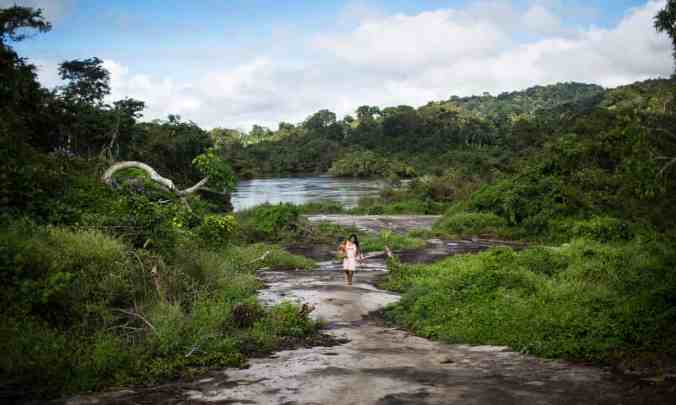
A Xikrin woman walks back to her village from the Cateté River in Brazil. Photograph: Taylor Weidman/Getty Images

Thanks to Lisa Cox, the Guardian’s Australia correspondent for environment, for this:

Five countries hold 70% of world’s last wildernesses, map reveals

First map of Earth’s intact ecosystems shows just five nations are responsible for most of them – but it will require global action to protect them

1048.jpg

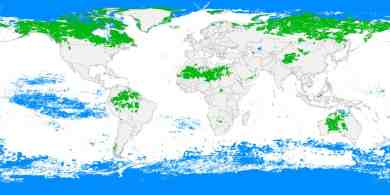
Map of the world’s remaining wilderness. Green represents land wilderness, while blue represents ocean wilderness. Photograph: Nature

Just five countries hold 70% of the world’s remaining untouched wilderness areas and urgent international action is needed to protect them, according to new research.

Researchers from the University of Queensland (UQ) and the Wildlife Conservation Society (WCS) have for the first time produced a global map that sets out which countries are responsible for nature that is devoid of heavy industrial activity.

It comes ahead of the conference of parties to the Convention on Biological Diversity in Egypt in November where signatory nations are working towards a plan for the protection of biodiversity beyond 2020.

Conservationists are calling for a mandated target for wilderness conservation that will preserve the planet’s vulnerable ecosystems. Continue reading

Really, China?

merlin_142564782_e9db5834-8efb-4fc8-8b50-16d6b83fad22-jumbo

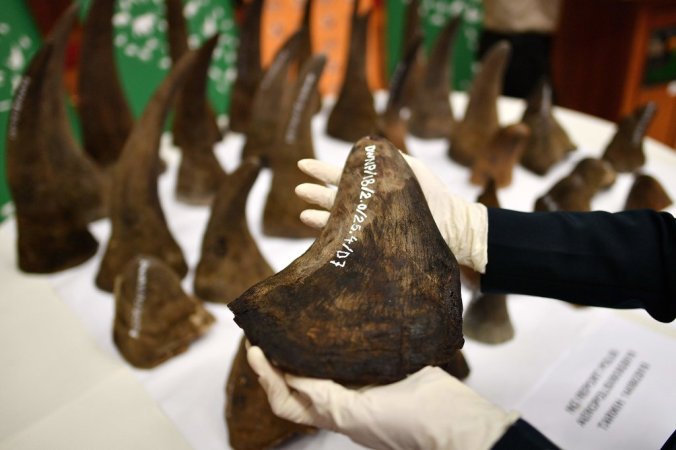
Seized rhinoceros horns and other animal parts at the Department of Wildlife and National Parks headquarters in Kuala Lumpur in August.CreditCreditManan Vatsyayana/Agence France-Presse — Getty Images

Javier C. Hernández shares this news from China, more frightening and more real than any Halloween horror story we can think of:

China Reverses Ban on Rhino and Tiger Parts in Medicine, Worrying Activists

BEIJING — The Chinese government, reversing a 25-year ban, announced on Monday that it would allow the use of rhinoceros horns and tiger bones in medicine, a move that environmentalists described as a significant setback for efforts to protect the animals from extinction.

The State Council, China’s cabinet, said in a policy directive that it would legalize the use of rhino horns and tiger bones for “medical research or in healing,” but only by certified hospitals and doctors, and only from rhinos and tigers raised in captivity, excluding zoo animals. While such remedies are highly profitable, they have no proven benefits to humans.

Environmentalists said the decision would likely help fuel a black market for wild rhino and tiger parts, which are revered in traditional Chinese medicine for supposed healing powers, and could lead to increased poaching of the fewer than 30,000 rhinos and 3,900 tigers still in the wild. Continue reading
Reckoning With Doom

Kolbert.jpgWe have featured work by Elizabeth Kolbert since the earliest days of this platform, about twice a year. A year ago we linked to The Fate of Earth, which remains a favorite.

LongformShe has chosen to focus her work on the existential environmental challenges created by mankind, and unflinchingly reports on what we collectively are, and more often are not, doing about those challenges. The word doom always comes to mind when I see her name or think about her work. Today I am recommending this rare interview with her, in which she shares personal reflections on what it is like to do the work she does, and about 40 minutes in touches on how and why she persists with her work, even knowing that most people simply cannot bear to face the facts she is presenting:

Elizabeth Kolbert, author of Field Notes from a Catastrophe: Man, Nature, and Climate Change and The Sixth Extinction: An Unnatural History, is a staff writer at The New Yorker.

“I still nurse the idea in my heart of hearts that something you write, that there’s some key to this all. Continue reading
A Big Step To Reduce Plastic Pollution


gettyimages-984354822-1cd9174e52fd0dc14cf00ca4ec859b0ee256e09a-s1300-c85.jpg

Volunteers cleared trash from the banks of the River Thames during the annual Big Bottle Count in London last month. Credit Matt Dunham/Associated Press

Thanks to Ceylan Yeginsu and the New York Times for this news:

European Parliament Approves Ban on Single-Use Plastics

merlin_145766505_d571d0f9-8739-4a8d-b1cb-691bce23acf5-jumbo.jpg

Under the proposal, 10 single-use plastics that most often end up in the ocean will be prohibited in the European Union. Credit Rafael Marchante/Reuters

LONDON — The European Parliament has overwhelmingly approved a ban on single-use plastics such as straws, plates, cutlery and cotton-swab sticks in Europe by 2021, joining a global shift as environmentalists emphasize the urgency of halting the use of materials that are detrimental to the planet.

Under the proposal, approved on a vote of 571 to 53 on Wednesday, 10 single-use plastics that most often end up in the ocean will be prohibited in the European Union, as well as oxo-degradable plastics, such as bags or fast-food container packaging. Continue reading

Keeping Track Of Renewables

Kormann-Prop-127.jpg

Despite the rapid decline in the cost of solar-energy technology and battery storage, Arizona gets only six per cent of its electricity from solar. Photograph by Joshua Lott / Bloomberg / Getty

Thanks to Carolyn Kormann, making her fifth appearance since early 2016 in our pages, including this recent item that I particularly favored, for the article below that helps us understand what is happening with renewable energy these days in the USA. It is easy to forget, amidst all the noise of a federal government working to deregulate and reduce environmental protection, that important work continues:

The Battle for Solar Energy in the Country’s Sunniest State

In late September, the Heartland Institute, a libertarian think tank that receives donations from fossil-fuel companies, published a blog post titled “California Billionaire’s Renewable Energy Initiative Makes Arizona Ballot.” The billionaire in question was Tom Steyer, whose year-long effort to pass Proposition 127, an amendment to Arizona’s constitution that would require power companies to generate fifty per cent of their electricity from renewable sources by 2030, has faced aggressive opposition from the state’s largest utility, Arizona Public Service, or A.P.S. The blog post lamented a failed lawsuit filed by Arizonans for Affordable Energy, a political-action committee funded by A.P.S.’s parent company, to keep Prop 127 off the ballot, and quoted several opponents who believed the measure, now up for a vote in November, would be a costly mistake. “Prop 127 would tie Arizona’s future to technologies that do not deliver baseload electricity,” Mark Finchem, a Republican state representative, said, “and are arguably worse for the environment as a whole than the dependable technologies we already have.” The photograph accompanying the post depicted a wind-turbine farm, and, in the foreground, a dead bald eagle.

Arizona is the sunniest state in the country, with more than three hundred bluebird days per year. It is also projected to endure an additional month of hundred-degree days in the coming decades owing to climate change. Yet, despite the rapid decline in the cost of solar-energy technology and battery storage—to the point that, as an A.P.S. director told me, it now frequently outbids fossil fuels, even natural gas—in 2017, Arizona generated only six per cent of its electricity from solar, according to the ballot initiative’s advocates. The state currently requires utilities to generate eight per cent of their power from sources like solar and wind, scaling up to fifteen per cent by 2025. Natural gas, the largest source of Arizona’s net electricity generation, is imported from out of state. “Our most abundant resource in Arizona is our sunshine,” D. J. Quinlan, a spokesman for Clean Energy for a Healthy Arizona, the Phoenix-based political-action committee that Steyer is funding, said. “We need a nationwide transition to renewables. One of the first places we should be doing it is where it’s most efficient and cost-effective, and that’s here.” Continue reading

Scotland, Land Of Regret-Reducing Renewable Resources

5329

Scottish Power’s Whitelee windfarm on Eaglesham moor, just south of Glasgow. Photograph: Global Warming Images/REX

My daily contribution to this platform is a habit vaguely in the tradition of meditation–finding something each day that is worthy of gratitude, or otherwise worthy of sharing with friends, family, and anyone else who cares to listen. Because of the good fortune I have had to visit and work in many amazing places, it is important to me to never regret the places where I still have not been. Scotland is one of those places that, if I were a regretter, I would be feeling it now. I owe that place a visit (even if the company name sounds like a Bond villain):

Scottish Power shifts to 100% wind generation after £700m Drax sale

Big six energy firm drops fossil fuels for generation and say cheap green energy is the future

Scottish Power has ditched fossil fuels for electricity generation and switched to 100% wind power, by selling off its last remaining gas power stations to Drax for more than £700m.

Iberdrola, Scottish Power’s Spanish parent company, said the move was part of its strategy to tackle climate change and would free it up to invest in renewables and power grids in the UK.

The deal also marks a significant expansion and diversification for Drax, whose main business is a coal- and biomass-fired power station in North Yorkshire. Continue reading

Forests, Deforestation & Climate Change

Trees cleared in the western Amazon region of Brazil in September 2017. CARL DE SOUZA / AFP / GETTY IMAGES

If you have been following the news recently, you may have noticed a report that indicates the urgency from climate change is greater than scientists previously thought. Everyone who cares has been digesting the science and we appreciate every effort to clarify what the science is saying. Fred Pearce, writing for Yale e360, has this:

Conflicting Data: How Fast Is the World Losing its Forests?

GP0STRVIX_PressMedia_web.jpg

Forest cut to make way for an oil palm plantation in Papua, Indonesia in April 2018. ULET IFANSASTI / GREENPEACE

The latest UN report on climate says reducing deforestation is crucial to slowing global warming. But researchers must first reconcile two contradictory sets of statistics on tree loss in order to determine whether promises made by nations to protect and restore forests are on target.

The world is losing trees faster than ever. An area the size of Italy disappeared last year. Or did it? New research suggests three-quarters of those lost forests may already be regrowing. That hardly means we are out of the woods. Fighting climate change and protecting biodiversity still needs a global campaign to reforest the planet. But it does suggest that, given the chance, nature will do much of the work. Continue reading

Carbon Insurance As Heritage Insurance

Kormann-YurokCarbonCredits-Primary.jpg

A carbon-offset project, the first of its kind in the United States, has become the Yurok’s main source of discretionary income, helping the tribe buy back thousands of acres of land. Photograph by Joel Redman

Carbon trading has featured, or at least been mentioned, only rarely on this platform, now that I stop to check. That seems impossible. But the scheme with so much promise has simply not taken off. Indigenous heritage, on the other hand, has featured in dozens of stories here since we started in 2011. Thanks to Carolyn Kormann for bringing this story to my attention, helped by two captivating photos and the fact that it highlights the approach of the Yurok Tribe (a community I had not heard of before):

Kormann-YurokCarbonCredits-Secondary2

“I think we did a good thing by saving the trees, but I’m not happy with it,” Jene McCovey, a tribal elder, said. “It’s not viable. It allows polluters to pollute.” Photograph by Joel Redman

How Carbon Trading Became a Way of Life for California’s Yurok Tribe

When Marty Lamebear is not fighting fires, he is starting them. In the past few years, as a member of the Yurok Tribe Forestry Program’s fire department, he has been helping revive the controversial practice of prescribed burns to protect and restore the coastal redwood forests of northern California. Lamebear is also a hunter, fisherman, and dancer. In his free time, he makes tribal regalia for ceremonial dances from parts of elk, deer, minks, and porcupines, which he shoots or finds already dead, and from frozen eagles that he orders from the U.S. Fish and Wildlife Service. A prescribed burn, what Lamebear calls a culture burn, creates prairies within the forest, which attract those animals. “At first, we couldn’t really tell its effects,” he said. “But, after about six years now, we can honestly start seeing the landscape open up, animals come around.” They also serve another purpose, he said. “It’s insurance for our carbon.” Continue reading

Trees, Cities & Happiness

merlin_144034221_4ee0b063-798b-4669-80dc-817bcbc10dfe-superJumbo.jpg

A tree in Riverfront Park competes for grandeur with Nashville’s iconic At&T building. Credit William DeShazer for The New York Times

PlantTreeCity.jpgI just learned of an urban tree-planting initiative on a day when the news shows purposeful indifference about climate change on the part of a powerful country’s elected leader, on the same day when the news also shows that an economist considered a pioneer of environmental economics is receiving a prestigious prize and what he said when he learned of his being awarded the prize:

“Once we start to try to reduce carbon emissions, we’ll be surprised that it wasn’t as hard as we anticipated. The danger with very alarming forecasts is that it will make people feel apathetic and hopeless.

“One problem today is that people think protecting the environment will be so costly and so hard that they want to ignore the problem and pretend it doesn’t exist. Humans are capable of amazing accomplishments if we set our minds to it.”

PlantTreesCity2Let’s decide together to do something, seems to be his message. I learned about this urban tree-planting initiative, news of a president’s abdication of responsibility, and this economist’s optimistic message on the same day I read about a 15-year old climate activist who has decided to do something where she sees her government failing to take action. She has decided at a very young age to do what she can regardless of the daunting odds. So thanks to Margaret Renkl a Nashville-based contributing opinion writer for The New York Times, for bringing this initiative to my attention, as a reminder to do something:

More Trees, Happier People

When cities grow, green space dies. Replanting it has been shown to lift the human spirit.

merlin_144034215_0e5eb0e9-e3ad-4046-b39b-a6189d715df7-superJumbo

A tale of two trees in Nashville. A mature tree in England Park, left, and a newly planted tree at Wright Middle School.

NASHVILLE — The scene in a tiny pocket park outside Plaza Mariachi here on Nolensville Pike last Wednesday was like a tableau from a Norman Rockwell painting, 21st-century style. Surrounded by signs advertising the Hispanic Family Foundation, Dubai Jewelry, the Dominican Barber Shop and restaurants offering Peruvian, Chinese, Mediterranean and Indian food — as well as a Game Stop franchise and H&R Block — was a small sign that read, “Today: Free trees.”

merlin_144034152_9a1c43d3-ccb7-42c0-bfd7-979917608536-superJumbo

Photographs by William DeShazer for The New York Times

The arrow on the sign pointed to a pop-up canopy where the Nashville Tree Foundation was hosting its fourth tree giveaway of October. A family standing under the canopy was posing for a photo with the sapling they had just adopted. Carolyn Sorenson, executive director of the foundation, was taking the picture: “Say ‘trees’!” she said.

The tree giveaway at Plaza Mariachi happened to fall on the very day that Nashville’s mayor, David Briley, announced a campaign to restore and enlarge the city’s tree canopy. The effort, called “Root Nashville,” will be overseen by the city and the Cumberland River Compact, an environmental nonprofit, and funded through a combination of public, corporate, foundation and private dollars. Together with several municipal departments and other nonprofit organizations, the initiative aims to plant 500,000 trees in Davidson County by 2050.

Many of these newly planted saplings will replace very large, very old trees that have been lost to Nashville’s meteoric growth — a population increase of more than 45 percent since 2000. As the city has grown, the city’s trees have fallen: deliberately felled by developers to make room for new construction or unintentionally killed as a side effect of nearby building. Just since 2008, the tree canopy in the urban core has dropped from 28 percent to 24 percent, a loss of roughly 9,000 trees a year. Continue reading
A Visual Requiem, And A Call For Quiet Grace At The Grand Canyon

Paumgarten-Grandy-Canyon_01.jpg

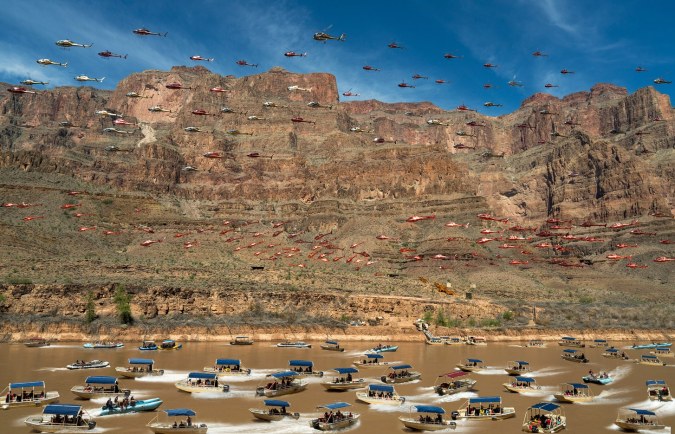
In a merged image, the photographer Peter McBride captured a vision of the Grand Canyon choked by noise and exhaust. Photograph by Pete McBride

Noise pollution was the topic of several of the first posts on this platform when we started it in 2011, and has been a persistent theme ever since then. We especially appreciate those related to noise in wilderness areas, so thanks to Nick Paumgarten for this story:

The Grand Canyon Needs to Be Saved By Every Generation

Paumgarten-Grandy-Canyon_03.jpg

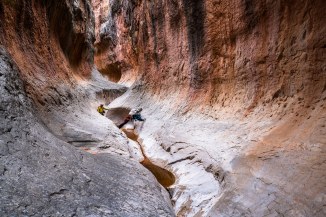
Hiking in the Grand Canyon can be a perilous pursuit. Photograph by Pete McBride

Three years ago, in the course of thirteen months, the photographer Peter McBride and the writer Kevin Fedarko hiked from one end of the Grand Canyon to the other. They did it in eight sections, mainly so that McBride could shoot in different seasons. In all, it took them seventy-one days to cover two hundred and seventy-seven river miles and some eight hundred shoe-leather miles, through some of the continent’s roughest hiking terrain—“a whole lot of scratching around the rock puzzles in that giant abyss,” as McBride put it recently.

Before they set off, the Grand Canyon had been hiked nose to tail only nine times in recorded history. There is also a handful of obsessives who have chipped away at it, piece by piece, in the course of decades. “Maybe some crazy ancestral Puebloan did the whole thing, but that wouldn’t make logical sense—they wouldn’t have had any reason to,” McBride said.

Paumgarten-Grandy-Canyon_02.jpg

 panoramic view of the confluence of the Colorado and the Little Colorado. Photograph by Pete McBride

McBride, a native Coloradan who shoots for National Geographic, has been documenting the Colorado River for a decade, sometimes from a perch in an ultralight aircraft. Fedarko, who lives in Flagstaff, Arizona, has guided on the river and is the author of “The Emerald Mile,” an account (with many historical tributaries) of a harrowing speed run of the Grand in a dory during the biggest flood in generations. (As it happens, Kenton Grua, the boatman in the book, was also the first person to walk the canyon, in 1976.) McBride and Fedarko have both become persistent, ardent advocates for preserving the place, in all its spellbinding, inhospitable glory, in abidance with Teddy Roosevelt’s famous dictum, issued during his one visit, in 1903: “Leave it as it is. Man cannot improve on it; not a bit.” Still, this was the first time, and surely the last, that either of them had tried to walk it. Continue reading

Science Writing, A Genre That Keeps Improving, Is The Best Way To Explain A Conservation Paradox

1920 (2).jpg

Eric Nyquist

Two years of working in southern Chile taught me just enough about the complexity of this particular issue (among the many complex issues in our practice)to appreciate the article below by Emma Marris, who we already knew to be provocative, enough that she could challenge Bill McKibben two minutes into her TED talk, and does so convincingly. The primary reason I appreciate this article, is the same reason this platform has showcased the best of this genre of writers over the years. Scientists, translated into regular language we non-scientists can understand:

When Conservationists Kill Lots (and Lots) of Animals

Invasive species are sometimes trapped, poisoned, and shot in large numbers to save native species from extinction. Some scientists say the bloodshed isn’t worth it.

dcafc084c

Eric Nyquist

The desert of south-central Australia is crenellated with sandstone hills in shades of ivory, crimson, and apricot. The ground is littered with dead trees and tree limbs, big hunks of transparent mica, dried cow dung, and thousands of stone spearheads and blades made by the Aboriginal people who lived here for tens of thousands of years—and live here still. Around the few water holes are the doglike tracks of dingoes, wild canines that were brought to Australia thousands of years ago and are now the country’s top predators.

I have come to the Evelyn Downs ranch, on the famously remote highway between Adelaide and Alice Springs, to meet Arian Wallach, a conservationist who thinks there is too much killing in conservation. Wallach has come to this massive 888-square-mile ranch because it is one of the few places in Australia where people aren’t actively killing wild animals. Tough, outback Herefords share the landscape with kangaroos, wild horses, wild donkeys, camels, emus, cats, foxes, native rodents, dingoes, and very large antediluvian-looking reptiles called perenties. Of the animals on this list, dingoes, cats, foxes, horses, camels, and donkeys are all killed in large numbers throughout Australia—but not here. Wallach has convinced the owners to experiment with a more hands-off approach. Continue reading

Analyzing Local Sources Of Big Carbon Footprints

lead_720_405.png

GOOGLE

What gets measured gets managed. In the realm of climate science, national governments have the scale and responsibility to be involved in measurement. But if a skeptic is in charge of the government apparatus, good luck with that. With the national government of one of the big carbon footprint countries abandoning science and dropping out of the fight to reduce climate change, one of that country’s biggest companies is stepping up to offer an alternative. It may be too little too late but under the circumstances we may have no choice but to cheer it on:

Google’s New Tool to Fight Climate Change

The company will begin estimating local carbon pollution from cities around the world.

In the next decade or so, more than 6,000 cities, states, and provinces around the world will try to do something that has eluded humanity for 25 years: reduce their emissions of greenhouse gases, which warm the atmosphere and cause climate change.

The city-level leaders overseeing this task won’t have the same tools available to their national peers. Most of them won’t have an Environmental Protection Agency (or its equivalent), a meteorological bureau, a team of military engineers, or nasa. So where will they start? Never mind how to reduce their city’s greenhouse-gas emissions; how will they know what’s spewing carbon dioxide in the first place?

Maybe Google will do it for them. Or, at least, do it with them.

Google has started estimating greenhouse-gas emissions for individual cities, part of what it recently described as an ambitious new plan to deploy its hoard of geographic information on the side of climate-concerned local leaders. Continue reading

The Most Important Infrastructure

New York Library Historic Rooms

People read in the Rose Main Reading Room of the New York Public Library MARK LENNIHAN / AP

This podcast featuring Eric Klinenberg resonated with many of our readers, and this article he wrote for the Atlantic may be the next best step in advance of reading his book:

Worry Less About Crumbling Roads, More About Crumbling Libraries

America’s social infrastructure is falling apart, and it’s hurting democracy.

Every four years, the American Society for Civil Engineers issues grades for the nation’s infrastructure. In the most recent evaluation, released in 2017, America’s overall infrastructure score was a D+, the same as in 2013. Although seven systems, including hazardous waste and levees, received modestly better grades than in the previous assessment, transit and solid waste, among others, did worse. Aviation (D), roads (D), drinking water (D), and energy (D+), retained their miserably low scores. Continue reading
Economics, Prodigy & A Better Future

merlin_140063802_2cbcf897-0703-4f45-9abd-01cca30177ca-jumbo

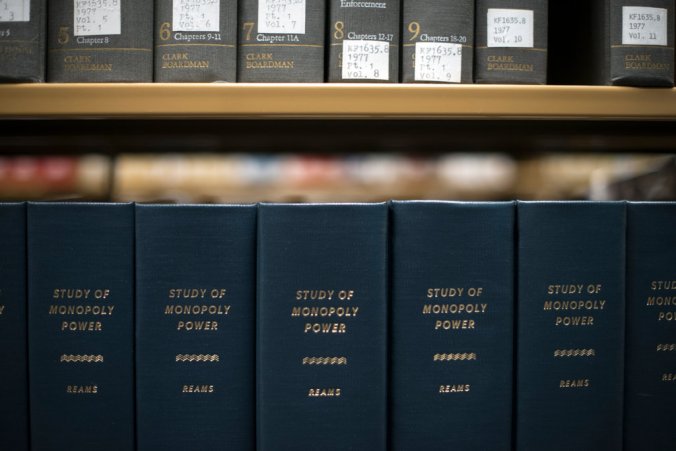
At the S.M.U. library in Dallas, Ms. Khan was finding inspiration from books that predated the price-based era of monopoly law. Credit Brandon Thibodeaux for The New York Times

I have resisted placing orders through Amazon about as steadfastly as humanly possible in the economic and cultural life Amazon has now taken such a prodigious role in. I have had plenty of hints of what the key points are in the growing debate about the company and why to resist it. Thanks to this excellent profile by David Streitfeld, I have a better understanding of why this is so important, and thanks to Lina Khan I have faith that the only way to counter prodigious power is with the power of prodigy:

Amazon’s Antitrust Antagonist Has a Breakthrough Idea

With a single scholarly article, Lina Khan, 29, has reframed decades of monopoly law.

09Khan1.print-superJumbo-v2.jpg

In early 2017, when she was an unknown law student, Lina Khan published “Amazon’s Antitrust Paradox” in the Yale Law Journal. Credit Brandon Thibodeaux for The New York Times

The dead books are on the top floor of Southern Methodist University’s law library.

“Antitrust Dilemma.” “The Antitrust Impulse.” “Antitrust in an Expanding Economy.” Shelf after shelf of volumes ignored for decades. There are a dozen fat tomes with transcripts of the congressional hearings on monopoly power in 1949, when the world was in ruins and the Soviets on the march. Lawmakers believed economic concentration would make America more vulnerable.

At the end of the antitrust stacks is a table near the window. “This is my command post,” said Lina Khan.

It’s nothing, really. A few books are piled up haphazardly next to a bottle with water and another with tea. Ms. Khan was in Dallas quite a bit over the last year, refining an argument about monopoly power that takes aim at one of the most admired, secretive and feared companies of our era: Amazon.

The retailer overwhelmingly dominates online commerce, employs more than half a million people and powers much of the internet itself through its cloud computing division. On Tuesday, it briefly became the second company to be worth a trillion dollars. Continue reading
Greening Indian Cities

Another creative commitment to Green Innovation. Thanks to the Times of India for this story about how Ahmedabad embraces green walls, goes vertical:

Aapnu Amdavad has a lot to boast about. From being the first city to have been declared India’s first Unesco World Heritage City to being home to some prime educational institutes, this city has gained prominence on the global map. Having said that, the city has its share of dark spots too. The fast diminishing green cover in the city is one of them. India’s fifth largest city has a tree cover of approximately 35 crores (as per a 2017 census), which although is 13% more than the number of trees in 2013, is still not enough. The ongoing metro project has also led to a lot of felling of trees. Taking into consideration all this, Ahmedabad Municipal Corporation (AMC) has decided to build vertical gardens in the city. It recently set up a small vertical garden along one of the pillars at the flyover at Helmet crossroads.

What are vertical gardens? Essentially vertical gardens are the kind of gardens that grow vertically, along walls or pillars, with the help of trellis (which are wooden frames) or similar support systems. Continue reading

Behavioral Science & Green Innovation

5749.jpg

Green registration plates are already in use in China. Photograph: Roman Pilipey/EPA-EFE/Rex/Shutterstock

The UK, whatever other challenges it may be experiencing, is proving itself creatively committed to green innovation:

Green number plates ‘could boost sales of electric cars’ in UK

Behavioural insights unit proposes new colour for registration plates to help ‘normalise the idea of clean vehicles’

Wind Powering 590,000 Homes

WindFarm.jpg

 Drone footage shows world’s largest offshore windfarm – video

Thanks to the Guardian for this news about harnessing wind at a record scale:

World’s largest offshore windfarm opens off Cumbrian coast

Walney Extension will power 590,000 homes amid fears Brexit could stifle growth

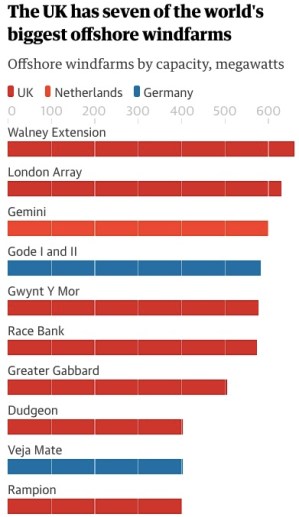
ChartWind.jpg

Guardian Graphic | Source: Renewable

The world’s biggest offshore windfarm has officially opened in the Irish Sea, amid warnings that Brexit could increase costs for future projects.

Walney Extension, off the Cumbrian coast, spans an area the size of 20,000 football pitches and has a capacity of 659 megawatts, enough to power the equivalent of 590,000 homes.

The project is a sign of how dramatically wind technology has progressed in the past five years since the previous biggest, the London Array, was finished.

The new windfarm uses less than half the number of turbines but is more powerful.

Matthew Wright, the UK managing director of Danish energy firm Ørsted, the project’s developer, said: “It’s another benchmark in terms of the scale. This – bigger turbines, with fewer positions and a bit further out – is really the shape of projects going forward.” Continue reading

Europe And The Race To Car Electrification

ElectricCars.jpg

Thanks to Adam Vaughan and the Guardian for this update on this race:

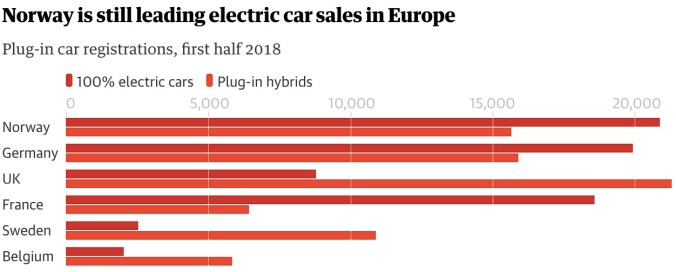
Electric cars exceed 1m in Europe as sales soar by more than 40%

Milestone reached nearly a year after China but ahead of the US

3963.jpg

Between January and June around 195,000 plug-in cars were sold across the EU, Iceland, Liechtenstein, Norway and Switzerland. Photograph: Miles Willis/Getty Images for Go Ultra Low

There are now more than a million electric cars in Europe after sales soared by more than 40% in the first half of the year, new figures reveal.

Europe hit the milestone nearly a year after China, which has a much larger car market, but ahead of the US, which is expected to reach the landmark later this year driven by the appetite for Tesla’s latest model.

Between January and June around 195,000 plug-in cars were sold across the EU, Iceland, Liechtenstein, Norway and Switzerland, a 42% increase on the same period a year before. Continue reading

Off Halogen, On With LED

Switching to LEDs has been estimated to save consumers up to £112 a year. Photograph: imageBroker/Rex/Shutterstock

Arthur Neslen at the Guardian shares the news, in Europe to ban halogen lightbulbs, that we have been waiting to hear for years:

After nearly 60 years of lighting homes halogens will be replaced with more energy efficient LEDs

After nearly 60 years of brightening our homes and streets, halogen lightbulbs will finally be banned across Europe on 1 September.

The lights will dim gradually for halogen. Remaining stocks may still be sold, and capsules, linear and low voltage incandescents used in oven lights will be exempted. But a continent-wide switchover to light-emitting diodes (LEDs) is underway that will slash emissions and energy bills, according to industry, campaigners and experts.

LEDs consume five times less energy than halogen bulbs and their phase-out will prevent more than 15m tonnes of carbon emissions a year, an amount equal to Portugal’s annual electricity usage. Continue reading