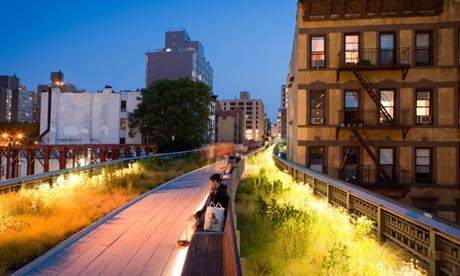
If You Happen To Be In New York City

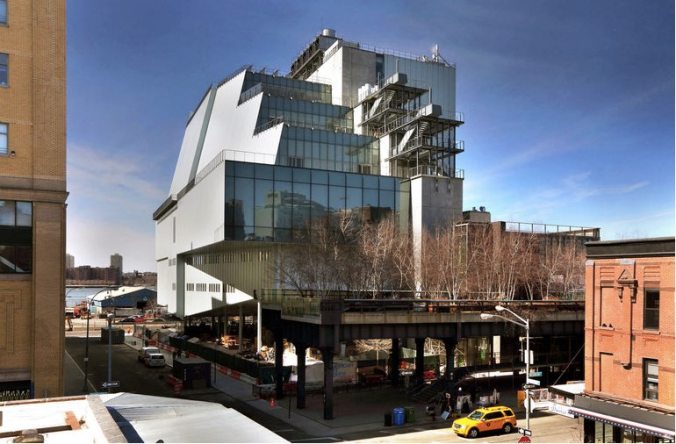
Whitney Museum of American Art. Photograph by Ed Lederman

Whitney Museum of American Art. Photograph by Ed Lederman

We have a thing for public spaces, especially when they combine with community activism. We try to get firsthand experience, and when we have learned enough about such places, we share what we can here. Ditto for museum exhibits, special library exhibitions, and unusual library thingys. It is not every day we get to announce the opening, or re-opening, of one of the greatest museums in the world, right in the midst of such a public space:

THE NEW WHITNEY OPENS MAY 1, 2015 BUY ADVANCE TICKETS NOW

The reviews convince us that this will be worth the visit, and this particular wording puts it in perspective:

The Whitney Museum of American Art, long the odd duck among the Big Four of Manhattan art museums—a cohort that includes the mighty Metropolitan, the starry Modern, and the raffish Guggenheim—takes wing on May 1st, when it reopens in a new, vastly expanded headquarters downtown. The fledging owes a lot to the Italian architect Renzo Piano’s ingenious building, on Gansevoort Street, which features six floors of shapely galleries, four open-air terraces, spaces for performance and screening, a library and reading rooms, a restaurant, a café, and an over-all feeling of seductive amenity—a bar on the piazza-like ground floor bodes to be one of the toniest trysting spots in town. It is likely to win far more fans than the Whitney’s old home, Marcel Breuer’s brutalist “inverted ziggurat,” which opened in 1966, on Madison Avenue, and which it vacated six months ago and leased to the Met. Piano’s museum stands at the southern end of the High Line and hard by the Hudson River, in what remains of the tatterdemalion meatpacking district. It looms like a mother ship for both gallery-jammed Chelsea, to the north, and the puttering West Village, to the south. It is instantly a landmark on the cultural and social maps of the city—and on its poetic map, as a site to germinate memories. Continue reading
If You Happen To Be In London

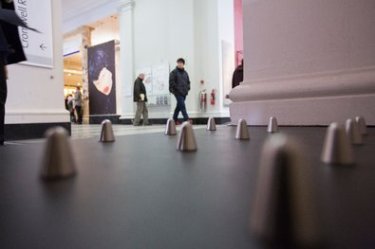
Peter Kelleher/Victoria and Albert Museum, London, 2015. Spike studs, used to keep people from sleeping near buildings, are part of the exhibition.

Peter Kelleher/Victoria and Albert Museum, London, 2015. Spike studs, used to keep people from sleeping near buildings, are part of the exhibition.

When we hear of civic-minded initiatives, museum shows are not the first thing that comes to mind. Schools, and libraries, and conservation initiatives come to mind.

Museums are civic institutions, of course, and we have posted more on this site about museums than almost any other topic.

But civic? We like the theme. This is a show we know will be worth seeing:

V&A Museum Returns to Its Civic-Minded Roots

“All of This Belongs to You,” an exhibition running through July 19 at the Victoria and Albert in London, seeks to stimulate debate about citizenship and the role of museums as public spaces.

Green, Greener, Greenest–Which City? Says Who? And How?

260cd679-e63d-417f-84b1-be816cf7f658-2060x1236

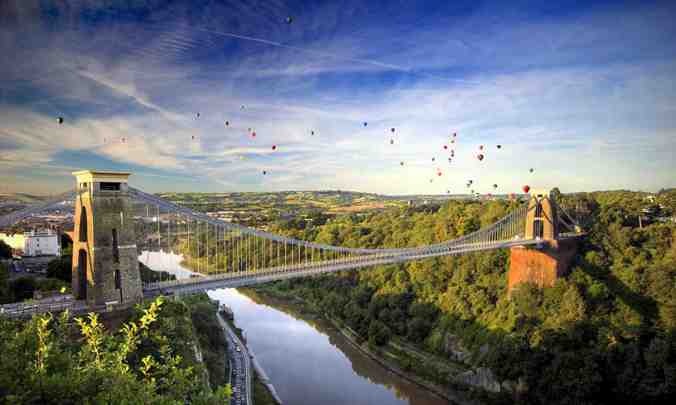
The Clifton Suspension Bridge in Bristol, 2015 Green Capital of Europe. Photograph: Destination Bristol.com/EPA

This is one of the environmentally-oriented rankings that many of us think about, from time to time, and then throw our hands in the air in frustration at the criteria used for judging green-ness, or what is often green-ish-ness. Thanks to the Guardian for asking the questions we want answered when it comes to rankings like this:

Where is the world’s greenest city?

Bristol is the ‘green capital’ of Europe, but its predecessor Copenhagen comes top in a Europe-wide index. Curitiba, San Francisco and Singapore all have strong eco-friendly claims too – so what’s the best way to compare cities’ greenness?

It’s easy to say we’d like our cities to be cleaner and greener. But what does that even mean? “Greenness” is a concept that’s hard to pin down – there’s no official list of the top 50 most eco-friendly cities, nor any widely agreed set of measurements for working out how green a city actually is.

Continue reading

Sustainable Cities Index 2015

Screen Shot 2015-02-11 at 7.15.47 PM

We have not had as many posts on sustainable cities as we should, but aim to begin making up for that with this link to the current state of the art:

…The purpose of this report, our first Sustainable Cities Index, is to take 50 of the world’s most prominent cities and look at how viable they are as places to live, their environmental impact, their financial stability, and how these elements complement one another. All 50 of these brilliantly different cities – many of which I have been fortunate enough to visit – are in various stages of evolution – some being further along the sustainability journey than others. Each possesses its own geolocation and cultural distinctions but shares common urban challenges in the areas of job creation, mobility, resiliency and improving the quality of life of its residents.

Continue reading

Seeing The Forest Through The Concrete Jungle

urbanization-680x450

Shutterstock, Oxygen64

Thanks to Dan Levitan for his ever-punchy summaries of important environmental science stories in Conservation:

IS THERE AN OPTIMAL URBANIZATION STRATEGY?

Cities are going to get bigger. With more than half the world now living in urban areas, and that percentage growing steadily, that means the concrete and steel will have to stretch out into areas that are currently forest and farm and grass. But just letting that process happen without a plan is likely to be a very bad idea.

A study published in the journal Landscape and Urban Planning simulated the urbanization process in the Piedmont region of North Carolina out to 2032. The question the authors posed was, essentially, what land will suffer in favor of the ever-growing city? Continue reading

Starry Night Bike Path

Artist Dan Roosegaarde pays tribute to Vincent Van Gogh's painting Starry Night by creating this bike path in Van Gogh's hometown of Eindhoven. Courtesy of Studio Roosegaarde

Artist Dan Roosegaarde pays tribute to Vincent Van Gogh’s painting Starry Night by creating this bike path in Van Gogh’s hometown of Eindhoven. Courtesy of Studio Roosegaarde

Thanks to National Public Radio (USA) for this follow up to another recent story from Holland about bike path innovations:

In the Dutch town of Eindhoven, artist Daan Roosegaarde has paid homage to its most famous resident, Vincent Van Gogh, by creating a glowing bike path that relies on solar-powered LED lights and interprets his classic painting Starry Night.

Roosegaarde says he wants his work, illuminated by thousands of twinkling blue and green lights, to speak to everyone. Continue reading

The Solar Cycling Double Whammy

5414df08-e96b-4af8-ae68-1c517a64a043-460x276

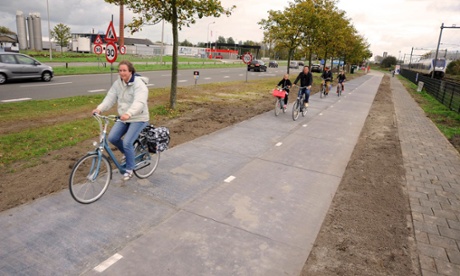
SolaRoad in Krommenie, the Netherlands, will be the world’s first cycle path with embedded solar panels. Photograph: SolaRoad

Two wrongs never make a right, but sometimes two green initiatives work together to create more than the sum of their parts, as this story reported in the Guardian demonstrates:

World’s first solar cycle lane opening in the Netherlands

Solar panels embedded in the cycle path near Amsterdam could generate enough electricity to power three houses, with potential to extend scheme to roads

The bike path that connects the Amsterdam suburbs of Krommenie and Wormerveer is popular with both school children and commuters: around 2,000 cyclists ride its two lanes on an average day.

But next week Krommenie’s cycle path promises to become even more useful: on 12 November a 70-metre stretch will become the world’s first public road with embedded solar panels.

Continue reading

Learning Laboratories, Museums, And Art’s Future Venues

Jon Chase/Harvard Staff Photographer. Harvard Art Museums Director Tom Lentz (from left) moderated a discussion with MoMA Director Glenn Lowry, A.M. '78, Ph.D. '82, Elizabeth Cary Agassiz Professor of the Humanities Jennifer Roberts, and Paul Ha, director, List Visual Arts Center at MIT.

Jon Chase/Harvard Staff Photographer. Harvard Art Museums Director Tom Lentz (from left) moderated a discussion with MoMA Director Glenn Lowry, A.M. ’78, Ph.D. ’82, Elizabeth Cary Agassiz Professor of the Humanities Jennifer Roberts, and Paul Ha, director, List Visual Arts Center at MIT.

Thanks to the Harvard Gazette for this story about museums functioning as inclusive, modern learning laboratories:

In the 1970s, the Italian architect Renzo Piano was a young upstart with immense talent and brazen daring. It was then, still fairly early in his career, that Piano and his partner, the architect Richard Rogers, redefined the architectural landscape with their groundbreaking Pompidou Center in Paris. Continue reading

If You Happen To Be In Paris

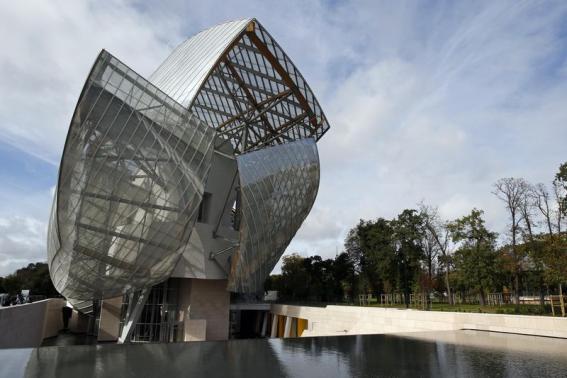
A general view shows the Fondation Louis Vuitton designed by architect Frank Gehry in the Bois de Boulogne, western Paris, October 17, 2014.  REUTERS/Benoit Tessier

A general view shows the Fondation Louis Vuitton designed by architect Frank Gehry in the Bois de Boulogne, western Paris, October 17, 2014. REUTERS/Benoit Tessier

We are in solidarity with the neighborhoods concerned about the loss of green space in Paris, as reported by Reuters on more than one occasion, and this project has been controversial since first announced, but for now, we can only say wow:

(Reuters) – Billowing sails of glass join the Eiffel Tower and the Sacre Coeur as permanent fixtures of the Paris skyline this month, when the new Fondation Louis Vuitton contemporary art museum designed by Frank Gehry opens to the public.

Thirteen years in the making, the museum is the brainchild of Bernard Arnault, the chief executive and founder of LVMH. France’s richest man envisioned a bold new piece of architecture in the capital that would tie the world’s largest luxury group with the cutting edge of art and design.

The private museum that opens to the public on Oct. 27 will be donated to the city of Paris in 50 years. Continue reading

Library Futures

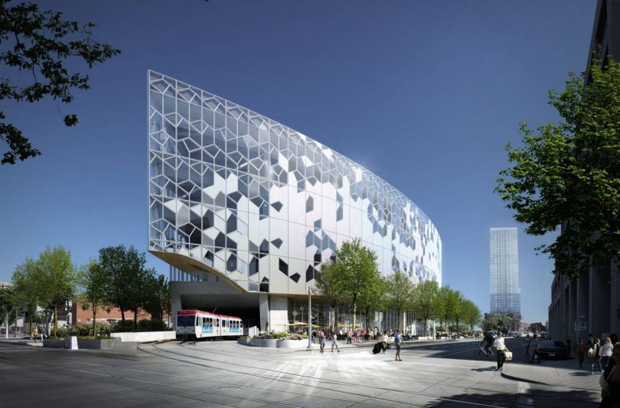
The New Central Library, Calgary, Canada - Snøhetta

The New Central Library, Calgary, Canada – Snøhetta

Thanks to Phaidon for these images and accompanying story that leads us to believe that libraries are less endangered than we might otherwise have thought, a story about a beautiful new library:

Snøhetta unveils ‘floating’ library design in Canada

Calgary design will feature arches inspired by cloud formations and will house over half-a-million books

As the Frankfurt Book Fair opens this week work has already begun in Calgary, Alberta, to construct a home for 600,000 books directly above a transport hub. The New Central Library by Norwegian starchitects Snøhetta will sit at the intersection of Downtown Calgary and the cultural hotspot that is East Village.

Trains on the light rail track will chug along tracks that appear out of the base of the slim, curved structure, with the library ‘lifted’ above the public transport below. A covered plaza has been created by cutting away the ground levels of the building, as if slicing through the corner of a pat of butter. Continue reading

Food Rebels

From guerilla gardeners, to food foraging, to our own movement toward preserving food biodiversity and farm to table sustainability, we love to write about the food we eat and how it reaches our plate.

Luckily for all of us we’re not alone in either our interest or speaking out about it. Generations since Rachel Carson‘s seminal book there have been people writing about, and more importantly, acting upon the need to re-embrace the old methods of food production while sometimes using technology to our more healthy advantage.

Food Forward opens the door into a new world of possibility, where pioneers and visionaries are creating viable alternatives to the pressing social and environmental impacts of our industrial food system. Continue reading

Another Reason To Visit The High Line

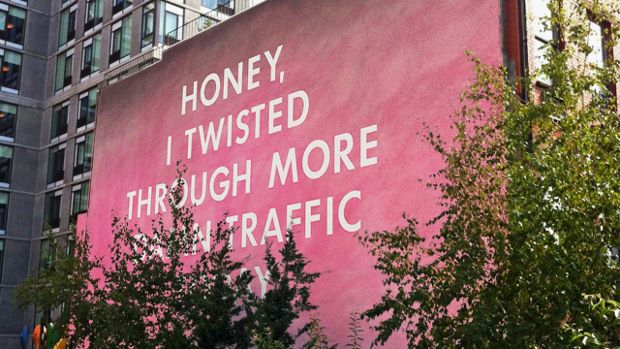
Rendering of Ed Ruscha's forthcoming High Line commission

Rendering of Ed Ruscha’s forthcoming High Line commission

Friends of the High Line, we try to remain steadfastly.  So, we count the following as good news. Thanks, as always, for the excellent arts coverage by Phaidon:

Ed Ruscha’s first public commission in NYC

His 1977 word painting will appear as a large hand-painted mural beside The High Line next month

Unveiled a few weeks after the city’s new mayor announced his commitment to lowering New York’s road deathsEd Ruscha’s High Line commission could be read like a vernacular traffic report.

Continue reading

Urban Muse

This slideshow requires JavaScript.

It does not matter whether you are a farmer, a geneticist, or whatever you do with your time: you will almost certainly be affected in important, unexpected ways after time spent in Paris.   Continue reading

Documentaries : Black Out by Eva Weber, children searching for the light

Short electricity cuts punctuate the day here in Kerala. As if to remind us, for a few seconds in our daily life, that the electricity fairy can play hard to get. Generators always kick in in an instant though, and that is it. Elsewhere, in Guinea for instance, generators are not there to save the day. 

Only about a fifth of Guinea’s people have access to electricity. With few families able to afford generators, school children have had to get creative to find a place to read, do their homework and study for exams. So every day during exam season, as the sun sets over Conakry, hundreds of children begin a nightly pilgrimage to the  G’bessia International Airport, to petrol stations and parks in wealthier areas of the city, searching for light.

Continue reading

A road paved with mixed intentions

Hotel on the lake road Thekkady

The pavement is being rebuilt on the street leading to ‘downtown’ Thekkady. Right now it looks like in many other Indian cities, which is apparently like a constant work in progress according to this article by N N Sachitanand in the New Indian Express:

Once upon a time, roadside pavements were meant for the use of pedestrians so that they could safely traverse the length of the road without being knocked down by traffic. That is why the Americans (as in the US of A) call them sidewalks. Indians have adopted and adapted to this Western concept to suit their own environment and, in the process, mangled its original purpose beyond recognition.

…or an extreme-gardening experimentation : Continue reading

High Lining Public Space

‘One of those once-in-a-decade projects’: the mile-long High Line linear park in Manhattan. Photograph: Andria Patino/ Alamy

‘One of those once-in-a-decade projects’: the mile-long High Line linear park in Manhattan. Photograph: Andria Patino/ Alamy

We have written about it more than once, but here is an article quoting one of the architects of this public space on the relatively low expectations for success when it was first being designed and proposed:

The High Line, the mile-long park created on an old elevated railway in Manhattan, is one of those once-in-a-decade projects that, like the 1990s Guggenheim in Bilbao, both captures the imagination of the world and offers limitless inspiration to plagiarists. There are wannabe High Lines mooted for Calabria, Singapore, Jerusalem and Shenzhen, and in any number of American cities. Continue reading