Full-Spectrum Farming

We haven’t met Natasha Bowens but her perspectives on the cultural empowerment of growing one’s own food tell us she’s a kindred spirit.

 Storytelling & Photography

The Color of Food is photographic and documentary in nature because I wanted to capture the personal stories of these farmers while also changing the image of agriculture as it is currently portrayed in the media. This project is not only political in it’s message, but also helps us celebrate and preserve the history, tradition and beautiful culture that make up our agricultural communities.

Continue reading

The Mysteries Of Elena Ferrante

Path of Figs, 2012. Giulia Bianchi.

If you have not heard of Elena Ferrante before, you may want to start here, here, or here. But then come back here for this review. Thanks to the nplusone magazine website:

Those Like Us

On Elena Ferrante, by Dayna Tortorici,Issue 22: Conviction, Spring 2015

WHENEVER I HEAR someone speculate about the true identity of Elena Ferrante, the pseudonymous Italian novelist of international fame, a private joke unspools in my head. Who is she? the headlines ask. Don’t you know? I whisper. In my joke I’m sitting opposite someone important. The person promises not to tell, so I say:

She’s Lidia Neri.

She’s Pia Ciccione.

She’s Francesca Pelligrina. Domenica Augello.

Different names, every time, but the reaction is the same: a momentary light in the listener’s eyes that fades to bored disappointment. An Italian woman from Naples, whose name you wouldn’t know. Who did you expect?

Continue reading

Language Spoken Is Knowledge Saved For A Rainy Day

150330_r26311-320

The consequences of losing a language may not be understood until it is too late.

At first glance, or quick skim, this will inject a darting depression into your soul, because of the seeming hopelessness. But then the grace of the writing, and the beauty of the story, will wash away the darkness and, very possibly, inspire you. Read it, and if you have thoughts, or actions, to share with us on the entrepreneurial (or other) conservation of intangible patrimony please share a comment below:

It is a singular fate to be the last of one’s kind. That is the fate of the men and women, nearly all of them elderly, who are—like Marie Wilcox, of California; Gyani Maiya Sen, of Nepal; Verdena Parker, of Oregon; and Charlie Mungulda, of Australia—the last known speakers of a language: Wukchumni, Kusunda, Hupa, and Amurdag, respectively. But a few years ago, in Chile, I met Joubert Yanten Gomez, who told me he was “the world’s only speaker of Selk’nam.” He was twenty-one.

Yanten Gomez, who uses the tribal name Keyuk, grew up modestly, in Santiago. Continue reading

Clothing Past, Experienced In The Present

One of Hortense Mitchell Acton’s Callot Soeurs gowns in the Camera Verde of Villa La Pietra. The gold and silver lace at the neck, the apron skirt, and the five metallic rosettes across the chest recall the forms of a Gothic cathedral. The sleeves are made of metallic lace, now oxidized. PHOTOGRAPHS BY PARI DUKOVIC

One of Hortense Mitchell Acton’s Callot Soeurs gowns in the Camera Verde of Villa La Pietra. The gold and silver lace at the neck, the apron skirt, and the five metallic rosettes across the chest recall the forms of a Gothic cathedral. The sleeves are made of metallic lace, now oxidized. PHOTOGRAPHS BY PARI DUKOVIC

It is likely that the New Yorker is the publication we link to the most, between its magazine and its website. If so, there is a reason. They care about stories we care about, enough to put their best writers and photographers on the task:

PortfolioMARCH 23, 2015 ISSUE

Twenty-One Dresses

BY AND

A number of years ago, a young painting conservator entered a forgotten storeroom in a fifteenth-century Florentine villa and stumbled on a pile of Louis Vuitton steamer trunks. She opened them and discovered a collection of exquisite dresses, the kind usually seen only in movies, or inside protective vitrines in museums. Closer inspection revealed silk labels, hand-woven with the name “Callot Soeurs.” Continue reading

What A Certain Change Of Scenery Can Do

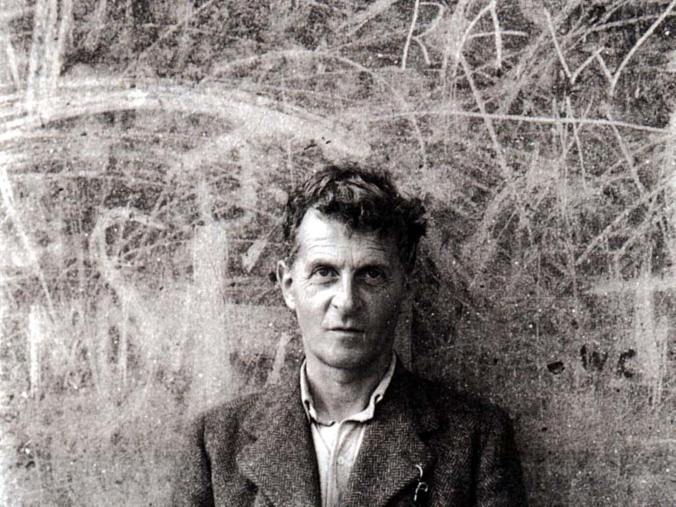
Ludwig Wittgenstein, who knew how to sully a chalkboard with the best of them.

Ludwig Wittgenstein, who knew how to sully a chalkboard with the best of them.

The photo above will make sense below, I hope. Read on. Derek is with us in Kerala for one more week before he moves on to Australia. I am reflecting on his time here, while also currently in conversation with prospective interns for the second half of 2015. And I just received news of Michael, the poet prince of past interns, who is currently on a tug boat in the Atlantic ocean. His experience, since graduating from Amherst College the year after he interned with us, is not typical of anything other than that we have had a very interesting variety of interns who go on to do very diverse, interesting, meaningful things of their own choosing.

These reflections are mixing up with reflections on Ethiopia that I hope to make enough sense of to produce one relevant post, soon. The meaning of our Ethiopia expedition, I already know, will have something to do with the value of perspective, and change of scenery, and leapfrogged expectations.

The pitch for an internship with us is related to those same values and is straightforward, in one sense: practical work experience in sustainable hospitality, social enterprise, or some variation of the two. The trickier part of the pitch is being clear about the value of spark plugs blowing out in the middle of the night before you’ve reached the top of the mountain.  It is not possible to predict what a particular spark plug moment is going to be like in the future, or even that a particular person will be ready for it.

But it is possible to predict that most of us, most of the time, benefit from removing ourselves from our comfort zone. We may have just one zen moment, or a whole string of them, or none at all. And any of those may be just the right thing for us. It is making the decision to put one foot forward in a particular direction, and living with it for as long as it is useful for you, that seems to be the real source of valuable life experience.

So, the photo. It is not necessary to know who this philosopher was, or even that he was a philosopher. Just knowing what follows is enough to appreciate that sometimes a change of scenery is the best way to prepare yourself for the next big thing in your life:

…He revolutionized philosophy twice, fought with shocking bravery in World War I, inspired a host of memoirs by people who knew him only glancingly—and for six years taught elementary school in the mountains of rural Austria. Biographers have tended to find this bizarre. Chapters covering the period after his teaching years, when Wittgenstein returned to philosophy, are usually called something like “Out of the Wilderness.” (That one’s from Ray Monk’s excellent Ludwig Wittgenstein: The Duty of Genius. The next chapter is called “The Second Coming.”) Continue reading

Mind Over Matter, Consumption, And Findings From Behavioral Economics

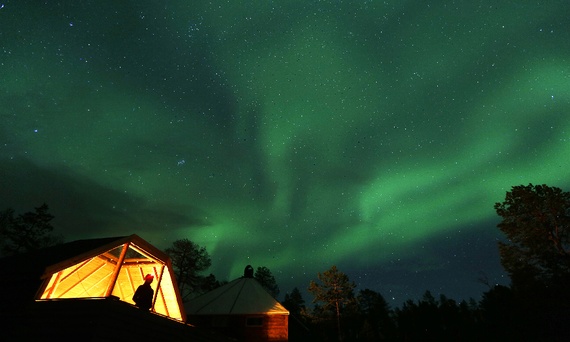
Northern lights over a camp north of the Arctic Circle, October 2014 (Yannis Behrakis/Reuters)

Northern lights over a camp north of the Arctic Circle, October 2014 (Yannis Behrakis/Reuters)

We may be a bit self-interested in declaring so, but this research matches what we believe from daily experience–not to say it is obvious–and so it is good to know science is helping us understand why:

Buy Experiences, Not Things

Live in anticipation, gathering stories and memories. New research builds on the vogue mantra of behavioral economics.

Forty-seven percent of the time, the average mind is wandering. It wanders about a third of the time while a person is reading, talking with other people, or taking care of children. It wanders 10 percent of the time, even, during sex. And that wandering, according to psychologist Matthew Killingsworth, is not good for well-being. A mind belongs in one place. During his training at Harvard, Killingsworth compiled those numbers and built a scientific case for every cliché about living in the moment. In a 2010 Science paper co-authored with psychology professor Daniel Gilbert, the two wrote that “a wandering mind is an unhappy mind.”

Continue reading

One From The Long-form Pantheon

BusinessAdventures

This may not be the first, and certainly will not be the only place you see this reference to Bill Gates’s favorite business book.  We have a longstanding love of long-form journalism, aka detailed descriptive story-telling. So we link to the post on gatesnotes in celebration of an otherwise-might-have-missed-it book:

…Brooks was also a masterful storyteller. He could craft a page-turner like “The Last Great Corner,” about the man who founded the Piggly Wiggly grocery chain and his attempt to foil investors intent on shorting his company’s stock. I couldn’t wait to see how things turned out for him. (Here’s a spoiler: Not well.) Other times you can almost hear Brooks chuckling as he tells some absurd story. There’s a passage in “The Fate of the Edsel” in which a PR man for Ford organizes a fashion show for the wives of newspaper reporters. The host of the fashion show turns out to be a female impersonator, which might seem edgy today but would have been scandalous for a major American corporation in 1957. Brooks notes that the reporters’ wives “were able to give their husbands an extra paragraph or two for their stories.” Continue reading

Incredible India!

As countries go, India is just about as varied as they come. With a history of people coming here to either lose themselves or find themselves, it’s simultaneously colorful, soulful and gritty.

This offering by the Indian tourism board will take your breath away!

Hermes, Circa 1969

As one of the contributors referred to in this post, and as the one who took the photographs in that post, it occurred to me that I should comment further on the reference.  And in doing so, perhaps I could add to the small collection of personal statements that have been gathering on this site since mid-2011.  I am 100% sure I took the photograph above during that same visit to Greece in 2008.  As I snapped this photo my mother was at my side and we both remembered having stood in the same spot in 1969. Continue reading

Documentaries : Black Out by Eva Weber, children searching for the light

Short electricity cuts punctuate the day here in Kerala. As if to remind us, for a few seconds in our daily life, that the electricity fairy can play hard to get. Generators always kick in in an instant though, and that is it. Elsewhere, in Guinea for instance, generators are not there to save the day. 

Only about a fifth of Guinea’s people have access to electricity. With few families able to afford generators, school children have had to get creative to find a place to read, do their homework and study for exams. So every day during exam season, as the sun sets over Conakry, hundreds of children begin a nightly pilgrimage to the  G’bessia International Airport, to petrol stations and parks in wealthier areas of the city, searching for light.

Continue reading

Living according to nature : trials and errors

IMG_0881

Back home in Paris I have exhausting reactions to pollens and fruits. As if I was allergic to nature, to my own environment. Here in the Ghats, I live in the forest, I’m surrounded with foreign trees, I eat exotic fruits. Yet they don’t seem to provoke any negative reaction in me. I can get rid of the first signs of headache with a cup of coffee. As if here I could let myself let nature take care of business.

When taking my first yoga lesson in India today I realized that when I apply my habitual automated thinking to my resolutions of living according to nature, it backlashes. Continue reading

See Sophie, Support Story

Forest ranger Klaus Echle tells us about befriending a wild female fox in Germany’s Black Forest. The fox wasn’t shy, and allowed him to follow her around and take astonishingly close-up photographs.

Love of a good story is the backstory of our site.  The backstory to that backstory–from before the time of Seth’s decade-old camping experience in Nicaragua, is one I have started telling here and there and intend to continue telling in the coming weeks of the new year.  Reading and listening to accomplished authors on the topic of writing can be inspiring or daunting to the would-be story-teller with more modest telling skills.  But tell we will, if only because practice makes perfect, and in the process we will also point out as many good stories as we can find.

Yesterday guests of Raxa Collective in Kerala, visiting from the USA, shared with Amie and me their enthusiasm for a radio show and podcast called The Story.  We found it.  We loved the first story we listened to, which brought to mind my own recent wild young animal experience.  Find The Story, and Sophie’s story, by clicking the image above.

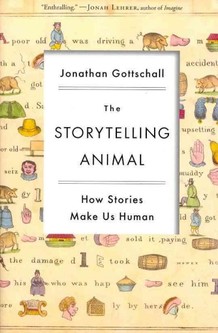
Humans Tell Stories For A Living

A great conversation with the author of this book is podcast here thanks to PBS and its contributors.  In the current issue of American Scientist, a review:

Gottschall clearly considers it safe to say that storytelling has something to do with helping us navigate our social worlds, since we are such thoroughly social animals: “We are attracted to fiction not because of an evolutionary glitch, but because fiction is, on the whole, good for us. This is because human life, especially social life, is intensely complicated and the stakes are high.”

Continue reading

Papa Was Here

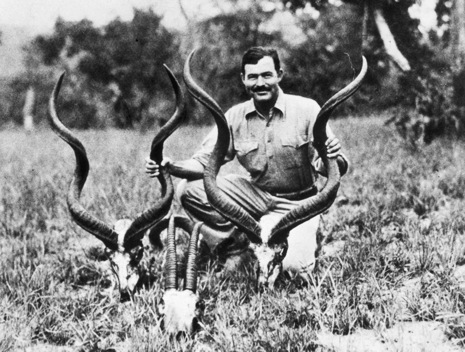
1937: American writer Ernest Hemingway (1899 – 1961) kneels while holding a pair of antelope horns during a safari, Africa. (Photo by Hulton Archive/Getty Images)

From The New Yorker‘s Page Turner series we highlight the last paragraph of a short comment by writer  (click the image above to go to the source):

At his best, Hemingway creates a terrain where he is no longer breaking any rules of grammar or codes of good writing. In this particular territory, the codes no longer apply. After all his travels, he has taken the ultimate step and fabricated his own landscape, and those who come to inhabit it are his followers, abiding by his rules. They are legion. Turn any which way. Welcome to Hemingway country.

Story’s It

I can trace it back to the beginning for you, trace my Moth addiction to its start. For the uninitiated, the Moth is an organization devoted to the craft of storytelling. It’s real people telling true stories, “live and without notes.”

So can I.  Click the image above to read Nathan Englander’s engaging account of telling stories in front of a live audience.  Reading it I am reminded of my recently untended year-old efforts to further articulate Why La Paz Group?

Continue reading

Stories In The Service Of Science Education

Andrew Revkin’s contributions to the New York Times, via Dot Earth, make a subscription to their website worthwhile; add in video with Daniel Kahneman addressing the National Academy of Sciences, and the value skyrockets.  68 minutes and 51 seconds later, you will know more about what you do not know; and likely appreciate the way that knowledge reached you.

We have pointed to evidence of this scholar’s general awesomeness, also to his 2011 book and to an event quite some time ago all without any video demonstration of his combined intellectual and communication capacities.  Click the image below to go to Revkin’s coverage, which includes the video of a surprisingly accessible lecture.

Telling Story

Click the image to the left for a five minute view into the art of story-telling in the words of one our own age’s Homeric wonders (thanks to Atlantic Monthly).  The team tasked with capturing and explaining his craft is thoughtfully artful:
His signature style is so well known that Apple’s iMovie has a function — a slow zoom on a still image — called “the Ken Burns effect.” For a documentary filmmaker, it’s hard to imagine a more intimidating project than making a documentary film about Ken Burns.

Report To Greco

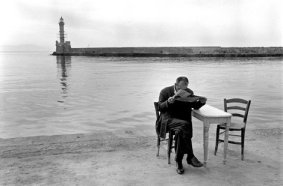
Man reading, Chania, Crete, 1962 (Costa Manos/Magnum Photos)

Click the photo to go to the recent post titled “Do We Need Stories?” in the blog site of the New York Review of Books.  It starts out:

Let’s tackle one of the literary set’s favorite orthodoxies head on: that the world “needs stories.” There is an enormous need,” Jonathan Franzen declares in an interview with Corriere della Sera (there’s no escape these days), “for long, elaborate, complex stories, such as can only be written by an author concentrating alone, free from the deafening chatter of Twitter.”

Continue reading

Selective Pantheon

The Guardian, more than most newspapers, investigates and reports stories of historical-scientific “cabinet of curiosities” value that match our interests on this site.  This slide show below is an example, and is worth a visit.

It is a side show, actually, from a story the paper covered titled “How a book about fish nearly sank Isaac Newton’s Principia” (also worth a visit) and had the subtitle “Poor sales of lavishly illustrated book forced Royal Society to go back on promise to finance publication of Newton’s Principia;” so if pictures intrigue you visit their site and read the captions for each image.

This slideshow requires JavaScript.