Cornell’s Nanoscale Carbon-scrubbing Sponges

© Provided/Genggeng Qi – A scanning electron microscopy image of a pristine silica support, before the amine is added.

We’ve had posts on this blog about carbon output by consumer technology, motor vehicles, and food. We’ve also posted, including quite recently, on carbon storage, often in forests. Less numerous are our posts on carbon output by power plants, probably because good news on technological advances in the field is infrequent (at least relative to the bad news). But scientists at Cornell have recently developed a nanoscale scaffold of silica that comes in the form of powder and could replace the current method of carbon capture called amine scrubbing. Anne Ju reports for the Cornell Chronicle below:

In the fight against global warming, carbon capture – chemically trapping carbon dioxide before it releases into the atmosphere – is gaining momentum, but standard methods are plagued by toxicity, corrosiveness and inefficiency. Using a bag of chemistry tricks, Cornell materials scientists have invented low-toxicity, highly effective carbon-trapping “sponges” that could lead to increased use of the technology.


Continue reading

Preparing For Citizen Science

shutterstock_200307821-copy

© kim7 | Shutterstock

Thanks to Roberta Kwok for her ever-clear and concise reviews of important scientific findings in Conservation, this one of particular interest to Raxa Collective contributors Seth Inman for the last few years, and Phil Karp since he started contributing to our blog in 2013:

HOW SHOULD CITIZEN SCIENTISTS BE TRAINED?

The potential power of citizen science is huge: Scientists can enlist smartphone-equipped nature enthusiasts to identify species, monitor ecological trends, and submit photos and other observations on a shoestring budget. But researchers who want to conduct studies over large or remote areas face a problem. If they need to train volunteers in person, their cheap citizen science project suddenly isn’t so cheap anymore.

Now cash-strapped researchers can take heart from a new study in PLOS ONE. Continue reading

Amazon, Thinking Of Our Future

LINES ARE DRAWN A battle over pricing may have been the Sarajevo moment. But the war is really about the future of publishing—and maybe of culture.

LINES ARE DRAWN A battle over pricing may have been the Sarajevo moment. But the war is really about the future of publishing—and maybe of culture.

I never tire of “think pieces” on Amazon because it is about our cultural future:

The War of the Words

Amazon’s war with publishing giant Hachette over e-book pricing has earned it a black eye in the media, with the likes of Philip Roth, James Patterson, and Stephen Colbert demanding that the online mega-store stand down. How did Amazon—which was once seen as the book industry’s savior—end up as Literary Enemy Number One? And how much of this fight is even about money? Keith Gessen reports.

By Keith Gessen  Photo Illustrations by Stephen Doyle Continue reading

Education, Innovation, Puzzling Future

Online education is a technology with potentially revolutionary implications—but without a precise plan for realizing that potential. CREDIT PHOTOGRAPH BY MELANIE STETSON FREEMAN / THE CHRISTIAN SCIENCE MONITOR VIA GETTY

Online education is a technology with potentially revolutionary implications—but without a precise plan for realizing that potential. CREDIT PHOTOGRAPH BY MELANIE STETSON FREEMAN / THE CHRISTIAN SCIENCE MONITOR VIA GETTY

If the first post of today was rather too depressing, here is an interesting puzzle to take your mind off that subject. In honor of all of this year’s interns, many of whom are probably thinking about MOOCs for various reasons, we thank the New Yorker’s Elements writer Maria Konnikova for this intriguing distraction:

On July 23rd, 1969, Geoffrey Crowther addressed the inaugural meeting of the Open University, a British institution that had just been created to provide an alternative to traditional higher education. Courses would be conducted by mail and live radio. The basic mission, Crowther declared, was a simple one: to be open to people from all walks of life. “The first, and most urgent task before us is to cater for the many thousands of people, fully capable of a higher education, who, for one reason or another, do not get it, or do not get as much of it as they can turn to advantage, or as they discover, sometimes too late, that they need,” he told his audience. “Men and women drop out through failures in the system,” he continued, “through disadvantages of their environment, through mistakes of their own judgment, through sheer bad luck. These are our primary material.” He then invoked the message emblazoned on the Statue of Liberty: Open University wanted the tired, the poor, the huddled masses. To them, most of all, it opened its doors. Continue reading

If You Use Amazon, Read This

Screen Shot 2014-10-11 at 10.58.33 AM

As the article below suggests, whether we shop with them or not we are all complicit. It is the best article yet on the growing concern over not only Amazon’s market power but its cultural influence. And in true liberal spirit of the great publication that offers it, both sides of the argument are presented starting at the first sentence:

Before we speak ill of Amazon, let us kneel down before it. Twenty years ago, the company began with the stated goal of creating a bookstore as comprehensive as the great Library of Alexandria, and then quickly managed to make even that grandiloquent ambition look puny. Amazon could soon conjure the full text of almost any volume onto a phone in less time than a yawn. Its warehouses are filled with an unabridged catalogue of items that comes damn close to serving every human need, both basic and esoterica mere click away, speedily delivered, and as cheap as capitalism permits. Continue reading

Walter Isaacson On Geniuses Of The Digital Revolution

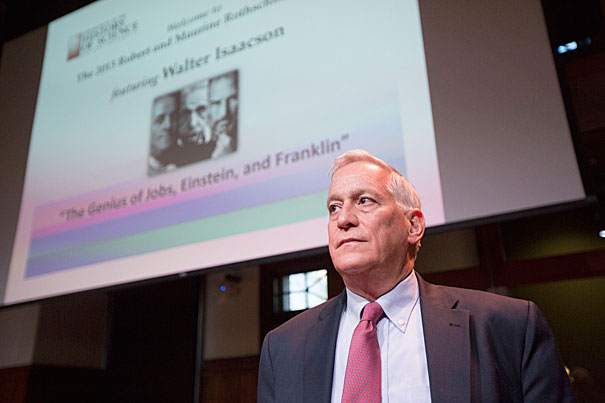
File photo by Kris Snibbe/Harvard Staff Photographer.  "We’re now in a phase in which the connection of creativity to technology is going to drive innovation," said Walter Isaacson ’74, a Harvard Overseer, biographer, and CEO of the Aspen Institute. "I do believe that it’s important for people to have an appreciation for the arts and humanities."

File photo by Kris Snibbe/Harvard Staff Photographer. “We’re now in a phase in which the connection of creativity to technology is going to drive innovation,” said Walter Isaacson ’74, a Harvard Overseer, biographer, and CEO of the Aspen Institute. “I do believe that it’s important for people to have an appreciation for the arts and humanities.”

Thanks to Christina Pazzanese and Harvard Gazette for this conversation with one of the more interesting biographers writing today:

Ghosts in the machines

The history of the Digital Revolution touches our hearts and heads, Isaacson says

In many ways, the entire Digital Era can rightly be laid at the courtly foot of Lord Byron’s rebellious daughter, Ada. Lady Lovelace was the poet’s only child born in wedlock, inheriting both her father’s headstrong, Romantic spirit and her mother’s practical respect for mathematics.

As the Industrial Revolution bloomed, her appreciation for the beauty of numbers and invention, an analytical approach she called “poetical science,” led her to write what is now regarded as the first algorithm and to help refine a machine that could be programmed to perform many different tasks, an idea that anticipated the modern computer by a century.

That’s where Walter Isaacson’s latest book, “The Innovators: How a Group of Hackers, Geniuses, and Geeks Created the Digital Revolution,” steps off.

Continue reading

eBird Expansion

Including historical data since 1810 and extending into checklists from December of last year, eBird’s Observational Dataset just hit a milestone of 500 million records, making eBird the largest repository of biodiversity information that is freely accessible.

Technology Aids Access Of Classicists To Classics

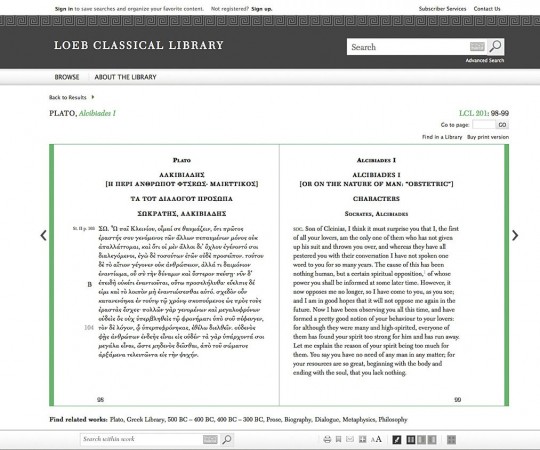
The Loeb classics, newly available online

The Loeb classics, newly available online

We do not know whether James has made his way to the library yet, but we imagine there are classical treasures in the vaults at Harvard University that can only be appreciated in person. But a scholar’s best friend will likely, increasingly be technology like this:

WHEN JAMES LOEB designed his soon-to-be-launched series of Greek and Roman texts at the turn of the twentieth century, he envisioned the production of volumes that could easily fit in readers’ coat pockets. A century later, that compact format is still one of the collection’s hallmarks. Beginning in September, however, the iconic books will be far handier than Loeb had hoped: users of the Loeb Classical Library (LCL) will have the entire collection at their fingertips. After five years of dedicated work on the part of the library’s trustees and Harvard University Press (HUP), which has overseen LCL since its creator’s death in 1933, the more than 520 volumes of literature that make up the series will be accessible online. Besides allowing users to browse the digitized volumes, which retain the unique side-by-side view of the original text and its English translation, the Digital Loeb Classical Library will enable readers to search for words and phrases across the entire corpus, to annotate content, to share notes and reading lists with others, and to create their own libraries using personal workspaces.  Continue reading

Listen, Learn, Elephants

Thermal imaging on an elephant in the Dzanga clearing. Photo by Peter Wrege

Thermal imaging on an elephant in the Dzanga clearing. Photo by Peter Wrege

Way back when, we first shared what we had read and visually devoured about this project, and the last line of our post at that time asked if “one of our Lab-based contributors will help us with an introduction to their office mates in the Elephant Listening Project?”. Not until now were we nudged to think again and do something about it. Stay tuned…

Meanwhile, thanks to the folks at Science Friday and the donor-listeners and producers of the amazingly diverse public radio networks in the USA, tune in to learn more:

Elephants have different rumbles and roars for how they greet each other, warn about danger, and even to show that they’re annoyed. Peter Wrege, director of The Elephant Listening Project, recorded an event called “mating pandemonium,” where a group of elephants roar after a pair of elephants mate. Wrege discusses the possible reasons for this pachyderm party.

Continue reading

Nature’s Apps

It’s not all fun and games when it comes to games featuring the environment. With some green game apps, not only can you live in your world and play in it, you can learn stuff too.

It’s not all fun and games when it comes to games featuring the environment. With some green game apps, not only can you live in your world and play in it, you can learn stuff too.

Thanks to Conservation magazine for this article, published coincidentally exactly at the time when several Raxa Collective contributors were visiting the Cornell Lab of Ornithology, which itself is participating in the App business (more on which, by Seth soon) in a manner resonant with the focus of this article:

DIALING INTO THE OUTDOORS THROUGH PHONE APPS

The Nature Deficit

Judging from the amount of time my grandkids hunch over their iPhones and iPads for game time, I’d have to say games have garnered a major portion of the younger set’s mindshare. And in my book that’s a shame. While more and more studies find that children’s outdoor time contributes to their well-being — by mitigating obesity, promoting cardiovascular, musculoskeletal, and mental health, as well as boosting academic achievement — the number of hours children spend outdoors is on the decline. (See also here.) Continue reading

New Tesla Model Test Driven

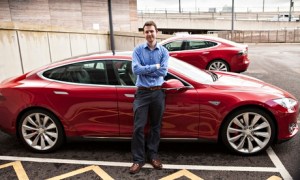
Samuel Gibbs test-drives a Tesla Model-S. Photograph: Antonio Zazueta Olmos

Samuel Gibbs test-drives a Tesla Model-S. Photograph: Antonio Zazueta Olmos

Its availability is limited to a few places. Its numbers are limited, period. But in the UK it is about to grow a new market, so this review is timely. We are not in the business of promoting automobiles or other consumer products but several La Paz Group contributors have been in the vicinity of the home location of this car and its claims of zero emissions are such that we could not help noting this remarkable thing:

…Inside it’s all premium Silicon Valley technology. Musk likes to think of Tesla as the “Apple” of cars, which might explain why there is what looks like a large iPad complete with Apple-style graphics where the centre console should be. The 17in touchscreen controls almost everything about the car, from the air conditioning and music to opening the sunroof and firing up the heated windscreen wipers. Continue reading

Food, Form, Philibuster

Tasters have compared Soylent to Cream of Wheat and “my grandpa’s Metamucil.” Photograph by Henry Hargreaves.

Life without food as we know it? After our inspiration and efforts to launch 51, and all kinds of other good reasons to love food as we know it (and all the forms of food we have yet to know), some tech fellows want to do away with all that? Food without form that we can recognize is fine for short term bursts of unusual pleasure, but not as a dominant replacement. We will resist and delay this as long as our breath and imaginations hold out:

In December of 2012, three young men were living in a claustrophobic apartment in San Francisco’s Tenderloin district, working on a technology startup. They had received a hundred and seventy thousand dollars from the incubator Y Combinator, but their project—a plan to make inexpensive cell-phone towers—had failed. Down to their last seventy thousand dollars, they resolved to keep trying out new software ideas until they ran out of money. But how to make the funds last? Rent was a sunk cost. Since they were working frantically, they already had no social life. As they examined their budget, one big problem remained: food. Continue reading

A Story About The Wind And The Cloud

MidAmerican Energy's wind farm in Adair, Iowa. Facebook is working with MidAmerican to build a similar wind farm near Wellsburg, Iowa, where it will help power Facebook's planned data center. Courtesy of MidAmerican Energy

MidAmerican Energy’s wind farm in Adair, Iowa. Facebook is working with MidAmerican to build a similar wind farm near Wellsburg, Iowa, where it will help power Facebook’s planned data center. Courtesy of MidAmerican Energy

Thanks to National Public Radio (USA) for this story about sourcing power for the special needs of modern technology:

You hear the term “the cloud” or “cloud computing,” and you picture something puffy, white, clean and quiet. Cloud computing is anything but.

Even from a distance you can hear the hum of a modern data center. Last week, I visited one of the largest in Santa Clara, Calif., in the heart of Silicon Valley. It’s called SC1, is owned by DuPont Fabros Technology and is about a quarter-mile long.

“It’s about the same size and length as a Nimitz aircraft carrier,” says Paul Hopkins, a regional vice president for the company, shortly after buzzing me through the door.

The entrance is guarded, and employees need fingerprint scans to get in and out. Hopkins has agreed to show me around. Continue reading

Time Zone Adjustments For Sleep


It is a drag. Just saying the two words that are the inspiration for this app below is a drag. So instead we will say it more soothingly, discussing the need for adjustments for sleep based on crossing time zones. This is definitely of interest to many of the travelers who make their way to properties we manage. Raxa Collective remains firmly rooted in Kerala, India–a long haul flight from most places–while expanding our project reach into Western Africa and Central America, which makes us susceptible to the attraction of this app brought to our attention by National Public Radio (USA):

Jet lag is nobody’s idea of fun. A bunch of mathematicians say they can make the adjustment less painful with a smartphone app that calculates the swiftest way to adjust.

Users plug in the time zone they’re traveling to, and the app will do the calculations before spitting out a schedule specifying when the user should stay in bright light, low light or be in the dark, says Olivia Walch, a graduate student at the University of Michigan who designed the app.

“The conventional wisdom is for every hour you’re shifting, it’s about a day of adjustment,” Walch says. So Washington, D.C., travelers going to Hong Kong — a 12-hour time difference — could take up to 12 days to adjust. The app can reduce that time to roughly four or five days, the inventors say. Continue reading

Art Revival

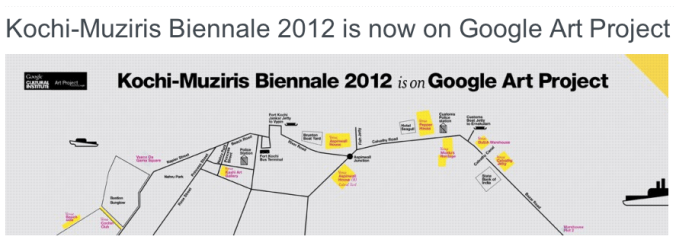
Kochi Muziris Biennale on Google Arts Project


As we finish up our development of Spice Harbour and think about how to sculpt our space into one hospitable to both people and art the flow of news about the second edition of the Kochi-Muziris Biennale is welcome. We’ve written about art in many facets on these pages, including the connection between art and technology. It’s an amusing coincidence that just about a year ago I shared interactive links about the then new, and still very cool, Google Art Project.

So what fun to learn that the Kochi-Muziris Biennale 2012 had “made the cut”, so to speak! It actually isn’t really news, but the good folks at the KMB 2014 website know their social media, and they popped it onto their Facebook page for followers like to me to find, like a wonderful sprinkle of breadcrumbs toward the next edition.

Do you want to revisit and experience the Kochi-Muziris Biennale 2012? Thanks to Google Art Project potentially millions of people across the world can now virtually discover and explore India’s first biennale. With this the Kochi-Muziris Biennale becomes the world’s first and only biennale to be archived and digitized by Google Art Project which has till date only collaborated with museums and other permanent exhibitions. Continue reading

Energy, Development and the Global Environment

Bosch is testing the viability of electric cars in Singapore. Photograph: Samuel He/Bosch

Bosch is testing the viability of electric cars in Singapore. Photograph: Samuel He/Bosch

Normally we avoid articles that look strictly like press releases promoting a PR firm’s client.  However, in this case, a couple of exceptions were allowed.  First, we like the storyline because of its relevance to three years’ worth of posts on our site.  Second, there is not one iota of obnoxious flimflam, which is what normally forces us to avoid press releases.

But, an additional component to this one really made the difference. Nearly one year ago two of Raxa Collective’s contributors had the opportunity to visit Duke University and sit in the office of the founder and director of their Center for Energy, Development and the Global Environment. A conversation that was meant to last 15 minutes continued for hours that day, because of the credible commitment that Center and its leadership are making to ensure that future business leaders see sustainability as serious business. So, we gladly pass this newsworthy article on:

When it comes to sustainability ambitions, Singapore might take the prize. The island nation, which currently relies on neighboring Malaysia for its water, is aiming for water self-sufficiency by 2050, with 55% of its water needs met via recycled water and 25% from seawater desalination. Continue reading

Dolphins, Drones, Delight

Screen Shot 2014-03-06 at 7.37.42 AM

We have noted on several occasions in the past about the use of drone technology to good ends, but this one takes the cake:

Whatever you think of drone technology, this may be one use that we can all agree on.

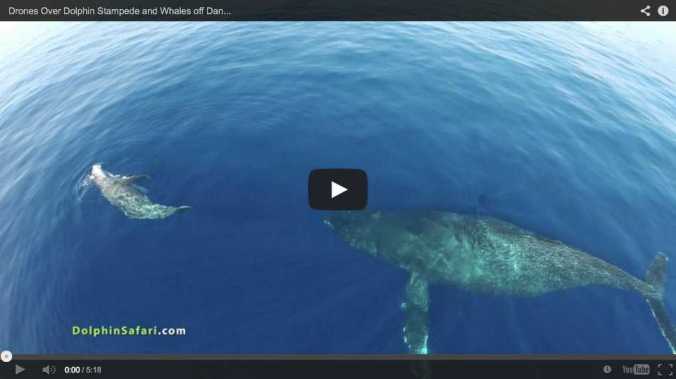
The captain of a whale-watching boat who’s also a filmmaker sent a drone with a camera into the sky to capture a stunning event: thousands of common dolphins in a super- or megapod speeding through the waters off California, destination unknown. His gorgeous video of Delphinus delphis, which includes a mama whale nuzzling its baby, is here. Continue reading

Bees With Backpacks

After a brief and minor lapse the Guardian is back on game. Albeit with a hint of Monty Python. Sometimes a serious ecological challenge has a solution with an unexpected look or a funny ring to it, and we appreciate that this story was deemed worthy:

Thousands of Australian honey bees have been fitted with tiny sensors in a study to help understand what is causing the precipitous collapse of colonies around the world.

About 5,000 bees will carry the 2.5mm x 2.5mm sensors, like hi-tech backpacks, for the next two months at the study site in Hobart. Continue reading

Self-Sufficiency Taken To The Outer Extremes

Before the lights go out on the last New Yorker issue of 2013, one more of several articles we found worth the read, and relevant to our common themes of interest–community-building, innovation, environmentalism, farming, etc.–on this blog, even if we tend to incremental change rather than the radicalism on display here:

Marcin Jakubowski, the owner of a small farm in northwestern Missouri, is an agrarian romantic for high-tech times. A forty-one-year-old Polish-American, he has spent the past five years building industrial machines from scratch, in a demonstration of radical self-sufficiency that he intends as a model for human society everywhere. He believes that freedom and prosperity lie within the reach of anyone willing to return to the land and make the tools necessary to erect civilization on top of it. His project, the Global Village Construction Set, has attracted a following, but among the obstacles he has faced is a dearth of skilled acolytes: the people who show up at his farm typically display more enthusiasm for his ideas than expertise with a lathe or a band saw. Continue reading

Channel 13, Tens Of Millions Of Community Beneficiaries, And One Man’s Contribution

We recently mentioned how we rarely get to link to Hertzberg written commentary, and here is one more of those rare opportunities. The man he writes about, unknown to any of us at Raxa Collective, was involved in the creation of an institution that several of us were deeply influenced by.

Channel 13, serving the New York City metropolitan area television community, started several Raxa Collective contributors (and many millions of our generation and subsequent generations) on Sesame Street as children in the 1970s, and well into adulthood we were still watching Channel 13’s excellent programming. But none of us remembers this particular show Hertzberg writes about.

Technology, including television, is neither good nor bad; it is how we use it that makes it one or the other or somewhere in between. Television today seems mostly to have abandoned its potential for good, but here was a man continuing to stick to its potential for good well into his 80s. Anyone so important to the history of Channel 13 is a community-building hero, even if it is otherwise difficult to associate television with heroism or community:

In the spring of 1954, my parents finally allowed themselves to bring a TV set into our home—a state-of-the-art DuMont, black and white, of course, with the aspect of an alien insect: spindly legs, pointy antennae, a body entirely dominated by a single bulging, bulbous eye. Reception was spotty: ghosts, chance of snow, iffy horizontal hold. But what a wondrous treat.

Mom and Pop maintained that they had bought the set for the Army-McCarthy hearings. I believed them. I still believe them. But even at our tender ages, my sister (age eight) and I (ten) were perceptive enough to notice that they had grown awfully tired of having to wangle invitations from people as their only access to Sid Caesar and Imogene Coca. Continue reading