TED Says Thank You In A Big Way

This slideshow requires JavaScript.

TED’s blog has this description of the man who it awarded $1 million this year:

It’s a question on so many minds: what will the future of education look like?

It’s something Sir Ken Robinson has asked for decades…Robinson got the opportunity to announce the winner of the 2013 TED Prize, someone who has a bold answer.

“So many kids are disengaged from education and there’s a tendency to confuse testing with learning,” says Robinson in his introduction. “What drives learning is curiosity, questioning … What fires people up to learn is having their mind opened up by possibilities.”

And with that, he revealed the winner of the $1 million TED Prize: education innovator Sugata Mitra, who has given two TED Talks over the years and released a TED ebook called Beyond The Hole in The Wall.

Continue reading

Technology & Happiness

Yarek Waszul

From the New York Times (click the image to the left to go to the source), a recent story covered a topic that one of our contributors would likely post on, if he was not on the road, toting his mobile device around in that cute sleeping bag.  As an aside, Neema was quoted in a story related indirectly to this one:

Speed, instant gratification, accessibility — these are a few of the appealing hallmarks of digital technology. It’s no coincidence that we love our smart wireless devices: Humans are a notoriously impatient species, born with a preference for immediate rewards.

Cornell’s Silicon Island

From the New Yorker’s website (click the image above to go to the story):

Can photovoltaics ever be romantic? Morphosis Architects’ design for a new academic building for the Cornell NYC Tech campus, scheduled to open on Roosevelt Island in 2017, suggests the answer could be yes. Continue reading

Droning On About Conservation

In a world where funding for national parks and rangers isn’t always in the budget, conservationists have to look to technologies to help protect the millions of acres that some of the world’s most threatened species make their home.  The World Wildlife Fund has developed remote controlled planes that use simple enough technology to be launched by hand and be powered by rechargeable electric batteries.  Click the image above to go to the story in the BBC:

Conservationists in Nepal will soon start using special drones…developed by the global wildlife organisation, WWF. Continue reading

Infrared Elephants

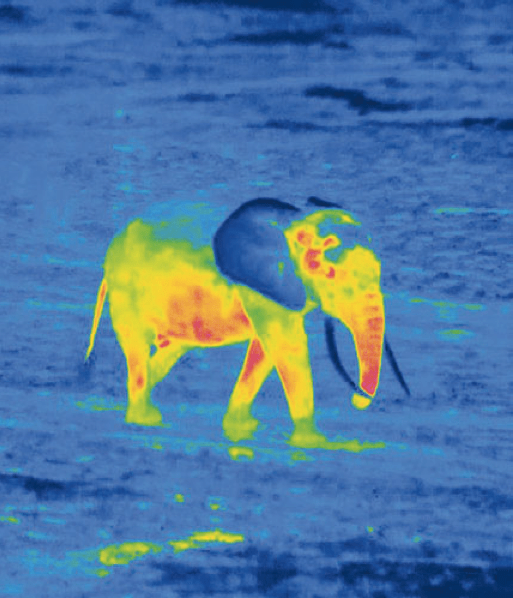
Click the image above for the story called “Forest Elephant Chronicles” in this month’s American Scientist, about new technology for understanding elephant behavior in the wild:

…What inspired your team to try thermal imaging?

Acoustic monitoring has allowed us to study elephant behavior, without bias, over 24-hour cycles. Their activity cycle is nearly equally distributed day and night, but they prefer to enter forest clearings at night. This is where we can observe the elephants directly. We suspect that different types of interactions occur at night because the types of calls differ then. But we have only the beginnings of an understanding of what the acoustic signals mean. We need to investigate this with visual observation. Also, important behaviors may not have identifying sounds associated with them, and we need to know what these are….

Continue reading

Support Plan Bee

Click the image above to see more about Plan Bee and their tools for connecting bee-keepers in urban and rural areas around the world (strongest in their home base, the UK but awaiting your participation elsewhere):

Our Plan Bee campaign aims to address the decline in pollinators such as bees, butterflies and moths.

Continue reading

Rethinking Good & Evil

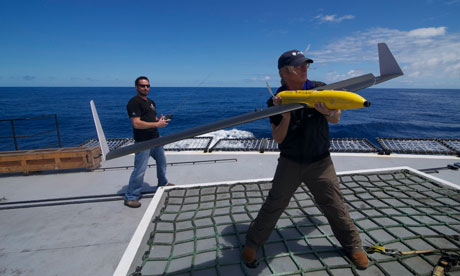
Activists launch a long-range drone from the deck of the Steve Irwin to locate a Japanese whaling ship. Photograph: Observer

If cormorants can possibly be defined as evil, can drones be re-redefined in the opposite sense in which we commonly think of them–namely related to death and destruction, including innocent “collateral damage.”  Click the image above to see what these environmental activists are doing with drones:

They are better known as stealthy killing machines to take out suspected terrorists with pinpoint accuracy. But drones are also being put to more benign use in skies across several continents to track endangered wildlife, spot poachers, and chart forest loss. Continue reading

Nepalese Agricultural Technology

Women work at a paddy field at the village of Bamundangi, eastern Nepal. Photograph: Dipendu Dutta/AFP/Getty

Click the image above for the story about how life is changing in Nepal’s paddy:

Most of Nepal‘s agriculture is undertaken by women, but research tailored to their needs is lacking. “We need new technologies that can reduce the drudgery for them,” said Devendra Gauchan, agricultural economist and chief of the socioeconomics and agri-research policy division at the Nepal Agricultural Research Council (Narc). Continue reading

Communitarian Is As Communitarian Does

Thanks to one of most thoughtful, witty writers at The Atlantic or any other similar publication, a glimpse of an unsung hero who has community and collaboration written all over his accomplishments (toward the end of the linked item, click further onward to a profile of this amazing fellow from a few years back):
The profile also reminded me what a thoroughly decent and public-spirited guy Tim Berners-Lee is. Sometimes people who do great things turn out to be jerks, but he definitely isn’t such a case. One other thing Tim Berners-Lee isn’t is fabulously wealthy–and finding out why he hadn’t taken the road to riches (and that he almost had) was for me one of the more interesting outcomes of this reporting project.

Crowdsourcing Wildlife Sightings

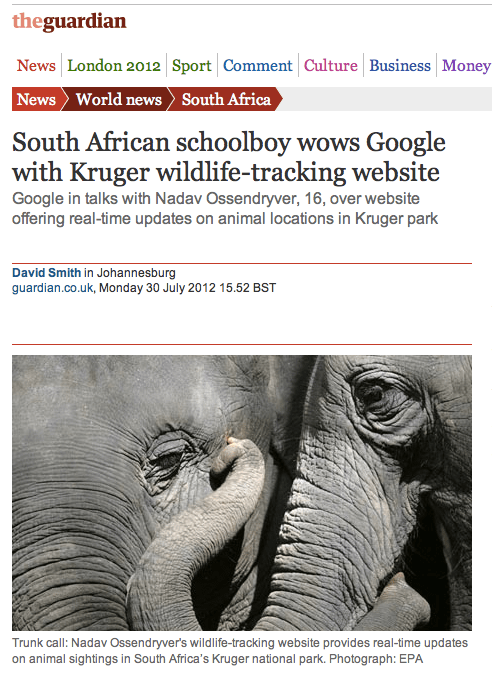
Yesterday’s Guardian had this interesting story of a young fellow’s innovation (click the image above to go to the full account):

In the decadent days when Theodore Roosevelt and British royals led African hunting expeditions, they had to rely on local trackers, patience and luck in their quest to bag “the big five”. Continue reading

Delicious vs. Tasty & Cardamom Calm

Guest Author: Neema Morajevi

I work at a computer.  Too much.

It stresses me out.  And I run the Calming Technology Lab at Stanford.  Ironic?  Well, I started the lab for a reason; I am my #1 client (my students are #2).

I want the productivity and efficiency of technology but I don’t want the stress usually associated with it.  And I am not alone.

I’m trying to figure out how to live sustainably in an always-on world.  One foot in the browser, the other on the grass. But which one is supporting the bulk of my weight?  It varies hour to hour.

When my wife and I decided to travel for several months, starting in India, I was more explicit in my desire to “unplug”: surely I’d be able to disconnect if I leave the country… right? Continue reading

Engineering a Conversation

Guest Author: Siobhan Powers

My roomie Chi-Chi recently blogged about miscommunication between clients and architects so I thought it may be timely to bring to light some of my own recent difficulties in conversation and work development. I could not even begin to blog about engineer-non-engineer relations as that would take all day and there’s no point-we’re nerds to the core, I’ve realized and thus, misunderstood. Recently, however, I’ve found not just confusion between myself and non-engineers, but also with my fellow engineers-my people!

I have had few moments of serious language barriers during my time in India. Most people speak at least a little English, and if not there are pictures and hand gestures that can get points across. Shopping and dining is easy enough. Camping with strangers? You’ll find something to talk about (reference my other blog post– shout-out to Chief and Wise Eyes!). Engineering conversations, however, are not like this-there are no commonalities across language boundaries that can be pointed at and then nodded about, but instead there are abstract concepts like energy and science (gasp!).

Gijo and I talking over some data in the engineering office.

Continue reading

5 Lenses For Every Vacation

Hey guys,

All of us photobugs and travel-junkies have struggled with the age-old question: which lens should I bring on my River Escapes backwaters adventure or my Roman holiday or my trip to the moon?

As a casual photographer, I’m not crazy about specs. I don’t get the numbers and technical terms! JUST TELL IT TO ME STRAIGHT! I know there are people out there who are like me, so Ben, Milo, and I will make it as easy as possible to understand which lens YOU need to bring on your next vacation! We’d also love to know what YOU brought on your last vacation!

See which of description fits you best:

  1. I’m out to shoot wildlife. Tell me what I need to know.
  2. I love architecture and the built world. What should I bring with me?
  3. I’m a tourist who’s going to stick out like a sore thumb, but I really want to capture candid portraits of interesting people– help!
  4. I’m going to a naturey place filled with dust/humidity/dirt/whatever and I don’t want to constantly change my lens. What’s the best daily walk-around lens?
  5. I’m going on a service trip and I’ll be working on a construction site. How do I make it look epic?
Here’s what we’ll be introducing from our private collections today:
  1. Canon EF 70-200mm f/2.8 L IS USM with 2x extender
  2. Canon EF 70-300mm f/4-5.6 IS USM
  3. Canon EF 50mm f/1.8
  4. Canon EF-S 10-22mm f/3.5-4.5 USM
  5. Canon EF-S 18-55mm f/3.5-5.6 IS

ALRIGHT, I’M READY!! NOW SHOW ME THE 5 LENSES I SHOULD BRING ON MY NEXT VACATION!!!

Continue reading

Man-Machine Collaboration

Click the banner above to go to the source, one of National Public Radio’s many excellent podcasts (this one being among our favorite, as you may have noticed here, as well as here and here, not to mention here):

Here’s a robot from Ishikawa Oku’s physics lab at the University of Tokyo that plays rock, paper, scissor and always beats the human, every single time. Because the team that built it gave it a superpower.

Worth Half A Minute

Thanks to the Environment section of the New York Times, its website, the “Green” and the “Science” initiatives on that site, the above quick video of an invention that may change clean up procedures for one of the scariest new energy trends (read the story here, and then scroll down that site for earlier stories on fracking itself):

In fracking, a mix of water, sand and chemical additives is injected into a drilling well under heavy pressure to release natural gas from shale deposits. At the end of the process, some of the chemical-laden water returns to the surface along with salts, radioactive elements and other contaminants absorbed from the shale. Safely disposing of the waste from fracking without contaminating drinking water and waterways has been a major environmental and health concern.

Intra-Galactic Weather Forecasting

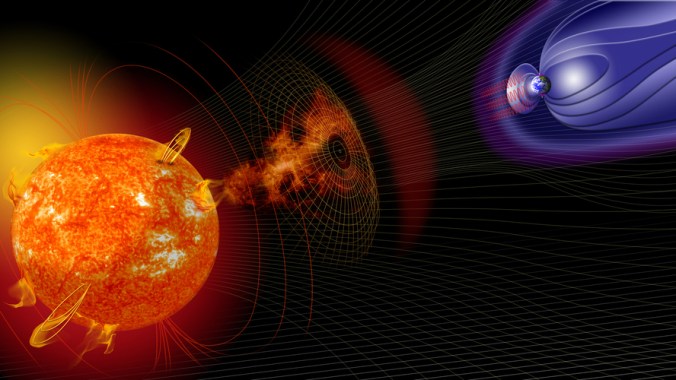
A NASA artist’s illustration of events on the sun changing the conditions in near-Earth space.

Click the image above to go to the 5-minuted podcasted explanation of a project you have likely never heard of.  But it sounds important (perhaps to explain why sometimes your mobile phone gets inexplicably scrambled) and as with the story here it may inspire the career aspirations of a few young clever dreamers:

“When one of these big storms comes in, it can actually change and flex the magnetic field around the Earth,” Stratton says. “So we’ll measure that and then we’ll see how all of that energy that’s coming out of the sun deposits into the Earth’s magnetic field, into the radiation belts.”

Ordinary satellites wouldn’t survive so much radiation. So Stratton and a large team at the Applied Physics Lab have spent years designing and building two very tough spacecraft.

Each of the spacecraft is an octagon about 4 feet tall. But once they are in space, they will deploy booms that extend about the length of a football field.

The Upside of Empire

For art lovers nothing quite tops the experience of standing before a favorite painting, sculpture or tapestry, far from the madding crowds, soaking in the aura of history.  But few of us have the luxury of being able to visit the “Hermitage” in the morning and the Musée d’Orsay in the afternoon, not to mention the connections that would enable a personalize tour with the curator.

Over the past year Google has put its technological powerhouse behind a project that brings over 30,000 pieces of art from 151 museums in 40 countries into the home of anyone with a computer and an internet connection. Continue reading

Curiouser Than Fiction

Children examine the Automaton during a visit to The Franklin Institute.

About 5 years ago I brought home a curious book called The Invention of Hugo Cabret by Brian Selznick.  Both of my sons had been avid readers and lovers of detailed illustrations since childhood and books like The Eleventh Hour by Graeme Base had been favorites for as long as I could remember, so the elaborate charcoal drawings and almost graphic novel design in this new book were intriguing.

The most fascinating moment came with poking around the history behind the story itself.  Although placed within a work of fiction, both Georges Méliès and automatons are quite real. The Franklin Institute of Science and Technology has one in their collection with a history similar to the one in Selznick’s book:

In November of 1928, a truck pulled up to The Franklin Institute science museum in Philadelphia and unloaded the pieces of an interesting, complex, but totally ruined brass machine. Donated by the estate of John Penn Brock, a wealthy Philadelphian, the machine was studied and the museum began to realize the treasure it had been given. Continue reading

Linking Locavores

Click the image above for a journalistic description of a utilization of new technology to conserve valuable traditions and provide more efficient access to healthy, tasty food.  Or, after the jump, a short video of the same.

Continue reading