Alternative Incentives For Living With The Rainforest

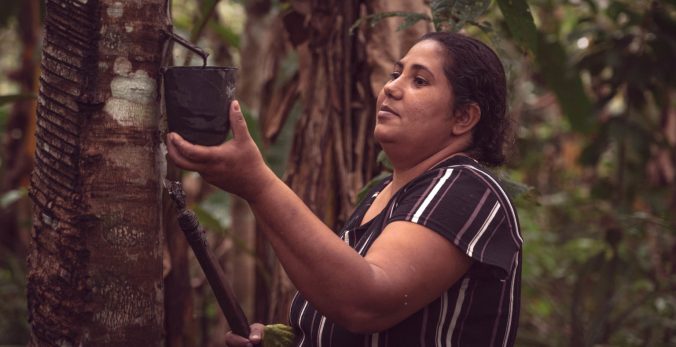
Eliane Lima Oliveira, 30, learned how to collect rubber with her family of traditional rubber tappers

We have been neglecting excellent reporting in the Food & Environment Reporting Network over the last four years. Here is a good correction to the oversight. Our orientation to entrepreneurial conservation makes us cheer this on:

Can fashion help small farmers preserve the Amazon?

Many downplay capitalist solutions to conservation. But they could spark the wealth transfer needed to save the world’s largest rainforest.

By Brian Barth and Flávia MilhorancePhotography by Flávia Milhorance

Small farmer and rubber tapper, Rogerio Mendes, 23: “I have an inexplicable feeling inside the forest. Because it’s a feeling of happiness, but with agony and concern.”

On a rainy March afternoon, Rogério Mendes strides through the dripping vegetation of a tract of virgin Amazonian forest and stops at a tree with scars arranged in neat diagonal rows across its trunk. From his back pocket he produces a wood-handled tool with a blade on one end, called a cabrita, and cuts another diagonal line though the bark, beneath the others. A milky white goo—raw liquid latex—begins to trickle down this tiny canal and into a metal pail below. Continue reading

2021 Ignobles

Enjoy this webcast of the awards ceremony from a journal we can all respect for the quality of its investigative research, its creative approach to choosing prize winners, and most of all its capacity to produce laughter:

The 2021 Ig Nobel Prize winners

BIOLOGY PRIZE [SWEDEN]:
Susanne Schötz for analyzing variations in purring, chirping, chattering, trilling, tweedling, murmuring, meowing, moaning, squeaking, hissing, yowling, howling, growling, and other modes of cat–human communication.
REFERENCE: “A Comparative Acoustic Analysis of Purring in Four Cats,” Susanne Schötz and Robert Eklund, Proceedings of Fonetik 2011, Speech, Music and Hearing, KTH, Stockholm, TMH-QPSR, 51. Continue reading
Smart People Do Smart Things, Sometimes Very Late

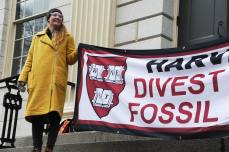
BREAKING: After a decade of constant pressure by students, faculty, and alums,
@HARVARD
IS FINALLY DIVESTING FROM FOSSIL FUELS.

While Rupert Murdoch is not even worthy of the “too little too late” moniker, Harvard University is worthy of “better late than never:”

Triumph! Harvard Finally Divests From Fossil Fuel

The richest university in the world capitulates after a decade of activism

The end came, as ends often do, quietly: at midafternoon today Harvard president Larry Bacow released a letter to Harvard students, faculty, and alumni. He didn’t use the word ‘divestment’–that would have been too humiliating–but he did say that the richest university on earth no longer had any direct investments in fossil fuel companies, and that its indirect investments through private equity funds would be allowed to lapse. “HMC has not made any new commitments to these limited partnerships since 2019 and has no intention to do so going forward. These legacy investments are in runoff mode and will end as these partnerships are liquidated.” Continue reading
Orca On

The video above is the shortest, clearest primer we could find to explain how this machine technology works. With Orca now on we will get the chance to see how much promise this process holds for carbon capture’s machine approach versus the tree approach, which we now know needs some reconsideration:

World’s biggest machine capturing carbon from air turned on in Iceland

Operators say the Orca plant can suck 4,000 tonnes of CO2 out of the air every year and inject it deep into the ground to be mineralised

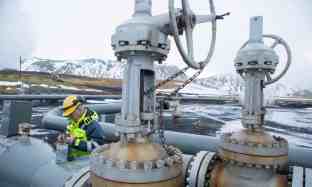
A worker on a CarbFix carbon injection well in Iceland in 2017. The company is involved in the new Orca plant designed to draw carbon dioxide out of the air and store it as rock. Photograph: Christian Science Monitor/Getty Images

The world’s largest plant designed to suck carbon dioxide out of the air and turn it into rock has started running, the companies behind the project said on Wednesday.

The plant, named Orca after the Icelandic word “orka” meaning “energy”, consists of four units, each made up of two metal boxes that look like shipping containers.

Constructed by Switzerland’s Climeworks and Iceland’s Carbfix, when operating at capacity the plant will draw 4,000 tonnes of carbon dioxide out of the air every year, according to the companies. Continue reading
Really, Rupert?

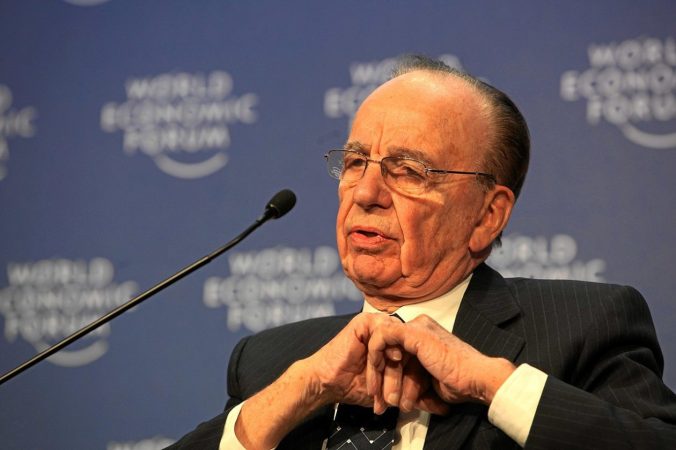
Rupert Murdoch, executive chairman of News Corp, at a meeting of the World Economic Forum, January 30, 2009. MONIKA FLUECKIGER / WORLD ECONOMIC FORUM

If we had a category called too little, too late, this man and his phenomenally profitable media empire would not even feature in it. He has done so much damage through his empire’s constant denialism of climate change that even one little act like this one would not be worthy. Australia is too fossil fuel friendly, for sure, but is small potatoes in the scope of Murdoch’s holdings and their relevance to the world. And it is not at all clear this move is genuine. It seems obvious that as more of the world believes its own eyes rather than what he has been selling, he needs to pivot. We should not reward such a pivot:

In Australia, Murdoch-Owned News Outlets Vow to Back Away From Climate Denial

Though long hostile toward climate science, News Corp Australia is planning an editorial campaign calling for a zero-carbon economy,The Sydney Morning Herald reported. Continue reading
Restor & Correcting The Trillion Tree Mess

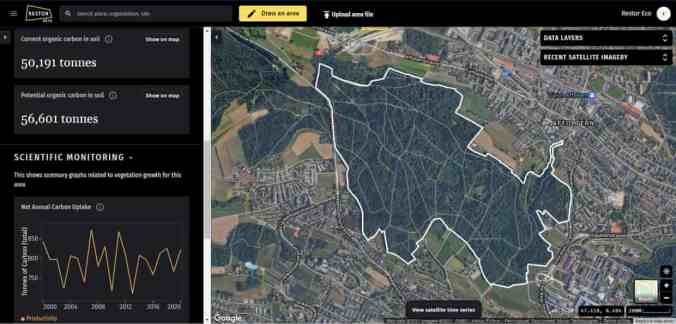
Crowther says Restor is his ‘life’s vision’, mapping the latest data and thousands of conservation projects. Photograph: Courtesy of Restor

I have been on a tree-planting spree in the last couple years. So I am constantly on the lookout for resources that help me see this work in a larger context. Here is a great one I have just learned about. Restor’s macro-level organizing of conservation through geographic information systems requires skills and ambitions that few have in such capacity as the scientist featured in the following story. Maps like the one shown above are less inspirational, but more powerful in other ways, than scenes of effective restoration like the one below.

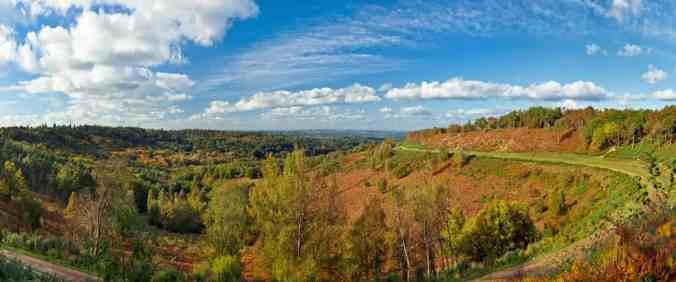
The former A3 London to Portsmouth road at Hindhead, after being restored back to heathland. Photograph: Tony Watson/Alamy

T. W. Crowther has featured in our pages for years, starting with our link to his work on how many trees are on our planet and what this implies with regard to climate. We lunged forward to share the idea that planting a trillion trees was the key implication, and also lurched back a bit when it seemed worthy of more consideration. This article does much to clear up “the mess” that Mr. Crowther acknowledges resulted from the trillion tree findings, and which I was captivated by:

‘I’ve never said we should plant a trillion trees’: what ecopreneur Thomas Crowther did next

Thomas Crowther understands more than most the danger of simple, optimistic messages about combating the climate crisis. Continue reading

Kim Stanley Robinson’s Message For All Of Us

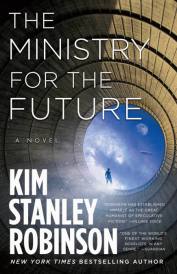
When The Ministry for the Future came to my attention late last year, it was the first I had heard of this author (I am buried deep under a big rock when it comes to science fiction). Now I wonder how I could have missed such an important thinker on the most important topics of our time (not science fiction):

Kim Stanley Robinson on “Utopian” Science Fiction

One of the premier writers of thinky sci-fi, Kim Stanley Robinson opened his book “The Ministry for the Future” with an all too plausible scenario: a lethal heat wave descends on India, with vast, horrifying consequences. It’s a sobering read, especially after July, 2021, was declared the hottest month on record. And yet Robinson tells Bill McKibben that his work is not dystopian; his central concern is how the globe could respond to such a disaster and begin to halt the momentum of global warming. Continue reading

Bitcoin’s Carbon Footprint Explained

Cryptocurrency’s immense carbon footprint has been well known since early on. What to do about it is the question. Getting a good answer to that question depends in part on understanding the nature of the problem. Read below for the clarity of the explanation on this topic, and let the illustrations make it that much clearer:

Bitcoin Uses More Electricity Than Many Countries. How Is That Possible?

Cryptocurrencies have emerged as one of the most captivating, yet head-scratching, investments in the world. They soar in value. They crash. They’ll change the world, their fans claim, by displacing traditional currencies like the dollar, rupee or ruble. They’re named after dog memes. Continue reading

Grounding The Carbon On Farmlands

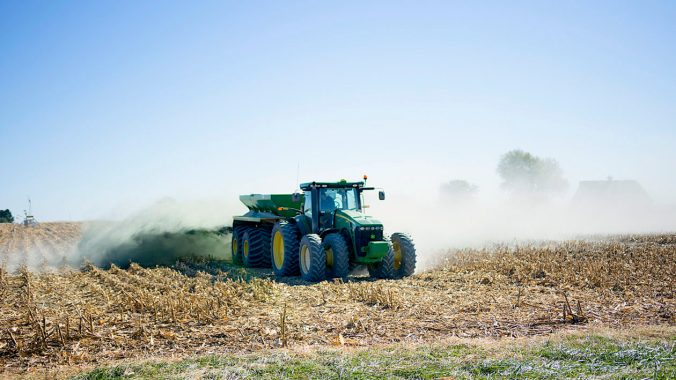
Basalt is spread on the Leverhulme Centre for Climate Change Mitigation’s research cornfields in Illinois. JORDAN GOEBIG

Thanks to Yale e360:

How Adding Rock Dust to Soil Can Help Get Carbon into the Ground

Researchers are finding that when pulverized rock is applied to agricultural fields, the soil pulls far more carbon from the air and crop yields increase. More studies are underway, but some scientists say this method shows significant benefits for farmers and the climate.

Researcher Zack Kozma (left) gathers a water sample from a field where rock dust has been added to the soil at Cornell’s AgriTech Agricultural Experiment Station. GARRETT BOUDINOT; SOPHIE NASRALLAH

On a hot and humid August day near Geneva, New York, Garrett Boudinot stands in a field of hemp, the green stalks towering a foot or more over his 6-foot, 4-inch frame. Today, the mustached Cornell University research assistant will harvest six acres of the crop, weigh it in red plastic garbage bins, and continue to analyze the hundreds of water samples taken with measuring devices called lysimeters that have been buried in the field over the last three months.

A clump of soil containing rock dust. GARRETT BOUDINOT; SOPHIE NASRALLAH

Boudinot, part of a research team at Cornell University, will sweat through the next two days of field work to see whether an unusual component added to the soil earlier in the year helped increase yields and sequester carbon. This soil amendment “we just call lovingly ‘rock dust,’ which isn’t very descriptive,” says Boudinot. “But it’s really silicate rocks that have been pulverized to a fine powder.” Continue reading

Balancing Power On Climate

The main way to counter the malign power of vested interest is to meet organized money with organized people. Photograph by Nicole Neri / Bloomberg / Getty

For the entire run of his newsletter McKibben made this point over and over again, and now one final time from his unique platform at the New Yorker:

The Answer to Climate Change Is Organizing

Dealing with global warming is always going to be about the balance of power.

Amore personal note than usual this week, because this will be the last of these Climate Crisis columns I’ll write (though it’s not the end of my work for the magazine). I’m incredibly grateful to The New Yorker for letting me do them—and especially thankful for Virginia Cannon, who has edited them each week with grace and aplomb. Our run has overlapped almost perfectly with the course of the pandemic, and for me it’s been the perfect moment to sit back and appreciate and highlight the work of so many across the wide universe of activists, scientists, economists, and politicians who are taking on the deepest problem that humans have ever wandered into. I can’t overstate the comfort of that universe: it didn’t exist thirty-two years ago, when I started writing about climate change; its slow but inexorable rise has given me not just welcome company but real hope. I’ve particularly enjoyed “passing the mic” to many members of that gathering throng. Continue reading