One year ago, when we had completed all the cupping sessions, farm visits and decision-making about the 12 coffees we would start with, a couple regions were left out of our mix. One of them was Orosi, and there was no good reason other than our shelf space considerations. We will resume our search and find a coffee to represent Orosi in our offering soon.
Bird of the Day: Volcano Hummingbird In Flight
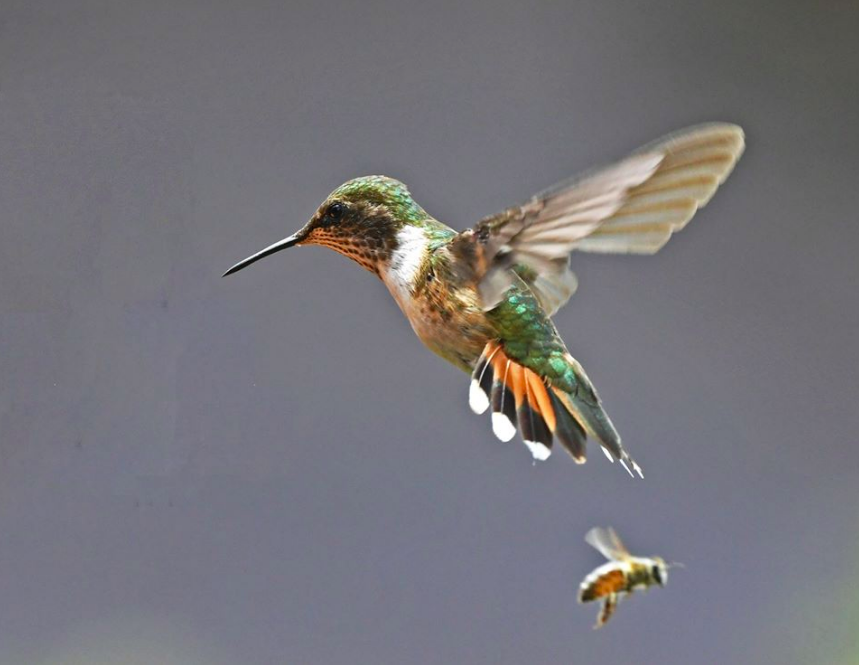
female – Talamanca Mountains, Costa Rica
Costa Rica Coffee Terrain: Tarrazu
Costa Rica has a remarkably diverse landscape for such a small country. And that diversity translates into an excellent variety of high quality coffees, each unique according to the region of origin, and the particular farms within those regions. We have chosen twelve coffees from the regions that international tasting competitions have consistently prized the most, including four single estate coffees that stand out for their quality. Continue reading
Bird of the Day: Roadside Hawk
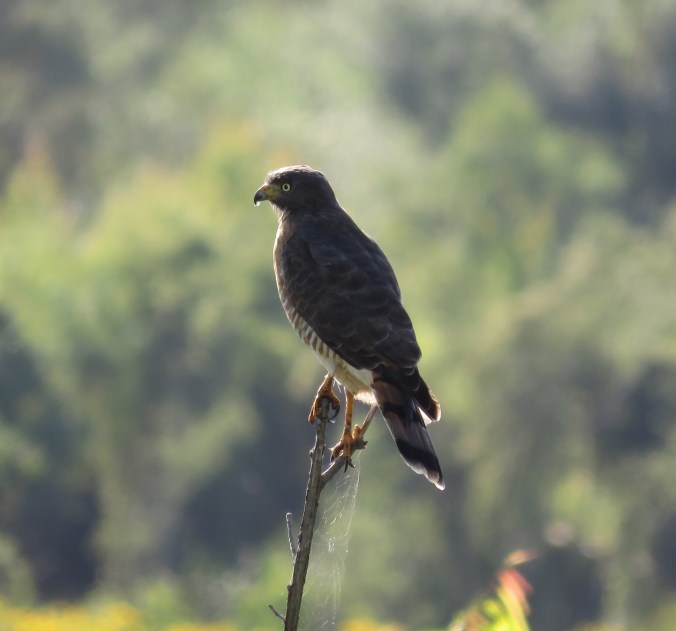
Buenos Aires, Argentina
Curvy Berms, Seedlings & Fertile Earth
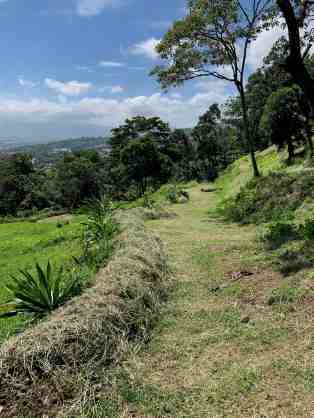
Curvy berm
What looks like an elongated haystack curving downslope in this photo we call a berm. No hay there, just a mix of cut grass covering branches, logs, and such. The purpose of a berm, diagonally traversing this hill, is explained better by others. When we prune trees and bushes, cut grass, and find old logs on the land their biomass help build this berm. Recently we trimmed all our vetiver grass, a soil retention ally that grows waist-high in rows throughout our hills. We cut it back twice a year, and added it to the top of the curvy berm.
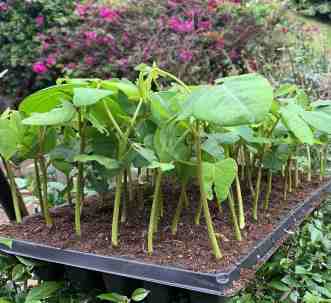
Poro seedlings
To the left of that berm are re-plantings of a type of palm that we had growing on the property already, which birds love for the orange fruit it provides and for nesting. Those 20 palms join the 30 banana and plantain trees on the flat area below, and the dozen or so citrus trees recently planted. The shade-providing and nitrogen-fixing tree called poro will be planted during the next waning moon cycle.
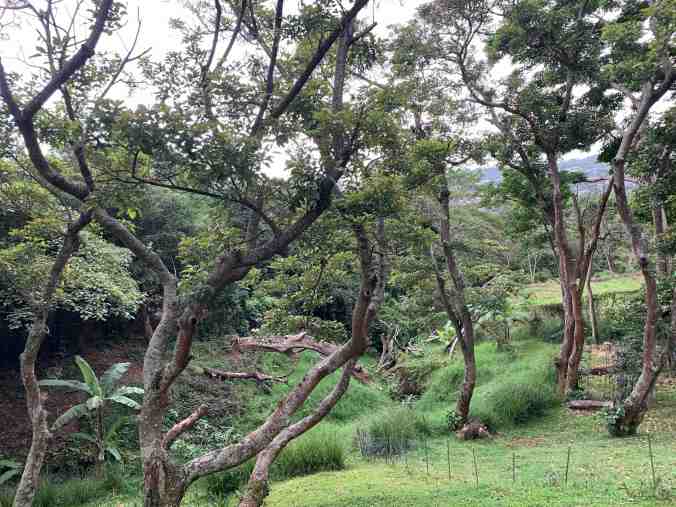
Poro trees, parents of the seedlings, with vetiver grass downslope
We have collected hundreds of seedlings from the poro trees originally planted when this land was part of a coffee farm.
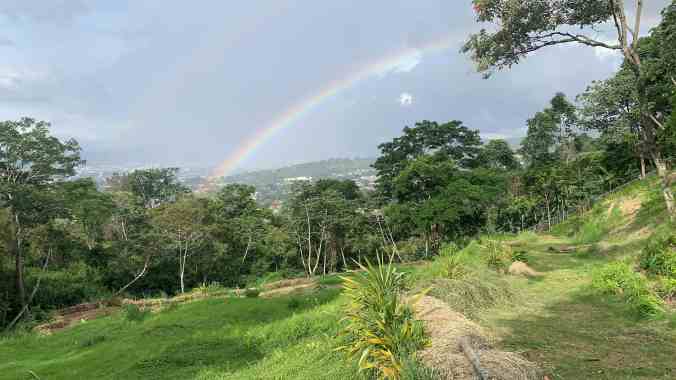
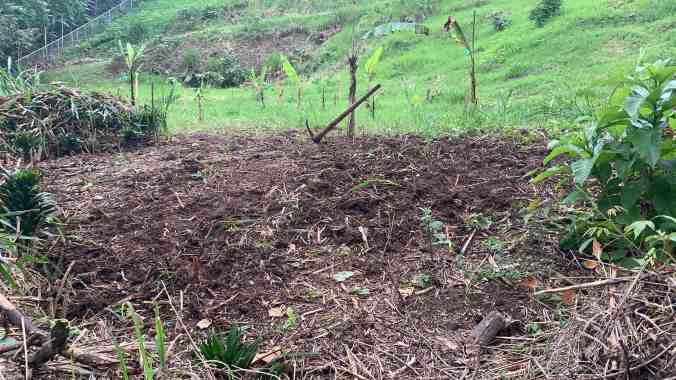
This rainbow reminded me to document the work on the land where the bees are, and where the coffee will be. For now, just a quick note. On the lower left of the photo above you can see where I have been using a pickax to loosen soil, dark and rich and teeming with earthworms, for planting in between the rows of bananas. I last cleared this space before we moved to Croatia in 2006. The grasses and vines that occupied this space for the intervening years until recent months, now our enemy for growing plants we favor, have performed an amazing ecosystem service. The earthworms and smell of the soil tell me that.
End of day, sunset time, back on the terrace of our home, an unexpected spectacle. In the photo below, which is looking due east, the sun is coming from the west, hitting Irazu volcano and lighting it up in such a way that it almost looks like golden lava is flowing down its cone. I’ll take that view, with thanks to whatever caused it.
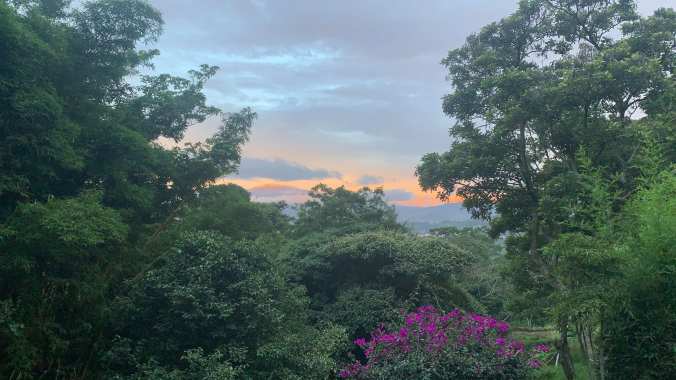
Sunset-illuminated Irazu volcano in the distance
Bird of the Day: Freckle-breasted Woodpecker
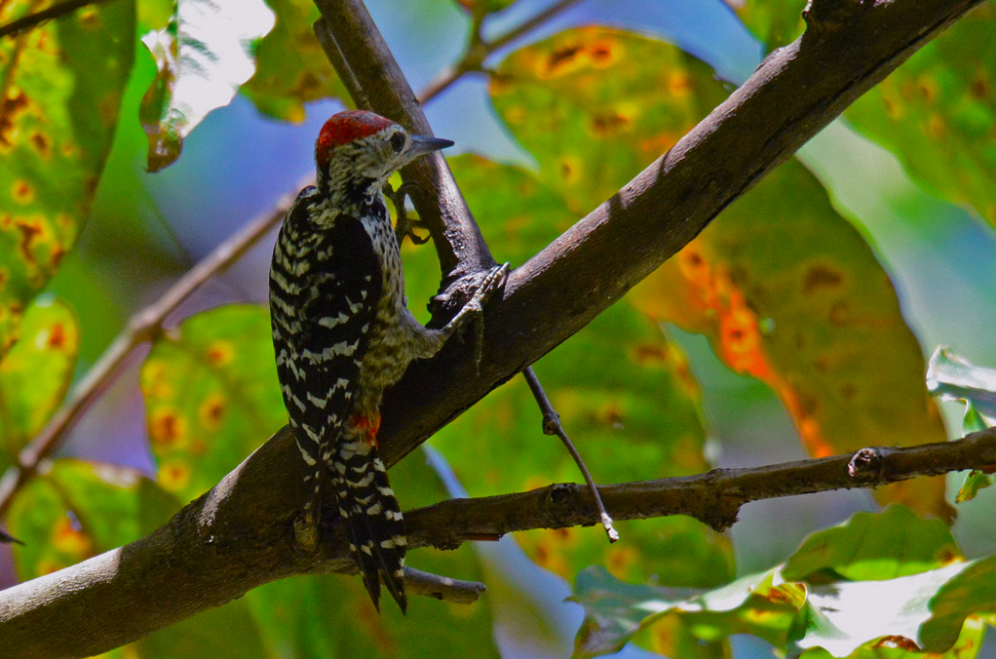
Andaman Islands
Wasp Surprises
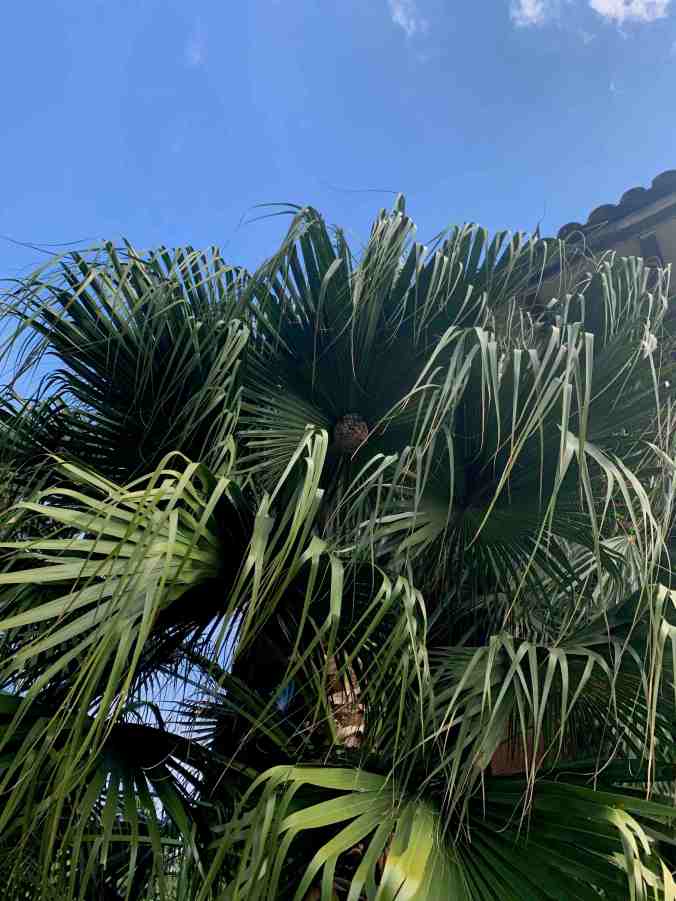
Nearly a month ago Cara Giaimo surprised me with a primer on bee vomit, and today she has done it again with an appreciation of wasps, whose ranking on the favored insect list is somewhere more tolerated than mosquitoes and less creepy than cockroaches. The bees we provided a new home for are doing well, and while their honey is something we look forward to, pollination is our primary motivator. I have been watching wasps build a home in the tree closest to our home–see it in the upper center of the tree in the photo above–and wondering whether to leave them in peace. Maybe so, for reasons outlined here:
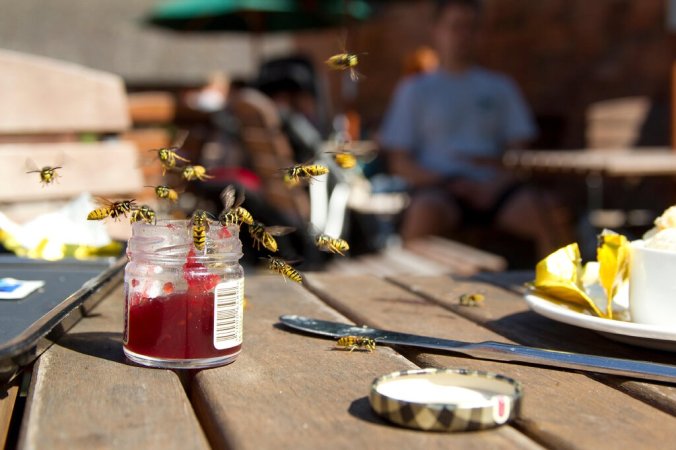
Paul Hobson/Nature Picture Library/Alamy
There Are Wasps in the Yard. You’d Better Get to Know Them.
They buzz. They hover. Sometimes they sting. But how much do you really know about these insects that can menace our summers?
Uwe Grün/Alamy
Wasps get a bad rap. And sometimes, they deserve it. Bumblebees don’t swarm your barbecue the moment you pour the lemonade. Butterflies won’t nest by the hundreds in your rafters, then sting you for the crime of walking by.
Mark Lehigh/Alamy
But they’re not all “murder hornets,” and there’s another side to these so-called pests. Wasps have a place in the whirl of summer life. They raise families, stage complex battle royals and make paper with their own spit. Some even help us by hunting caterpillars and other crop-munching bugs.
They’re also your neighbors. As you’re mowing, gardening or dining al fresco this summer, you’ll probably meet some of them. Here’s how to appreciate — and not tick off — these creatures we share the season with.
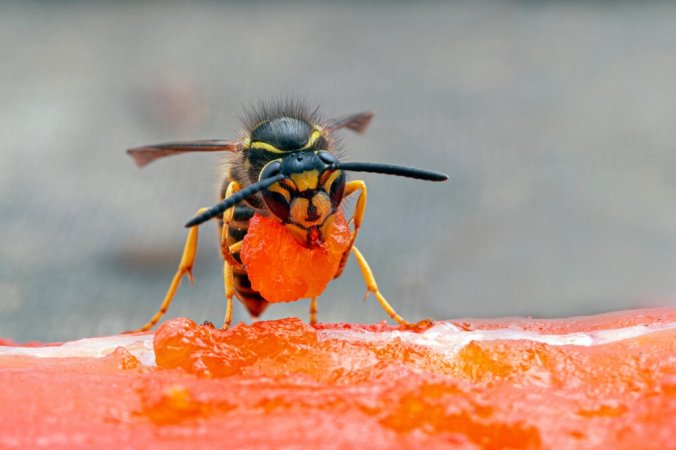
A German yellowjacket with a chunk of salmon to bring back to the nest. Ernest Cooper/Alamy
The Scavengers
Uninvited guests have arrived at your picnic. They’re striped and kind of stocky, with black dots on their faces. They’re German yellowjackets, and they will not leave you alone. Continue reading
Bird of the Day: Black-crowned Antshrike
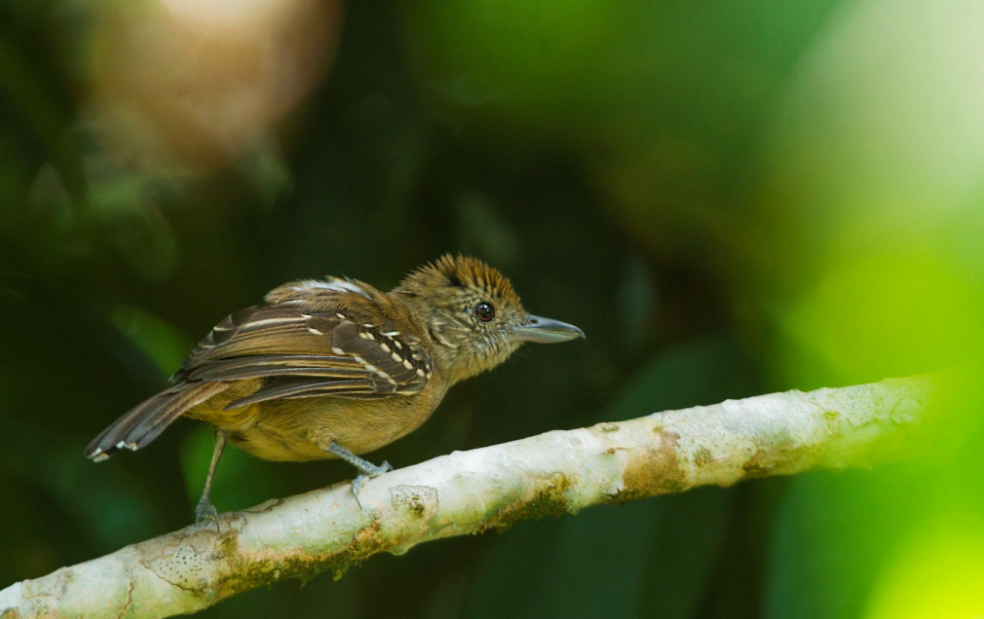
Isla Bastimentos, Panamá.
Swifts Here & There
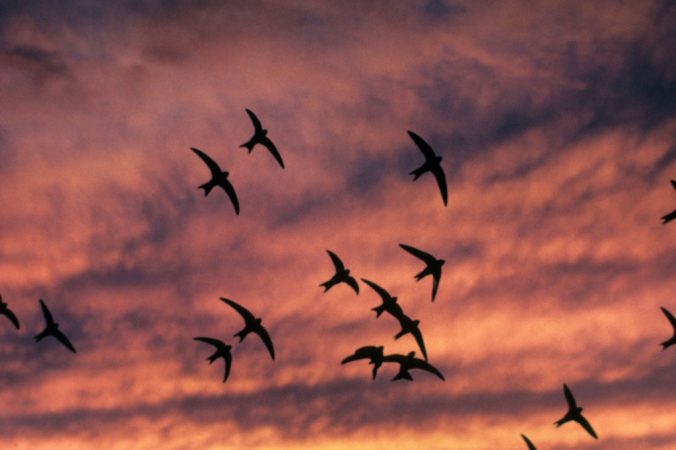
Watching a flock of swifts power and zoom all over the sky in Cornwall, I realized that the feeling of being trapped by the coronavirus is not just about wanting to be somewhere else—it is about wanting to escape this time entirely. Photograph from Alamy
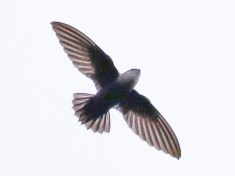
Costa Rican Swift. Chaetura fumosa. Smallest swift in most of range. All dark gray with contrasting pale rump and paler throat, both of which can be difficult to see in many viewing conditions. A good look at the rump is necessary for a firm visual identification, otherwise Vaux’s Swift can look very similar. However, in some parts of its range (the Osa Peninsula, for example) this is the only small Chaetura swift. Makes twittering calls similar to many other swifts. Usually found in flocks over forests and more open areas.
I am not even the second birdiest member of our family. I enjoy birding events and join the fun from time to time. Apart from such events I do not travel specifically for birds, even the one to the right. We see it on occasion and it is a particular pleasure. Not as thrillingly colorful as a scarlet macaw, nor as resplendent as a quetzal, but it is part of a famed family of birds. The essay below explains why. In Costa Rica the airports will be opening up again on August 1. Until then, and still for the foreseeable future, tourism is primarily locals going on weekend outings. Birding is usually thought of as a motivator for foreigners visiting Costa Rica–especially those from the UK–but now is an activity appreciated by more locals than usual. Sam Knight‘s perspective from the UK, where tourism is also primarily local currently, can be especially well appreciated from our vantage point in Costa Rica:
Letter from the U.K.
Swifts and the Fantasy of Escape
On July 17th, I drove out of London for the first time since the start of the pandemic. The last time I had seen a field or sensed a broad horizon was four months earlier, when we escaped the city in the early days of the coronavirus, feeling faintly ridiculous, to celebrate my daughter’s third birthday with an Easter-egg hunt on a quiet country lane. Last week, I was taking my daughters to stay with their grandparents for a few days, in the town of Helston, in Cornwall. It’s about three hundred miles from London—no great shakes by U.S. standards but about as far as you can drive in England without crossing into Scotland or falling into the sea. We left at 5:30 a.m., heading west, and arrived in Helston in the early afternoon. It’s hard to describe the effect of movement after being confined in a dense urban neighborhood for so long. The monotonous walks to the shitty park. I felt like I was being unpeeled. As we stood in my mother-in-law’s garden, in the bright July sun, a party of swifts, tipping from right to left, their long wings like blades, came over our heads and spiralled higher and higher into the sky, screaming. Continue reading
Bird of the Day: Purple Sunbird
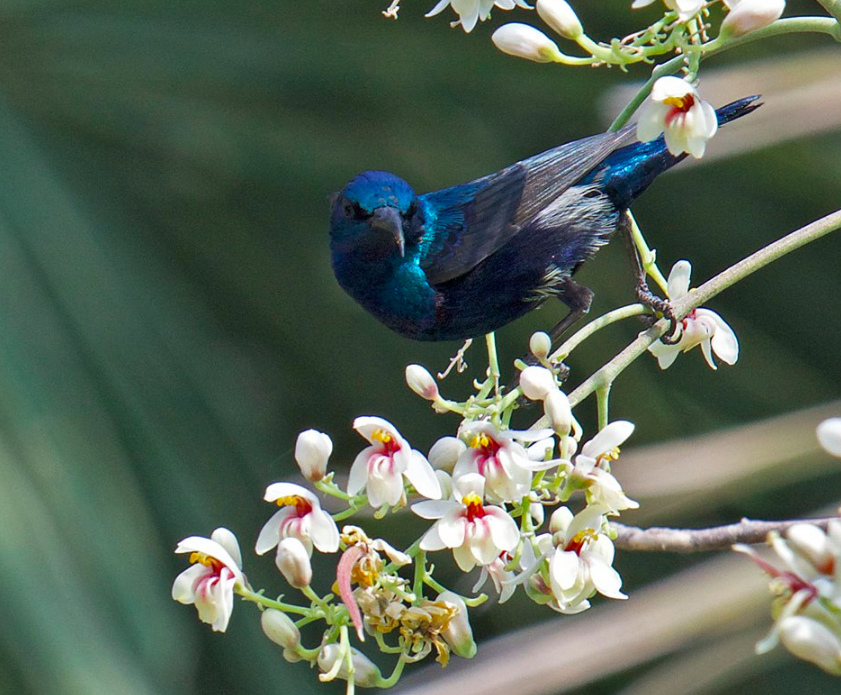
male – Little Rann of Kutch, Gujurat
Hats, History, Heritage
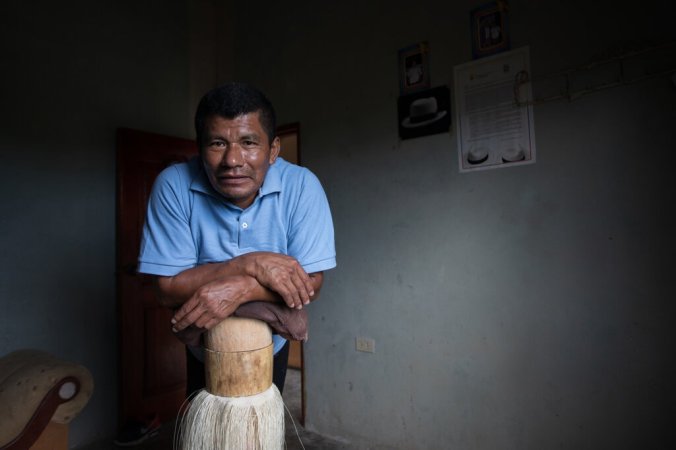
Mr. Espinal, 52, is widely regarded as the greatest living Panama hat weaver. All photographs by Roff Smith
Having lived and worked in Central America and South India, weaving with palms for shelter and adornment has been part of cultural norms. But in most cases, the craftsmanship has been simplified versions that lacked permanence – for the sake of festivals, traditional artesania , or with the knowledge that the woven shelter would last several seasons of rain before requiring replacement.
The artisan ethos described here mirrors both the fine work and collaborative efforts of Kerala sari weaving communities like Chendamangalam. In all cases, the “stuff of royalty.”
A Glimpse Inside the Workshops of the World’s Finest Panama Hat Makers
Creamy as silk and costlier than gold, a Montecristi superfino Panama hat is as much a work of art as it is of fashion.
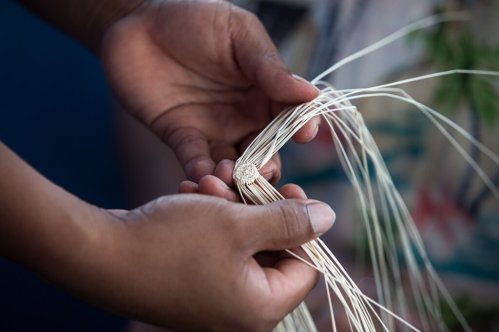
Creamy as silk, costlier by weight than gold, the color of fine old ivory, a Montecristi superfino Panama hat is as much a work of art as it is of fashion. The finest specimens have more than 4,000 weaves per square inch, a weave so fine it takes a jeweler’s loupe to count the rows. And every single one of those weaves is done by hand. No loom is used — only dexterous fingers, sharp eyes and Zen-like concentration.
“You cannot allow your mind to wander even for a second,” says Simón Espinal, a modest, soft-spoken man who is regarded by his peers as the greatest living weaver of Panama hats, possibly the greatest ever. “When you are weaving it is just you and the straw.”
Mr. Espinal’s hats average around 3,000 weaves per square inch — a fineness few weavers have ever even approached. His best has just over 4,200 weaves per square inch and took him five months to weave.
The 52-year-old Ecuadorean is one of a dwindling number of elite Panama hat weavers, nearly all of whom live in Pile, an obscure village tucked away in the foothills behind Montecristi, a low-slung town about 100 miles up the coast from Guayaquil.
Animals Having Fun
Thanks to Eric Vance for a fun and interesting read:
Where the Wild Things Play
The animal world is full of games. And tucked in among wrestling monkeys, belligerent birds and wily coyotes are lessons for us all.
As a sophomore in college I interned at a lab that studied dolphin behavior. The animals spent most of the year doing back flips and spraying water onto tourists at a theme park, then called Marine World Africa USA, just north of San Francisco. In their off months, they hung out with behavioral scientists who did experiments with them.
I quickly noticed a few things about dolphin research. One, it’s regularly interrupted by dolphin sex. Dolphins are dirty, dirty creatures. Two, despite this, it’s actually quite dull. Watching dolphins swim in circles eight hours a day gets old. And three, almost all dolphin experiments involve games and toys. Continue reading
Bird of the Day: Blackbird
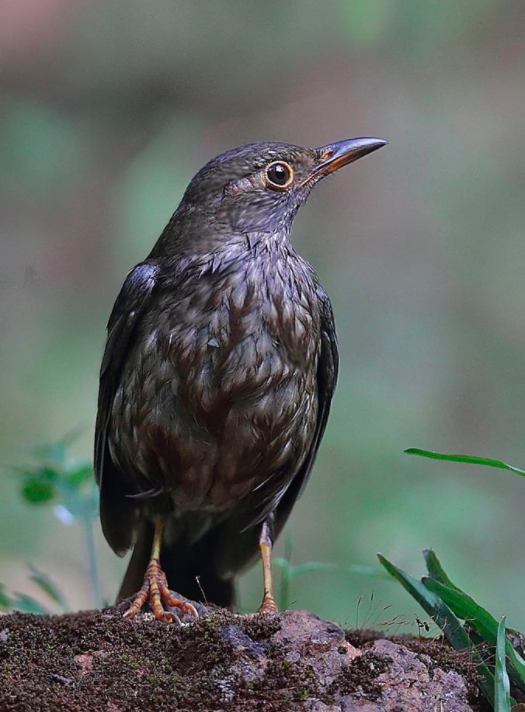
Dandeli Wildlife Sanctuary, Karnataka
The Elusive Uniform Crake
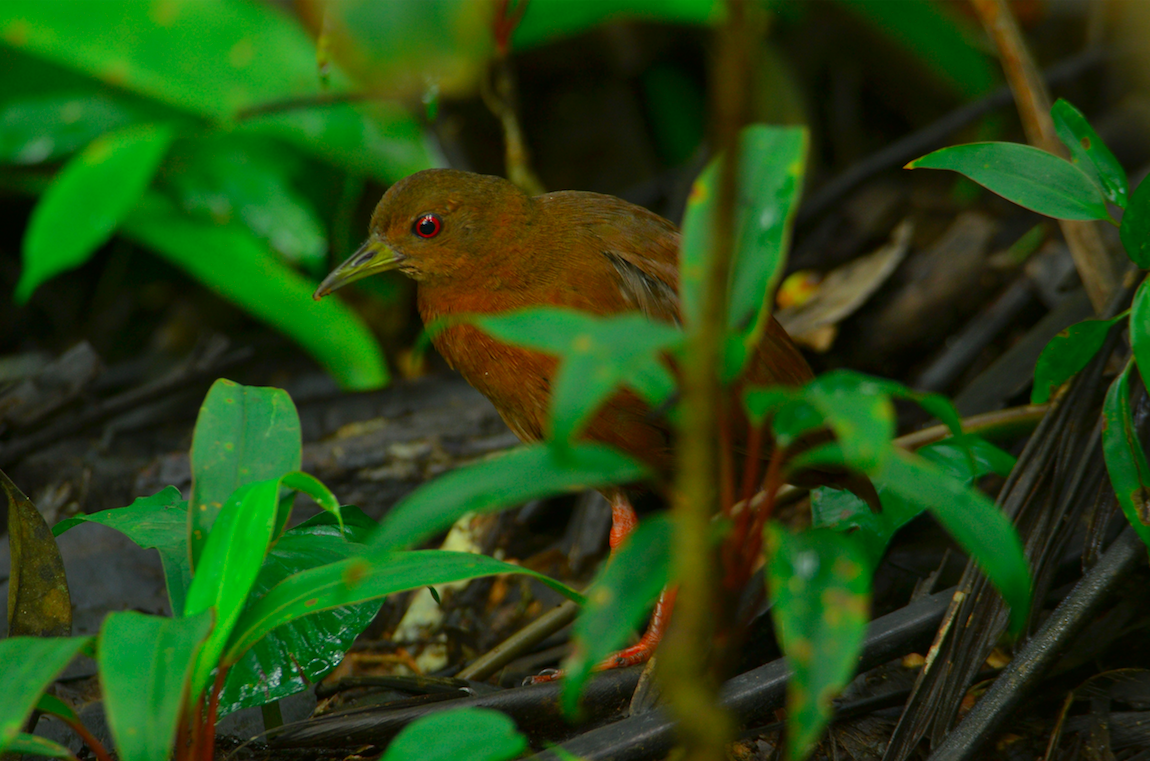
Photo credit: Beto Guido
On the morning of May 9 during Global Big Day 2020 an unfamiliar whistle resounded in the grasslands and bushes along the edge of the huge garden of Macaw Lodge. I would never have imagined that it was a Uniform Crake, but thanks to the keen hearing of guides Beto Guido and Marco Umaña, we were able to register this species for the first time in the Macaw Lodge Private Forest Reserve. The record was made only by the bird song, and despite the team’s effort to try to spot it, we could only hear it.
This elusive and shy crake (Amaurolimnas concolor) has rarely been sighted in the Costa Rican Central Pacific, so this record was of great importance to the region. Because it prefers to inhabit dense undergrowth thickets, it is usually identified by its sound rather than by actual sightings. Continue reading
Bird of the Day: Brown-hooded Parrot
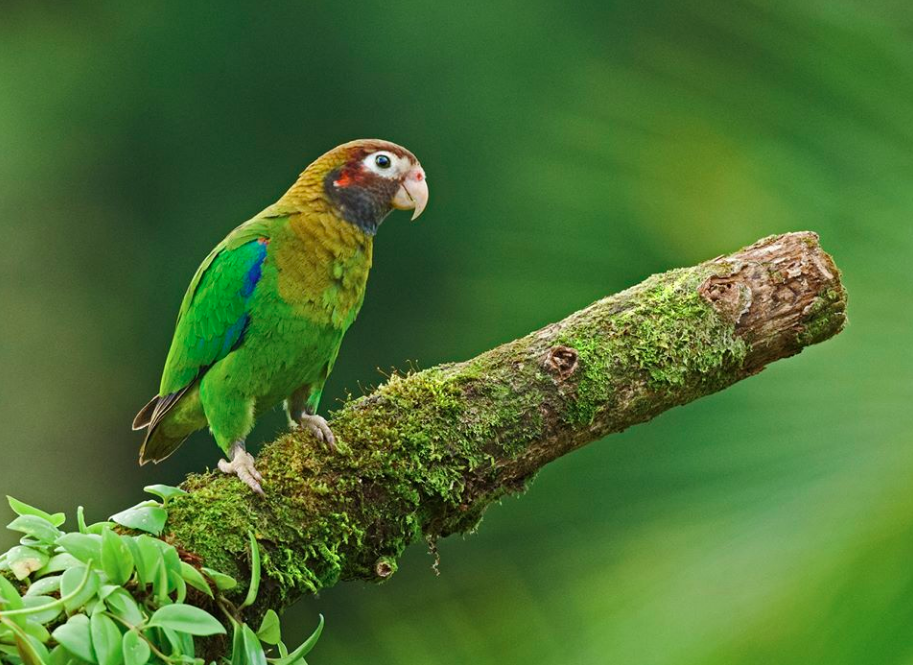
Boca Tapada de San Carlos, Costa Rica
Wine & Biophilia

Brian Britigan
Biophilia is a frequent topic here; wine, only a fraction as much. An article touching on both is a rare treat:
From Good Wine, a Direct Path to the Wonders of Nature
For this city dweller, wine provided the opening to a greater understanding of food and agriculture, and their precarious balance.
Last year a friend asked me a question I had never considered before: Over the many years I had been writing about wine, what was the greatest thing this job had given me?
I answered almost reflexively. As a New Yorker who has spent most of my life living in Manhattan, wine had provided me a connection to nature that I most likely would never have experienced otherwise. Continue reading
Bird of the Day: Golden-hooded Tanager

Macaw Lodge, Costa Rica
Sleuthing The Breeding Of Rare Birds
Thanks to Brendan Borrell for sleuthing this through to publication, with evocative illustrations, in Audubon Magazine:
THE PARROT KING
OVER THE PAST 14 YEARS, MARTIN GUTH HAS BUILT A MONOPOLY ON SOME OF THE WORLD’S RAREST BIRDS. WILL HIS SECRETIVE ORGANIZATION ULTIMATELY HELP PUT MORE PARROTS IN THE WILD, AS HE SAYS—OR PUSH THEM CLOSER TO EXTINCTION?For Stephen Durand, March 16, 2018, began like most other days—with an inordinate amount of squawking. Durand lives on the Caribbean island of Dominica and oversaw the federal aviary that houses rescued parrots, including casualties of Hurricane Maria. Six months earlier, the storm had leveled large numbers of the island’s trees and stripped many more of their fruit and foliage, threatening two endemic parrot species. Continue reading
Bird of the Day: Rain Quail
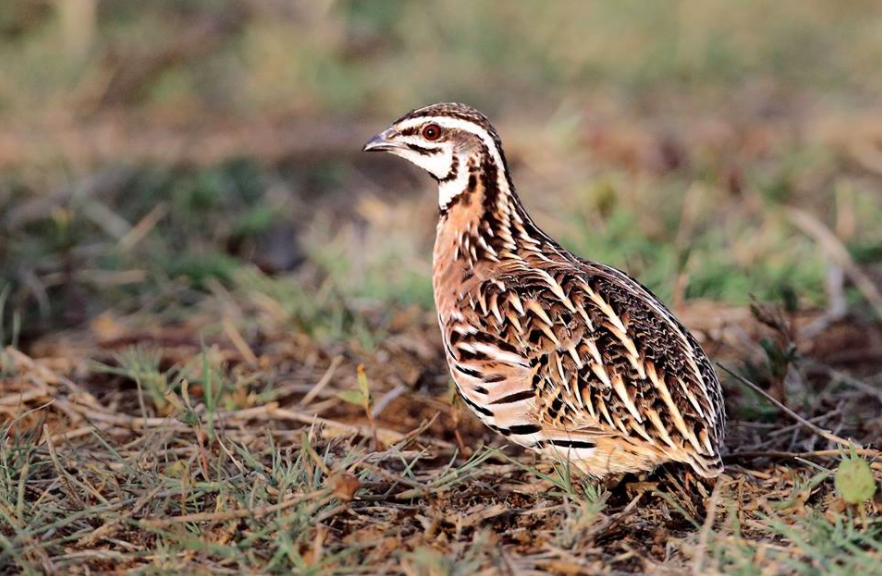
Bangalore, Karnataka
Scientific Expeditions Then, Considered Now
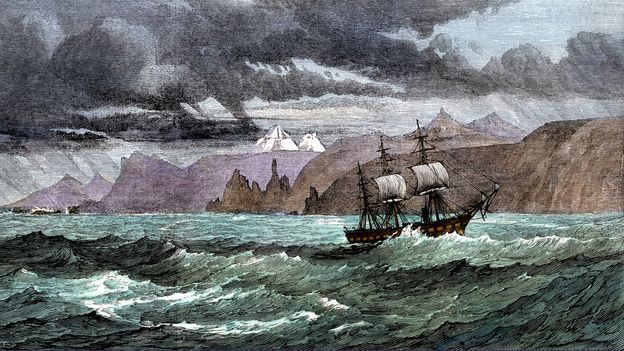
The HMS Challenger set sail from England in 1872 and changed the course of scientific history (Credit: North Wind Picture Archives/Alamy)
Thanks to the BBC for reminding us of the value of such voyages in earlier centuries, and their contributions to science, among other things:
HMS-Challenger: The Voyage That Birthed Oceanography
The 3.5-year voyage to the furthest corners of the globe reshaped marine science and permanently changed our relationship with the planet’s oceans.
During the four-year journey, the ship uncovered many new species and shaped our understanding of the seas (Credit: LeeYiuTung/Getty Images)
In the foyer of the National Oceanography Centre in Southampton, England, stands a ship’s painted figurehead. It towers well above head height and depicts an armoured knight with a silver chest plate, a raised visor and a thick handlebar moustache. The knight’s eyes have a faraway gaze in them – and well they might. This wooden statue is the sole remnant of a square-rigged ship that once embarked on a three-and-a-half-year voyage to the furthest corners of the globe, reshaping marine science, unearthing all manner of underwater oddities and permanently changing our relationship with the planet’s oceans. The vessel’s name was HMS Challenger. Continue reading
 Organikos