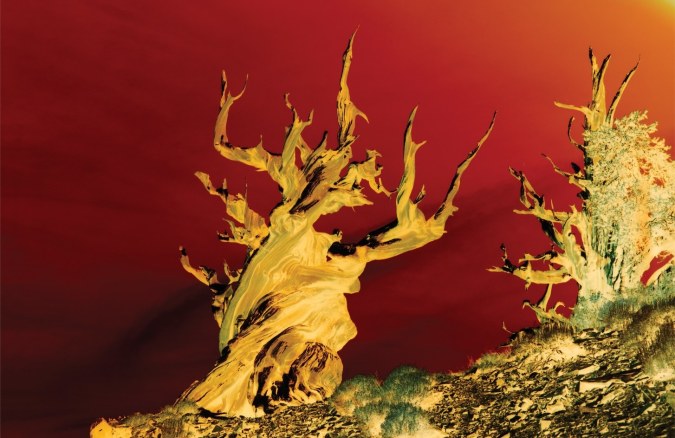
Bristlecone pines have the look of survivors, not conquerors. Fittingly, they found fame during the Cold War, when atomic tests were taking place not far off, in the Nevada desert. Bristlecones are post-apocalyptic trees, sci-fi trees. Photograph by John Chiara for The New Yorker
Alex Ross mainly writes about music, but when he sets his sights on other important topics his musicality illuminates in a powerful way:
Bristlecone pines have survived various catastrophes over the millennia, and they may survive humanity.
About forty-five hundred years ago, not long after the completion of the Great Pyramid at Giza, a seed of Pinus longaeva, the Great Basin bristlecone pine, landed on a steep slope in what are now known as the White Mountains, in eastern California. The seed may have travelled there on a gust of wind, its flight aided by a winglike attachment to the nut. Or it could have been planted by a bird known as the Clark’s nutcracker, which likes to hide pine seeds in caches; nutcrackers have phenomenal spatial memory and can recall thousands of such caches. This seed, however, lay undisturbed. On a moist day in fall, or in the wake of melting snows in spring, a seedling appeared above ground—a stubby one-inch stem with a tuft of bright-green shoots.
Most seedlings die within a year; the mortality rate is more than ninety-nine per cent. The survivors are sometimes seen growing in the shadow of a fallen tree. Continue reading →








 Organikos