Really, Nestle?

5184n.jpg

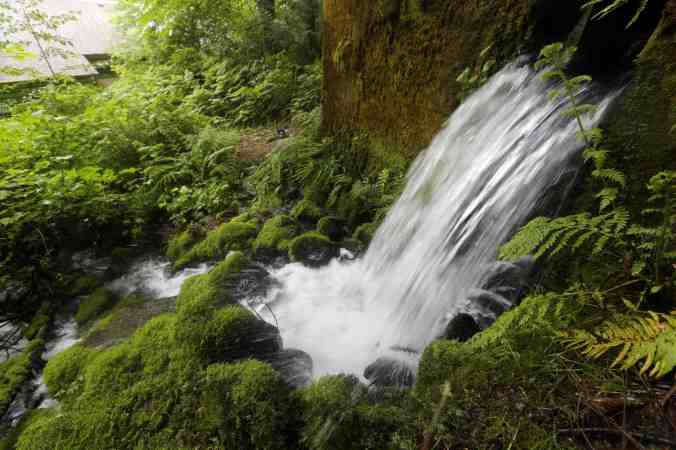
A proposal for Nestlé to build a water bottling plant in Cascade Locks, Oregon, was one of the most heated battles in the state in its 2016 primary. Photograph: Don Ryan/AP

The fight to stop Nestlé from taking America’s water to sell in plastic bottles

Creek beds are bone dry and once-gushing springs are reduced to trickles as fights play out around the nation over control of nation’s freshwater supply

5249.jpg

The Forest Service recently determined Nestlé’s activities left California’s Strawberry Creek ‘impaired’ while ‘the current water extraction is drying up surface water resources’. Photograph: Nick Todd/Alamy

We are as tired of these stories, and the fights they require, as you may be. Nonetheless, here is a fight we can get behind. Nestlé, once again, back off. Thanks to Tom Perkins and the Guardian:

The network of clear streams comprising California’s Strawberry Creek run down the side of a steep, rocky mountain in a national forest two hours east of Los Angeles. Last year Nestlé siphoned 45m gallons of pristine spring water from the creek and bottled it under the Arrowhead Water label.

Though it’s on federal land, the Swiss bottled water giant paid the US Forest Service and state practically nothing, and it profited handsomely: Nestlé Waters’ 2018 worldwide sales exceeded $7.8bn. Continue reading

Authentica, Organikos & Escazu

EscMtn.jpg

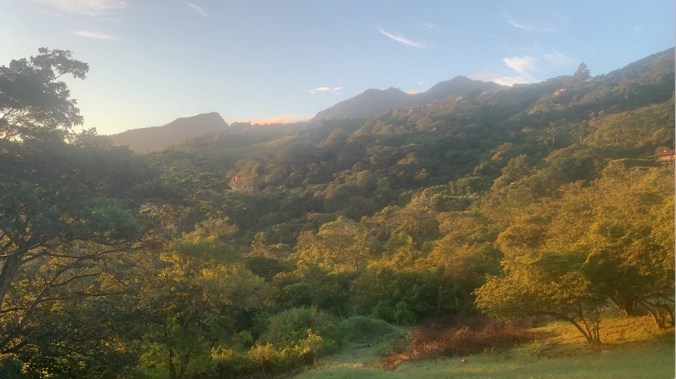
In the photo above, the view is from our home up to the home of a friend who grows coffee in the upper reaches of Escazu. He is an agronomist whose foremost specialty is bananas, which he has helped farmers grow more effectively throughout Latin America. AuthnticaLogoI mentioned his coffee at the start of this year when we were meeting farmers, chocolatiers, and local artisans, knowing we would launch Authentica, and its sibling Organikos logoventure Organikos sometime this year.

We ended up not choosing that particular coffee as one of our 12 offerings, but every tasting, every artisan meeting, every event we have attended to find things that offer “taste of place” and that look and feel like the essence of Costa Rica–all have been helpful in establishing our product line.

EscFeria.jpg

Escazu, where we live, where the idea for Authentica started and also where Organikos is situated is an ideal location for what we do. The festival of masks, organized by the community, is an example of why: local pride, sense of place, sharing with others.

Kate Marvel Has A Way With Words

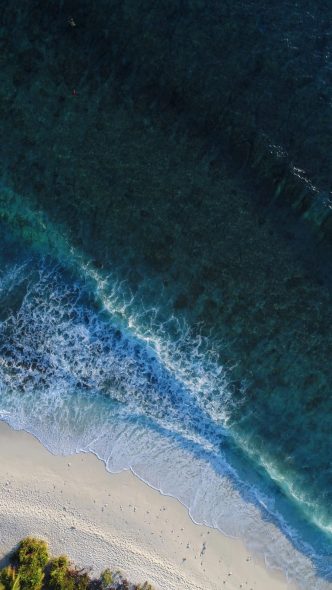
shifaaz-shamoon-302656-768x1365.jpg

Image by Shifaaz Shamoon/Unsplash, Public Domain Dedication (CC0).

We Should Never Have Called It Earth

We should never have called it Earth. Three quarters of the planet’s surface is saltwater, and most of it does not lap at tranquil beaches for our amusement. The ocean is deep; things are lost at sea. Sometimes we throw them there: messages in bottles, the bodies of mutinous sailors, plastic bags of plastic debris. Our sewage.

She is a scientist who explains in language I understand, without dumbing it down too much, something as complex as climate change and its relationship to global warming. She is also funny. I found the blog post above after listening to her on this podcast, just to double check that she is consistently clear, profound and funny. She will be responsible for my staying tuned to this series:

Rewilding Patagonia

Heroes who made it happen, and here is a bit of the story, thanks to Sierra Club:

The Fashion Executives Who Saved a Patagonian Paradise

Tompkins Conservation donations are the largest act of wildlands philanthropy in history

THE MINISTER of public lands was about to arrive, a television crew in tow, so everything had to be just right. It was 8:15 on a summer morning in February, and the office of Tompkins Conservation outside the Chilean hamlet of El Amarillo was hive-busy. The philanthropy’s controller was hunched over a laptop filled with spreadsheets. A supervisor was giving orders to groups of men in blue coveralls. Kristine McDivitt Tompkins, the organization’s president, sat at a conference table toggling between a pair of laptops and her cellphone. Continue reading

No Age Limit in Citizen Science

Our most recent post about marine ecosystem citizen science connects the dots between the amazing community of people involved in gathering much needed information about the health of biodiversity in the deep.

Women’s photography of greater sea snake, once believed to be an anomaly in the Baie des Citrons, help scientists understand the ecosystem

A group of snorkelling grandmothers who swim up to 3km five days a week have uncovered a large population of venomous sea snakes in a bay in Noumea where scientists once believed they were rare.

Dr Claire Goiran from the University of New Caledonia and Professor Rick Shine from Australia’s Macquarie University were studying a small harmless species known as the turtle‐headed sea snake located in the Baie des Citrons, but would occasionally encounter the 1.5 metre-long venomous greater sea snake, also known as the olive-headed sea snake.

Goiran and Shine believed the greater sea snake was an anomaly in the popular swimming bay as it had only been spotted about six times over 15 years. From 2013, they decided to take a closer look at the greater sea snake to better understand its importance to the bay’s ecosystem.

“The study zone is in the most touristic bay in Noumea, so I often meet people when I am doing field work on sea snakes,” Goiran said. “When I was snorkelling on my own studying sea snakes, I used to meet a friend of mine called Aline that was snorkelling and taking photos on the same reef. In order to help me, she started taking photos of sea snakes and would send them to me by mail.

“I was very happy, so she asked her neighbour and friend Monique to help me too. Monique asked another friend, and soon there were seven grandmothers helping me.” The group named themselves “the fantastic grandmothers” and range in age from 60 to 75. Continue reading

250 Miles Of Protected Bike Lanes, At Long Last

Today, good news from New York City resulting from some extended bad news. Instead of putting the headline and the photo from the news story (tragedy), we have placed the video above to digest before reading the news below:

Riding a bicycle in New York City is often a harrowing journey across a patchwork of bike lanes that leave cyclists vulnerable to cars. The dangers came into focus this year after 25 cyclists were killed on city streets — the highest toll in two decades.

Now Mayor Bill de Blasio and the City Council have agreed on a $1.7 billion plan that would sharply expand the number of protected bike lanes as part of a sweeping effort to transform the city’s streetscape and make it less perilous for bikers.

Its chief proponent, Corey Johnson, the City Council speaker, calls it nothing less than an effort to “break the car culture.’’

Such ambitions show how far New York has come since around 2007 when the city, under Mayor Michael R. Bloomberg, started aggressively taking away space for cars by rolling out bike lanes and pedestrian plazas. Continue reading

Time To Make Lemonade

3000u

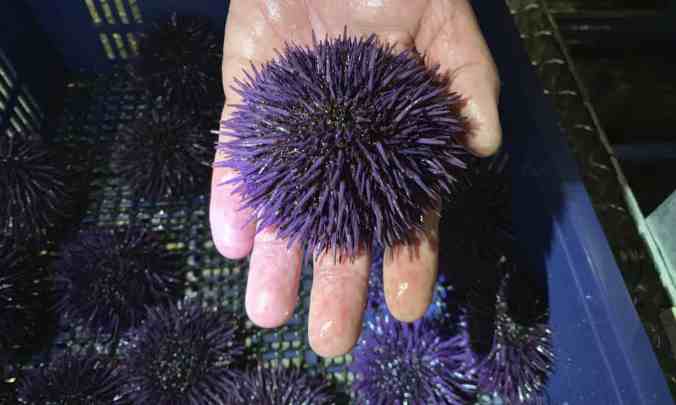
A purple urchin at Bodega Marine Lab in California, which is running a pilot project to remove purple urchins from the ocean floor, restore them to health, then sell them as premium seafood. Photograph: Terry Chea/AP

With invasive species, sometimes the only thing to do with such lemons is make them tasty:

Sea urchin population soars 10,000% in five years, devastating US coastline

Voracious purple urchins in waters of California and Oregon pose threat to kelp forests and risk upending delicate ecosystems

3000k

An aerial view of one of the last remaining kelp forests near Elk, California, on the Mendocino county coast, which has lost more than 90% of its bull kelp in less than a decade. Photograph: Terry Chea/AP

Tens of millions of voracious purple sea urchins that have already chomped their way through towering underwater kelp forests in California are spreading north to Oregon, sending the delicate marine ecosystem off the shore into such disarray that other critical species are starving to death.

A recent count found 350m purple sea urchins on one Oregon reef alone – more than a 10,000% increase since 2014. And in northern California, 90% of the giant bull kelp forests have been devoured by the urchins, perhaps never to return.

Vast “urchin barrens” – stretches of denuded seafloor dotted with nothing but hundreds of the spiny orbs – have spread to coastal Oregon, where kelp forests were once so thick it was impossible to navigate some areas by boat. Continue reading

A Color, Sans-Charisma, Worthy Of A Mission

ochre-hunter-slide-1J1C-jumbo

ochre-hunter-slide-8OK0-superJumbo.jpg

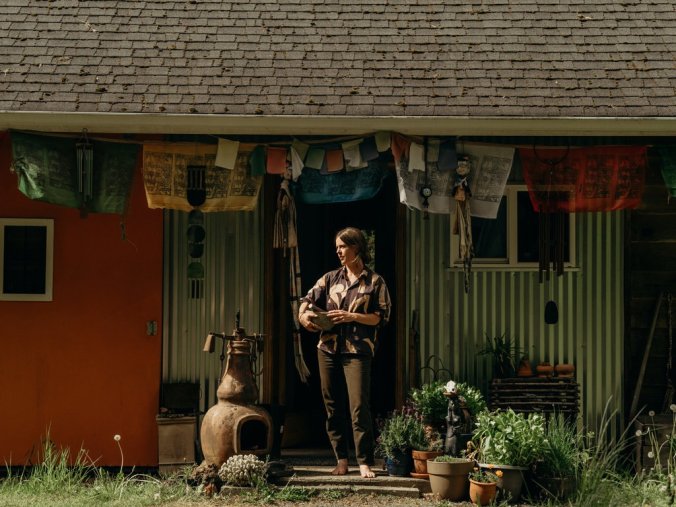
Inside Gustafson’s cabin are shelves lined with samples of ocher and the powdered pigments she makes from them. She likes to keep all processing to a minimum: She hand-grinds specimens with a mortar and pestle and then runs the resulting powder through a sieve. It’s more “personal and connective” that way, she says. Kyle Johnson

In the Pacific northwest of the United States there is a hunter-gatherer renaissance that we have been paying attention to in recent years, if only at our desks. The Willows Inn was the first story we started following, but they continue to come our way, including today. Improbably captivating, this story is about a need to know, and in the process conserve knowhow, about the source of naturally occurring colors that has a history as old as art. Even if some colors are not inherently charismatic (in the eye of the beholder), we take note:

The Woman Archiving the World’s Ochers

At her cabin in the woods of Washington, Heidi Gustafson is creating a many-colored library of one of mankind’s first pigments.
ochre-hunter-slide-7Q3A-jumbo.jpg

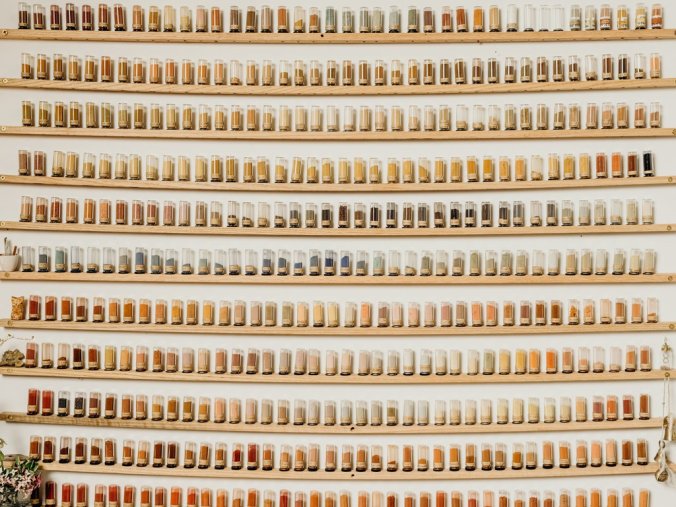
The archive at Gustafson’s cabin comprises over 400 vials of hand-ground ocher, and she doesn’t have an endpoint in mind. “I’ll keep doing it and see where it leads me,” she says. Chantal Anderson
ochre-hunter-slide-UHIP-superJumbo

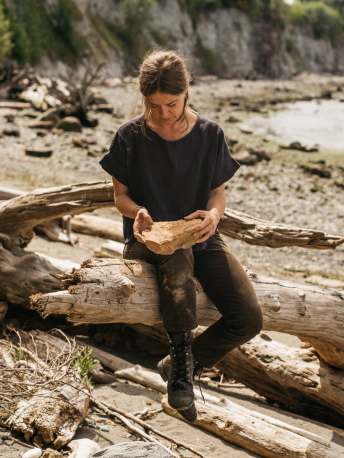
“This piece has a lot less iron in it and a lot more clay,” she says of a shard of rock discovered on the sand. “You can use it right away. It’s like a giant piece of sidewalk chalk.” Kyle Johnson

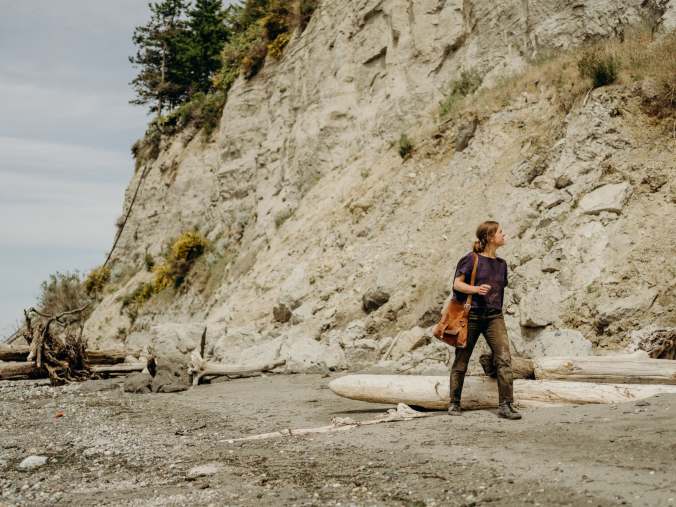
Heidi Gustafson has Whidbey Island’s Double Bluff Beach to herself. But she’s not sunbathing or scanning the waves for whales. Instead, she’s traveled to the northern end of Puget Sound in Washington to crouch, back to the ocean, foraging for ocher at the base of a cliff. Armed with a small magnet and a knife, she stoops low to assess the striations in the rock face, formed by glacial activity hundreds of thousands of years before.

Gustafson considers ocher to be any natural material primarily made up of iron (hence the magnet) that contains oxygen, a definition that she acknowledges is a bit “less strict” than ones used in various scientific communities. Seeking out the material has become, by happenstance, her life’s work.
ochre-hunter-slide-EQBY-superJumbo

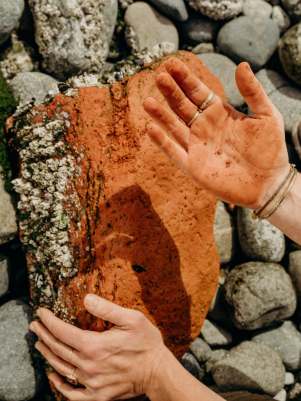
An especially low tide reveals a large piece of barnacle-clad red ocher that came from the nearby cliff. “It’s probably between 150,000 and 200,000 years old,” Gustafson says. She often contacts geologists if she needs help dating ocher from a particular site. Kyle Johnson

For years, she has been engaged in a wide-ranging, multidisciplinary exploration of the mineral: collecting samples all over the Pacific Northwest; grinding shards down into pigments she sells to artists through her website Early Futures; making her own art with ocher pigments; and, at her small cabin near the foothills of the Cascade Mountains, creating an extensive ocher archive to catalog samples she’s gathered along with submissions of the mineral sent in from all over the world. While there has recently been renewed interest in creating paints from natural pigments, Gustafson’s focus is on ocher alone — and it extends beyond the material’s artistic uses to its scientific, symbolic and spiritual properties.
ochre-hunter-slide-PNIO-superJumbo

Heidi Gustafson, who has spent the past five years collecting and working with ocher, walks along Whidbey Island’s Double Bluff Beach, off the coast of Washington, in search of the material. She came to scout this area, where she spent time as a child, after recalling its interesting cliff exposure. The beach is a scenic two-hour drive from her cabin near the foothills of the Cascade Mountains. Kyle Johnson

Her first encounter with the earthy compound began at a less scenic location than Double Bluff Beach: a Safeway parking lot in Oakland, Calif. Several years after earning a B.F.A. in sculpture at the Maryland Institute College of Art, Gustafson moved to the Bay Area to get a masters in philosophy, cosmology and consciousness at the California Institute of Integral Studies. After graduating in 2014, she wasn’t sure what to do. Continue reading

Putting the Reuse back into Recycle

Thanks once again to YaleEnvironment360 for sharing valuable information.

Scientists Find Way to Fully Recycle Plastics Without Losing Quality

A team of Swedish scientists have found a new way to break down plastic so that it can be recycled into material the same quality as the original — a process they say could help shift the focus of the plastics industry to recycling and drastically reduce the amount of pollution that ends up in the world’s oceans.

The technique involves heating discarded plastic to around 850 degrees Celsius until it turns into a gas mixture. That mixture “can then be recycled at the molecular level to become new plastic material of virgin quality,” Henrik Thunman, an environmental scientist at Chalmers University of Technology who led the new research, said in a statement. “Circular use would help give used plastics a true value, and thus an economic impetus for collecting it anywhere on earth.” Continue reading

Feeding Protesters

We were wondering how this worked. Thanks to Dan Hancox and the Economist for showing us how:

How to feed a protest movement: cooking with Extinction Rebellion

A peek inside the “Rebel Kitchen”

Taste the difference A view of Extinction Rebellion’s catering tent in Trafalgar Square, London

Running a kitchen in the middle of a protest camp presents some unusual operational challenges. “We’re cooking most of the hot food offsite at the moment,” says George Coiley, as he leads me past boiling stove-top kettles, catering-sized saucepans and two volunteers preparing a fruit salad of epic proportions. “The police keep taking our stuff…”

This is Coiley’s fourth Extinction Rebellion kitchen. Staffed by a rotating squad of around 30 volunteers, it serves food and hot drinks 24 hours a day to protesters and anyone else who needs it. All the food is vegan or vegetarian and is assembled from donations. Continue reading