Uttarakhand
Uttarakhand
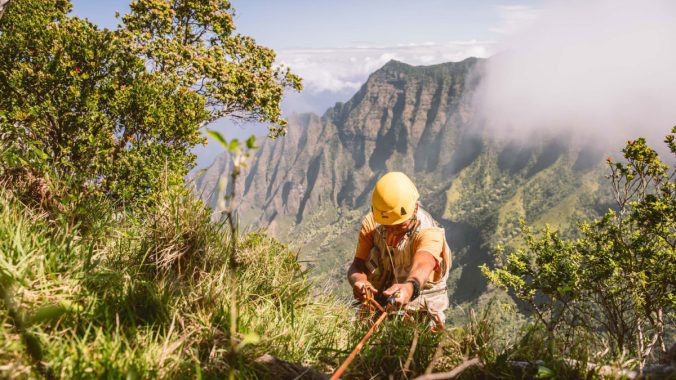
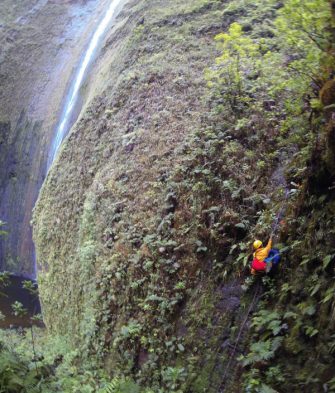
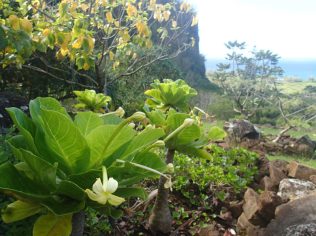
Botanist Steve Perlman rappels into the Kalalau Valley, a biodiversity hotspot on the Hawaiian island of Kauai. COURTESY OF BRYCE JOHNSON/FLUX HAWAII
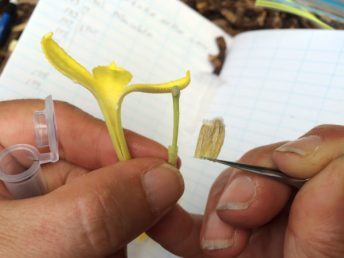
A botanist collects pollen from the flower of Brighamia insignis. NATIONAL TROPICAL BOTANICAL GARDEN
The work described in this article may explain why I first missed the story when it was published in October. The heroics get lost in the delicacy. My attention, like that of many people who are fortunate enough to have plenty of exposure to the natural world, gravitates to megafauna. And next in line for our attention is usually the rest of the fauna. But without flora, none of that fauna would be possible. And so our concern for biodiversity, and perhaps especially for the hotspots of biodiversity, should reflect an equal gravitational pull. So, my thanks to Yale e360 for this story:
Extreme Botany: The Precarious Science of Endangered Rare Plants
They don’t make the headlines the way charismatic animals such as rhinos and elephants do. But there are thousands of critically endangered plants in the world, and a determined group of botanists are ready to go to great lengths to save them.
A scientist with the Plant Extinction Prevention Program climbs through remote Hawaiian ecosystems to study endangered plant species. PEPP
To save plants that can no longer survive on their own, Steve Perlman has bushwhacked through remote valleys, dangled from helicopters, and teetered on the edge of towering sea cliffs. Watching a video of the self-described “extreme botanist” in action is not for the faint-hearted. “Each time I make this journey I’m aware that nature can turn on me,” Perlman says in the video as he battles ocean swells in a kayak to reach the few remaining members of a critically endangered species on a rugged, isolated stretch of Hawaiian coastline. “The ocean could suddenly rise up and dash me against the rocks like a piece of driftwood.”
The plant known as cabbage-on-a-stick (Brighamia insignis) has been grown at Limahuli Garden & Preserve on Kauai, which is within the historic range of the species. SEANA WALSH
When he arrives at his destination, Perlman starts hauling himself up an impossibly steep, razor-sharp cliff 3,000 feet above the sea without a rope, his fingers sending chunks of rock tumbling down to the waters below. Finally, he reaches the plants and painstakingly transfers pollen from the flowers of one to those of another to ensure that the species can perpetuate itself. At the end of the season, he will return to collect any seeds they were able to produce. Continue reading
Reserva Nacional Lomas de Lachay, Peru
The illustrative video above is on its own worth a couple minutes of your time. But the innovative approach to one of the world’s most pressing problems is the thing to take note of. Thanks to National Public Radio (USA) for bringing Evelyn Wang and Omar Yaghi’s work to our attention in this story:
A prototype MOF-based water-collection device is set up for testing on the roof of a building on the MIT campus.
Courtesy Evelyn Yang, MITResearchers have come up with a new way to extract water from thin air. Literally.
This isn’t the first technology that can turn water vapor in the atmosphere into liquid water that people can drink, but researchers from the Massachusetts Institute of Technology and the University of California, Berkeley, say their approach uses less power and works in drier environments. Continue reading
Munnar, Kerala
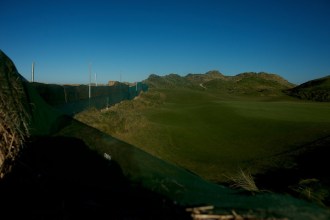
Grass bales intended to prevent erosion, in place last month at the Trump resort in Doonbeg, Ireland. Paulo Nunes dos Santos for The New York Times
I cannot explain why of all the mailing lists in all the world, most of which I opt out of preemptively and nearly all of which I opt out of within a week or two–I have remained on this mailing list since its inception. And this call to action catches my attention enough that I am passing it along. I first heard of this issue from Save the Waves a couple years ago. Then I noticed it in the news late the same year (click the image to the left), and again about a year ago there was this from Save the Waves. Now, one more time before it is too late, here is a copy/paste of the email from this week:
|
||
|

Sustainability in both concept and practice has a long history in Scandinavian cultures in general, and Sweden in particular. As consumers become more conscious of the finite nature of materials, upcycling has to eventually be considered more mainstream. We applaud this type of public and private sector leadership that is the very definition of entrepreneurial conservation.
Thanks to the BBC for this story.
‘Welcome to my high-fashion, trash shopping mall’
Anna Bergstrom had a dilemma. She loved the glitzy world of high fashion, but had also come to feel that it was unsustainable and bad for the planet. She’s now found peace of mind by running a stylish shopping mall in Sweden, where everything is second-hand.
“Do you notice the smell?” Anna Bergstrom says, as she surveys her mall from the mezzanine level. “It smells nice here, doesn’t it?”
It’s very important to Anna that this place is enticing, because she feels it is making a statement. Everything for sale here, in 14 specialist shops covering everything from clothes to DIY tools, is recycled.
She is usually turned off by the smell of second-hand stores, she explains, even though she adores vintage fashion. For most people flea-markets and charity shops carry a stigma, she thinks – a mark left by countless bad experiences. Too often they are worthy but depressing, Anna says. Her mission is to bring second-hand shopping into the mainstream.
The mall itself is spacious and appealing, almost Ikea-like. An art installation – a tree and circular bench all fashioned from recycled materials – greets customers at the entrance. There is even a coffee shop and gift-wrapping service.
The mall is called ReTuna. “Tuna” because that’s the nickname for the city where it is based – Eskilstuna, an hour’s train journey west of Stockholm – and “Re” because the goods on sale have been recycled or repurposed.
It was set up by Eskilstuna’s local government in 2015, in a warehouse which used to house trucks for a logistics company. Continue reading
Marin Headlands, California

Rutabaga tagliatelle, from Olmstead, in Brooklyn.Photograph by Evan Sung
In the interest of cutting back meat consumption, my eye is easily caught these days by pretty shiny things, like the image above, but even more so by rich description, especially when the history of a food is illuminated. This brief history of one root vegetable, accompanied by a couple of beautiful photos, led me to the book below right. Click the book image to go to the source. 
The original is in a collection akin to the one where Seth did his History honors thesis, and akin to the one where some of my doctoral dissertation‘s historic data was sourced (if you are a Cornell geek or library geek scroll upward from the cover page to see the details). Thanks to Helen Rosner once again brilliantly for getting me exploring:
The Swiss botanist Gaspard Bauhin was born in Basel in 1560, and he dedicated his life to obsessively cataloguing the vegetable world. To present-day historians, he’s notable primarily for his botanical thesaurus “Pinax Theatri Botanici” (“An Illustrated Exposition of Plants”), published in 1623. But, among cooks, he’s sometimes recalled for his lesser work, published in 1620: “Prodromos Theatri Botanici” (“Prologue to the Exposition of Plants”), a compendium of flora in which he describes a plant with vivid yellow flowers, a spray of leaves, and massive, hairy roots “more or less similar to those of turnip or carrots.” It was a specimen that had never before appeared in any scientific list of plants: the rutabaga.
The rutabaga is a culinary underdog. It struggles to shine among its fellow root vegetables.Photograph by Matthias Haupt / Picture Press / Redux
The annals of botany abound with claims that Bauhin was not only rutabaga’s biographer but also its inventor: that he found it growing wild and domesticated it; that he was a civic-minded scientist seeking a cold-resistant turnip to feed his chilly countrymen and not (more likely) a monomaniacal scholar who spent his life ensconced in an herbarium, scrivening endless latinate lists of plant names. “The turnip is older than history,” the caption on a color plate in a 1949 issue of National Geographic declares. “The rutabaga almost modern.” In fact, the vegetable has been around at least since ancient-Roman times, when the naturalist Pliny the Elder, writing in the first century, described an edible root “between a radish and a rape”—meaning the plant from which rapeseed oil derives, which is a cultivar of the same species. Bauhin writes that in his time the vegetable was widely grown in “the cold Noric fields of Bohemia,” where it was eaten pickled or mashed and was called simply “root” by its cultivators. Continue reading

Walong, Arunachal Pradesh
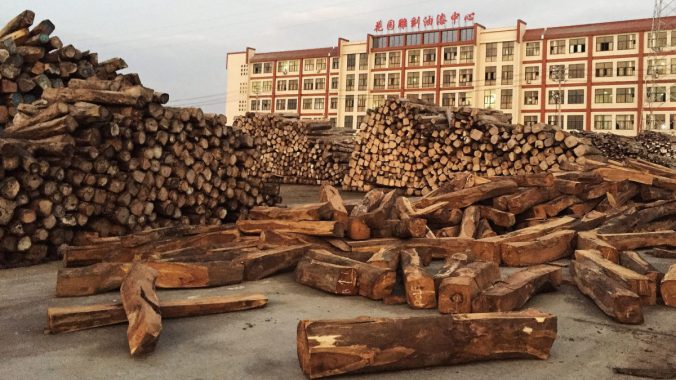
Stacks of rosewood at a timber market in Dongyang, China, a well-known hub for the illegal trade. SANDY ONG
Thanks to Sandy Ong and Edward Carver for this story about a type of tree that is too beautiful for its own good:
The Rosewood Trade: The Illicit Trail from Forest to Furniture
The most widely traded illegal wild product in the world today is rosewood, an endangered hardwood prized for its use in traditional Chinese furniture. An e360investigation follows the trail of destruction and corruption from the forests of Madagascar to furniture showrooms in China.
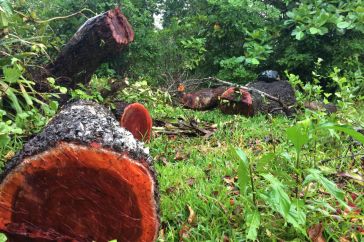
Logged wood on a path near Masoala National Park in northeast Madagascar. The park has been plundered not just of rosewood but many types of tropical hardwood. EDWARD CARVER
Fampotakely, a sandy village in northeast Madagascar, at first seems an unlikely destination for migrants. It has no hospital, no secondary school, no electricity, and limited well water. Yet its population has exploded to 5,000 in recent years. A few of the houses, usually made from dried palm leaves and stalks, now have concrete foundations and solar panels. Fampotakely’s relative wealth is due to its strategic location in the illegal timber trade: it’s downriver from Masoala National Park, home to some of the world’s most valuable rosewood.
Waterways around Fampotakely, Madagascar run blood red from rosewood stored underwater while waiting for ships to transport it to China. EDWARD CARVER
For the last decade, men from all over the region have gone into the park’s dense forests to work as loggers, a job that pays well by local standards. They cut down the massive trees, carve grooves in the logs, and use climbing vines to drag them to the nearest waterway. With rafts made from other felled trees, they use bamboo poles to float the precious hardwood toward Fampotakely and other villages along the Indian Ocean coastline. Continue reading
Bullet Tree, Belize
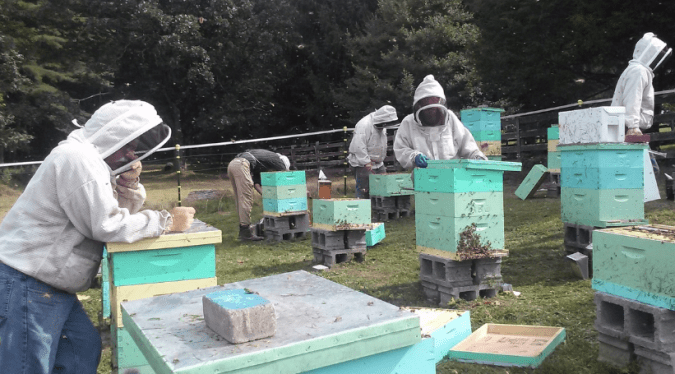
Members of the Appalachian Beekeeping Collective inspect one of their apiaries. The collective trains displaced coal miners in West Virginia on how to keep bees as a way to supplement their income. Courtesy of Kevin Johnson
We never tire of highlighting good news about bees. Thanks to NPR, Jody Helmer, and the Salt for bringing us this to our attention.
Out-Of-Work Appalachian Coal Miners Train As Beekeepers To Earn Extra Cash
Just like his grandfather and father before him, James Scyphers spent almost two decades mining coal in West Virginia.
“These were the best jobs in the area; we depended on ’em,” he recalls.
But mining jobs started disappearing, declining from 132,000 in 1990 to 53,000 in 2018, devastating the area’s economy. In a state that now has the lowest labor-force participation rate in the nation, the long-term decline of coal mining has left West Virginia residents without new options to make a living.
Scyphers was fortunate to find a construction job, but it paid 2/3 less than what he earned underground. He often took odd jobs to make ends meet. One of those odd jobs included building hives and tending bees for the Appalachian Beekeeping Collective.
“I wish this group had been here 30 years ago,” he says. “Our region needs it.” Continue reading
Sattal, Uttarakhand

To help protect the planet and promote good health, people should eat less than 1 ounce of red meat a day and limit poultry and milk, too. That’s according to a new report from some of the top names in nutrition science. People should instead consume more nuts, fruits and vegetables, legumes, and whole grains, the report says. The strict recommended limits on meat are getting pushback. Westend61/Getty Images/Westend61
Preparing ahead for a meal to be cooked today, I was reading this recipe, whose image (below) was competing for my attention with the image above. The picture above is eye-catching, at least to me, a visual cue leading me to the type of meal I should be thinking about more often. It is a big picture picture. I have red lentils in the cupboard, and I intend to prepare them today, so the recipe won the race for my attention.

Melissa Clark’s red lentil soup.CreditJoseph De Leo for The New York Times. Food Stylist: Monica Pierini.
The story by National Public Radio (USA) waited. It is about diet, with the kind of explanatory information that motivates me to find lentils more appealing, and to understand why meals like this should dominate the weekly menu:
What we eat – and how our food is produced – is becoming increasingly politicized.
Why? More people are connecting the dots between diet and health – not just personal health, but also the health of the planet. And the central thesis that has emerged is this: If we eat less meat, it’s better for both.
So, how much less? A new, headline-grabbing report — compiled by some of the top names in nutrition science — has come up with a recommended target: Eat less than half an ounce of red meat per day. That works out to about 3.5 ounces — or a single serving of red meat — per week. And it’s far less red meat than Americans currently consume on average: between an estimated 2 and 3 ounces per day. Continue reading

Mpala Research Center, Kenya
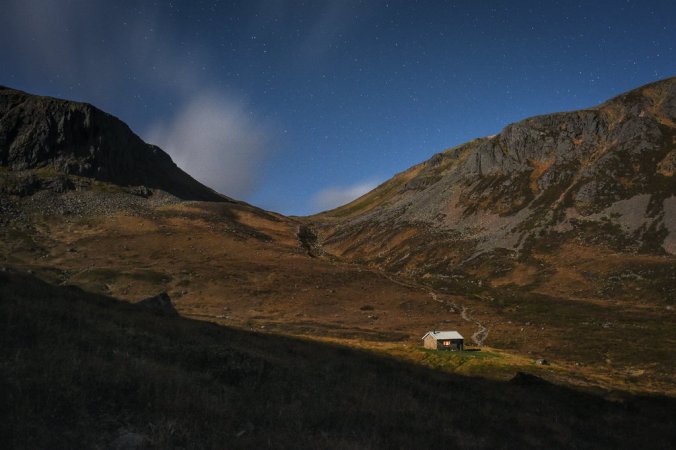
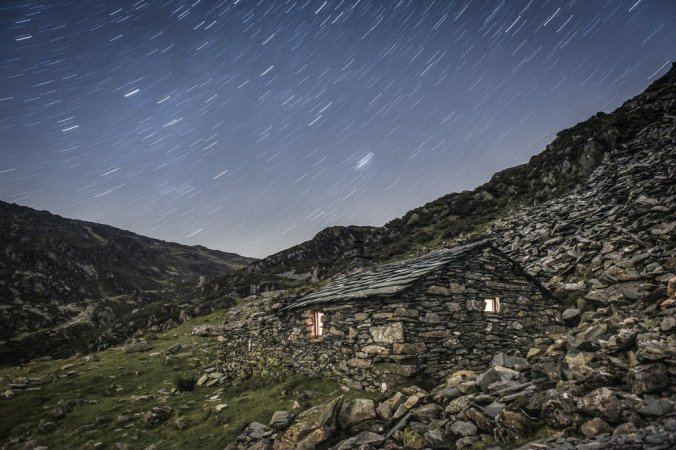
The Hutchison Memorial Hut, colloquially called the Hutchie Hut, illuminated by moonlight in Scotland’s Cairngorms National Park. Stephen Hiltner/The New York Times
How did Stephen Hiltner know? I was just looking through photos from the 2009 edition of the Patagonia Expedition Race, and remembering the huts along the way. They were perfect places to escape the realities of the rest of the world, in order to contemplate more clearly. With perspective. They could come in handy for plenty of folks these days, I am sure. Seems certain to me now that those huts at the southern tip of the South American continent were built by folks from the hills sampled in the story below:
In Britain, Enraptured by the Wild, Lonely and Remote
Rustic shelters called bothies — more than 100 of which are scattered throughout England, Wales and Scotland — are an indispensable, if little-known, element of British hill culture.
Warnscale Head at night. Since bothies are often built with local stones, they’re easily camouflaged in their surrounding landscapes. Stephen Hiltner/The New York Times
Shenavall Stephen Hiltner/The New York Times
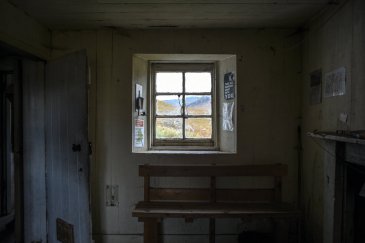
By the time the tiny hut came into view, nestled high in a corrie in Scotland’s 1,748-square-mile Cairngorms National Park, I’d trekked for nearly nine miles, three of which, regrettably, I’d had to navigate after nightfall. The hike, through a broad valley in the Eastern Highlands called Glen Derry, carried me past groves of Scots pines and over a series of streams, some of which, lined with slick steppingstones, made for precarious crossings. All the while, two rows of smooth, eroded mountain peaks enclosed me in an amphitheater of muted colors: hazel-hued heather, golden grasses. Though much of my walk was solitary, the flickering glow in the hut’s main window, I knew, meant I’d have some company for the night and the warmth of a fire to greet me. Continue reading
Baja California Sur, Mexico
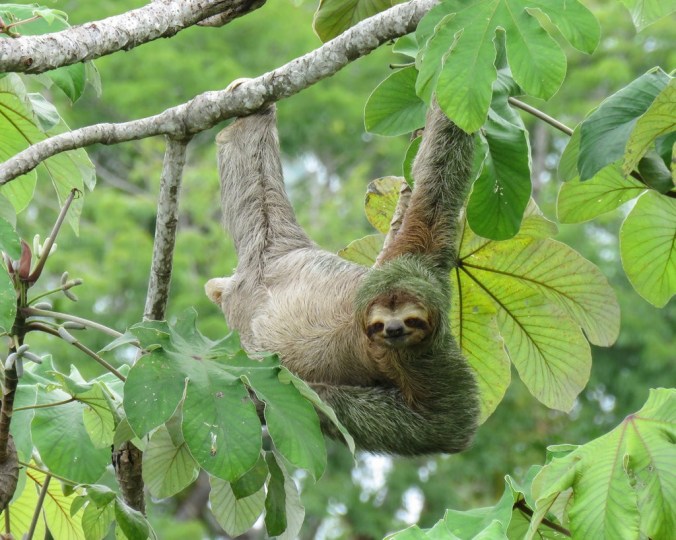
A sloth in Costa Rica. Karen Reyes
I had never heard the name guarumo for this tree before. Cecropia is the name we have commonly heard for it in Costa Rica. Veronique Greenwood, who we have linked to twice until now, has contributed more than vocabulary to me through this article. I am particularly thankful for the realization that cacao can be more useful than I had been aware. Beyond the benefits of being grown organically it may play a key role in regenerative forest development. This, entrepreneurial conservation in mind, must become a variable by which Organikos sources chocolate in Costa Rica:
Where Sloths Find These Branches, Their Family Trees Expand
A study showed that when some animals find a crucial resource, they can survive in changing environments and even thrive.
Look closely up in the trees of a shade-grown cacao plantation in eastern Costa Rica, and you’ll see an array of small furry faces peering back at you. Those are three-toed sloths that make their homes there, clambering ever so slowly into the upper branches to bask in the morning sun. You might also spot them munching on leaves from the guarumo tree, which shades the cacao plants. Continue reading



 Organikos