
St. Simon’s Island, Georgia, USA
St. Simon’s Island, Georgia, USA
Thanks to the Guardian for the latest story in this series. We have avoided adding our voice to the many rightly concerned about the radically pro-extraction, carbon-freewheeling policies of the United States since early 2017. The concern is loud and widespread. We have listened. Today, reading this story, I pictured a naughty boy, a bully, getting away with bad behavior for an extended period. Any period of bad boy behavior is intolerable but it happens. Until it is no longer tolerated. Which eventually always happens. And that may be the best stand-in for optimism these days:
Lost lands? The American wilderness at risk in the Trump era
Exclusive: a new study reveals the vast extent of public lands being opened up to the energy industry. The Guardian heard from three communities on the frontlines
by Charlotte Simmonds, Gloria Dickie and Jen Byers
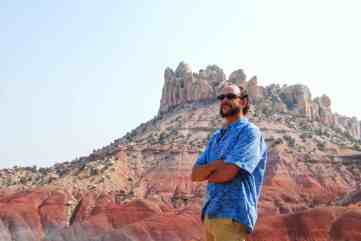
Colter Hoyt, an outdoors guide and conservationist, at Grand Staircase-Escalante. Photograph: Charlotte Simmonds for the Guardian
In the great expanses of the Grand Staircase-Escalante national monument, the silence hits you first. Minutes pass, smooth and unbroken as glass. The smallest sound – a breath of wind, a falling rock – can seem as loud as passing traffic.
Colter Hoyt knows this landscape well. As an outdoor guide, he walks the monument almost daily. Yet these days he is full of fear. This remote paradise of red rocks, slot canyons and towering plateaus faces an uncertain future, following a controversial presidential proclamation that removed 800,000 acres from the monument and opened land up for potential energy development.
When Trump took office in 2016, he promised the energy industry a new era of “American energy dominance”. This would only be possible by exploiting America’s 640m acres of public land: mountains, deserts, forests and sites of Native American history that cover more than a quarter of the country. Continue reading

Mishmi Hills, Arunachal Pradesh

Harvesting soybeans in Mato Grosso, Brazil. Credit Yasuyoshi Chiba/Agence France-Presse — Getty Images
Can We Grow More Food on Less Land? We’ll Have To, a New Study Finds
A farm in the Pays de la Loire region of France. Cows have an especially large environmental footprint. Credit Loic Venance/Agence France-Presse — Getty Images
WASHINGTON — If the world hopes to make meaningful progress on climate change, it won’t be enough for cars and factories to get cleaner. Our cows and wheat fields will have to become radically more efficient, too.
That’s the basic conclusion of a sweeping new study issued Wednesday by the World Resources Institute, an environmental group. The report warns that the world’s agricultural system will need drastic changes in the next few decades in order to feed billions more people without triggering a climate catastrophe.
The challenge is daunting: Agriculture already occupies roughly 40 percent of the world’s land and is responsible for about a quarter of humanity’s greenhouse gas emissions. But with the global population expected to grow from 7.2 billion people today to nearly 10 billion by 2050, and with many millions of people eating more meat as incomes rise, that environmental impact is on pace to expand dramatically. Continue reading
female – Baja California Sur, Mexico
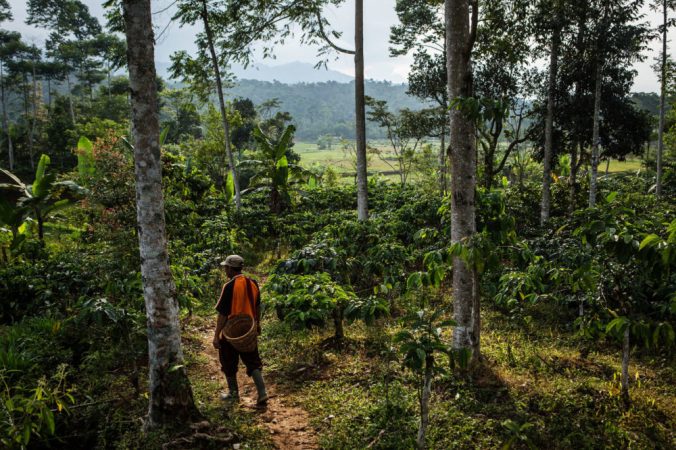
A farmer walks through his coffee plantation, which is integrated into the forest, in Lampung province, Indonesia. ULET IFANSASTI/CIFOR
Our work has required occasional philosophical reflection to get our bearings on the choices we have made on how to approach conservation. Share approaches such as the duck farming mentioned here, or the coffee farming mentioned here are equally as common as the spare approaches in our practice. I had not encountered these two terms until now, so thanks to Fred Pearce for this expansion of my vocabulary:
Sparing vs Sharing: The Great Debate Over How to Protect Nature
What is the best way to save nature – to cordon off areas for parks and open space or to integrate conservation measures on working lands? Recent research makes a case for each of these approaches and has reignited a long-standing debate among scientists and conservationists.
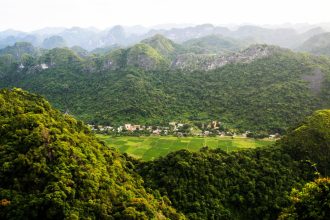
A farming village surrounded by undeveloped forests in the province of Quang Ninh, Vietnam. TERRY SUNDERLAND/CIFOR
It is one of the biggest questions in conservation: Should we be sharing our landscapes with nature by reviving small woodlands and adopting small-scale eco-friendly farming? Or should we instead be sparing large tracts of land for nature’s exclusive use – by creating more national parks and industrializing agriculture on existing farmland?
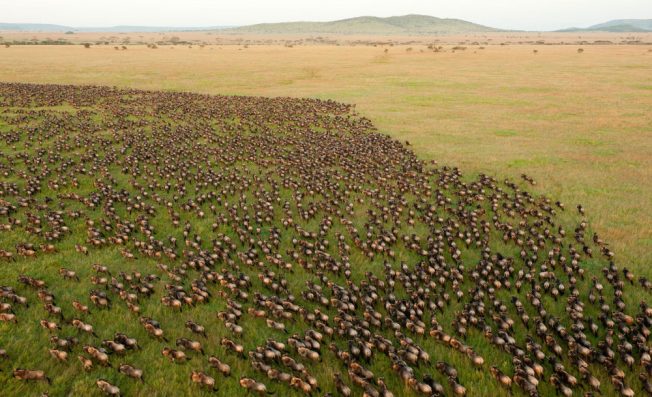
More than 1.5 million wildebeest migrate annually across Tanzania’s Serengeti National Park, which covers 5,700 square miles. DANIEL ROSENGREN / WIKIMEDIA
The argument between “sparing” and “sharing” as a conservation tool has been raging since researchers first coined the terms more than a decade ago. Arguably it began almost half a century before when Norman Borlaug, the father of the Green Revolution of high-yielding crop varieties, declared that “by producing more food per unit of cultivated area, more land would be available for other uses, including recreation and wildlife.”
LUISA RIVERA FOR YALE E360
E.O. Wilson’s 2016 book Half-Earth upped the ante by calling for us to extend protected areas from the current 15 percent of the earth’s land surface to 50 percent. Research studies and critiques have flourished on both sides. Continue reading
male – Baja California Sur, Mexico
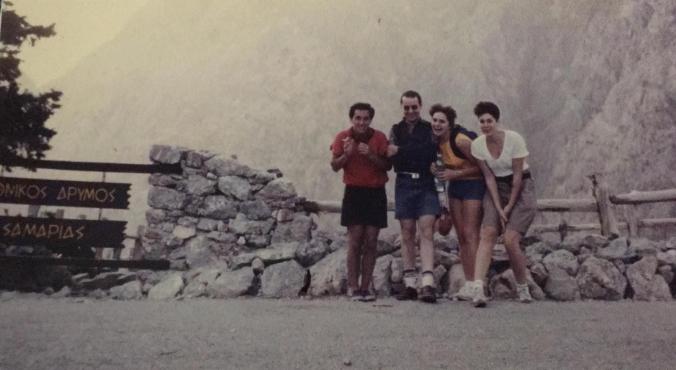
After writing yesterday’s post I got a message from the “new friend.” She is the one on the right in the photo above. I am the one on the left. My two childhood friends are in the middle. The new friend’s name, Amie, will be familiar to regular readers on this platform. After reading my post yesterday she sent me these three old photos. Above is at the top of the gorge, just as the sun is coming over the mountain. Dawn’s rosy tipped finger, someone among us surely said. By late morning, time for a fruit break, below is the place where I might have started thinking of stacking stones, in the figurative sense of wishing something of the future. But I did not then, nor do I now, believe in totemic powers of objects, or good luck.
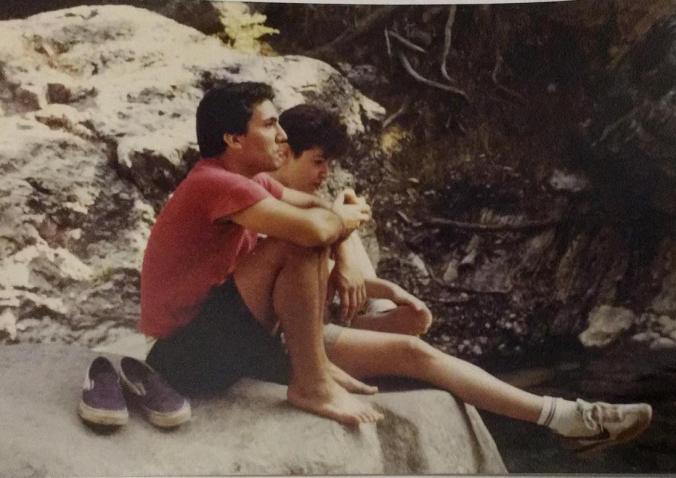
I believed that a new friendship was sufficient good fortune, and being in that natural setting was the closest I got to worshiping things.
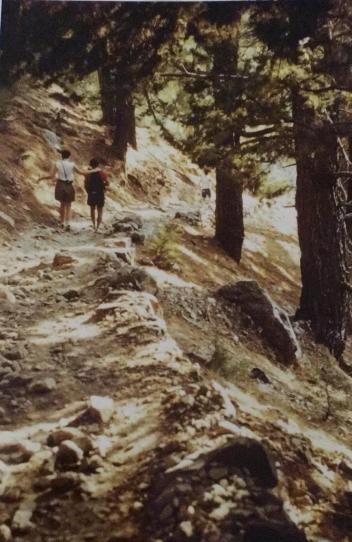 No need to stack stones. As we made our way down to the bottom of the gorge, to where those sky-high rock walls allowed single file passage to the black stone beach, conversation was the thing.
The black stones were a surprise because they seemed to bear no relationship with the geology of the gorge. And I do remember now, playing with the stones, and surely stacking them while we sat there looking out to the sea, continuing the conversation. But I was not stacking stones in the way Sophie Haigney’s story refers to.
Really. I can say that with confidence because Amie reminds me that the oblong oval-shaped stones were not stackable. So I tried my best, but could not get one to rest upon another. That said, I am also confident that while not superstitious I was still able to make wishes, and then take actions to fulfill them.
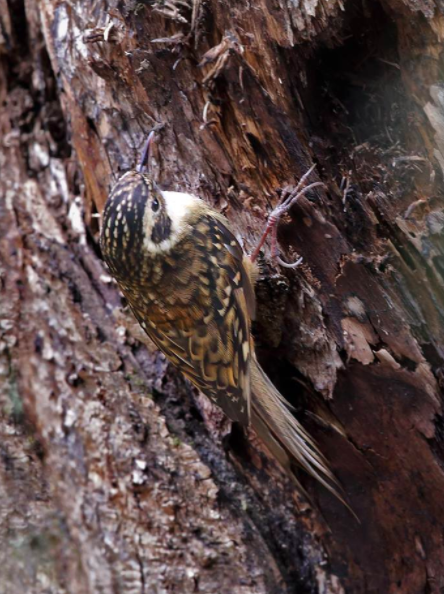
Mandala, Arunachal Pradesh
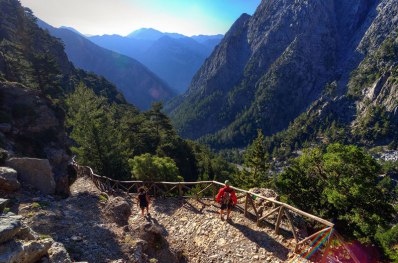
The steep downhill path starting from Xyloskalo
If I have done it, it would have been once. And hopefully less of an issue than the examples given in this story below. It was a day in September, 1983 and I had traveled to Greece with two childhood friends, all of us now in early adulthood.
With us was one new friend, who we had met in JFK airport just prior to departure.
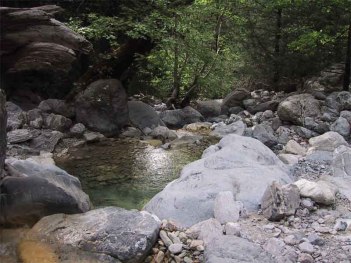
The peaceful river crossing Samaria Gorge
On the island of Crete, we left Xania well before sunrise to hike from the top to the bottom of Samaria Gorge, as far south in Greece as you can get and still be on land. With every switchback of our descent, I was getting more and more lost in conversation with our new friend, so that by the time we reached the bottom of the gorge I wondered where the day had gone. After a full day of hiking, lost in conversation or otherwise, the stones of the gorge play on your mind.
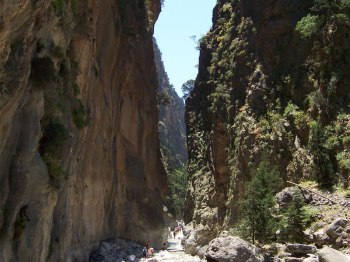
The impressive Portes in Samaria Gorge
At this point you pass through one last formation that is so stunning that if you had not been thinking of playing with stones until now, you had not been paying enough attention. And that was my case. I remember walking silently through this last section and not talking again until the very end, when you spill onto a beach formed by smooth black stones, facing south, nothing but water until you reach Africa. There, in Agia Roumeli, you can get a cool drink before a boat takes you back to Xania. And while you wait for the boat, if you have something to wish for, you may find yourself stacking those smooth black stones.
My photographs from that day, somewhere in storage, would show the beginning, long middle sections, and end of that day. If I did stack stones the evidence will be in those photos, and I will find them. For now I have linked to photos from the blog of a Cretan travel consortium to give a hint of what the place looks like, and as a recommendation to others to visit. Sophie Haigney, writing on the New Yorker website, gave me reason just now to think about my own culpability in what can now be described as a dangerous, destructive form of travel footprint, and I thank her for bringing this to our attention:
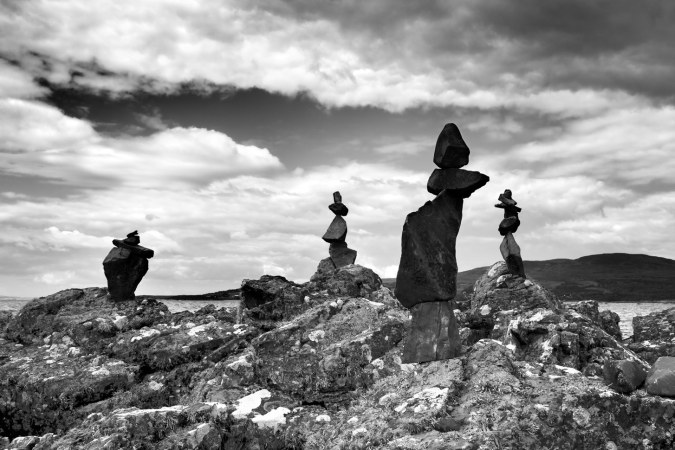
An Instagram trend that’s littering national parks with towers of carefully balanced stones, #StoneStacking can cause erosion and damage ecosystems. Photograph by Sam Oakes / Alamy
People Are Stacking Too Many Stones
The photograph in the Facebook post is pretty: piles of red rocks balanced at the edge of a cliff, suggesting a miniature mirror of the jagged rock face opposite. The stacks look like small shrines to mountain solitude, carefully balanced at the edge of a precipice. But when Zion National Park posted the photo, in September, the social-media coördinators for the park included a plea: “Please, enjoy the park but leave rocks and all natural objects in place.” The post noted the “curious but destructive practice” of building small stone towers, and said, “stacking up stones is simply vandalism.” Continue reading
Sydney, New South Wales, Australia
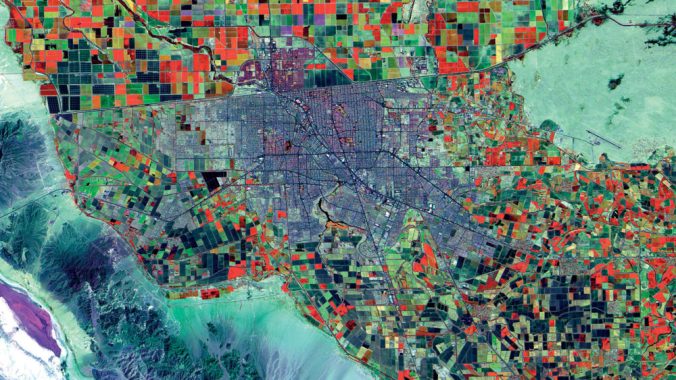
The U.S.-Mexico border separating Calexico, California, and Mexicali, Mexico.
Katherine Bagley, Managing Editor at Yale Environment 360 (Yale e360, one of our go-to sources on this platform), has this to say:
From High Above, A New Way of Seeing Our Urban Planet
The world’s cities are expected to grow by another 2.5 billion people by 2050. A new collection of satellite images starkly illustrates the sheer size and imprint of the world’s urban centers and their vulnerability in the face of population growth and climate change.
February 10, 1977. Population 43,000. LANDSAT OLI/TIRS
Driven by rapid economic expansion and global trade, the world’s urban population has more than quintupled since the mid-20th century, from 751 million people in 1950 to 4.2 billion today. Centuries-old cities have pushed upward and outward to accommodate the influx of people, and entirely new megacities, home to tens of millions, have sprung up.
February 7, 2016. Population 10.8 million. LANDSAT OLI/TIRS
Nowhere can this swift urban growth be seen as vividly as from space. In their new book City Unseen, geographers Karen C. Seto and Meredith Reba, experts in urbanization and global change, offer a collection of satellite images from all seven continents that exhibit the massive imprint these cities have on the landscapes around them.
“If you look at images of Las Vegas and Lagos and Shenzhen, you see how much land it takes to house billions people, and it’s astonishing,” Seto, a professor of geography and urbanization science at the Yale School of Forestry & Environmental Studies, says. “But the impact of urbanization is not only the direct land these people live on. It’s all these other non-urban places where we need to extract resources to house and electrify, to operate these cities. That’s part of the story too.” Continue reading

Point Calimere Wildlife and Bird Sanctuary, Tamil Nadu

E.ON’s Rampion windfarm in the English Channel, which can power 350,000 homes. Photograph: Darren Cool/E.On/PA
Thanks to Adam Vaughan and the Guardian for this news:
Windy weather carries Britain to renewable energy record
Windfarms supplied third of UK’s electricity this week, with output hitting 14.9GW high
Storm Diana brought travel chaos to road, rail and airports, but the clouds did have a silver lining: the strong winds helped set a renewable energy record.
Windfarms supplied about a third of the UK’s electricity between 6pm and 6.30pm on Wednesday, a time of peak energy demand. Output hit a high of 14.9GW, beating a previous record of 14.5GW. Continue reading
female – Estero San José, Baja California Sur, Mexico

A collection of Kanji Hama’s beautifully hand-patterned and indigo-dyed fabrics along with tools of the craft. Credit Photograph by Kyoko Hamada. Styled by Theresa Rivera. Photographer’s assistant: Garrett Milanovich. Styling assistant: Sarice Olson. Indigo pieces courtesy of Kanji Hama
Two stories today about textile and tradition, the first more in keeping with our norm, but both heavy on the blues:
How a Japanese Craftsman Lives by the Consuming Art of Indigo Dyeing
There are some traditions that are universal. Here, we highlight a single craft — and how it’s being adapted, rethought and remade for the 21st century.
KANJI HAMA, 69, has quietly dedicated his life to maintaining the traditional Japanese craft of katazome: stencil-printed indigo-dyed kimonos made according to the manner and style of the Edo period. He works alone seven days a week from his home in Matsumoto, Nagano, keeping indigo fermentation vats brewing in his backyard and cutting highly detailed patterns into handmade paper hardened with persimmon tannins to create designs for a craft for which there is virtually no market. Nearly identical-looking garments can be had for a pittance at any souvenir store.
Indigo is one of a handful of blue dyes found in nature, and it’s surprising that it was ever discovered at all, as the plants that yield it reveal no hint of the secret they hold…
The story from Japan is about maintaining traditional craft and the story about flannel is about industrial renaissance.
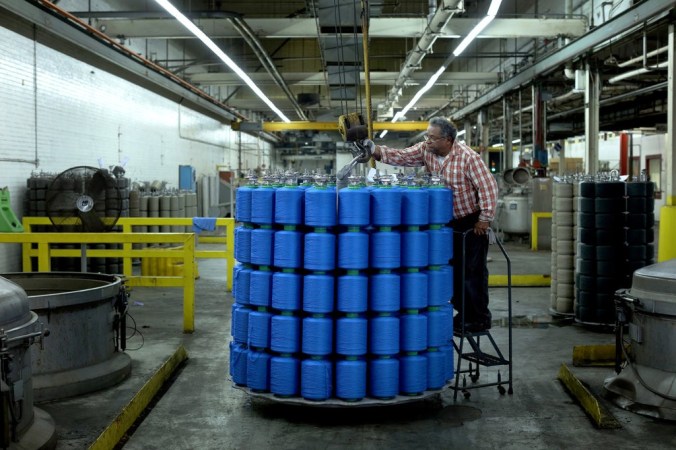
Blue state: Charlie Richmond pulls yarn from a dyeing machine on the floor of the Burlington Manufacturing Services plant in Burlington, N.C. Credit Travis Dove for The New York Times
I am not partial to either story. They make fascinating bookends:
The Annals of Flannel
Told that the cozy shirting fabric could no longer be made in America, one man began a yearlong quest.
An American Giant flannel shirt. Credit Travis Dove for The New York Times
Three years ago, Bayard Winthrop, the chief executive and founder of the clothing brand American Giant, started thinking about a flannel shirt he wore as a kid in the 1970s. It was blue plaid and bought for him by his grandmother, probably at Caldor, a discount department store popular in the northeast back then. The flannel was one of the first pieces of clothing Mr. Winthrop owned that suggested a personality.
“I thought it looked great,” he said, “and I thought it said something about me. That I was cool and physical and capable and outdoorsy.”…
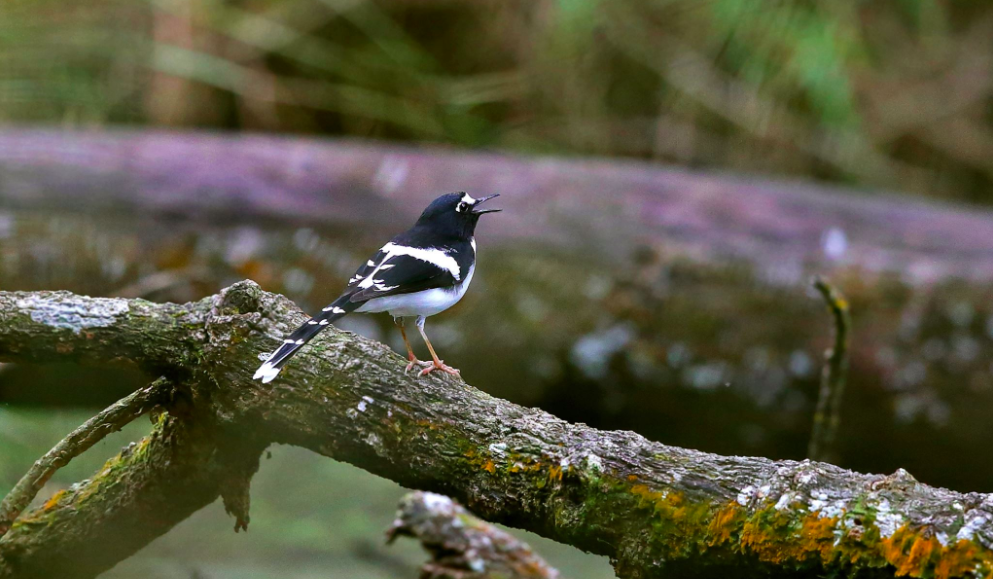
Dehing Patkai Wildlife Sanctuary, Assam
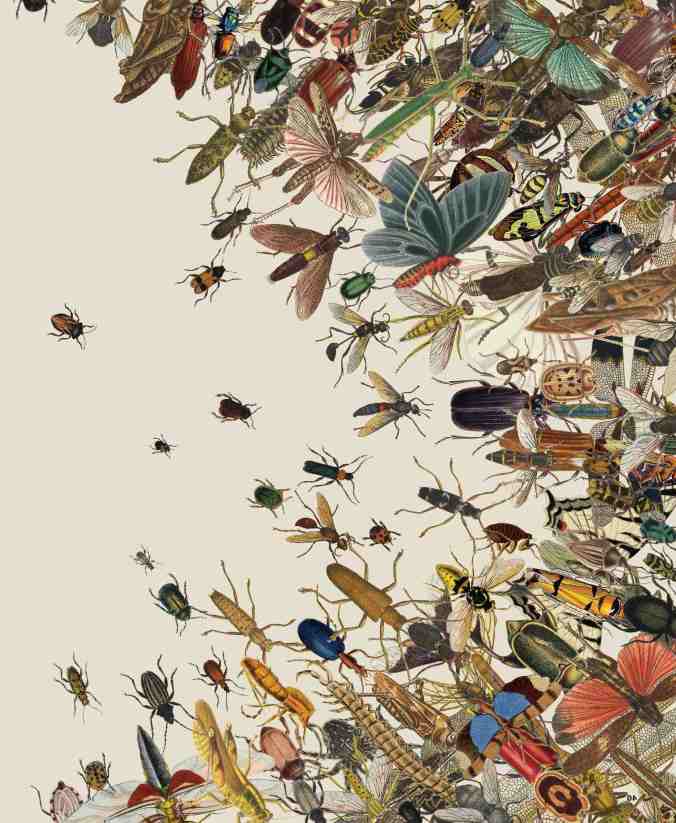
Photo illustrations by Matt Dorfman. Source photographs: Bridgeman Images.
Brooke Jarvis has written a longform feature article with the word apocalypse in the title, which may make you wince and turn away. As might the word insect, even if you find the illustration above mesmerizing as I do. And reading to the end is an investment in time. But do not turn away just because the illustration below is alarming. It is another alarming topic we are responsible for taking account of.
Sune Boye Riis was on a bike ride with his youngest son, enjoying the sun slanting over the fields and woodlands near their home north of Copenhagen, when it suddenly occurred to him that something about the experience was amiss. Specifically, something was missing.
It was summer. He was out in the country, moving fast. But strangely, he wasn’t eating any bugs.
For a moment, Riis was transported to his childhood on the Danish island of Lolland, in the Baltic Sea. Back then, summer bike rides meant closing his mouth to cruise through thick clouds of insects, but inevitably he swallowed some anyway. When his parents took him driving, he remembered, the car’s windshield was frequently so smeared with insect carcasses that you almost couldn’t see through it. But all that seemed distant now. He couldn’t recall the last time he needed to wash bugs from his windshield; he even wondered, vaguely, whether car manufacturers had invented some fancy new coating to keep off insects. But this absence, he now realized with some alarm, seemed to be all around him. Where had all those insects gone? And when? And why hadn’t he noticed? Continue reading
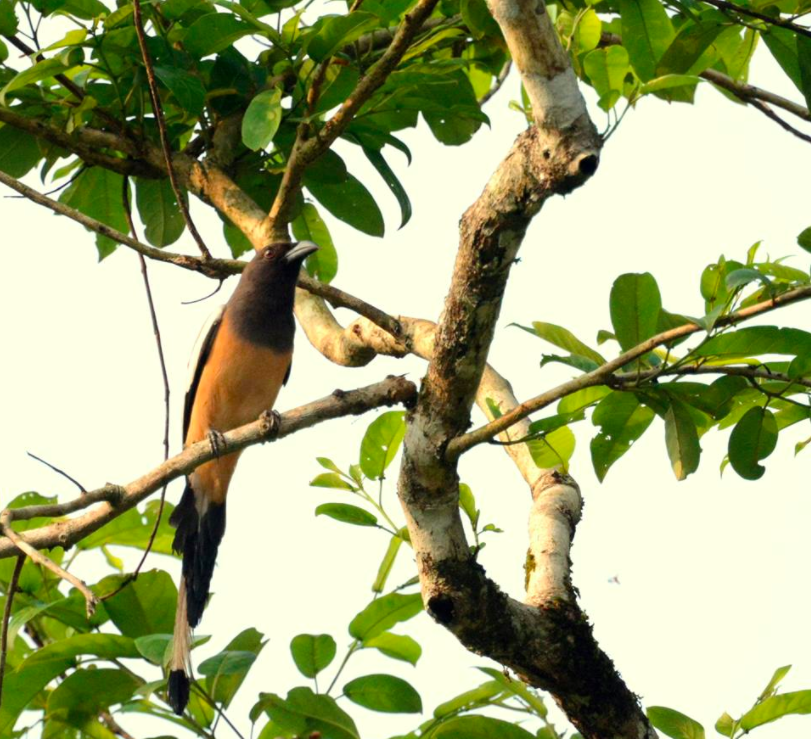
Thattekad Bird Sancturary, Kerala

A direct air capture facility in Zurich, created by the Swiss-based technology company ClimeWorks. JULIA DUNLOP / CLIMEWORKS
I was not aware that Elizabeth Kolbert has been writing for Yale e360 for the entire time we have been linking to her New Yorker work on this platform. And then some, because she started publishing there ten years ago. This is her 17th publication for Yale e360 and it can help a layperson understand in a relatively short read whether technology has any chance of accelerating our progress on climate change mitigation:
Climate Solutions: Is It Feasible to Remove Enough CO2 from the Air?
A U.S. scientific panel reports that technologies that take CO2 out of the atmosphere could be a significant part of a strategy to mitigate global warming. In an e360 interview, Stephen Pacala, the panel’s chairman, discusses how these fast-developing technologies are becoming increasingly viable.
Is there still time to avoid runaway climate change? To a large degree, the answer depends on the feasibility of “negative emissions” — techniques or technologies that suck CO2 out of the air. In the latest report from the Intergovernmental Panel on Climate Change (IPCC), all scenarios for limiting warming to 1.5 degrees Celsius depend on negative emissions technologies, or NETs. Most 2-degree scenarios also rely on negative emissions; many call for removing billions of tons of CO2 per year by mid-century.
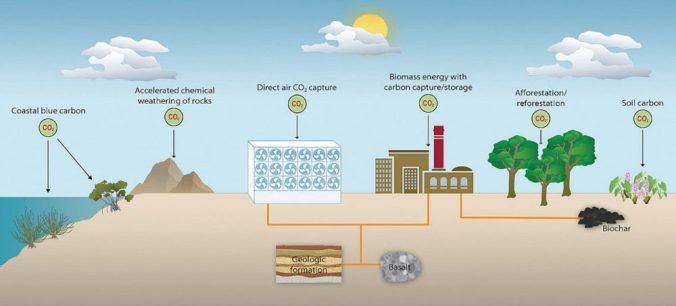
Negative Emissions Technologies (NETs) range from low-tech, such as planting more trees, to more high-tech options, such as developing machines to scrub CO2 from the air. NATIONAL ACADEMY OF SCIENCES, 2018
Yet most NETs remain either untested or unproved. To help bridge this gap, the National Academies convened a panel of scientists and asked it to propose a research agenda. The panel considered several possible techniques, ranging from the low-tech — planting more trees — to the high-tech — developing machines to scrub CO2 from the sky. It also looked at a hybrid technology that has become known as bioenergy with carbon capture and storage, or BECCS. The panel recommended several billion dollars be directed to research on NETs. Such technologies, it suggested, ought to be viewed as a “component of the mitigation portfolio,” rather than as a futuristic, last-ditch effort to reduce atmospheric CO2.
Stephen Pacala. CREDIT: ISOMETRIC STUDIOS
Stephen Pacala, a professor of ecology and evolutionary biology at Princeton University, chaired the panel. In an interview with Yale Environment 360, he talks about why NETs are needed, what should be done to advance them, and why he believes that “direct air capture” technologies could come into widespread use within the next decade. Continue reading






 Organikos