
Bangalore, Karnataka
Bangalore, Karnataka
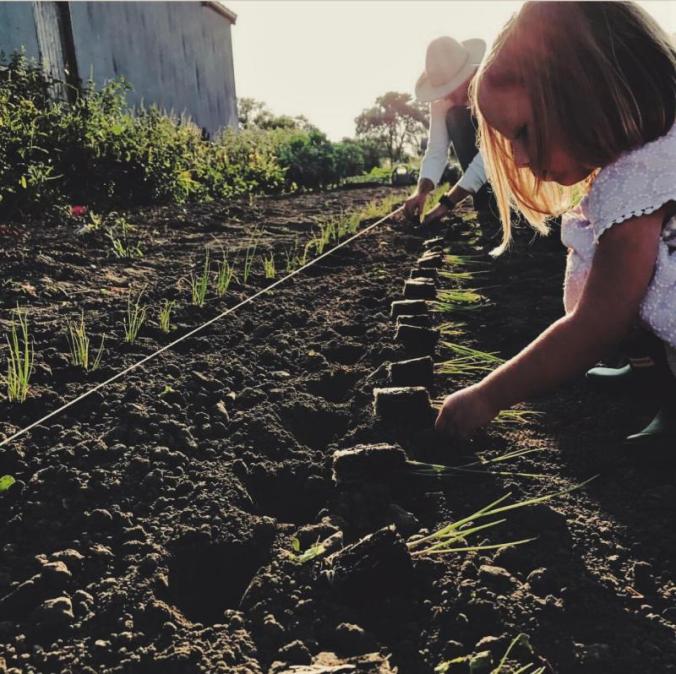
Four-year-old Emma is already helping out at Field and Farm Co., doing things like transplanting onions. SNARE FAMILY / FIELD AND FARM CO.
Thanks to Madelyn Beck:
Handing Off: The Reality Of Land Transfer Between Older, Younger Farmers
This farm near Springfield, Illinois, has been in the Curry family since 1886, though Kim Curry only moved there in 2008 when her father was dying of cancer. She, her sister and her niece grow and sell pigs, piglets, chickens and cows.
CREDIT MADELYN BECK / HARVEST PUBLIC MEDIAAs life expectancy increases, farmers are staying in the business, but there’s still a need to plan for what happens when they die. At the same time, young farmers who come from non-farming backgrounds are looking for the space to grow their own careers.
A land transfer may seem simple, but challenges abound: How do retiring farmers connect with beginning farmers? When does a farmer confront death? How can smaller farm organizations fit into the ever-growing 1,000-acre farm scene?
Formerly a biochemist in Michigan, Curry now works in disability claims for the state of Illinois on top of helping run the family farm. She said dinnertime often comes late, about 8 or 8:30 p.m.
CREDIT MADELYN BECK / HARVEST PUBLIC MEDIAPast the likeness of Western movie icon John Wayne etched in stone, a ways down North John Wayne Road and at the end of a long dirt driveway is Kim Curry’s place. A few of the farm’s seven dogs meander up to the gate to bark at anyone who pulls up, while chickens and occasional escapee piglet scrounge for food around the yard.
The Curry Family Farm is near Springfield, Illinois, but unlike most of that area, it has green, rolling hills, a few creeks and a few ponds. It’s been in the family since 1886.
“It’s just so restful and relaxing out here. We’ll have to show you the pigs,” Curry said. “They’re all eating.”
The 59-year-old lives there with her sister and niece, but the three of them can’t keep up with it all, especially because she has a full-time state job working with disability claims.
So, she is selling about 80 acres, which she said “really has potential with someone with younger, more energy.”
And that’s where it gets tricky for people trying to offload land in Illinois, which doesn’t have an online system like several other states — Iowa, Nebraska and Montana, for example — that specifically links older farmers with newer ones looking for land.
Jekyll Island, Georgia, USA

Botanist Steve Perlman rappels into the Kalalau Valley, a biodiversity hotspot on the Hawaiian island of Kauai. COURTESY OF BRYCE JOHNSON/FLUX HAWAII
Thanks to Janet Marinelli and the team at Yale e360 for a reminder that charisma is not all that matters in decisions about conservation:
Extreme Botany: The Precarious Science of Endangered Rare Plants
They don’t make the headlines the way charismatic animals such as rhinos and elephants do. But there are thousands of critically endangered plants in the world, and a determined group of botanists are ready to go to great lengths to save them.
The plant known as cabbage-on-a-stick (Brighamia insignis) has been grown at Limahuli Garden & Preserve on Kauai, which is within the historic range of the species. SEANA WALSH
To save plants that can no longer survive on their own, Steve Perlman has bushwhacked through remote valleys, dangled from helicopters, and teetered on the edge of towering sea cliffs. Watching a video of the self-described “extreme botanist” in action is not for the faint-hearted. “Each time I make this journey I’m aware that nature can turn on me,” Perlman says in the video as he battles ocean swells in a kayak to reach the few remaining members of a critically endangered species on a rugged, isolated stretch of Hawaiian coastline. “The ocean could suddenly rise up and dash me against the rocks like a piece of driftwood.”
A botanist collects pollen from the flower of Brighamia insignis. NATIONAL TROPICAL BOTANICAL GARDEN
When he arrives at his destination, Perlman starts hauling himself up an impossibly steep, razor-sharp cliff 3,000 feet above the sea without a rope, his fingers sending chunks of rock tumbling down to the waters below. Finally, he reaches the plants and painstakingly transfers pollen from the flowers of one to those of another to ensure that the species can perpetuate itself. At the end of the season, he will return to collect any seeds they were able to produce. Continue reading

Baja California Sur, Mexico
This is more science-y than is our custom, but Nature magazine has been appreciated on this platform as a source of intriguing findings about creatures from time to time, so here goes:
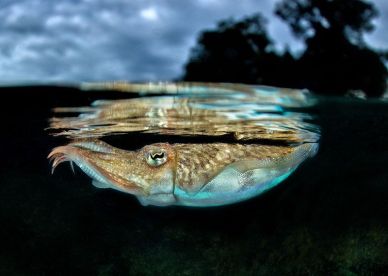
Cuttlefish wear their thoughts on their skin
Elaborate video system tracks how pigment cells controlled by neurons generate complex patterns of camouflage.
Cuttlefish are masters of quick-change camouflage, thanks to skin cells that act as coloured pixels. Credit: Pasquale Vassallo/Getty
Cuttlefish are masters at altering their appearance to blend into their surroundings. But the cephalopods can no longer hide their inner thoughts, thanks to a technique that infers a cuttlefish’s brain activity by tracking the ever-changing patterns on its skin. The findings, published in Nature on 17 October1, could help researchers to better understand how the brain controls behaviour.
The cuttlefish (Sepia officinalis) camouflages itself by contracting the muscles around tiny, coloured skin cells called chromatophores. The cells come in several colours and act as pixels across the cuttlefish’s body, changing their size to alter the pattern on the animal’s skin.
The cuttlefish doesn’t always conjure up an exact match for its background. It can also blanket itself in stripes, rings, mottles or other complex patterns to make itself less noticeable to predators. “On any background, especially a coral reef, it can’t look like a thousand things,” says Roger Hanlon, a cephalopod biologist at the Marine Biological Laboratory in Woods Hole, Massachusetts. “Camouflage is about deceiving the visual system.” Continue reading

San Gerardo de Dota, Costa Rica
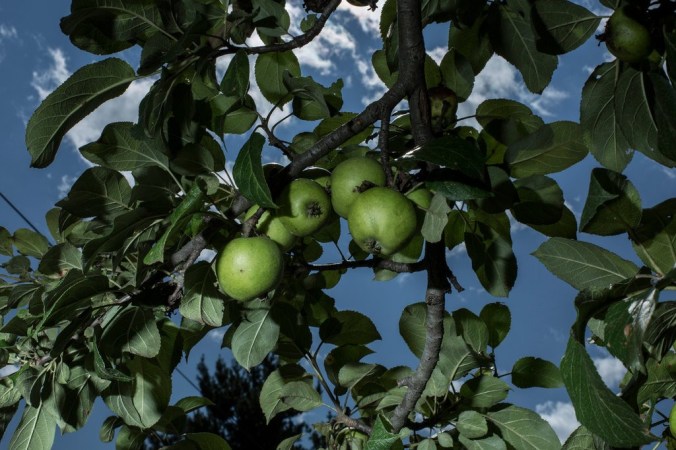
The Harrison apple tree that Thomas Vilardi found near Newark in the fall of 2015. “I knew I had seen apples on a tree,” he said. “I wasn’t expecting to find a Harrison.” Credit Bryan Anselm for The New York Times
Thanks for this article to Rachel Wharton, who is batting 1000 for our taste in food writing:
Finding Lost Apples and Reviving a Beloved Cider
George Washington was among the many fans of Newark cider, a long-missing treat now being recreated by a former ad man on a mission.
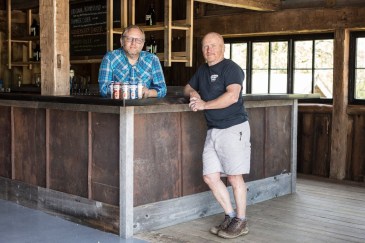
Charles Rosen, left, and Cameron Stark in the new taproom they opened last week at Ironbound Hard Cider in Asbury, N.J. It will serve limited-edition ciders made by Mr. Stark, the head cider maker.CreditBryan Anselm for The New York Times
ASBURY, N.J. — Ironbound Hard Cider may seem an odd name for the business Charles Rosen has built here on 108 acres in central New Jersey. The farm, where a new taproom offers pastoral views of the still-ripening fruit, doesn’t appear to share much with the Ironbound, an industrial neighborhood 50 miles to the east in Newark.
Yet they do have common roots, thanks to four very old apple varieties now growing on Mr. Rosen’s land.
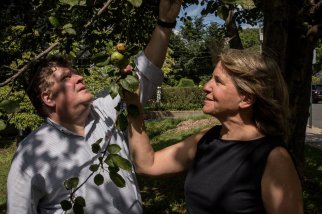
Mr. Vilardi and Fran McManus at the old apple tree he found three years ago. An apple expert connected him to Ms. McManus, who had written an article about Newark cider in 2010. Credit Bryan Anselm for The New York Times
Mr. Rosen, the former chief executive of a Manhattan advertising agency that promoted Svedka vodka and Mike’s Hard Lemonade, wants to reintroduce Newark cider, an 18th- and 19th-century alcoholic drink once famously compared to Champagne.
Newark cider was both a point of pride and big business for the region — requested by name, reportedly lauded by George Washington and produced by dozens of Newark-area cideries with acres of orchards. The secret wasn’t a recipe, but the blending of a quartet of superior apples born in the region: Campfield, Poveshon, Granniwinkle and Harrison, the most celebrated of the four.
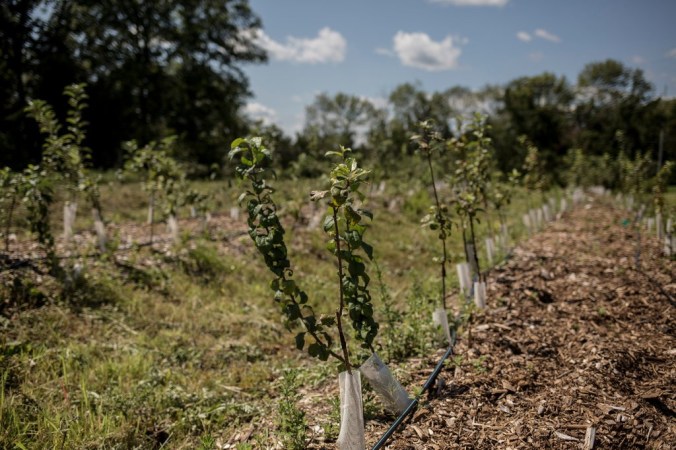
The 1- and 2-year-old apple trees in Ironbound Hard Cider’s nursery include the Harrisons shown here and Poveshons, a New Jersey-born variety thought to be extinct until 2015. Credit Bryan Anselm for The New York Times
As a result of urbanization and then Prohibition, when many of the nation’s remaining cider orchards were destroyed, Newark cider hasn’t been made for at least a century. But after years of planning and planting — not to mention the accidental discovery of two lost apple trees and the investment of what Mr. Rosen called “100 percent of all the money I ever had in my entire life” — Ironbound Hard Cider is on the precipice of bringing it back. Continue reading
Gallon Jug Estates, Belize

In a village near Watamu, Kenya, a sea turtle accidentally caught by a fisherman was turned over to Local Ocean Conservation. Credit Amy Yee
These creatures have been around forever, more or less. Survived everything that nature threw at them over the epochs. Until mankind and its addiction to plastic. And now it is clear their days are numbered, so any initiative anywhere that tries to slow the clock and keep the species going, we are happy to hear about it and share on this platform. Thanks to Amy Yee for bringing this to our attention:
Rescuing Sea Turtles From Fishermen’s Nets
An organization on the coast of Kenya tries to persuade local residents to help return the trapped reptiles to the ocean, rather than sell their meat and shells for a living.
A green sea turtle trapped in a gill net. Scientists estimate the global green turtle population has declined 50 to 70 percent since 1900. Credit Jeff Rotman/Science Source
WATAMU, Kenya — The young hawksbill turtle was accidentally caught in a net in the Indian Ocean off Kenya’s coast.
The fisherman called Local Ocean Conservation, a nonprofit based in the town of Watamu that is the only turtle rescue and rehabilitation center on the East African seaboard. The hawksbill, critically endangered in this region, was a mere seven pounds; adults can weigh up to 160 pounds.
X-rays showed that the reptile’s intestinal tract was clogged with plastic. Hogaar, as Local Ocean named her, floated and couldn’t dive. Gas had built up in her innards after she had eaten small pieces of plastic mistaken for food such as jellyfish. Local Ocean staff members placed Hogaar in a rehab pool and gave her laxatives. She passed feces laced with shreds of packaging and had little appetite. After more than four months at Local Ocean, Hogaar died. A necropsy revealed her gut was also full of sharp shards of white, blue and pink plastic and tangles of blue and gray string.
Turtles are reptiles that have existed for at least 110 million years and survived the mass extinction that killed off dinosaurs. But today, sea turtles worldwide are threatened with extinction. And it’s estimated that only one of 1,000 turtle eggs laid survive to adulthood. Continue reading
Bijapur, Karnataka
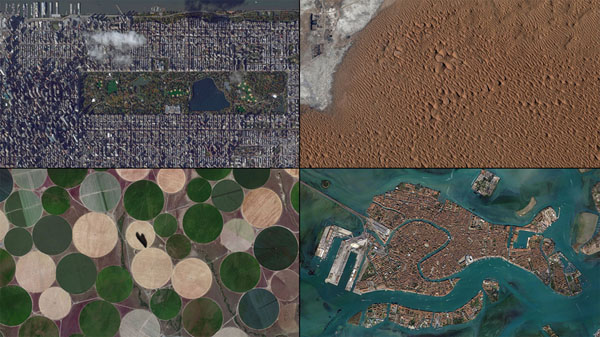
(Clockwise, from upper left) Seven-square-mile views of Manhattan; Chaganbulage Administrative Village in Inner Mongolia; Venice, Italy; and farms in Plymouth, Washington # © Google
Every now and then, it is good to just let the mind wander. And some of those times, visual prompts are the fastest way to get from here to there.
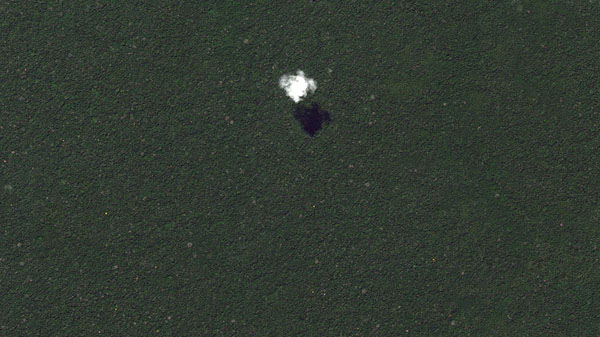
A seven-square-mile snapshot of the 2,700,000-square-mile Amazon rainforest in Brazil #© Google
Thanks to the Atlantic’s Senior Editor of the photo section, Alan Taylor, for this:
Seven Square Miles
Spending time looking at the varying and beautiful images of our planet from above in Google Earth, zooming in and out at dizzying rates, I thought it would be interesting to compare all of these vistas at a fixed scale—to see what New York City, Venice, or the Grand Canyon would look like from the same virtual height. So, the following images are snapshots from Google Earth, all rectangles of the same size and scale, approximately three and a half miles (5.6 kilometers) wide by two miles (3.2 kilometers) tall—showing seven square miles (18.1 square kilometers, or 4,480 acres) of the surface of our planet in each view.
Ngorongoro Crater, Tanzania

Scottish Power’s Whitelee windfarm on Eaglesham moor, just south of Glasgow. Photograph: Global Warming Images/REX
My daily contribution to this platform is a habit vaguely in the tradition of meditation–finding something each day that is worthy of gratitude, or otherwise worthy of sharing with friends, family, and anyone else who cares to listen. Because of the good fortune I have had to visit and work in many amazing places, it is important to me to never regret the places where I still have not been. Scotland is one of those places that, if I were a regretter, I would be feeling it now. I owe that place a visit (even if the company name sounds like a Bond villain):
Scottish Power shifts to 100% wind generation after £700m Drax sale
Big six energy firm drops fossil fuels for generation and say cheap green energy is the future
Scottish Power has ditched fossil fuels for electricity generation and switched to 100% wind power, by selling off its last remaining gas power stations to Drax for more than £700m.
Iberdrola, Scottish Power’s Spanish parent company, said the move was part of its strategy to tackle climate change and would free it up to invest in renewables and power grids in the UK.
The deal also marks a significant expansion and diversification for Drax, whose main business is a coal- and biomass-fired power station in North Yorkshire. Continue reading
Bullet Tree Falls, Belize
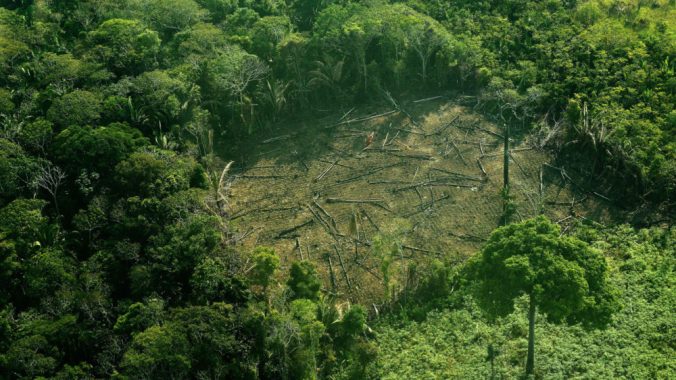
Trees cleared in the western Amazon region of Brazil in September 2017. CARL DE SOUZA / AFP / GETTY IMAGES
If you have been following the news recently, you may have noticed a report that indicates the urgency from climate change is greater than scientists previously thought. Everyone who cares has been digesting the science and we appreciate every effort to clarify what the science is saying. Fred Pearce, writing for Yale e360, has this:
Conflicting Data: How Fast Is the World Losing its Forests?
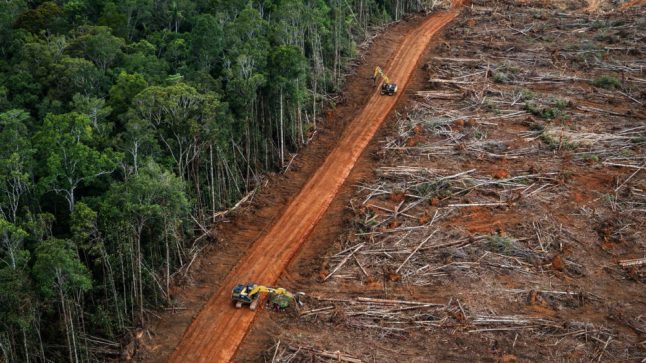
Forest cut to make way for an oil palm plantation in Papua, Indonesia in April 2018. ULET IFANSASTI / GREENPEACE
The latest UN report on climate says reducing deforestation is crucial to slowing global warming. But researchers must first reconcile two contradictory sets of statistics on tree loss in order to determine whether promises made by nations to protect and restore forests are on target.
The world is losing trees faster than ever. An area the size of Italy disappeared last year. Or did it? New research suggests three-quarters of those lost forests may already be regrowing. That hardly means we are out of the woods. Fighting climate change and protecting biodiversity still needs a global campaign to reforest the planet. But it does suggest that, given the chance, nature will do much of the work. Continue reading
Sydney, New South Wales, Australia
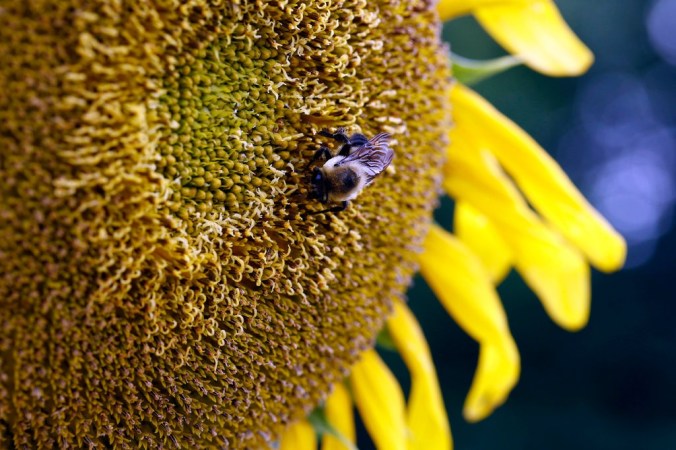
Scientists expected bees to gradually cease buzzing as the sky darkened during an eclipse. Instead, they stopped altogether. Credit Rogelio V. Solis/Associated Press
After following the work of Nicholas St. Fleur for a couple years now–his beat includes archaeology, paleontology, and space among other of the things we care about on this platform, including conservation–his most recent story below is my favorite for one reason, namely citizen science. Specifically the participation of youth in such an important scientific investigation:
The Moon Eclipsed the Sun. Then the Bees Stopped Buzzing.
Researchers worked with a small army of elementary school children to collect audio recordings of bees as they visited flowers along the path of last summer’s total eclipse.
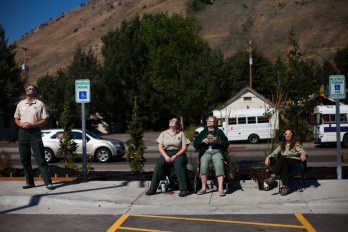
National Forest Service workers at the Bridger-Teton National Forest Office in Jackson, Wyo., took a break to watch the Great American Eclipse last year. Credit Celia Talbot Tobin for The New York Times
Last year’s Great American Eclipse drew hundreds of millions of eyes to the sky. But while people across the country “oohed” and “aahed” at the phenomenon, it appears the bees went silent.
So found a new study that monitored the acoustic activity of bees before, during and after totality — the moment when the moon completely blocked the sun — during the solar eclipse on Aug. 21, 2017. Researchers at the University of Missouri, along with a small army of elementary school children and other volunteers, collected audio recordings of honeybees, bumblebees and other types of bees as they visited flowers along the path of totality Continue reading
Crooked Tree, Belize
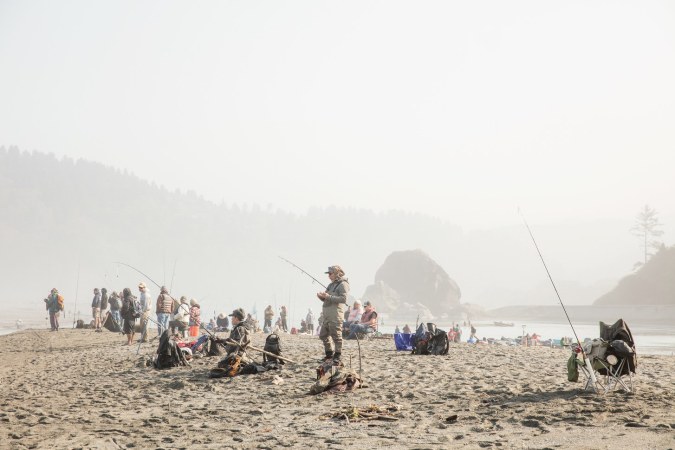
A carbon-offset project, the first of its kind in the United States, has become the Yurok’s main source of discretionary income, helping the tribe buy back thousands of acres of land. Photograph by Joel Redman
Carbon trading has featured, or at least been mentioned, only rarely on this platform, now that I stop to check. That seems impossible. But the scheme with so much promise has simply not taken off. Indigenous heritage, on the other hand, has featured in dozens of stories here since we started in 2011. Thanks to Carolyn Kormann for bringing this story to my attention, helped by two captivating photos and the fact that it highlights the approach of the Yurok Tribe (a community I had not heard of before):

“I think we did a good thing by saving the trees, but I’m not happy with it,” Jene McCovey, a tribal elder, said. “It’s not viable. It allows polluters to pollute.” Photograph by Joel Redman
How Carbon Trading Became a Way of Life for California’s Yurok Tribe
When Marty Lamebear is not fighting fires, he is starting them. In the past few years, as a member of the Yurok Tribe Forestry Program’s fire department, he has been helping revive the controversial practice of prescribed burns to protect and restore the coastal redwood forests of northern California. Lamebear is also a hunter, fisherman, and dancer. In his free time, he makes tribal regalia for ceremonial dances from parts of elk, deer, minks, and porcupines, which he shoots or finds already dead, and from frozen eagles that he orders from the U.S. Fish and Wildlife Service. A prescribed burn, what Lamebear calls a culture burn, creates prairies within the forest, which attract those animals. “At first, we couldn’t really tell its effects,” he said. “But, after about six years now, we can honestly start seeing the landscape open up, animals come around.” They also serve another purpose, he said. “It’s insurance for our carbon.” Continue reading





 Organikos