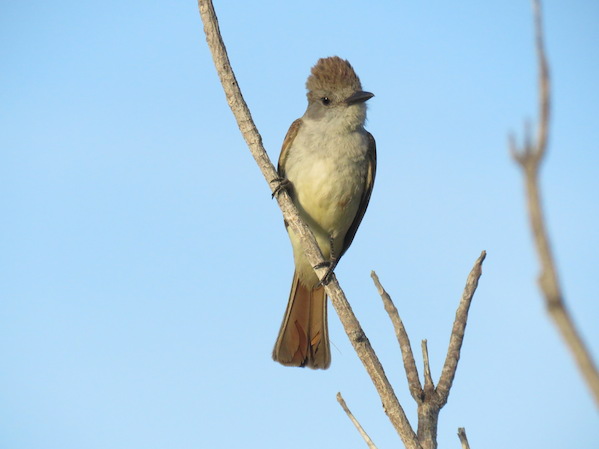
Baja California Sur, Mexico
Baja California Sur, Mexico
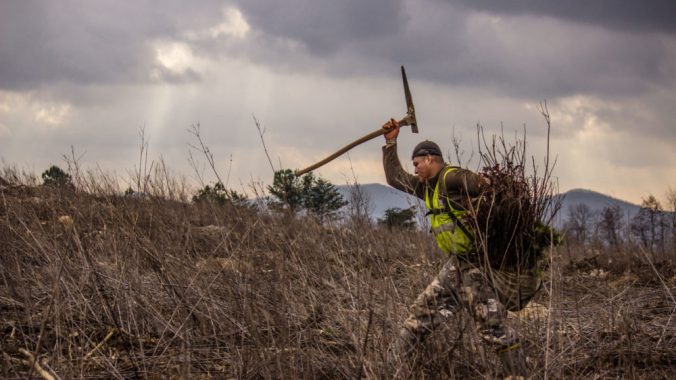
A contractor for Green Forests Work plants native hardwood and evergreen seedlings on a reclaimed mine site in Dorton, Kentucky. GREEN FORESTS WORK
Thanks to Yale 360 for this story about Green Forests Work, in a part of North America that is often considered lost, from an ecological perspective:
Reclaiming Appalachia: A Push to Bring Back Native Forests to Coal Country
Previous efforts to restore former coal mine sites in Appalachia have left behind vast swaths of unproductive land. Now, a group of nonprofits and scientists are working to restore native trees to the region — even if it means starting the reclamation process from scratch.
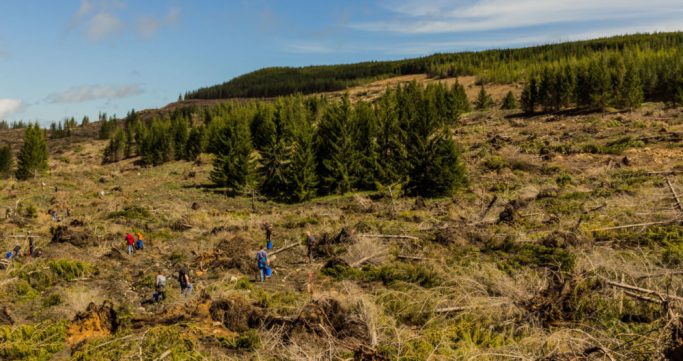
Volunteers fan out over a recently bulldozed plot on Cheat Mountain to plant red spruce and other native seedlings. GREEN FORESTS WORK
Near the top of Cheat Mountain in West Virginia, bulldozer operator Bill Moore gazes down a steep slope littered with toppled conifers. Tangled roots and angled boulders protrude from the slate-colored soil, and the earth is crisscrossed with deep gouges.
“Anywhere else I’ve ever worked,” Moore says, “if I did what I did here, I’d be fired.” Continue reading

Dinokeng Game Reserve, South Africa

An illustration of a solar train in action. Photograph: Esther Griffin
Thanks to Alice Bell and the Guardian for a look into the latest on harnessing the sun to power more of our transportation needs:
In 10 years time trains could be solar powered
A technique has been devised that allows electricity to flow directly from solar panels to electrified train tracks to the trains themselves making solar powered trains more feasible than ever before Continue reading
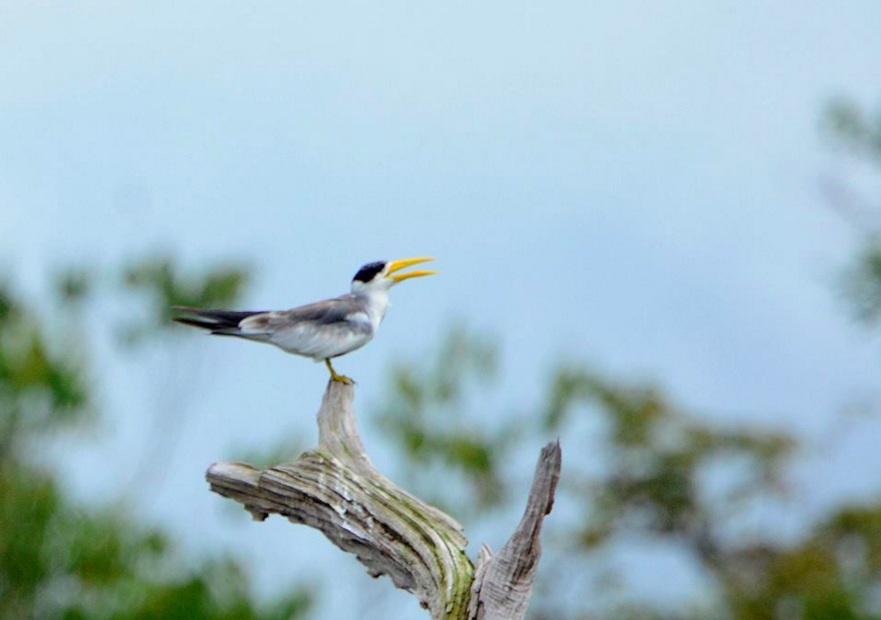
Rio Preto de Eva, Brazil
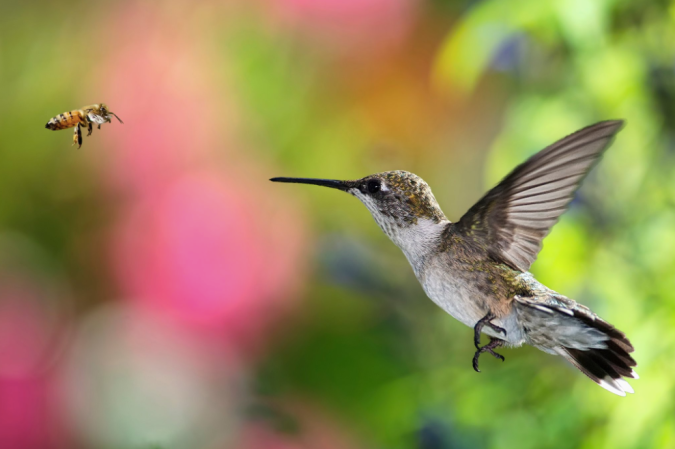
Scientists say that studying bee behavior could help them understand hummingbird behavior, too. Credit DansPhotoArt on flickr, via Getty Images
Members of our team have long been fans of bees and all bird species, with a particular soft spot for hummingbirds in particular. With their gemlike plumage and engaging personality, what’s not to love?
You Should Think of Hummingbirds as Bees With Feathers
What’s small, buzzes here and there and visits flowers?
If you said bees or hummingbirds, you got it. And you wouldn’t be the first if you mixed the two up. In Medieval Europe, some called bees the smallest birds. In Chinese and Japanese, the words for hummingbird translate into “bee bird.” Today we call the smallest hummingbird — weighing less than a penny and only a bit larger than the biggest bee — the bee hummingbird.
And now a group of researchers say we should embrace our history of lumping the two together. The way scientists study bees could help them study hummingbird behavior, too, they argue in a review published Tuesday in Biology Letters. Continue reading

Mandala, Arunachal Pradesh
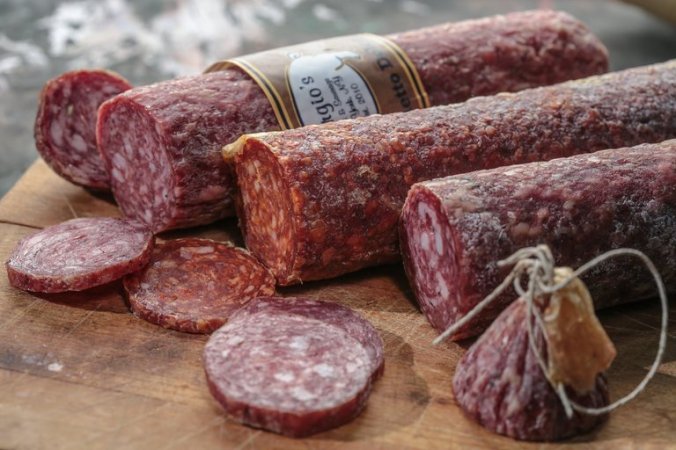
Bacteria are responsible for the delicious taste of salami, although industrial microbes do not yield as tasty dried sausages as wild microbes. Credit Tony Cenicola/The New York Times
Fermented meat does not have the sound of mmmm to it, but we learn something new each day:
Actually, You Do Want to Know How This Sausage Gets Made
When you slice into a salami, you are enjoying the fruits of some very small organisms’ labor.
Like other dried sausages, salami is a fermented food. Its production involves a period where manufacturers allow microbes to work on the ground meat filling to create a bouquet of pungent, savory molecules. Traditionally, the bugs find their way to the sausage from the surrounding environment. But these days, industrial manufacturers add a starter culture of bacteria to the meat instead, much the way a bread baker adds a packet of yeast to her dough. Continue reading
Chan Chich Lodge, Belize
The mission of the Flatiron Institute is to advance scientific research through computational methods, including data analysis, modeling and simulation.
The institute, an internal research division of the Simons Foundation, is a community of scientists who are working to use modern computational tools to advance our understanding of science, both through the analysis of large, rich datasets and through the simulations of physical process.
Jim Simons, the Numbers King
Algorithms made him a Wall Street billionaire. His new research center helps scientists mine data for the common good.
Simons is donating billions of dollars to science. But much of his fortune, long stashed offshore, has never been taxed. Illustration by Oliver Munday; photograph by Tim Sloan / AFP / Getty
By D. T. Max
A visit to a scientific-research center usually begins at a star professor’s laboratory that is abuzz with a dozen postdocs collaborating on various experiments. But when I recently toured the Flatiron Institute, which formally opened in September, in lower Manhattan, I was taken straight to a computer room. The only sound came from a susurrating climate-control system. I was surrounded by rows of black metal cages outfitted, from floor to ceiling, with black metal shelves filled with black server nodes: boxes with small, twinkling lights and protruding multicolored wires. Tags dangled from some of the wires, notes that the tech staff had written to themselves. I realized that I’d seen a facility like this only in movies. Nick Carriero, one of the directors of what the institute calls its “scientific-computing core,” walked me around the space. He pointed to a cage with empty shelves. “We’re waiting for the quantum-physics people to start showing up,” he said. Continue reading

Ukhimath, Uttarakhand
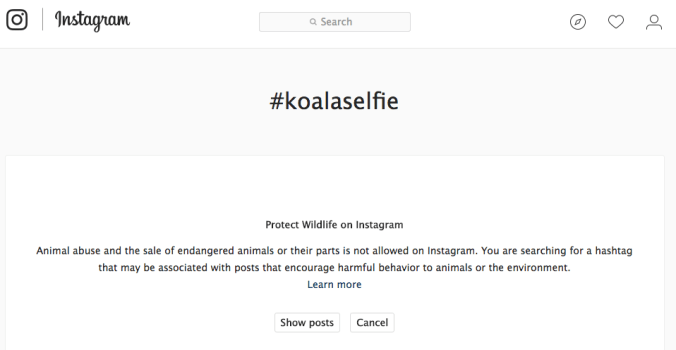
This is the message that now appears on Instagram if you search for a hashtag like #koalaselfie
I post on Instagram a couple times a month, but I often browse pictures on the app at least once a day. I can’t say that I’ve encountered photos like those described in the NatGeo article below, but I’m still thankful that Instagram is taking action to try to keep it that way, by pointing out to people using certain hashtags involving wildlife that the animals may be suffering behind the scenes:
Instagram is rife with photos of cute wild animals—including the exotic and endangered. A picture of someone hugging a sloth or showing off a pet tiger cub is just a click away on the massively popular photo-sharing platform, which serves 800 million users.
But starting [December 4th], searches for a wide range of wildlife hashtags will trigger a notification informing people of the behind-the-scenes animal abuse that makes some seemingly innocent wildlife photos possible.
Instagram will now deliver a pop-up message whenever someone searches or clicks on a hashtag like “#slothselfie.” The message reads, in part, “You are searching for a hashtag that may be associated with posts that encourage harmful behavior to animals or the environment.”

Zuluk, Sikkim
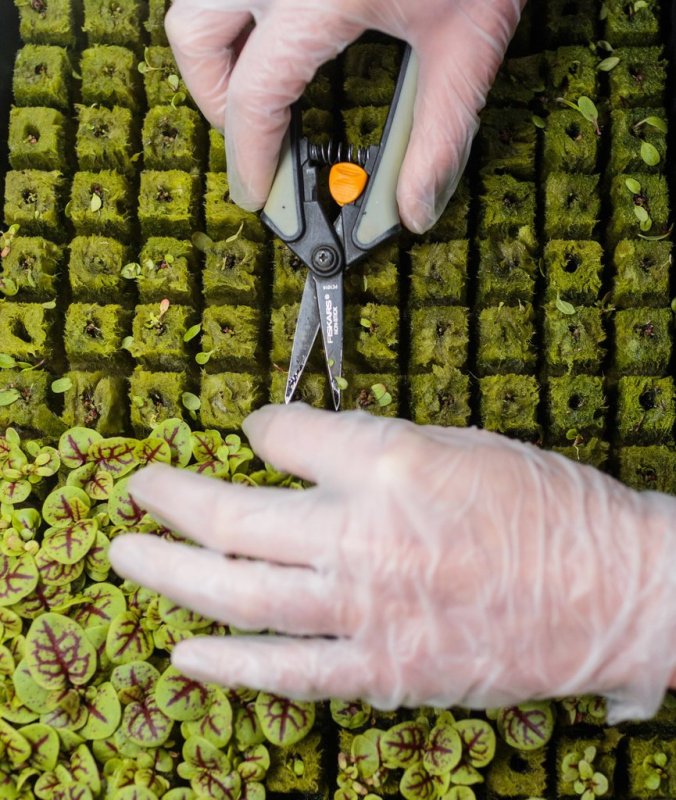
At Farm.One, a hydroponic garden in TriBeCa, red-veined sorrel is prepared for a delivery. Credit Sarah Blesener for The New York Times
We have posted on urban farming and related topics numerous times since 2011, and hydroponics as its own topic of interest plenty of times as well. Culinary and/or gastronomic topics as related to agriculture are a magnitude of order more represented in these pages. Finally, they are combined for us in one amazing article, thanks to Alyson Krueger. If you only have time to look at the photos, those alone are worth the click:
Herbs From the Underground
Farm.One just opened an indoor rare herb and flower garden in a TriBeCa basement, and many prominent chefs are flocking to it.
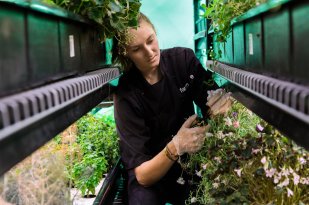
Katherine Chester, a farm hand at Farm.One, harvests for a morning delivery. Credit Sarah Blesener for The New York Times
In the basement of a loft-style building in TriBeCa that houses a vet, a dog swimming pool, an eye-and-ear infirmary, and a two-Michelin-starred restaurant, there is a working farm.
Farm.One is a hydroponic facility, which means that the plants do not grow in soil. Many of these farms are located indoors, in controlled environments, with artificial lighting.
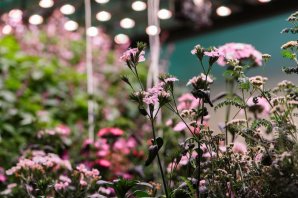
Amazon neon cherry dianthus and neon rose magic dianthus. Credit Sarah Blesener for The New York Times
The new two-room space, which opened in November in a former cycling studio for high-altitude training and an old storage area, is only 1200 square feet. There is no fresh air or natural light; there is not even a window. Yet the venue can grow around 580 varieties of rare herbs and flowers (200 at a time) that supply New York’s top restaurants. Le Turtle, Le Coucou, Mission Chinese Food, and The Pool get regular deliveries from Farm.One, sometimes several times a week. Continue reading

Dinokeng Game Reserve, Pretoria, SA
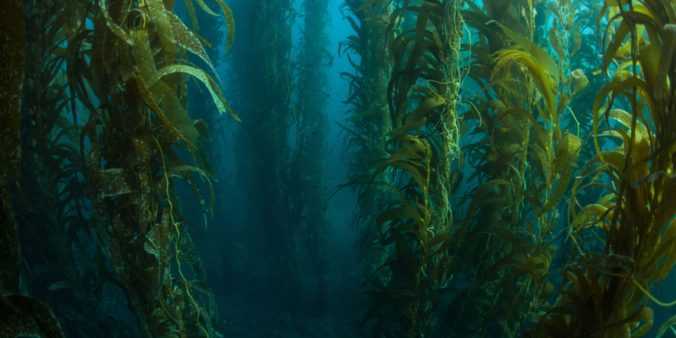
Kelp forest commentary is not new to our pages, but much more frequently the generic category seaweed has been highlighted for its farming potential. We have apparently not give sufficient attention to the specific value of natural kelp forests. Thanks to Yale 360 and science writer Alastair Bland for this story:
As Oceans Warm, the World’s Kelp Forests Begin to Disappear
The progression of the destruction of a kelp forest in Tasmania by urchins, photo 1/3.
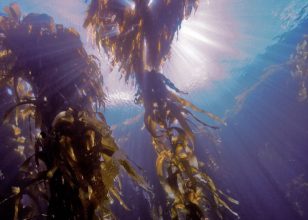
Kelp forests — luxuriant coastal ecosystems that are home to a wide variety of marine biodiversity — are being wiped out from Tasmania to California, replaced by sea urchin barrens that are nearly devoid of life.
A steady increase in ocean temperatures — nearly 3 degrees Fahrenheit in recent decades — was all it took to doom the once-luxuriant giant kelp forests of eastern Australia and Tasmania: Thick canopies that once covered much of the region’s coastal sea surface have wilted in intolerably warm and nutrient-poor water.
The progression of the destruction of a kelp forest in Tasmania by urchins, photo 2/3.
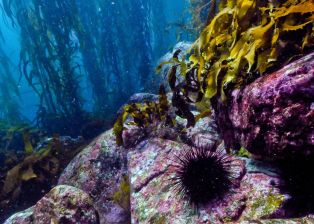
Then, a warm-water sea urchin species moved in. Voracious grazers, the invaders have mowed down much of the remaining vegetation and, over vast areas, have formed what scientists call urchin barrens, bleak marine environments largely devoid of life.
Today, more than 95 percent of eastern Tasmania’s kelp forests — luxuriant marine environments that provide food and shelter for species at all levels of the food web — are gone. With the water still warming rapidly and the long-spine urchin spreading southward in the favorable conditions, researchers see little hope of saving the vanishing ecosystem.
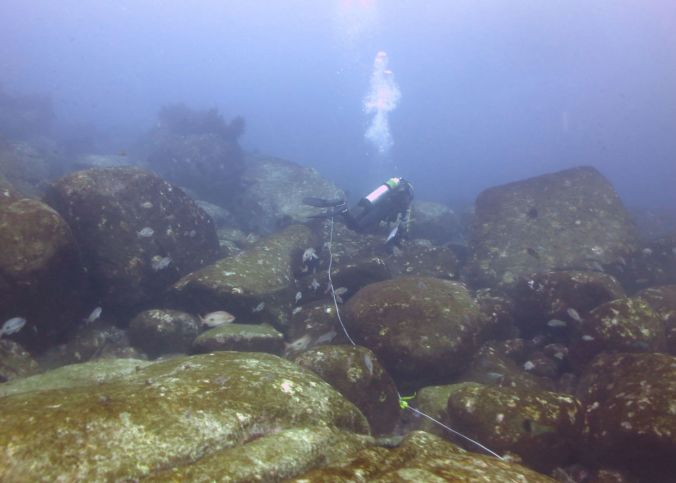 The progression of the destruction of a kelp forest in Tasmania by urchins, photo 3/3. The Australian island state has lost more than 95 percent its kelp forests in recent decades. COURTESY OF SCOTT LING Continue reading


The ruined castle of La Mothe-Chandeniers in central western France. The crowdfunding site Dartagnans organized an effort to buy the chateau for 500,000 euros. Guillaume Souvant/AFP/Getty Images
Thanks to National Public Radio (USA) for this signal that trust, the cement of civilization, is alive and well in some quarters:
7,500 Strangers Just Bought A Crumbling French Chateau Together
It’s late 2017. By now, crowdfunding has been used to finance films, board games, classical music, scientific research and infertility treatments.
Add this to the list of things bought with collective purchasing power: A chateau in the French countryside, complete with moat.
Mais oui!
The platform used to raise the funds announced on Friday that the castle had been purchased by milliers d’internautes – that is, thousands of Internet users, who each paid at least 50 euros (about $60) to “adopt” the chateau and help restore it. In just 40 days, the site raised the 500,000 euros it needed to buy it. Continue reading
Valparai, Tamil Nadu
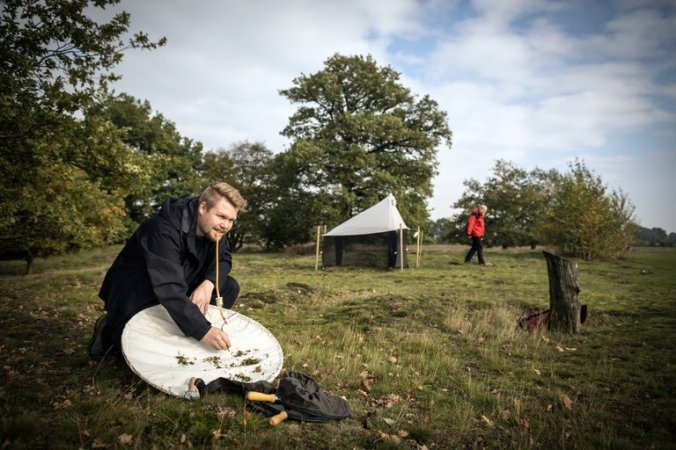
Thomas Hörren, a member of the Entomological Society Krefeld, collecting beetles from a soil sample. CreditGordon Welters for The New York Times
Thanks to Sally McGrane for this important article:
KREFELD, Germany — In a nature preserve in western Germany, an elderly gentleman approached a tent-like structure that was in fact a large trap for flying insects. Peering through thick eyeglasses, the 75-year-old retired chemist checked the plastic bottle attached at the top, filled with alcohol and bugs.
Then, with a glance at the clear, late-autumn sky, the man, Heinz Schwan, recalled comparing a 2013 haul from a trap like this one to samples taken in the same place some 20 years earlier. The drop was huge: “75 percent,” Mr. Schwan, a caterpillar lover, said.
Alarmed, the group of local insect enthusiasts Mr. Schwan is co-chairman of ran similar tests in different locations the next year. And the next year. And the next. Continue reading

 Organikos