
Atlanta, Georgia
Atlanta, Georgia

Peaches that bloomed late and thus missed the March freeze at Pearson Farm in Georgia. Production in the state this year might be just a quarter of what it was in 2016. Credit Maura Friedman for The New York Times
I have family in Georgia, and can attest to the state’s obsession described in the first paragraph of the article below. I have visited the state when peach is at its best, and the obsession makes sense to me. Although the article does not mention climate change, per se, considering the news I cannot help filtering this story through that one.
Farmers in the south are part of “the base” that have been led to believe that climate change is a hoax, and that efforts to mitigate it are wasted, even wasteful. Which leads me to wonder whether peach farmers at a moment like this might be on particularly fertile ground–whether they might be inclined to listen to science that can help them understand the season’s tragedy in a new light. For as long as there have been farmers they have been inclined to listen to all kinds of explanations for why things happen the way they do. Maybe climate change has just not been presented by the right messenger with the right message. I love peach enough to want to find out:
The South Faces a Summer With Fewer Peaches
ATLANTA — Peaches are such a part of Georgia’s identity that schools, streets and health care plans are named after them. Even the sticker you get when you vote is in the shape of the fruit. South Carolina, one state over, grows more peaches than Georgia. A giant statue of a peach is its most famous roadside attraction. Continue reading

California Gov. Jerry Brown talks with Sharon Dijksma, Netherlands Minister for the Environment, during the joint Netherlands and California Environmental Protection Agency conference called, “Climate is Big Business,” at the Presidio Wednesday, May 24, 2017, in San Francisco; Photo: Eric Risberg, Associated Press
The news yesterday that the USA is exiting the Paris climate accord was in a font size the New York Times only uses at times of true tragedy–i.e. big news. Editorials accompanying that headline on the front page were proportionately big with invective:
All consistent with the implications of the news. There is no discounting the scale of that tragedy, so it is possibly not the right moment to look for silver linings. But that is what we do here, so here goes. In the model mad series we linked to a story about California Governor Jerry Brown, who has been making a stand during decades of public service, and he clearly has no intention of slowing down. The governors of California, New York and Washington on Thursday announced a new “alliance of states dedicated to fighting global warming and urged others to join them”.
“California will resist,” Brown told journalists on a conference call, going on to say that the administration may well create the exact opposite of what is intended –
an aroused citizenry — and an aroused international community — who will not tolerate this kind of deviant behavior from the highest office in the land.”
Brown and his counterparts, Jay Inslee of Washington and Andrew Cuomo of New York, announced that they would join forces in a United States Climate Alliance, a coalition of states committed to upholding the goals of the Paris agreement.
The three states, combined, represent more than 20 percent of the U.S. population and at least 10 percent of the country’s greenhouse-gas emissions, according to the governors. Continue reading

Nicobar Islands
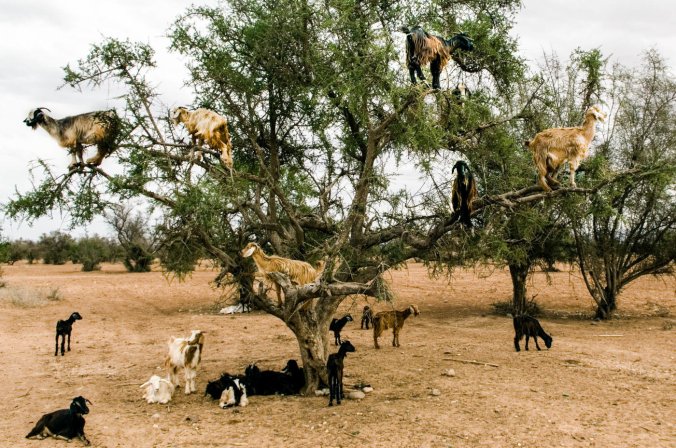
Goats climb an argan tree in Morocco to dine on its fruit. Jeremy Horner/Getty Images
At Chan Chich Lodge we are just embarking on a tree-related culinary journey, so any counterintuitive story about trees is likely to catch my attention these days.
Thanks to Marc Silver at National Public Radio for the story about the picture above, Do Tree-Climbing Goats Help Plant New Trees? It is a short read and worth every second of your attention if you are interested in arboreal foodstuff.
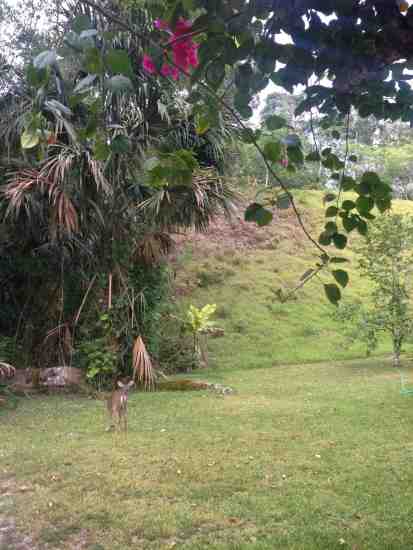
This image to the left, while not as amusing as the one above, shows a deer doing the same thing with less panache. That deer will spread the seeds of that wild fig far and wide in the forest, increasing food supply. Continue reading

Frédéric Bazille’s The Family Gathering has none of the quick, airy brush strokes his future impressionist peers would discover; but the sunshine is there, as are the bright colors. Musée d’Orsay, Paris/Courtesy of the National Gallery of Art
Considering the changes in the air of the 1860’s Paris art scene, the “might have been” aspect of this story about a lesser known 19th century French painter is poignant, to say the least. Thanks, once again, to NPR for sharing this story about what could have been.
France’s ambassador to the United States, Gérard Araud, is a fan of 19th-century French painter Frédéric Bazille. But I had a confession to make when I spoke with him about the National Gallery’s “Frédéric Bazille and the Birth of Impressionism” exhibition. I said that I usually walk right past Bazille’s paintings and go straight to the impressionists — and I assume I’m not the only one who does that.
Araud understands, but says he likes Bazille for the opposite reason: The impressionists are so well-known, he says, “I’ve reached a point where I don’t look at them anymore.”
Those impressionists were also Bazille’s pals. Continue reading
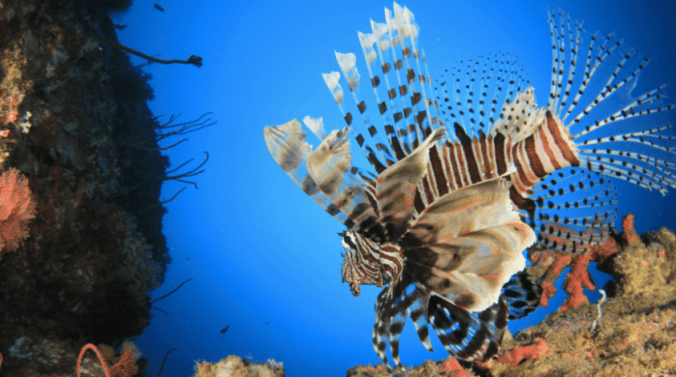
Market-based approaches to controlling invasive lionfish populations were highlighted at a recent GEF event in Grenada.
La Paz Group contributor Phil Karp has long been our guide into marine ecosystems, with both citizen science and social entrepreneurship posts on his work with groups in Belize and other parts of the Caribbean focused on these goals.
This collaboration with Sarah Wyatt, a colleague from the Global Environment Facility, illustrates the on-going market-based approaches to managing the invasive species while creating new cottage industry opportunities.
Seeing a lionfish while diving in the Caribbean is a cause for mixed emotions. On the one hand, one marvels at the exquisite beauty of the fishes’ flowery fins and its amazing adaptability to a range of habitats, from shallow estuaries with low salinity to deep reef environments. But then you remember that these fish don’t belong in the Caribbean, and that the very versatility noted above makes them an invasive menace. Indeed, if the fish you are looking at is a female, she may be carrying up to 30,000 eggs, and may have thirty or more native fish or crustaceans in her stomach.
One of the many impacts of the Anthropocene era on global biodiversity is the increased spread of invasive species, like the lionfish, due to rapid globalization. With the United Nations Ocean Conference taking place in New York next week, the conservation and sustainable use of the oceans and marine resources is high on the international agenda. While long recognized as an environmental and biodiversity threat, invasive species also pose a threat to livelihoods, particularly in developing countries where incomes may be heavily dependent upon a single sector or product.
Traditionally, efforts to eradicate or control invasive species have been focused on public sector interventions. But control efforts are often expensive and are either out of reach, or pose severe strains on limited budgets of developing countries. Hence there has been growing attention to identification of market-based control approaches which create commercial incentives for removing the invaders, providing a financially sustainable means of control… Continue reading

male – Gallon Jug Estate, Belize
On Seth’s invitation, I am honored to have a chance to contribute to the group. I have a biology background, but am now retired and have an interest in photographing birds. I use point and shoot cameras, starting two years ago with a Canon SX60HS, graduating to a Sony RX10iii this year. I teach classes in bird photography with these cameras. My interests are in telling a story of birds in a small ecotype such as a pond, or in this case one plant species, a cactus, the cardon of the deserts of Northwest Mexico. These photos were taken over two trips to the Baja California Sur Cape Region, and the majority were on one cardon that was outside the bungalow I was staying at in Cabo Pulmo, Mexico while having my morning coffee.
Pachycereus pringlei, also known as Mexican giant cardon or elephant cactus, is a close relative of the Saguaro of the desert southwest. It is the tallest cactus in the world, lives for several hundred years, and has a fungal-bacteria symbiotic relationship that allows it to grow on bare rock. For birds, it is the perch of choice for everything from hawks to wrens, a source of abundant food, a prolific producer of fruit and used by all woodpeckers for their nesting holes. On larger cardons it is not uncommon to see several bird species on a cactus at once and most birds whose territory includes a cardon will touch it several times a day for a song, a snack, and good luck.


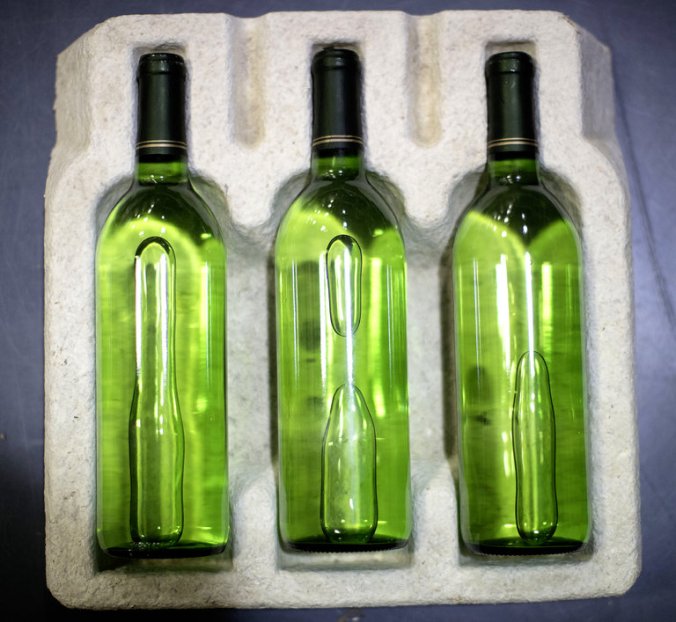
The design company Ecovative makes a variety of packaging materials using mycelium fungus. Credit Nathaniel Brooks for The New York Times
Thanks again to Stephanie Strom for a story about ecology that surprises:
Packaging Food With Food to Reduce Waste
For the environmentally conscious eater, they are among the most inconvenient truths: Too much food goes to waste. Too much packaging comes with the food. And too much of the packaging is made to last for ages.
Now there may be a single answer to all three problems: using excess food to make the packaging. Continue reading
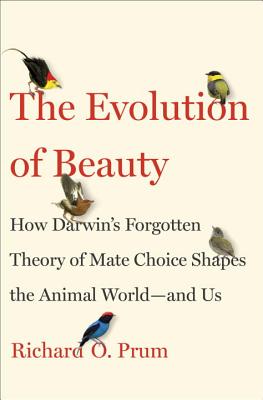 For evolutionary biology, on this platform we have favored E.O. Wilson because of his biophilia ideas (about which, plenty). For ornithology, we have leaned heavily on the Lab at Cornell and its many wonderful folks. Now, a scientist at Yale combines both of those fields and takes on the topic of beauty in a challenging manner–I am looking forward to this.
Click the book image at the left to go Indie Bound, a community of independent local bookstores, or if you need more convincing, read the beautifully illustrated Challenging Mainstream Thought About Beauty’s Big Hand in Evolution by James Gorman in the Science section of the New York Times. It is as much profile as review and asks:
Are aesthetic judgments about mates invariably tied to traits we see as adaptive and worth passing on Or, does beauty just ‘happen’?
Not long ago, a physicist at Stanford posed a rhetorical question that took me by surprise.
“Why is there so much beauty?” he asked.
Beauty was not what I was thinking the world was full of when he brought it up. The physicist, Manu Prakash, was captivated by the patterns in seawater made as starfish larvae swam about. But he did put his finger on quite a puzzle: Why is there beauty? Why is there any beauty at all? Continue reading
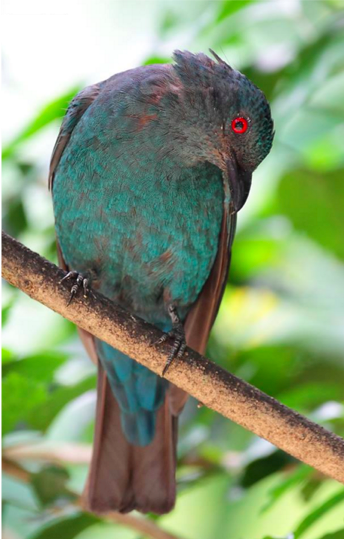
female – Western Ghats, Kerala
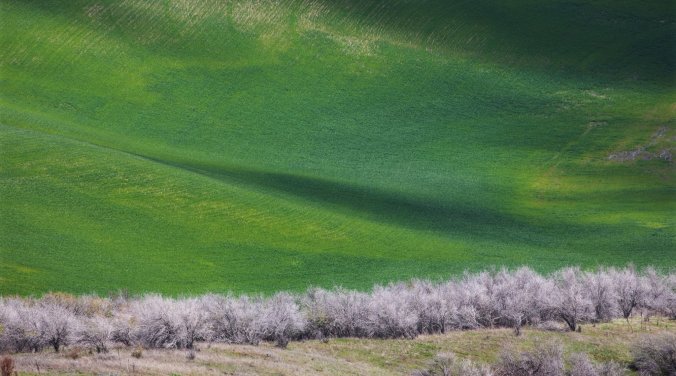
The remnant of an old apple orchard among wheat fields in Steptoe Butte State Park in Washington. Credit Ruth Fremson/The New York Times
Yesterday magic happened. After sharing in the morning a quick mention of why my thoughts are on agriculture, I was walking with a member of Chan Chich Lodge’s groundskeeping team to review some work he had completed. On the way, we encountered a tree showering small fruits onto the ground. Fragrant. I asked him what it was and he said a word I did not recognize that sounded like “yo”.
About the size of a blueberry but not a berry, nor resembling anything I could identify. Until I opened it and its inside looked exactly like that of my favorite fruit. And then I realized my colleague had said higo, the Spanish word for fig. He then told me that in his village the old Mayans use this to make a flour, something they have done since olden times. He paused a moment, a bit of reverie I could tell, and then he continued about how the tortilla made from this is the best. It’s got me thinking. Thanks to Kirk Johnson for this second unexpected pleasure of a story:
Hunting Down the Lost Apples of the Pacific Northwest
STEPTOE, Wash. — David Benscoter honed his craft as an investigator for the F.B.I. and the United States Treasury, cornering corrupt politicians and tax evaders. The lost apple trees that he hunts down now are really not so different. People and things, he said, tend to hide in plain sight if you know how and where to look. Continue reading
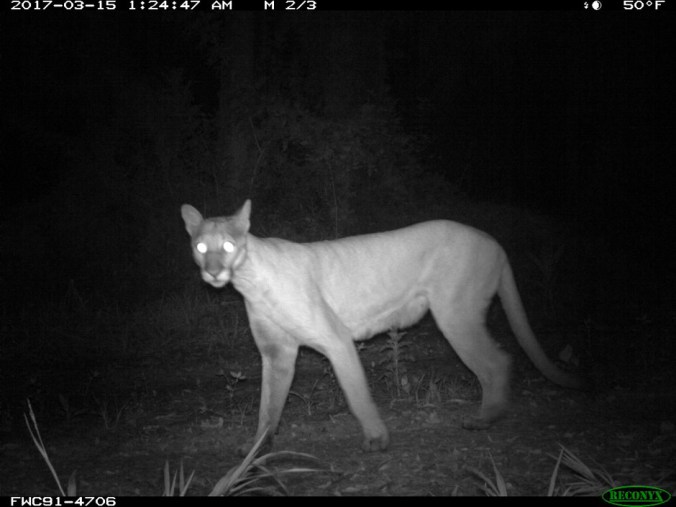
As Florida panthers have begun to multiply, they’ve been forced to search for new home ranges. PHOTOGRAPH COURTESY FLORIDA FISH AND WILDLIFE / FLICKR
Rewilding is a topic I started linking to as a matter of solidarity. While based in south India, I had plenty of exposure to residual evidence of the complicated–sometimes resplendently beautiful and other times brutally tragic–relationship between mankind and wild animals as played out over millennia, and still evolving. So I have kept an eye open for these stories, and have posted so many times on the topic that it might give the impression that it is a thing. As if it is happening more or better than it is really happening. But it is happening so I will keep the links coming.
Now I am in Belize most of the year, where the man-cat relationship is also millennia old, and as constant challenge as ever. But I am seeing it from well within the confines of Chan Chich Lodge and its surrounding hundreds of thousands of acres of healthy cat habitat. I know there are big cats in the USA, but not enough. That is why this story is a thrill. Dexter Filkins, never yet cited in these pages but whose reporting I depend on for other kinds of stories, was not a byline I expected to see on this story, but thanks to him for it:
For years, the Florida panther, a majestic creature that lurks in and around the forests of the ovbnm,./, has teetered on the edge of permanent disappearance. Closely related to the mountain lion, the panther once roamed across much of the South, but the ever-advancing modern world pushed it into a tiny corner of Southwest Florida. By the late nineteen-seventies, fewer than thirty survived.
Since then, the panther has been coming back, helped by a government- and privately backed expansion of its habitat. Florida panthers are now thought to number around two hundred. Indeed, there are so many big cats in the Everglades that they are venturing out in search of new territory. Continue reading
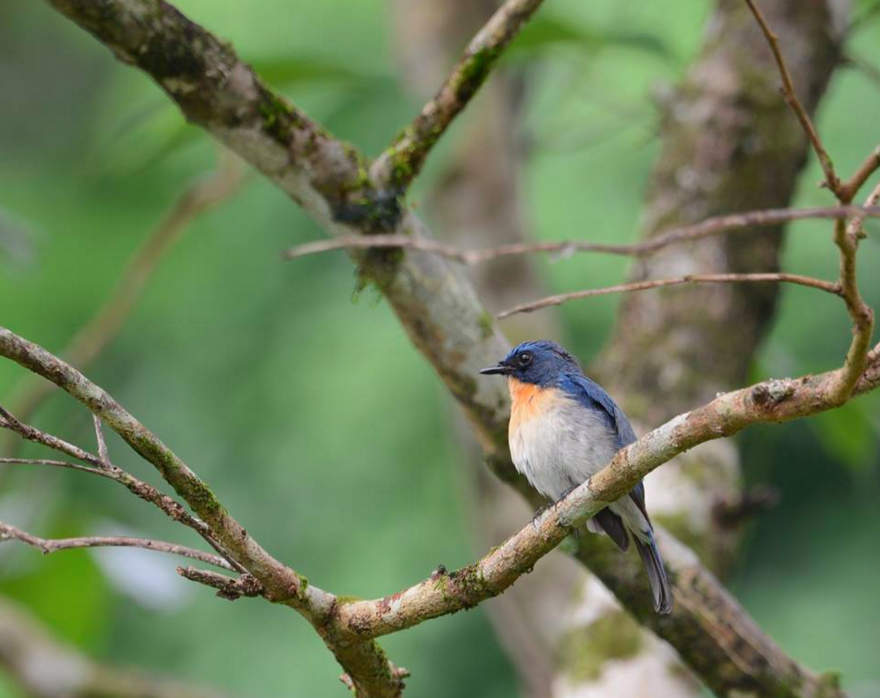
Thattekad Bird Sanctuary, Kerala

A view of Manhattan from the roof of the Bridge building on the Cornell Tech campus on Roosevelt Island. Photo VINCENT TULLO
When Cornell University competed in 2011 to develop an applied science and engineering campus in New York City, part of its pitch was that it would construct an academic building that would at least approach making as much energy as it used in a year, a concept known as net zero. It won. Then came the hard work of making that vision happen at the campus, known as Cornell Tech. Continue reading

I am back at Chan Chich, with one goal before I start focusing on my plan to go to graduate school. A recurring theme in my work for La Paz Group, especially at Xandari, has been the intersection of birds and coffee. And now I have some months to think about how this may relate to what I will study in graduate school. One of the programs I am considering applying to is the Masters in Environmental Management at the Yale School of Forestry. Can I link what I have learned while working to what I would study there? If so, maybe I could link that to what I do after grad school.
This other post today reminds me of the value of geeking out from time to time. Most of my attention to coral reef comes from Phil Karp’s posts on this platform and I admit to preferring stories featuring real people and their entrepreneurial approaches to conservation. But science is the other best friend of conservation. Today my attention is turning to coffee, in advance of the arrival this week of an intern coming from Cornell University’s College of Agriculture and Life Sciences.
Just one of the many topics for an intern, with science and research on her side, to help us tackle over the next ten weeks, bird-friendly coffee has been on been on my mind since last year but I have been waiting for the perfect moment to focus. Nothing like the arrival of an intern to focus your mind. And so today in my task-oriented wanderings I came across this website (click the banner above), which I loved immediately for sharing this news on capsules, but the rest of the site is a great resource for present purposes as well:
A short round-up of coffee news.
- Keurig is finally designing a more eco-friendly K-cup, Washington Post. I have written many times about K-Cups: the excess waste, when the company said they were recyclable but they really weren’t, as well as the high cost and better alternatives. Continue reading
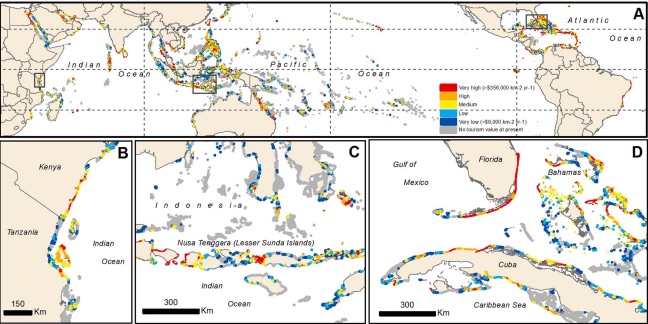
Economic value of coral reefs for tourism (A). This figure summarises the combined dollar values of expenditures for on-reef and reef-adjacent tourism. Reefs without assigned tourism value are grey; all other reefs present values binned into quintiles. Lower panels show Kenya and Tanzania (B), South-central Indonesia (C), and Northern Caribbean, with part of Florida, Cuba and the Bahamas (D). (Further maps can be seen in Appendix A and online at maps.oceanwealth.org
A country that depends on its coral reef to attract visitors, as Belize does, has every reason to pay attention to the various sciences paying attention to those reefs. Mostly marine biologists, perhaps, but also economists. Geeks and wonks are heroically gathering information, processing it, publishing it and if not for The Nature Conservancy’s efforts some of us might not ever see it.
The August, 2017 issue of Marine Policy, an academic journal, carries the article “Mapping the global value and distribution of coral reef tourism” by the scientists Mark Spalding, Lauretta Burke, Spencer A. Wood, Joscelyne Ashpole, James Hutchison, and Philine zu Ermgassen and TNC’s Cool Green Science has a summary in common language. Also they complement the academic illustration above with one of their own:
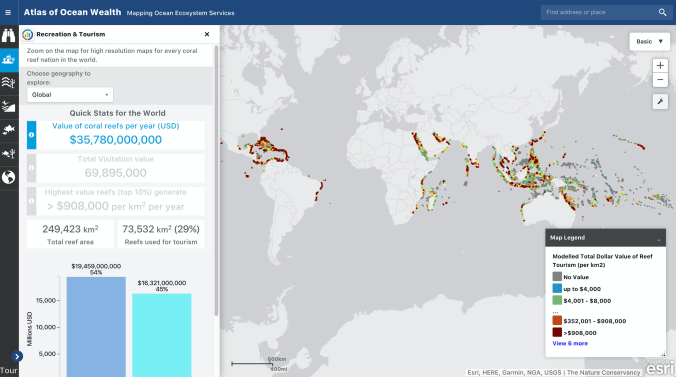
Screen shot from the Atlas of Ocean Wealth showing global reef value to tourism. © The Nature Conservancy
If it’s true that people reveal their true values by how they spend their money, coral reefs are very valuable indeed. In fact, according to a new study in the Journal Marine Policy coral reef tourism generates $36 billion (U.S) in global value every year. Continue reading

Bhadra Tiger Reserve, Karnataka
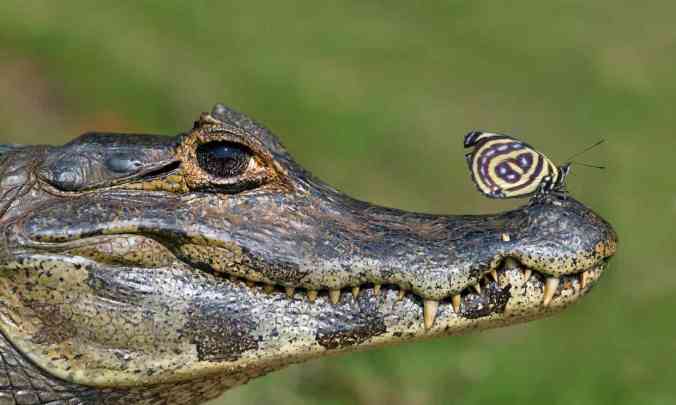
Serro Ricardo Franco is in one of the world’s biggest and most diverse ecological reserves. But reality on the ground is different, putting many animals at risk, such as Yacare caiman and giant river otters. Photograph: Angelo Gandolfi/Getty Images/Nature Picture Library
Sometimes, sitting in a glass house, reading the news makes me want to throw a stone. The glass house where I live includes a farm in an extremely biodiverse area. It is surrounded by nearly half a million acres where logging happens. But there is farming, as you can read about in the news below, and there are plenty of better ways of farming; there are loggers like those in the news below, and there are forests where extraction happens according to standards such as those set and enforced by the Forest Stewardship Council.
Instead of throwing a stone, I get up every day and make sure the glass around here is as transparent as possible, because we can demonstrate a better way of supplying food, of harvesting wood, and doing so with the protection of wildlife in constant view. Meanwhile, I do read the news from elsewhere and continue to share it here (thanks to the Guardian’s Jonathan Watts in Vila Bela da Santíssima Trindade for this one):
Wild Amazon faces destruction as Brazil’s farmers and loggers target national park
The Sierra Ricardo Franco park was meant to be a conservation area protecting rare wildlife
To understand why the Brazilian government is deliberately losing the battle against deforestation, you need only retrace the bootmarks of the Edwardian explorer Percy Fawcett along the Amazonian border with Bolivia.
During a failed attempt to cross a spectacular tabletop plateau here in 1906, the adventurer nearly died on the first of his many trips to South America. Back then, the area was so far from human habitation, the foliage so dense and the terrain so steep that Fawcett and his party came close to starvation.
He returned home with tales of a towering, inaccessible mesa teeming with wildlife and irrigated by secret waterfalls and crystalline rivers. By some accounts, this was one of the stories that inspired his friend Arthur Conan Doyle to write The Lost World about a fictional plateau jutting high above the jungle that served as a sanctuary for species long since extinct elsewhere. Continue reading
 Organikos