Merlin Flying Further Afield

We’ve written about this amazing APP on our pages before, and it’s exciting to watch it’s evolution and expansion of both technology and territory.

Our work has yet to expand to Mexico, but birds don’t acknowledge national borders, so the majority of the species in the Yucatan  can be found in all 3 countries that make up the peninsula – Belize, Guatemala and of course, Mexico.

We look forward to having our marvelous guides try it out just for fun!

 Merlin Expands to Mexico

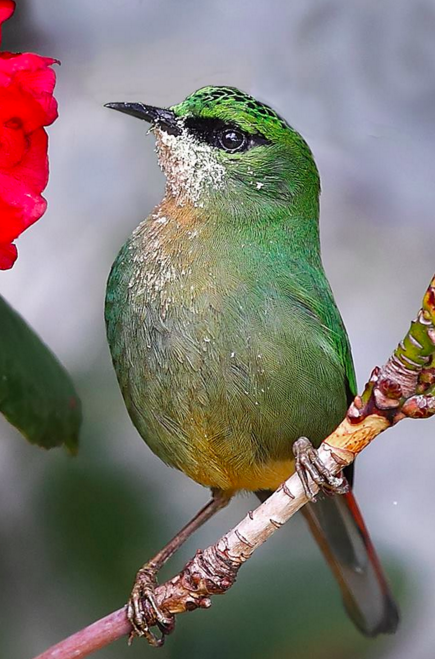
We’ve spent the last few months working to expand coverage of Merlin, and we’ve just released a new bird pack for the Yucatan Peninsula. Research at the Cornell Lab of Ornithology repeatedly points to the Yucatan Peninsula as a vital wintering ground for many of our favorite breeding birds in the United States. It’s also home to many dazzling birds unique to the Neotropics. Continue reading

Sense & Sensibility Off Grid

170313_r29532-600

“Sanditon” is robust, unsparing, and alert to all the latest fashions in human foolishness. Illustration by Rutu Modan

It has been nearly two decades since we adopted and adapted the two words, made meaningful as a study in contrasts and complementary values by a favored novelist, to remind us of what we are out to accomplish.

In recent weeks at Chan Chich Lodge the senses have been stimulated by wildlife sightings. Meditation on and in nature seems to fix, if momentarily, everything.

Apart from those meditations our guests find time to relax in a hammock, reading. Whether on paper (we prefer its off grid feel), or even on modern devices (on which there are some clear advantages) reading is a perfect complement to the day’s action. The quiet contemplation is a perfect counterpart to the nature excursions, so we are pleased to see Jane Austen has more to say than any of us knew:

On March 18, 1817, Jane Austen stopped writing a book. We know the date because she wrote it at the end of the manuscript, in her slanting hand. She had done the same at the beginning of the manuscript, on January 27th of that year. In the seven weeks in between, she had completed eleven chapters and slightly more than nine pages of a twelfth—some twenty-three thousand five hundred words. The final sentence in the manuscript runs as follows: Continue reading

Patagonia’s Defense Of Bears Ears

PatagAd.jpg

This banner was displayed during the last 12 hours across more than one of the news websites we monitor daily, perhaps showing up on our browsers because of our featuring a reference to Patagonia’s activism here. We had also recently noted their action on Bears Ears. Regardless of why this banner ad reached us, we are happy to extend its reach. Click above if you are in a position to explore and take action on this particular campaign.

Admire & Emulate

5333.jpg

It is not the first time we have enjoyed a good long read about either of these companies’ and/or founders, but this one in the Guardian offers a good look circa 2017:

Patagonia and The North Face: saving the world – one puffer jacket at a time

The retail giants are not only competing to sell outdoor gear – they are rivals in the contest to sell the thrill of the wilderness to the urban masses Continue reading

Coming To A Lodge Near You

08CORNEDBEEF4-master675

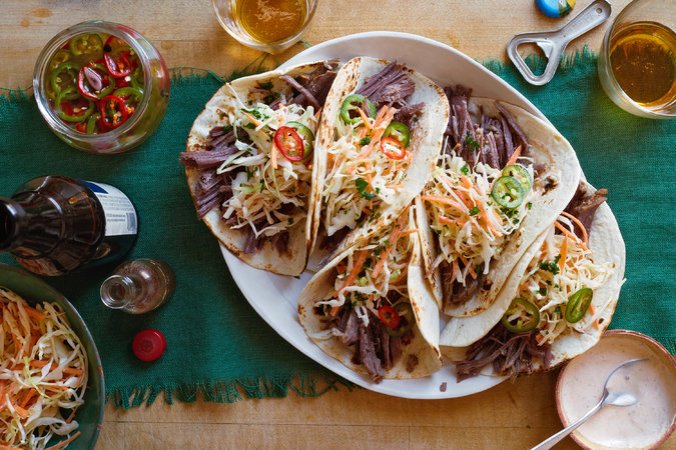
A bright cabbage slaw and a flour tortilla complement corned beef’s fatty saltiness. Credit Melina Hammer for The New York Times

Vegetarians, look away. Guests who have enjoyed the food program at Chan Chich Lodge, and have visited Gallon Jug Farm, normally come to know our commitment to fresh, all natural menu items. Including some of the finest beef in the world. And fresh tortillas. And bright cabbage slaw. Habaneros nearby. And a cold Belikin beer to accompany the meal. As Chef Ram explores all the options that the farm allows for his kitchen, we can imagine him making good use of the book below, brought to our attention by the Food Editor at the New York Times:

What if You Could Make Great Corned Beef?

By

51gO0bcPi8L._SL500_AA300_.jpg…You can do it easily, said Michael Ruhlman, a passionate advocate of the process and the author, with Brian Polcyn, of “Charcuterie: The Craft of Salting, Smoking and Curing.” You need only start by corning your own beef. “You can achieve tastes that aren’t available in the mass-produced versions,” he said. “Also, it’s a genuine thrill to transform plain old beef into something so tangy and piquant and red and delicious.”

Corned beef takes its name from the salt that was originally used to brine it, the crystals so large they resembled kernels of corn. Curing and packing plants in Ireland used that salt in the 19th century to cure slabs of beef that went into barrels, later cans, and onto ships to feed, among others, British colonists, troops, slaves and laborers across the globe. Eventually someone in Boston or the Bahamas fished out a cut of beef neck or a brisket and boiled it into submission with a head of cabbage, and that was dinner. Continue reading

A Novelist, Birding, Wades In Murky Territory

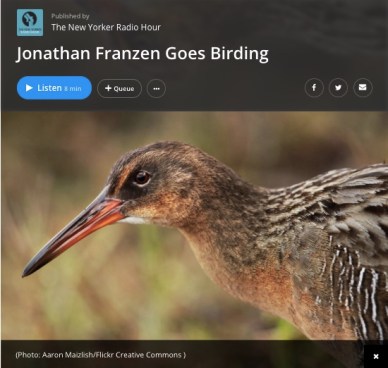
FranzenWNYC.jpgIn 2012 we started a string of posts featuring him, but have not linked to a Franzen-related birding story in a while. Best in epic category was likely here. Last time might have been here. He would no doubt love Chan Chich Lodge. If you appreciate his passion for birds, you should take a few minutes and listen to this, featuring him during an outing near his home:

Before achieving success as a novelist, Jonathan Franzen couldn’t imagine doing something just for fun.  But now, he’ll spend an entire afternoon dodging puddles of manure for the pleasure of looking at birds, “these very visible, very beautiful, very intelligent bipeds who are a lot like us.” Through the “portal” of birds, Franzen says, we can get to know the natural world.  He took our producer Rhiannon Corby along on a trip to MoonGlow Dairy, near on Monterey Bay, where the birds are as plentiful as the cow pies. Watch your step!

Galapagos, Bird Behavior & More Great Science Writing

07BOOBIESJP2-jumbo-v3.jpg

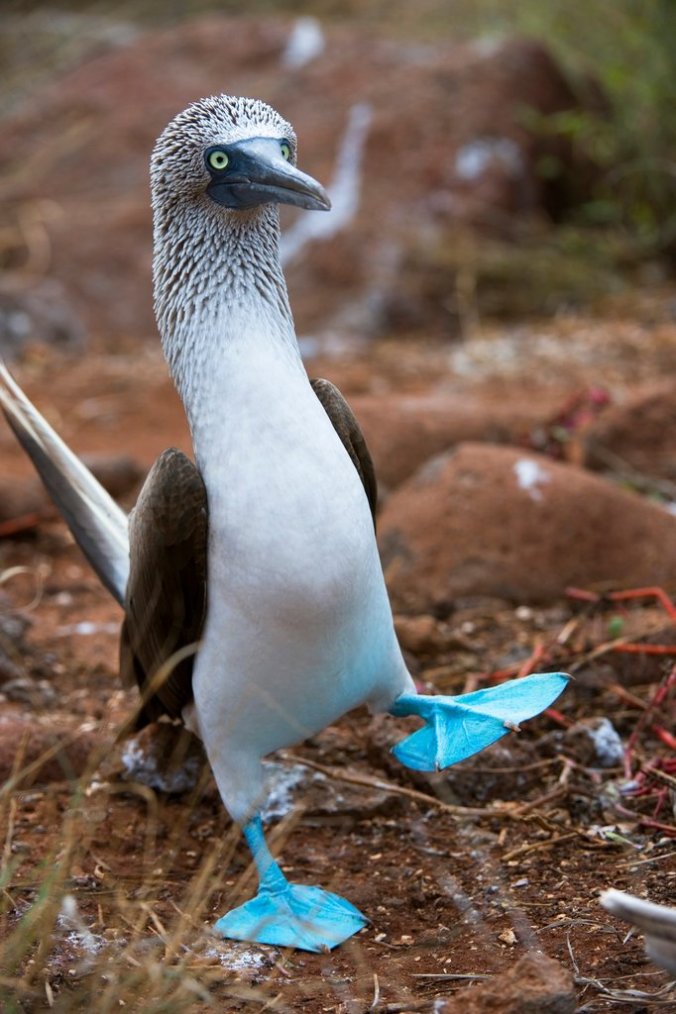
A booby doing its mating dance. Credit Wolfgang Kaehler/LightRocket, via Getty Images

We had missed one of our favorite science writers for a while and we are so happy she is back! In her latest outing, covering ground we thought was already familiar, we get some new clues to the meaning of their coloration and rituals:

On Galápagos, Revealing theBlue-Footed Booby’s True Colors

With no real predators, the birds live proud, public lives. That accessibility has proved a bonanza for scientists, casting light on their mating habits and even why the shade of their feet matters.

By Natalie AngierContinue reading

Chan Chich Wildlife

CCLBoard.jpg

A couple weeks back, there were a string of remarkable sightings, recorded by guests in a series of photos and then listed on the board by the Chan Chich Lodge reception area. That was a good preview for what happened yesterday, when guests arriving to the Lodge encountered a mature jaguar crossing the road. Continue reading

Marvelous Marvin’s Magical Mysteries

17039220_1419637051415082_6579151992410107862_o

At Chan Chich Lodge, in the northwest of Belize, something brings loyal guest back year after year, sometimes multiple times a year. There are many guests who have been coming to Chan Chich year after year for decades; there are more than a handful of guests who have had more than 200 total night stays at the Lodge, one couple approaching 300 nights and at least one couple approaching 400 nights. Having grown up in this business and knowing no other business, I do not have metrics to compare this level of loyalty to any other kind of business. Continue reading

Carbon, Climate, Concern & Confusion

4754.jpg

Americans love clean energy and climate policies. Photograph: Alamy

 Odd, but noteworthy (thanks to the Guardian for this article its environment section):

There’s broad support for climate policies in every state and county, but Americans view global warming as a distant problem

The Yale Program on Climate Change Communication published the findings of its 2016 survey on American public opinion about climate change. The results are interesting – in some ways confusing – and yet they reveal surprisingly broad support for action to address climate change. The Yale team created a tool with which the results can be broken down by state, congressional district, or county to drill down into the geographic differences in Americans’ climate beliefs. Continue reading

Diving For Megalodon

cohen-aprehistorickillerburiedinmuck-1200

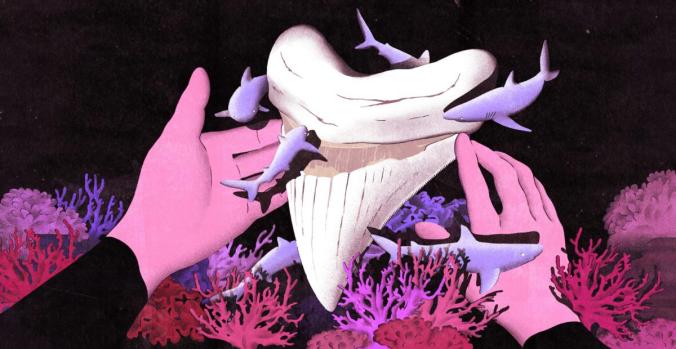
Hunting the teeth of the Megalodon, the largest shark that ever lived, can be very profitable—and very dangerous. ILLUSTRATION BY JEE-OOK CHOI

Thanks to Brent Crane for this posting about a search for one of prehistory’s wonders:

On a sunny January morning outside Richmond Hill, Georgia, Bill Eberlein, a fifty-two-year-old former I.T. specialist, went diving in a local creek. He wore a wetsuit, a drysuit, a dive hood, and an orange kayaking helmet affixed with a waterproof headlamp, whose ten thousand lumens would afford him six inches of visibility under the murky water. Continue reading

Impossible’s Intriguing Inclination

Impossible.jpgMeatless is not even a concept yet for some, but we’re working on that. Many of us contributing on this platform have already started taking it seriously even if not totally converted–reducing meat consumption rather than going all out vegetarian, let alone vegan–for all kinds of good reasons.

We have already expressed our interest as best we can without having yet tasted one of these, but thanks to this Guardian review we are now a step closer to the impossible. We do not need to have tasted it to have high expectations and hopes to match the ambitions of the company:

Impossible Foods is on the cusp of big things. But as the company lines up its first burger chain, it still needs to show it can convert the meat-loving masses Continue reading

Cacao’s Curious Clues

4TB-amazon1-superJumbo.jpg

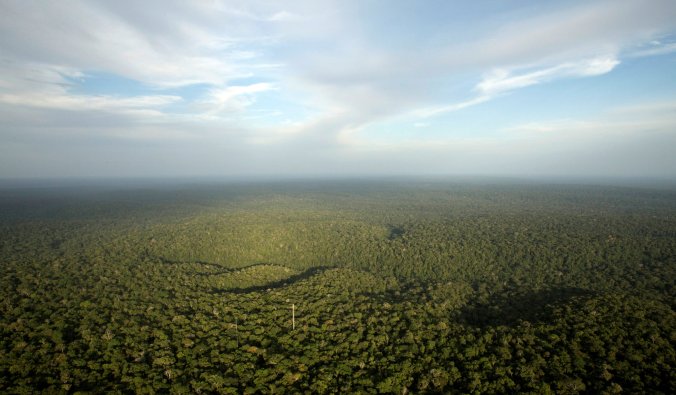
A view from the Amazon Tall Tower Observatory in São Sebastião do Uatumã, Brazil. A new study examines correlations between plant species in the forest today and archaeological finds. Credit Bruno Kelly/Reuters

Different day, different location, and our interest in cacao is  piqued again:

How the Amazon’s Cashews and Cacao Point to Cultivation by the Ancients

By

Scientists studying the Amazon rain forest are tangled in a debate of nature versus nurture.

Many ecologists tend to think that before Europeans arrived in the Americas, the vast wilderness was pristine and untouched by humans. But several archaeologists argue that ancient civilizations once thrived in its thickets and played a role in its development. Continue reading

Last Of A Kind

what-do-you-call-the-last-of-a-species-1200

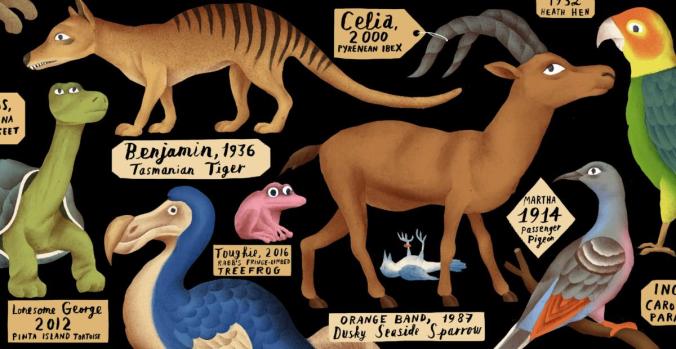
The word “endling” has given artists, writers, and others a new way to reckon with the meaning of extinction. ILLUSTRATION BY BJØRN LIE

Douglas Adams provided my first adult consideration of extinction, after a childhood fascination with dinosaurs, which I loved in part because of the mythology that their extinction seemed to encourage; Last Chance to See was an eye-opener, sad, funny and more. So this post on the New Yorker website catches my attention. Same depressing topic, with a New Yorker twist of wit:

WHAT DO YOU CALL THE LAST OF A SPECIES?

By Michelle Nijhuis

When Robert Webster, a physician in Jasper, Georgia, died, in 2004, he was survived by his wife of more than half a century, two daughters, four grandchildren, and a single word, which he had coined himself: “endling,” defined as the last person, animal, or other individual in a lineage.

Continue reading