Thank You National Public Radio (USA)

gettyimages-461032685-d9e390da618284547ffcceb14e2c93177fe08e0a-s1400-c85.jpg

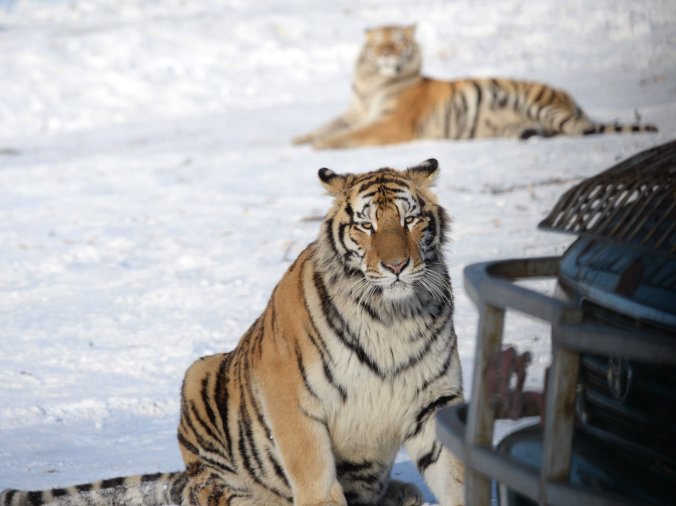
In this 2014 photo, two Siberian tigers rest beside a gamekeeper’s vehicle at the Harbin Siberian Tiger Park in China’s Heilongjiang province. Goh Chai Hin/AFP/Getty Images

We watched this video, from a link on social media that sometimes offers excellent, informative material related to the animal kingdom, wilderness, and conservation; but this turned our stomach so we are happy that NPR gives it exactly the kind of attention it deserves:

The Problem With That Video Of Tigers Squaring Off With A Drone

By Colin Dwyer

The video of about a dozen hefty Siberian tigers chasing and batting a flying drone from the sky seemed a lighthearted reprieve from the more serious news of the day. But since sharing the footage, we’ve become aware that it may conceal a darker story. Continue reading


A Serving Of Tradition, If You Please

mexico-mole-slide-DWS8-jumbo.jpg

We are close to this tradition, geographically anyway, both in Belize and in Baja California Sur where members of our team are, so we must pass this along:

The New Age of Traditional Mexican Mole

The country’s top chefs are reinventing the complex sauce — 10, 20, even 30 ingredients at a time. Continue reading

If You Happen To Be In The Deep South

25TB-Eclipse-master768.jpg

An annular solar eclipse as seen in Utah in May 2012. A similar “ring of fire” eclipse will be visible in the southern hemisphere on Sunday. CreditRobyn Beck/Agence France-Presse — Getty Images

For our friends and colleagues in the south, both in the Americas and in Africa, an astrophysical rarity will be in the night sky, not to be missed:

Cue the Johnny Cash music. On Sunday, a “ring of fire” eclipse will blaze over parts of South America and the southern and western tips of Africa. Scientifically known as an annular eclipse, this solar phenomenon occurs when the moon moves in between the sun and the Earth but is too far away to completely block the sun as it would during a total solar eclipse.

“Because you have this thin little ring around the edge of the moon where the sun pokes out, it gives it that ring of fire effect,” said C. Alex Young, a solar astrophysicist from NASA. Continue reading

Oh Amazon, Where Art Thou?

time-lapse-tablet.jpg

By The New York Times

It is a heavy read, but now is not the time to shrink away from the tough news. Something can be done, and something must be done. Soon. Thanks to the New York Times for the reporting on this topic:

Amazon Deforestation, Once Tamed, Comes Roaring Back

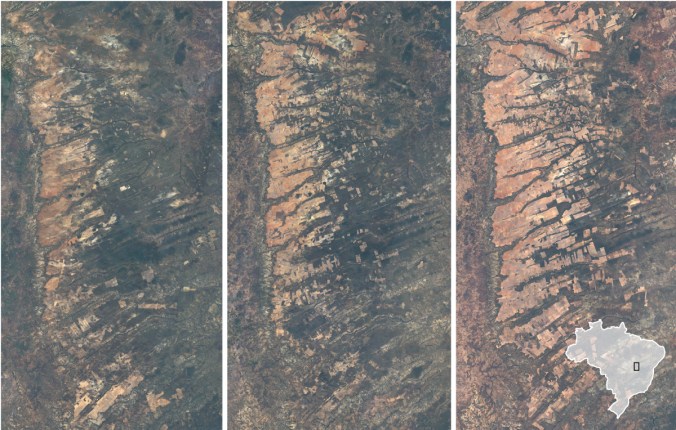
A decade after the “Save the Rainforest” movement captured the world’s imagination, Cargill and other food giants are pushing deeper into the wilderness. Continue reading

Scott Chaskey, Inspiration

Chaskey.jpgI had not heard of him before, but as we move the Chan Chich Lodge farm to table program forward it is instructive to listen to him speak about his journey:
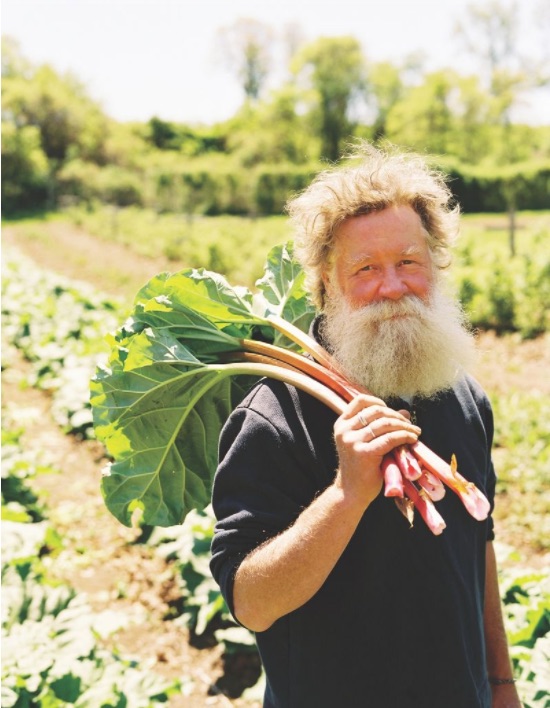
Farmer, poet, and pioneer of the community farming movement, Scott Chaskey is the kind of progressive thinker that doesn’t come around often. Weaving together his passion for farming and prose, the 66-year-old has penned multiple books on the community farming movement, creating a road-map for Americans who want to live off the land as a community. He talks to Here’s the Thing host Alec Baldwin about deciding to “eat consciously,” watching his love for the earth go global, and the food his kids hid from him when they were little.

This also has me looking at his books: Continue reading

Forest Attrition Distance

24tb-forests-master768.jpg

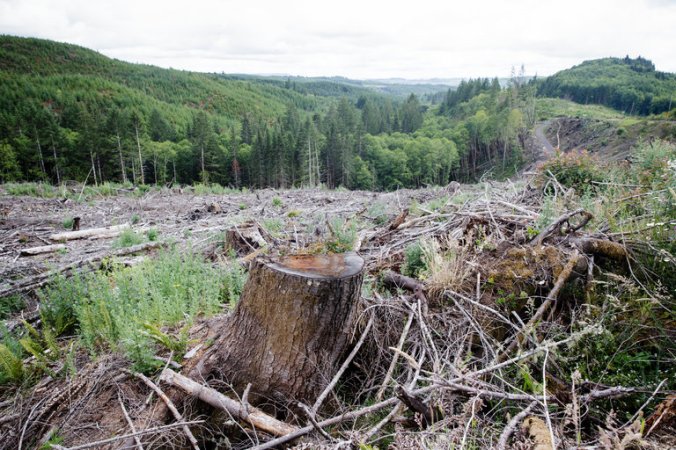
A forest in Oregon along Highway 30, part of which has been clear-cut. Researchers say the average distance to the nearest forest from any point in the continental United States widened in the 1990s. Credit Leah Nash for The New York Times

Thanks to the Science section of the New York Times, for the description of the research as well as for the name of the measurement:

How Far to the Next Forest? A New Way to Measure Deforestation

Looking Forward To The Debate On Nature As Climate Technology

Nature_Poster.jpg

We cannot help wondering, with the political upheavals in the USA and Europe, what will become of our commitments to take care of serious environmental issues, and specifically climate change; we are looking forward to this debate on the Intelligence Squared podcast, and will post a reminder when the podcast drops:

NATURE: OUR BEST CLIMATE TECHNOLOGY?

It was historic. The 2015 Paris climate agreement saw every member country of the UN pledge to cut its carbon emissions to zero by the second half of this century and keep global warming at well below 2°C above pre-industrial levels.

There’s just one problem. To reach this goal the world would need to shut down all of its coal-fired power stations by 2025 and ditch the combustion engine entirely by 2030. To reach its own targets, the UK will need to decarbonise the vast majority of its electricity supply within a mere 15 years. Eliminating fossil fuels this way is going to be extremely challenging. An extra lever is needed to reach the Paris climate targets. But from where? Continue reading

Model Mad, Icon


petrusich-harrybelafonteandthesocialpowerofsong-800

A new anthology of the work of Harry Belafonte, pictured here in the nineteen-forties or fifties, reiterates his standing in American music. PHOTOGRAPH BY BETTMANN / GETTY

There was an editorial a few days ago that alerted us to the birthdays of two buddies, each on icon in his own right, who have 70 years of solidarity in the tough times, and best of times too. It also alerted us to the time since our last post with the model mad theme, so here is one more:

HARRY BELAFONTE AND THE SOCIAL POWER OF SONG

By Amanda Petrusich

Sixty-one years ago, in 1956, Harry Belafonte recorded a version of the Jamaican folk song “Day-O,” for his third studio album, “Calypso.” It opens with a distant and eager rumbling—as if something dark and hulking were approaching from a remote horizon. Belafonte—who was born in Harlem in 1927, but lived with his grandmother in a wooden house on stilts in Aboukir, a mountain village in Jamaica, for a good chunk of his childhood—bellows the title in a clipped island pitch. The instrumentation is spare and creeping. His voice bounces and echoes as it moves closer. It sounds like a call to prayer. Continue reading

Urban Renewal We Can Relate To

copenhgn2

We like the sound of it:

In Denmark, Brewery’s Departure Offers a Chance to Go Green

By

Copenhgn3.jpgCOPENHAGEN — Perched in his centrally located office, Laust Joen Jakobsen looks out onto a small plaza, a rooftop basketball court and a grass bed that will be lush with flowers by the summer.

Just months ago, Mr. Jakobsen, the rector of University College Copenhagen, was sitting in a suburban campus between parking lots and a residential neighborhood. “We are happier here when we look out the windows,” he said. Continue reading

The Future Of News

2503_cover_beigeThe purpose of this, where I am typing this just now, is to share information. Sometimes that information comes in the form of a personal story, which is highly subjective but informative about the challenges, the innovations, and accomplishments related to conservation and the wellbeing of communities around the world. We depend on the New York Times for this kind of information every day, and more days than not we link out to stories they publish related to the environment, community, or other topics of interest on this platform; so this story matters to us:

ARTHUR GREGG SULZBERGER doesn’t remember the first time he visited the family business. He was young, he says, no older than 6, when he shuffled through the brass-plated revolving doors of the old concrete hulk on 43rd Street and boarded the elevator up to his father’s and grandfather’s offices. He often visited for a few minutes before taking a trip to the newsroom on the third floor, all typewriters and moldering stacks of paper, and then he’d sometimes go down to the subbasement to take in the oily scents and clanking sounds of the printing press. Continue reading

Healthy Prairies & Space Cowboys

Thanks to Cool Green Science:

Space Cowboys: A New Generation of Prairie Keepers

Continue reading

Truffle Entrepreneur, Immigrant Son’s Success

lavin-howatexasteen-agerbecamenewyorkcitystoptruffledealer-800

Ian Purkayastha, the twenty-four-year-old wunderkind behind the luxury-food company Regalis, aims to “demystify this bourgeois product for a new generation.” PHOTOGRAPH BY KRISTIN GLADNEY / WIEDEN+KENNEDY

It could just be that I have had a nearly two-decade love for truffles; or the storyline combining entrepreneurship, economics and food, a mix that I favor; or maybe my being the son of an immigrant explains my response to this post at the New Yorker’s website; probably it is because I can almost picture my own son in such a story, in a parallel universe; whatever, enjoy:

HOW A TEXAS TEEN-AGER BECAME NEW YORK CITY’S PREMIER TRUFFLE DEALER

On a bare side street in Long Island City, Queens, beside Oh Bok Steel Shelving & Electric Supply, the Regalis luxury-food company keeps its goods. Upon entering the warehouse through a small red door, a visitor is immediately greeted by an intoxicating and pungent scent: the unmistakable, and nearly indescribable, odor of truffles. Continue reading

Cleaner Cook Stoves

smoky-cookstove.jpg

Image: Gumilang Aryo Sahadewo/Flickr

Thanks to Anthropocene:

Tackling climate change through cleaner cookstoves

Love Your Seagrass

shutterstock_142303630.jpg

Seagrass meadow © Rich Carey / Shutterstock.com

Thanks to Cool Green Science:

New Science Shows Seagrass Meadows Suppress Pathogens

NatureNet Fellows Science Update

It was a rough bout of illness while she and her colleagues were studying corals in Indonesia that first focused Nature Conservancy NatureNet Science Fellow Joleah Lamb’s attention on the disease-mitigating possibilities of seagrass meadows. Continue reading