We published this post in the early period of this site, but the beauty of the subject and the timeliness of the season begs its redux…
The colorful stars that begin to grace Kerala buildings in December from homes, to businesses, to places of worship have humble beginnings despite their current flashy status. The were originally a simple white 7 point star that correlated with the beacon leading to the Christmas manger.
Many of these folded and cut paper stars are the handiwork of a group of women in a fishing villages around the southern Kerala city of Kollam. Continue reading →
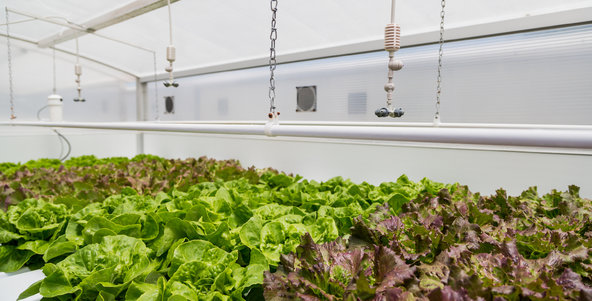
Are vegetables grown hydroponically as nutritious as those grown in soil?
The bottom line is it depends on the nutrient solution the vegetables are grown in, but hydroponically grown vegetables can be just as nutritious as those grown in soil.
“Much as I think that soil is just great for growing plants, hydroponics has come a long way,” said Marion Nestle, a professor of nutrition, food studies and public health at New York University. “I’ve seen hydroponic producers who have tested their leafy greens for key nutrients, and the amounts fall well within normal limits for their crop and are sometimes even higher.” Continue reading →
Thanks to Jessica Leigh Hester for her article in the upcoming issue of the Atlantic–Big in Japan: Tiny Food, The joy of cooking in miniature–which helps us put 2016 into some kind of perspective (we cannot articulate the perspective, just that this is as good as any other story to help us make sense of it):
The broth sizzles in a tiny pot hung over a flame on a miniature irori, or “hearth.” A knife the size of a pinkie finger nudges minuscule cubes of tofu from a palm-size cutting board. Flakes of seaweed tumble off a spoon pinched between a thumb and finger. A couple of minutes later, a tiny ladle dishes the finished miso soup into bowls no bigger than a thumbnail. Continue reading →
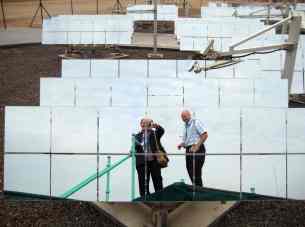
Vidal visiting the experimental solar thermal power plant on the outskirts of Masdar, UAE, in 2011.
When the photograph to the left was taken we were just starting to gather stories here. John Vidal was the veteran among major news-gathering organizations and the Guardian had shown leadership with an Environment section. Not always pleasant, but fair to say that Mr. Vidal has balanced the good, the bad and the ugly better than most. Thanks to him for that.
In 27 years as environment editor at the Guardian, I have seen both devastation and progress. Now I’m retiring – but I still have hope for the future of the planet
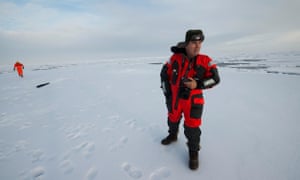
John Vidal on an Arctic ice floe in 2012. Photograph: Daniel Beltrá/Greenpeace
In September 1989, Guardian editor Peter Preston took me to one side. “Environment? Your idea. You do it,” he said. I was on the arts desk and had quite forgotten that, two years earlier, I had proposed that we cover this fast-emerging issue in more depth and with new pages. Continue reading →
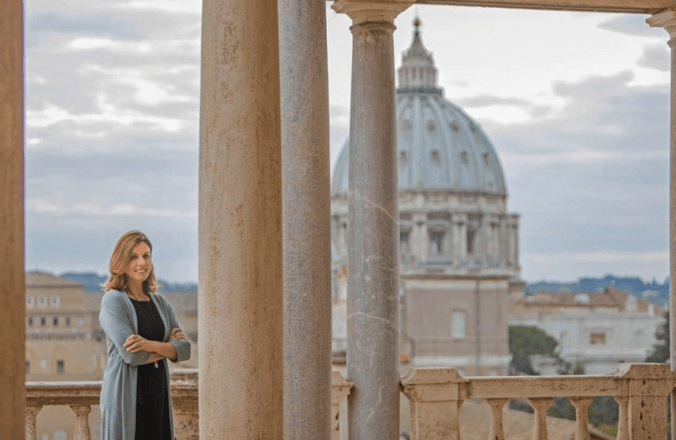
Barbara Jatta will oversee an institution that is one of the Holy See’s major sources of funds with about $311 million in gross revenues a year. PHOTO: VATICAN MUSEUMS
Without religious affiliation, we’ve applauded the current pope’s embrace of environmental protection and other progressive leaning policies. In a current political atmosphere where gender often overrides qualification, we appreciate this appointment all the more.
ROME—The Vatican Museums, one of the world’s pre-eminent art collections, announced Tuesday that Barbara Jatta, an Italian art historian and longtime Vatican official, will become its new director, making her the first woman to hold one of the most prestigious jobs in the art world.
The appointment by Pope Francis, which is effective Jan. 1, will also make Ms. Jatta the most prominent female administrator at the Vatican. The pope has spoken about expanding the roles of women in the Catholic Church, but most high Vatican offices are reserved for cardinals and bishops, who must be men. (Margaret Archer, a British sociologist, was named president of the Pontifical Academy of Social Sciences, an advisory body to the pope, in 2014.)
The Museums, which include priceless masterpieces including the Sistine Chapel frescoes by Michelangelo, regularly appear among the world’s top 10 museum complexes by attendance, with over six million visitors in 2015. The collections include 70,000 objects, dating back from antiquity through the 20th century. Continue reading →
A test phase will evaluate whether the solar panel road can provide enough energy to power street lighting. Photograph: Christophe Petit Tesson/EPA
When we think of Normandy, apples and oysters come to mind. Calvados, too. We are happy those traditions endure but even happier to see the roads there as a hotbed of environmental innovation:
The proposals threaten indigenous territory in Brazil, opponents say. Photograph: Alamy Stock Photo
We hear it is coming to the USA after inauguration next month, and has been a tendency in tough times in many places–relaxing environmental protections to encourage economic growth. Bad ideas have a way of spreading and our thanks to the Guardian for their observations in Brazil:
Environmental and indigenous activists condemn plan they say would threaten indigenous territories and make compliance with Paris deal impossible Continue reading →
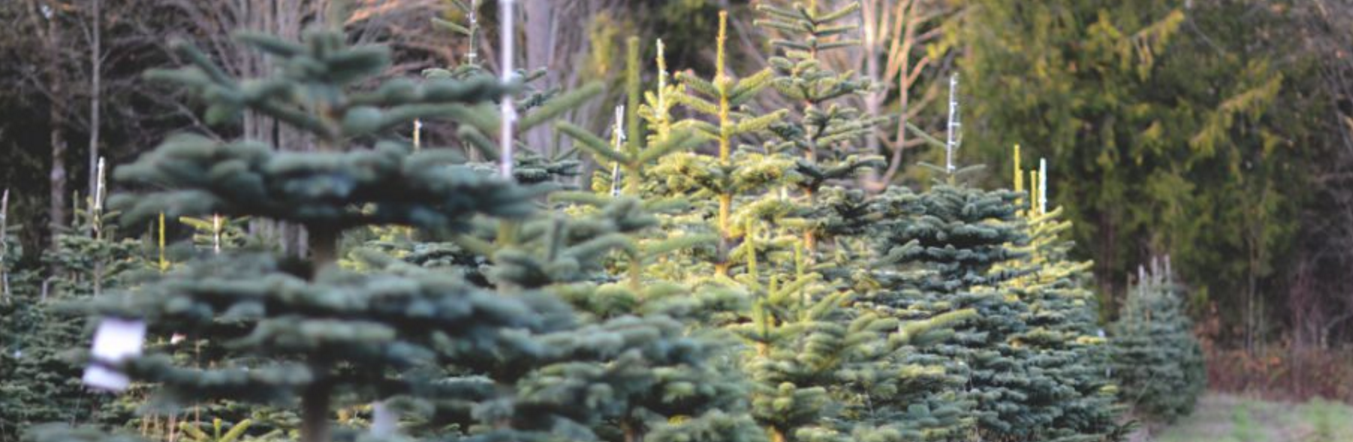
Tis the season for an age-old question: Which kind of Christmas tree – real or fake – is better for the environment?
We love this question, because it’s an example of a simple choice that anyone and everyone can make that can reduce our impacts on the environment.
We also love this question because, like many environmental issues, the answer isn’t as simple as you might think. Our #1 recommendation? Buy a real tree. Read on for more details on the impacts of both real and fake Christmas trees, and then make the choice that’s right for you. And check out our 12 Tree Tips for other earth-friendly holiday decoration tips.
REAL CHRISTMAS TREES
In 2015, 26.9 million trees were purchased from live Christmas tree farms – more than twice the number of fake trees purchased (12 million). Continue reading →
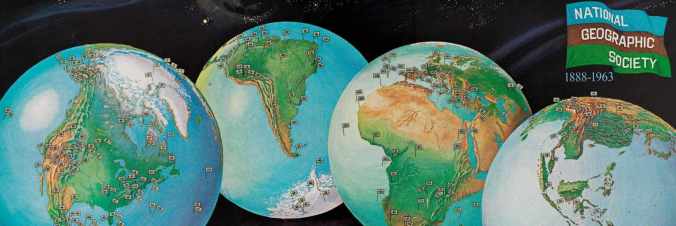
The best infographics from the National Geographic archives
Back in the days when the information age was a distant dream and the world a more mysterious place, National Geographic began its mission to reveal the wonders of history, popular science, and culture to eager audiences around the globe. Since that 1888 launch, the world has changed; empires have risen and crumbled and a galaxy of information is today only a click away. But National Geographic endures; its calm, authoritative voice is as respected as ever amid the surfeit of data in our daily lives. Continue reading →
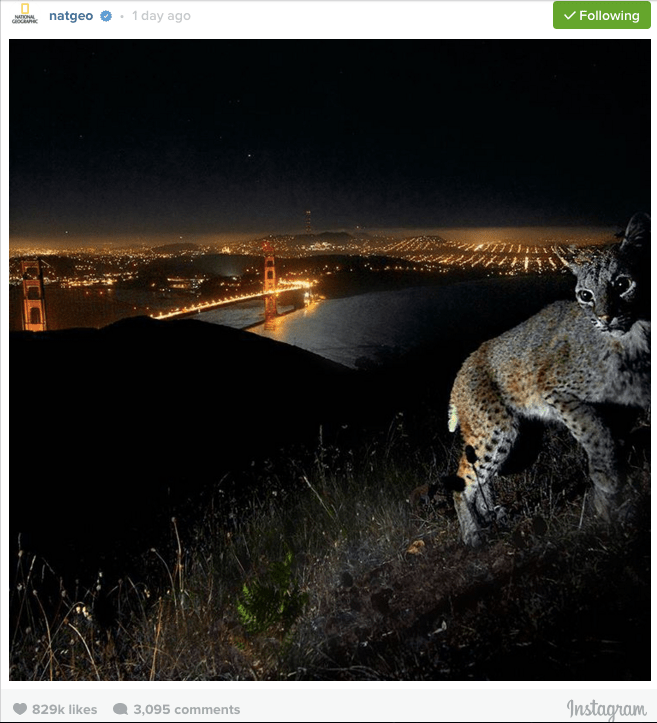
Seldom seen, bobcats rarely will stand still for a photo.
But every once in a while the shy, nocturnal feline will take a selfie — although not intentionally, of course.
This one triggered a remote camera hidden on a ridge in the Marin Headlands overlooking San Francisco and the Golden Gate Bridge. The camera was set up by National Geographic photographer Steve Winter.
The photo was posted today on the National Geographic’s Instagram account, but it’s apparently several years old. Continue reading →
We made a commitment in 2011 at the time we started this platform to search for and share as much positive news as we could find on entrepreneurial conservation, scientific and social innovations that improve life in developing countries, and such. We do not avoid “bad news” with pollyanna blinders on, but share more enlightening news that does not get enough attention. We occasionally share doomsday analysis; it is difficult to avoid some of the trends pressing down on us all. Thanks to the New York Times for digging this one out of the archives, which will relieve us a bit when we come across and process doom and gloom:
Editors’ note: We’re resurfacing this story from the archives because who wouldn’t want to master their emotions?
LAST month, in San Jose, Calif., 21 people were treated for burns after walking barefoot over hot coals as part of an event called Unleash the Power Within, starring the motivational speaker Tony Robbins. If you’re anything like me, a cynical retort might suggest itself: What, exactly, did they expect would happen? In fact, there’s a simple secret to “firewalking”: coal is a poor conductor of heat to surrounding surfaces, including human flesh, so with quick, light steps, you’ll usually be fine. Continue reading →
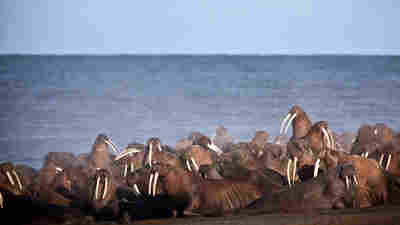
Walruses rest on the shores of the Chukchi Sea, the vast majority of which was designated off-limits to drilling on Tuesday. Ryan Kingsbery/AP
It is impossible to predict what will happen 2017 onward to these final environmental initiatives of the outgoing President of the USA. Nonetheless, we will cheer his efforts on behalf of conservation right to the very end of his term. Thanks to National Public Radio (USA) for this news:
“These actions, and Canada’s parallel actions, protect a sensitive and unique ecosystem that is unlike any other region on earth,” the White House said in a statement. Continue reading →
Emerging markets are leapfrogging the developed world thanks to cheap panels.
by Tom Randall
A transformation is happening in global energy markets that’s worth noting as 2016 comes to an end: Solar power, for the first time, is becoming the cheapest form of new electricity. Continue reading →
What make Cabo Pulmo a success story is its people: when faced with the dilemma to either continue fishing or to turn towards conservative goals, the community decided they needed to change. Continue reading →







 Organikos