Exclusive Clip: DiCaprio’s Climate Doc Exposes Destruction of Rainforest for Palm Oil as Huge Driver of Global Carbon Emissions
Rainforest Action Network
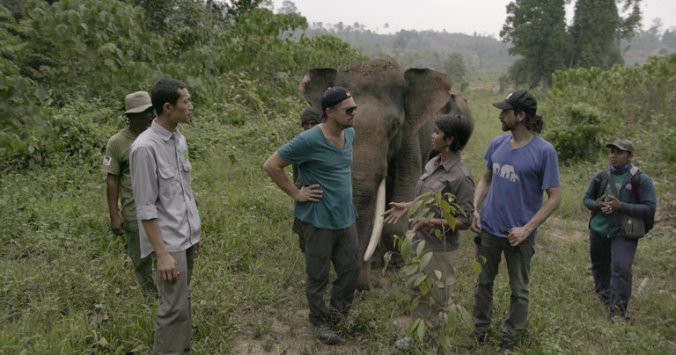
A new documentary produced and starring actor and activist Leonardo DiCaprio premieres in Los Angeles today and will be broadcast globally in 45 languages in 171 countries on the National Geographic Channel starting Oct. 30, timed to air in advance of the November elections. Continue reading
Returning Rivers To Their Natural State

A view of the Milford Dam. After the removal of two large dams downriver, the Milford Dam is now the first barrier fish face when ascending the Penobscot River. Credit Murray Carpenter
We are thrilled to read about the rivers getting their groove back:
Taking Down Dams and Letting the Fish Flow
By
BANGOR, Me. — Joseph Zydlewski, a research biologist with the Maine Cooperative Fish and Wildlife Research Unit of the United States Geological Survey, drifted in a boat on the Penobscot River, listening to a crackling radio receiver. The staccato clicks told him that one of the shad that his team had outfitted with a transmitter was swimming somewhere below.
Shad, alewives, blueback herring and other migratory fish once were plentiful on the Penobscot. “Seven thousand shad and one hundred barrels of alewives were taken at one haul of the seine,” in May 1827, according to one historian. Continue reading
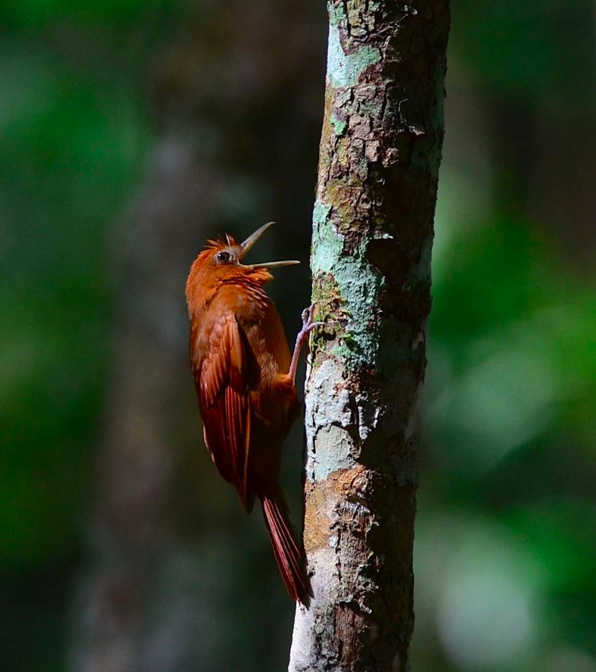
Bird of the Day: Ruddy Woodcreeper
Genetic Engineering Versus GMO

E-maxx/Flickr.com
Thanks to Anthropocene for this summary of promising new findings for the GMO-concerned:
A novel approach to pesticide-free, non-GMO food?
Sani Choice, Yasuni Future

Wildlife watch … the author’s guide, Victor, explores an area of flooded forest in the Yasuni national park, Ecuador. Photograph: The Guardian
The Guardian keeps attention on this difficult balancing act, requiring Solomonic wisdom, that we have linked to on more than one occasion:
Ecuador’s Yasuni park: where oil vies with tourism for the rainforest
The Sani people face a choice between encouraging ecotourism to their rainforest – one of the world’s most biodiverse – and allowing in the oil companies
Kevin Rushby
Fernando was sitting on his veranda listening to the whoops and whistles of the jungle. Our visit was a surprise, but the old man was soon answering my questions, keen to talk.
“I arrived here in about 1960,” he told me. “A group of us came to start a new life. Hunting was easy. The animals were almost tame. We just used a blowpipe, no guns.” Continue reading
Farms, Interns, Valuable Life Experience
We have a long, productive and gratifying history with internships, and so we take note when the Thanks to the Atlantic’s website for this:
The Benefits of Interning on a Farm
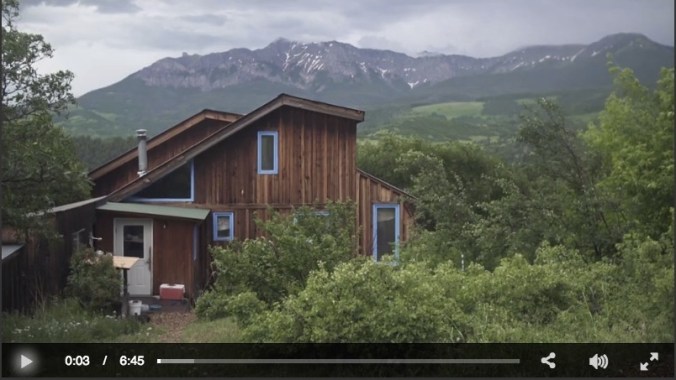
Video by The Perennial PlateHigh in the mountains of Telluride, Colorado, Tomten Farms offers the opportunity to learn agriculture through an internship program. Continue reading
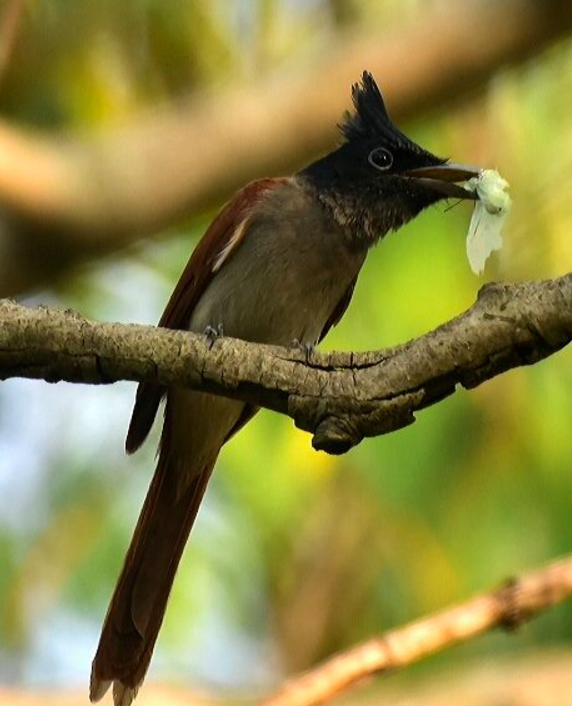
Bird of the Day: Asian Paradise Flycatcher
Carbon Capture’s Unintended Consequences

Photo: Ryan T. Flickr Creative Commons.
Be careful what you wish for as this summary of a new scientific study reminds us:
Could carbon capture fuel our carbon addiction?
Monkeys & Tools
Ed Yong’s recent story about this cleverest of creatures:
Rock-Smashing Monkeys Unintentionally Make Sharp Stone Tools
What this says—and doesn’t say—about the evolution of human technology
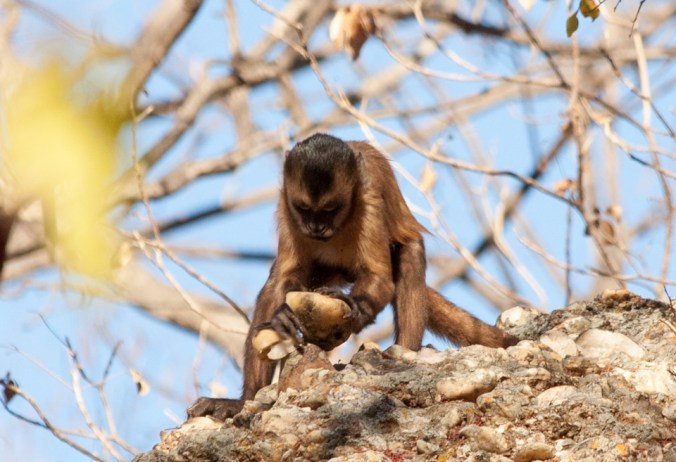
In 2014, Michael Haslam wedged between two boulders in northeast Brazil and filmed some monkeys. Oblivious to the voyeur, the monkeys—bearded capuchins—began smashing stones together. They lifted small cobbles into the air and brought these down upon a rock face, like a hammer upon an anvil. In the process, the hammer stones would often shatter.
After the monkeys had gone, Haslam picked up some of these broken fragments—and was amazed. Many had sharp edges, and looked remarkably like human tools. Continue reading
FishFace

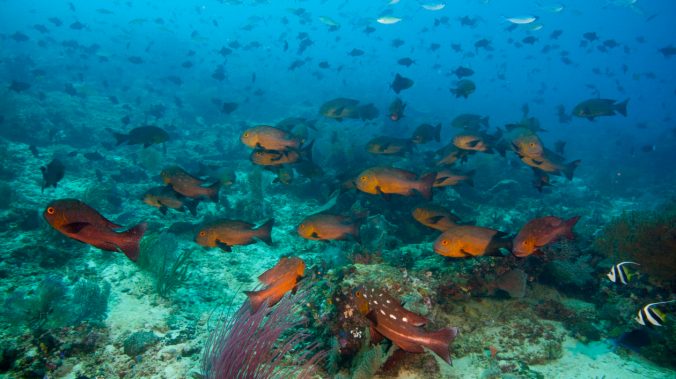
Midnight Snappers, Fusiliers, and Triggers school in deep water, photographed in the waters off Kofiau. Photo © Jeff Yonover
Nature Conservancy’s blog,
We Can Have Oceans Teeming with Fish with FishFace Technology
By Lisa Feldkamp
Traditional methods of gathering fisheries data can take as long as one or two years, costing time and money that many imperiled global fisheries don’t have.Enter FishFace, a new application under development by The Nature Conservancy in partnership with Refind Technologies. Similar to facial recognition software used to identify people, FishFace uses artificial intelligence to learn to recognize fish species in photographs. Continue reading
Bird of the Day: Grey Tit
National Park of the Week: Ras Mohammad National Park, Egypt

Pinterest.com
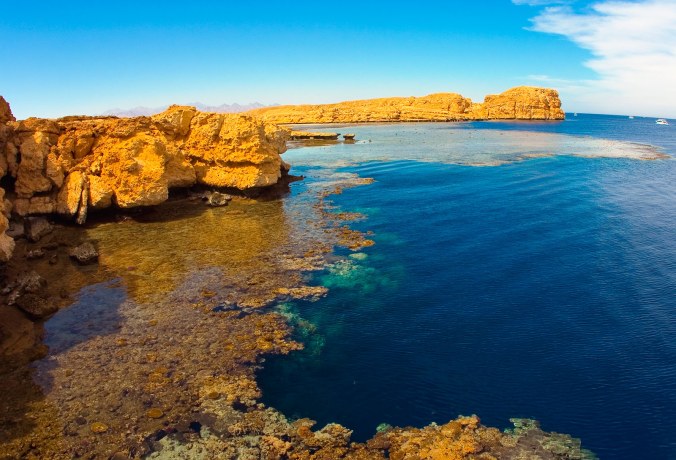
Overlooking the Gulf of Suez on the west and the Gulf of Aqaba to the east, Ras Mohammad National Park in Egypt lies at the southern extreme of the Sinai Peninsula and offers waters that are considered to be the jewel in the crown of the Red Sea. The coastline, characterized by vertical overhangs at least 100m deep, is surrounded by fringing coral reefs that emerged after a change in the coastline 70,000 years ago. Due to its location at the juncture of the two gulfs, the combining waters of varying salinity has lead to a magnificent array of reef and pelagic fish, diverse coral reef and luxuriant sea walls.
Solar Rising

A road divides solar panels at the Ivanpah Solar Electric Generating System in the Mojave Desert, Nevada. Photograph: Bloomberg/Bloomberg via Getty Images
Those of us who live near the Kochi Airport in Kerala, India feel pretty proud of our 100% solar-powered access to the outside world; but this story tells us to expect even more in the USA soon:
US energy shakeup continues as solar capacity set to triple
Solar expected to almost triple in less than three years by 2017 as coal continues to fall, solidifying gas as country’s chief electricity source, reports Climate Central
Bobby Magill for Climate Central, part of the Guardian Environment Network
Solar power capacity in the US will have nearly tripled in size in less than three years by 2017 amid an energy shakeup that has seen natural gas solidify its position as the country’s chief source of electricity and coal power continue to fade, according to monthly data published by the US Department of Energy. Continue reading
Health Via Happiness
Thanks to Harvard Magazine for this one:
RIGHT NOW | BENEFITS OF BLISS
Can Happiness Make You Healthier?
THE QUEST to study human happiness, including its causes and effects, even agreeing on a definition is a formidable undertaking. Joy, euphoria, contentment, satisfaction—each of these, at times, has been used as a proxy or emphasized in research studies. Continue reading
Remote Living, Well Done

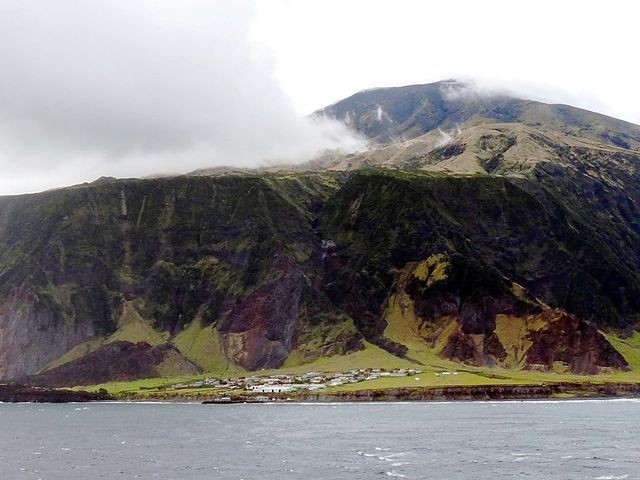
Edinburgh of the Seven Seas, Tristan da Cunha, South Atlantic Ocean michael clarke stuff / Wikipedia
Thanks to EcoWatch for keeping us posted on the greenish news from the bottom edge of the planet:
World’s Most Remote Village Is About to Become Self-Sufficient World’s Most Remote Village Is About to Become Self-Sufficient
The most remote village on Earth, located on Tristan da Cunha in the South Atlantic Ocean, is about to get a 21st century upgrade thanks to an international design competition aimed at creating a more sustainable future for the farming and fishing community. Continue reading
Bird of the Day: Muscovy Duck
New Study on How Boobies Dive Safely

Replicas of gannet skulls from the collection at the Smithsonian Institution allowed researchers to measure the forces a bird’s skill experiences during a dive. (Photo by Sunny Jung/Virginia Tech)
The title may seem silly, but I can’t help that a whole family of birds are alternatingly called boobies or gannets – most of us have heard of the Blue-footed Booby, but there are several other species, all of which hunt for fish by diving, head first, at extremely high speeds from many meters above the water. For a human entering water at fifty miles an hour, a neck injury would be a certainty, and even organ damage could occur, but boobies/gannets accomplish the dives plenty of times during a day’s hunting, with no apparent problem. It seems that their physiology, as well as the way they contract their muscles during the plunge, save them from harm. From the Smithsonian Insider:
New research from Virginia Tech, the Smithsonian’s National Museum of Natural History, the National Museum of Rio de Janeiro and the North Carolina Museum of Natural Sciences helps explain how the birds manage these high-speed dives.
“We were interested in what happens when objects plunge into water, so we looked for examples in nature; the gannets are incredible,” said Sunny Jung, an associate professor of biomedical engineering and mechanics in the College of Engineering and an expert in fluid biomechanics; he has also studied dogs’ unusual drinking technique and how shrimp use microscopic bubbles to hunt.
Public Art Pulling More Than Its Own Weight
Thanks to Anthropocene:
Art That Delivers Clean Water & Power
An international competition challenges designers to show that clean energy production and dazzling public art can be one and the same
Since 2010, the Land Art Generator Initiative (LAGI) has sponsored site-specific design competitions, soliciting ideas for public art that generates clean power. Its 2016 contest was the most ambitious yet. It called on designers to conceive of art installations that generate both clean power and water for the city of Santa Monica, California. Continue reading
Before the Flood

Leonardo DiCaprio in a scene from the global-warming documentary “Before the Flood.” Credit National Geographic
Have you seen it? Let us know if the reviewer got it right:
Review: In ‘Before the Flood,’ Leonardo DiCaprio Sounds the Climate-Change Alarm
Even if you subscribe to the view that a problem isn’t a problem until a Hollywood celebrity tells you it is, “Before the Flood” feels out of phase. It’s a documentary in which Leonardo DiCaprio sounds the alarm about global warming, something that could not possibly have escaped anyone’s attention in recent years and is at this point probably beyond discussion: Either you think climate change is real or you don’t, and the battle lines aren’t likely to be shifted by an earnest movie star. Continue reading

Rainforest Action Network