New Mouse Lemur Species Found

Microcebus ganzhorni is named in honor of the Hamburg ecologist Prof. Jörg Ganzhorn who has worked on ecology and conservation in Madagascar for more than thirty years. Photo by G. Donati via Mongabay.

Madagascar is a place of wonder and near-fantastical wildlife, though sadly many of their ecosystems are at risk, as referenced in this UNESCO World Heritage Site post. So it’s no surprise to read that new species are being found there. Mike Garowecki reports for Mongabay:

There are now 24 known species of mouse lemur, all of them found in Madagascar.

Scientists with the German Primate Center (DPZ), the University of Kentucky, the American Duke Lemur Center, and Madagascar’s Université d’Antananarivo have found three new species of mouse lemurs that live in the South and East of Madagascar. They described the new species — Microcebus boraha, Microcebus ganzhorni, and Microcebus manitatra — in the journal Molecular Ecology.

Though their name and appearance might suggest that they are rodents, mouse lemurs are in fact primates. What’s more, all mouse lemur species look extremely similar: they are small, nocturnal animals with brown fur and large eyes. It was only through the use of advanced methods that allow for more precise measurements of genetic differences that the team of researchers was able to establish the three new species.


Continue reading

If You Happen To Be In Atlanta

Vik Muniz Double Mona Lisa (Peanut Butter and Jelly), from the After Warhol series, 1999 Chromogenic print Galerie Xippas, Paris Art © Vik Muniz/Licensed by VAGA, New York, NY

It’s easy to be a fan of Vik Muniz’s work on so many levels: his visual wit redefining materials as medium for art; his entrepreneurial use of art to bring attention to disenfranchised communities; the collaborative spirit clearly evident in so many of his works… I, personally, love his cheeky reproductions of the world’s iconic artworks, rendered in the most banal of mediums.

A mid-career retrospective, currently mounted at the High Museum of Art Atlanta covers the full range of his work from grand to microscopic scale, using diverse media—including food, dust, string, sugar, magazine clippings, and literal junk.

On view through August 21, 2016.

Swallow-tailed Kite Conservation

Bird of the Day 9/19/15: Swallow-tailed Kite (Reserva El Copal, Costa Rica)

I’ve had the fortune of seeing this long-rumped raptor outside of the United States, where they are now considered rare despite their wide range throughout the Caribbean and Central and South America. And although the population did decrease in the last several decades, the IUCN does now list the species as having an “increasing” population trend. This interesting article in The Nature Conservancy, however, does raise concern over habitat loss and the species’ vulnerability. Ginger Strand reports:

Maria Whitehead yanks her feet out of the water as something crashes into Bull Creek next to the boat. Seconds later, a 10-foot-long alligator surfaces a few yards away. As the prehistoric reptile glides off, leaving a sinuous wake in the tannin-brown river, Whitehead casually retrieves her binoculars and goes back to watching a nest of swallow-tailed kites near the top of a soaring pine.

A project director for The Nature Conservancy in the South Carolina Lowcountry, Whitehead seems unfazed by nearly losing a toe on the job. So does Craig Sasser, manager of the Waccamaw National Wildlife Refuge. Wading into primeval cypress swamps, scaling 100-foot pine trees, paddling up tidal rivers through clouds of insects in triple digit heat: These are all part of researching swallow-tailed kites, a spectacular but poorly understood raptor.

Continue reading

Solar Improvements Increase Output Estimates

Update: Check out The Guardian‘s coverage of a new San Francisco law requiring solar panels on new buildings for 2017.

We’re always happy to see photovoltaics in the news, whether they’re installed in old golf courses, floating on rafts, powering an airport in Kerala, or remotely charging your phone via adaptor. So we’re not surprised to see that since 2008, US rooftop solar potential has doubled. From Conservation Magazine:

To take advantage of the sun’s energy to satisfy our ever-increasing need for electricity, Americans will have to take a fresh look at their roofs. A report by the National Renewable Energy Laboratory shows that if all suitable roof areas in the United States were plastered with solar panels, they would generate about 1,118 gigawatts of solar power. That is 40% of the power that Americans consume every year.

And that isn’t the half of it. The study only estimates the solar power potential of existing, suitable rooftops, and does not look at the immense potential of ground-mounted photovoltaics, said NREL senior energy analyst Robert Margolis in a press release. “Actual generation from PV in urban areas could exceed these estimates by installing systems on less suitable roof space, by mounting PV on canopies over open spaces such as parking lots, or by integrating PV into building facades. Further, the results are sensitive to assumptions about module performance, which are expected to continue improving over time.”

Continue reading

The Law Of Unintended Consequences

Google

A Google self-driving car. Photo © Grendelkhan / Wikimedia through a Creative Commons license

From Cool Green Science:

Why Driverless Cars May Make Cities Sprawl Even More

Continue reading

Snapshots In The Interest Of Our Environment

1170 (1)

@kellydelay captures a tornado-warmed supercell outside of Courtney, Oklahoma. Photograph: Kelly Delay

This story in the Guardian’s Environment section is told mostly with pictures, and is worth a minute’s review to consider how much more value we might extract from social media:

Sometimes, the best way to understand what’s happening on the other side of the world is to see it for yourself. Here are some of our favorite Instagrammers who focus on capturing our changing planet

Screen Shot 2016-04-21 at 7.45.44 AM

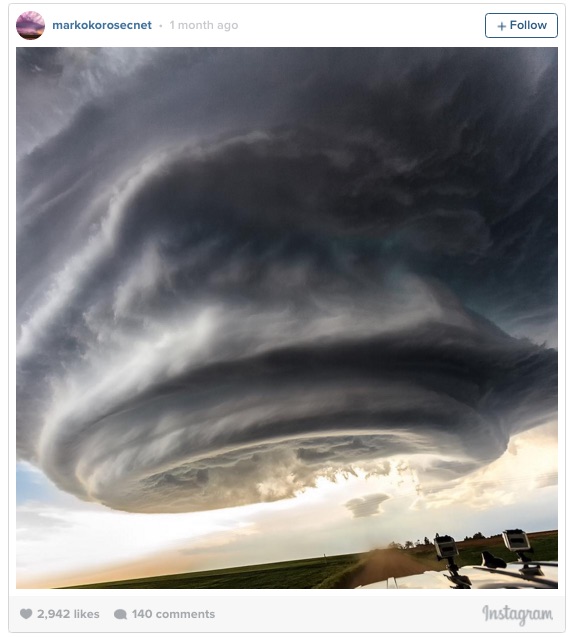
A storm chaser from Slovenia, Marko Korosec (@markokorosecnet) has been researching severe weather events through forecasting, chasing and analysis since 2000. He counts the above capture of a “spaceship” supercell storm in Colorado among his most memorable chases. It was like “an UFO landing on Earth”, he writes.

Read/view the whole article here.

US Currency Change Coming

We’ve reported on the positive alterations of currency before, when it was the British five-pound note that was becoming plastic instead of plant fiber. That was good news in terms of ecological footprint, because the plastic notes should live longer and thereby save materials in the long run. In the case of the US change with the five-, ten-, and twenty-dollar bills, the impact is less on the environment and more in the social arena: women would feature on paper currency for the first time in modern history. From the New York Times:

WASHINGTON — Treasury Secretary Jacob J. Lew on Wednesday announced the most sweeping and historically symbolic makeover of American currency in a century, proposing to replace the slaveholding Andrew Jackson on the $20 bill with Harriet Tubman, the former slave and abolitionist, and to add women and civil rights leaders to the $5 and $10 notes.

Mr. Lew may have reneged on a commitment he made last year to make a woman the face of the $10 bill, opting instead to keep Alexander Hamilton, to the delight of a fan base swollen with enthusiasm over a Broadway rap musical named after and based on the life of the first Treasury secretary.

Continue reading

If You Happen To Be In New York City

Screen Shot 2016-04-21 at 5.28.08 AM

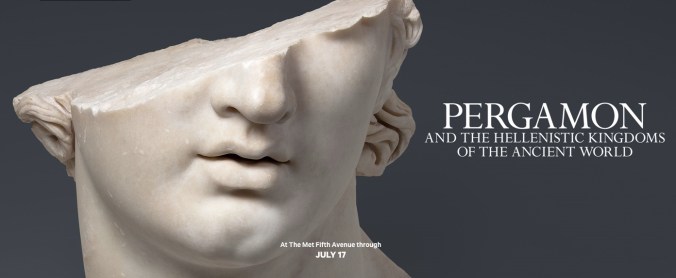
History can be dry, except when in the hands of masterful story-tellers. Which reminds us of James, and other scholars who have graced these pages in recent years with practical stories of the past linked to our present day lives. The value of this Pergamon exhibition (click the image above to go to the museum’s description of the exhibition) catches our attention because this review, which exemplifies the sort of interpretation that allows history to jump into our present tense:

…This tidal wave of wealth sloshed all around the eastern Mediterranean during the three centuries that followed, the era known today as the Hellenistic Age. It soaked the shores of the half-dozen new kingdoms carved out of Alexander’s conquests…

Read the description of this exhibition below, in the words of the Met’s curators, to get a renewed sense of the important role museums play in our civic lives.

The conquests of Alexander the Great transformed the ancient world, making trade and cultural exchange possible across great distances. Alexander’s retinue of court artists and extensive artistic patronage provided a model for his successors, the Hellenistic kings, who came to rule over much of his empire. For the first time in the United States, a major international loan exhibition will focus on the astonishing wealth, outstanding artistry, and technical achievements of the Hellenistic period—the three centuries between Alexander’s death, in 323 B.C., and the establishment of the Roman Empire, in the first century B.C. Continue reading

Of the Land


Tradition is like a collective memory, where craft and cultivation intermingle, inspired with stories of the land, its history and its culture.

Anoodha from Curiouser says “A stay at Xandari Pearl, is experiencing a slice of life, of the beautiful coastal town of Marari.”

Yes indeed.


Treetops Teeming

19REDWOODS-master1050-v2

Climbers, including a master instructor, made their way up Grandfather, an 800-year-old, 200-foot-tall redwood near Los Gatos, Calif., last month. Credit Steve Lillegren

A topic we have been coming back to on a regular basis for years–the value of biodiversity in general (we are not averse to stating the obvious in these funny times we live in) and in particular the as-yet still to be explored forest treetops–appears in the Science section of this week’s New York Times. Apart from reminding us of a tree-inclined scientific friend (Meg, of treetop science fame, we have just recently learned you are now out in the vicinity of these redwoods, and so we shout this one out to you!), and reminding us of one of the great long-form pieces of journalism on the same topic, it is worth a read:

An Orchidean Cryptid

A female juvenile orchid mantis chows down. Photo courtesy of James O’Hanlon via Science Friday

A few days ago we shared about the clade of flowers known as orchids, and how people in the UK can become citizen scientists regarding them. Now, Science Friday writer Julie Liebach (who also edits the site’s content online) explores the research of an entomologist studying a type of “praying” mantis that, as a juvenile, mimics the general feeling of the average orchid – but not a particular species or genus of the flowers, interestingly enough:

They’re predominantly white with pink or yellow accents, similar to some orchids and other flowers, and their four hind legs are lobed, like petals. But if you search for an exact floral counterpart, as behavioral ecologist James O’Hanlon did, you probably won’t find one. “I spent forever looking for a flower that they look just like,” he says, to no avail.

As it turns out, rather than mimicking one floral species, the insect instead may embody a “generic or an average type of flower” in order to attract bees and other pollinating insects as prey.

Continue reading

Bad News for Lionfish in Costa Rica, Good News for Costa Rica

After a long day of fishing, the lionfish are fried and served up with rice and beans. Lindsay Fendt/The Tico Times

We’re always keeping our eye out for updates on the lionfish situation, and that’s why we’re happy to see that some more efforts are being made in Costa Rica to control a problem that is pretty out of control. More from Lindsay Fendt from the Tico Times:

Local efforts to curb the encroachment of invasive species in Costa Rica’s Caribbean got a big boost this week with the formation of a National Commission for the Management and Control of Lionfish. The new commission will provide government support for Caribbean fishing associations that are already actively combatting the proliferation of lionfish (Pterois).

Introduced to the Atlantic Ocean from the Indo-Pacific sometime in the 1980s, the lionfish has been wreaking havoc on Caribbean fish populations. The fish can gobble up two smaller fish every minute and lay up to 30,000 eggs each year, depleting catches for fishermen and damaging the ecosystem. Though not the hardest hit country in the region, Costa Rica has approximately 90 lionfish per hectare and fishermen have reported an 80-87 percent decline in their catches since 2009 when the fish began to appear off the country’s coast.

Continue reading

Coffee Capsules Are Terrible For The Environment, Still

17REVALUED1-master675

An engineer measuring a K-Cup prototype at a Keurig Green Mountain lab in Burlington, Mass. Tony Luong for The New York Times

Way back when, early last year, I thought for sure this company was going to respond seriously to the challenge posed by the fun-yet-serious viral campaign highlighting its environmental atrocities. Many people I know and love use these machines or machines like them. These friends are generally serious devotees of the capsule machines due to their convenience.

Every person every time, once they learn about how environmentally irresponsible the capsule machines are (more specifically, the capsules themselves are the problem), seems genuinely horrified (or expresses some emotion akin to the one generated by the viral video). But, how many have given up the K-convenience? Hmmm. The notable quote in the following story implies that because demand for this convenience is growing, there is not much likelihood of abandoning the technology–expect continued tinkering for the time being (sounds like fiddling while Rome burned):

The Minecraft Generation

Screenshot of the first hour of survival mode in Minecraft

In this past week’s edition, the New York Times Magazine published a very interesting story by Clive Thompson about the popular video game Minecraft, which he argues is becoming an educational tool in a way, particularly in the arena of coding and problem-solving. I’ve played the game myself for a number of hours (probably somewhere between 50-150, which among the “Minecraft generation” would be considered pennies). I can affirm that this Swedish blockbuster–the game is built on cubes of different materials that you can break down and build up–is addictive, a creative outlet, and a fun way to spend time with friends.

As Thompson states, the STEM educational movement, where science, technology, engineering, and math are especially encouraged in the US system to increase competitiveness in students, can benefit from some of the habits and skills that Minecraft helps develop for those interested enough. The article is worth reading if you have kids who might play, enjoy playing yourself, or are interested in checking the game out:

Jordan wanted to build an unpredictable trap.

An 11-year-old in dark horn-­rimmed glasses, Jordan is a devotee of Minecraft, the computer game in which you make things out of virtual blocks, from dizzying towers to entire cities.

Continue reading