
Marikanive State Forest, Karnataka
Marikanive State Forest, Karnataka
We appreciate the sentiment from Mark Twain’s 1897 lesser known but ever interesting Following the Equator and feel obliged to show some India quotes that we can relate to, or at least smile at, as a recommendation for your reading pleasure while joining Raxa Collective in India sometime this year:
…So far as I am able to judge, nothing has been left undone, either by man or Nature, to make India the most extraordinary country that the sun visits on his round…
…This is indeed India! the land of dreams and romance, of fabulous wealth and fabulous poverty, of splendor and rags, of palaces and hovels, of famine and pestilence, of genii and giants and Aladdin lamps, of tigers and elephants, the cobra and the jungle, the country of a hundred nations and a hundred tongues, of a thousand religions and two million gods, cradle of the human race, birthplace of human speech, Continue reading
We have a strong reaction of affinity with the theme of this op-ed essay in the New York Times from an author, an avid birder, we think highly of:
Matthew The Horse
Anyone over the age of 40 who went to school in Britain will know what a nature table is. Almost anyone younger than that will not because the nature table — the classroom altar or grotto made of child-gathered natural treasure — is no more. From the age of 7 to 11, I was a major contributor to the one in my suburban junior school. I mostly brought old nests like various leafy crowns, but also a squirrel’s drey, a wren’s foot and a goldfinch’s wing. My classmates came with furry catkins in jam jars, Continue reading

This five-month-old boy, rescued 22 hours after a 7.8 magnitude earthquake hit Nepal on April 25, is an entire nation’s miracle. SOURCE: kathmandutoday.com
It is not every afternoon that you hear a mention of the Richter scale and your country’s name in the same breath. Unfamiliar it being, you do what seems natural – seek answers. So a call goes to the friend in the capital (New Delhi), who appears to not have felt the tremors that were otherwise shaking headlines. As two people who spent half of each day in the newsroom and well understood the adage of bad news being good news (talk about occupational hazards), we got to the heart of the matter: tremors in India result of a 7.8 magnitude earthquake in the bordering country of Nepal. For comparison, take the 2010 Haiti earthquake recorded at 7.0; both countries share similar economic conditions and the latter continues on the path to recovery, with international aid. We knew the counters had started ticking, headlines were already screaming numbers.
Justin Proctor, Department of Natural Resources, Cornell University, Ithaca, NY
Seth E. Inman, Cornell Laboratory of Ornithology, Ithaca, NY
John M. Zeiger, Cornell Laboratory of Ornithology, Ithaca, NY
Gary R. Graves, Smithsonian Institution, Washington, D.C.

Hispaniolan Golden Swallows in Parque Valle Nuevo, Dominican Republic. (From left to right) Adult in flight; adult perched overtop of artificial nest-box; 25-day-old chicks in nest-box, one day prior to fledging.
The Golden Swallow (Tachycineta euchrysea) is an aerial insectivore and obligate secondary cavity-nester known exclusively to the Caribbean islands of Jamaica and Hispaniola. The Hispaniolan subspecies (T. e. sclateri) was first described in 1866 by the American ornithologist, Charles Barney Cory, and though considered common in the early 1900s, it has become an increasingly rare resident of the highlands of Haiti and the Dominican Republic. The subspecies is currently categorized as vulnerable by the International Union for Conservation of Nature (IUCN). Researchers have been studying the life history and breeding biology of the Hispaniolan subspecies since 2012, and initial conservation efforts are currently underway. The nominate Jamaican Golden Swallow race (T. e. euchrysea) was first described in 1847 by the English naturalist, Philip Henry Gosse, and was always considered uncommon, locally distributed, and endemic to Jamaica. Sadly, the Jamaican Golden Swallow subspecies has not been unequivocally observed since the late 1980s. Continue reading

photo credit: Stephen Crafts
Sanibel Island, Florida

Illustration by Javier Jaén
Thanks to one of the great writers on food-related ethical issues for getting us to think about a core definition for our everyday vocabulary, including taken-for-granted words like this one:
Why ‘Natural’ Doesn’t Mean Anything Anymore
By
It isn’t every day that the definition of a common English word that is ubiquitous in common parlance is challenged in federal court, but that is precisely what has happened with the word “natural.” During the past few years, some 200 class-action suits have been filed against food manufacturers, charging them with misuse of the adjective in marketing such edible oxymorons as “natural” Cheetos Puffs, “all-natural” Sun Chips, “all-natural” Naked Juice, “100 percent all-natural” Tyson chicken nuggets and so forth. The plaintiffs argue that many of these products contain ingredients — high-fructose corn syrup, artificial flavors and colorings, chemical preservatives and genetically modified organisms — that the typical consumer wouldn’t think of as “natural.” Continue reading
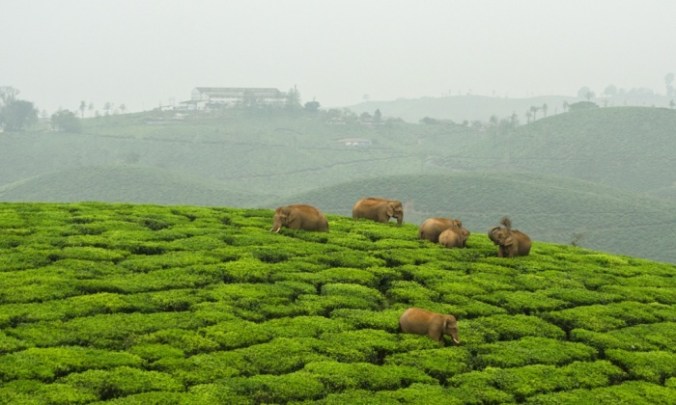
Elephants have to negotiate a vast expanse of tea estates to reach distant rainforest fragments in the Western Ghats of India. Photograph: Ganesh Raghunathan/Whitley award
Whatever can be done, should be done, to improve the safety of humans living in the area where elephants consider home, by reducing the likelihood of encounters. This will in turn ensure the safety of elephants as well as the humans. Thanks to the Guardian for this news:
Dr Ananda Kumar wins one of seven ‘Green Oscars’ for his system of reducing human-elephant conflict by tracking and texting elephants’ locations to people
Karl Mathiesen
On the Valparai plateau in southern India people live in fear of unexpected encounters with giants in the dark.
As dusk settles, tea and coffee pickers collect rations from the townships run by the corporations that own the plantations and drift back towards their colonies. Buses drop workers on the roads and they make the precarious walk through the dark to their homes.
“They are scared. If I am there I am really scared,” said conservationist Dr Ananda Kumar, who created an SMS warning system to help workers live safely among elephants. On Wednesday at a ceremony in London, his work won a £35,000 Whitley Award, dubbed a ‘Green Oscar’. Continue reading
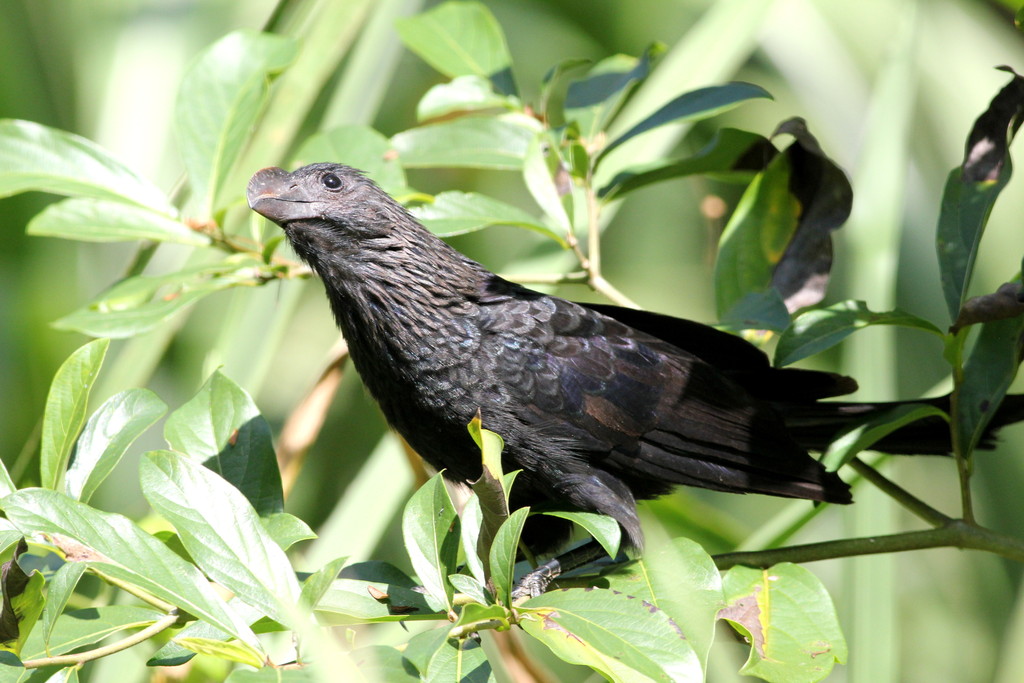
Cockpit Country, Jamaica

Word bird map artwork by Team Redhead member Luke Seitz, a Bartels Science Illustration Intern at the Cornell Lab.
Team Sapsucker, the Cornell Lab of Ornithology’s competitive birding team, has participated in the World Series of Birding for quite some time. We’ve even had a couple of the Lab’s student participants, Team Redhead, as contributors to the blog. Over the last several years, Team Sapsucker has been breaking or coming very close to the US record for a Big Day — the most bird species seen or heard in 24 hours — but this year, ten days from now in fact, the team will be in Panama instead of staying in the southwestern US! Here’s what Chris Wood, captain of Team Sapsucker and eBird’s project leader, has to say:
The time of year has come when migratory birds cross continents and even hemispheres to return home to their nesting grounds. Because long-distance migrants face many hazards during their journeys, Team Sapsucker, the Cornell Lab of Ornithology’s top birding team, has chosen to spend 24 hours of non-stop birding in Panama, a region critical to the travels of migratory birds in the Western Hemisphere.

An endangered Sumatran orangutan in the forest of Bukit Lawang, in Indonesia’s Sumatra island, one of the key sites identified as at risk. Photograph: Romeo Gacad/AFP/Getty Images

© WWF
The photograph above illustrates a story in today’s Guardian in the Environment section, and addresses the readership of that publication in a manner that expects action. We had provided the executive summary of the study here that is the maritime version of a major call to action, and that was still quite a read; here, thanks to the Guardian, is a briefer read on the topic of a terrestrial call to action by WWF, one we hope that apes of all varieties can appreciate:
Hundreds of millions of acres of forest could be lost in the next two decades in less than a dozen global hotspots for deforestation, conservationists have warned.
Research by wildlife charity WWF has identified 11 “deforestation fronts” where 80% of projected global forest losses by 2030 could occur.
Up to 170m hectares (420m acres) could be lost between 2010 and 2030 in these areas if current trends continued – equivalent to the disappearance of a forest stretching across Germany, France, Spain and Portugal.
The areas are the Amazon, the Atlantic Forest and Gran Chaco, and the Cerrado in South America, the Choco-Darien in Central America, the Congo Basin, East Africa, eastern Australia, the Greater Mekong in South East Asia, Borneo, New Guinea and Sumatra. Continue reading
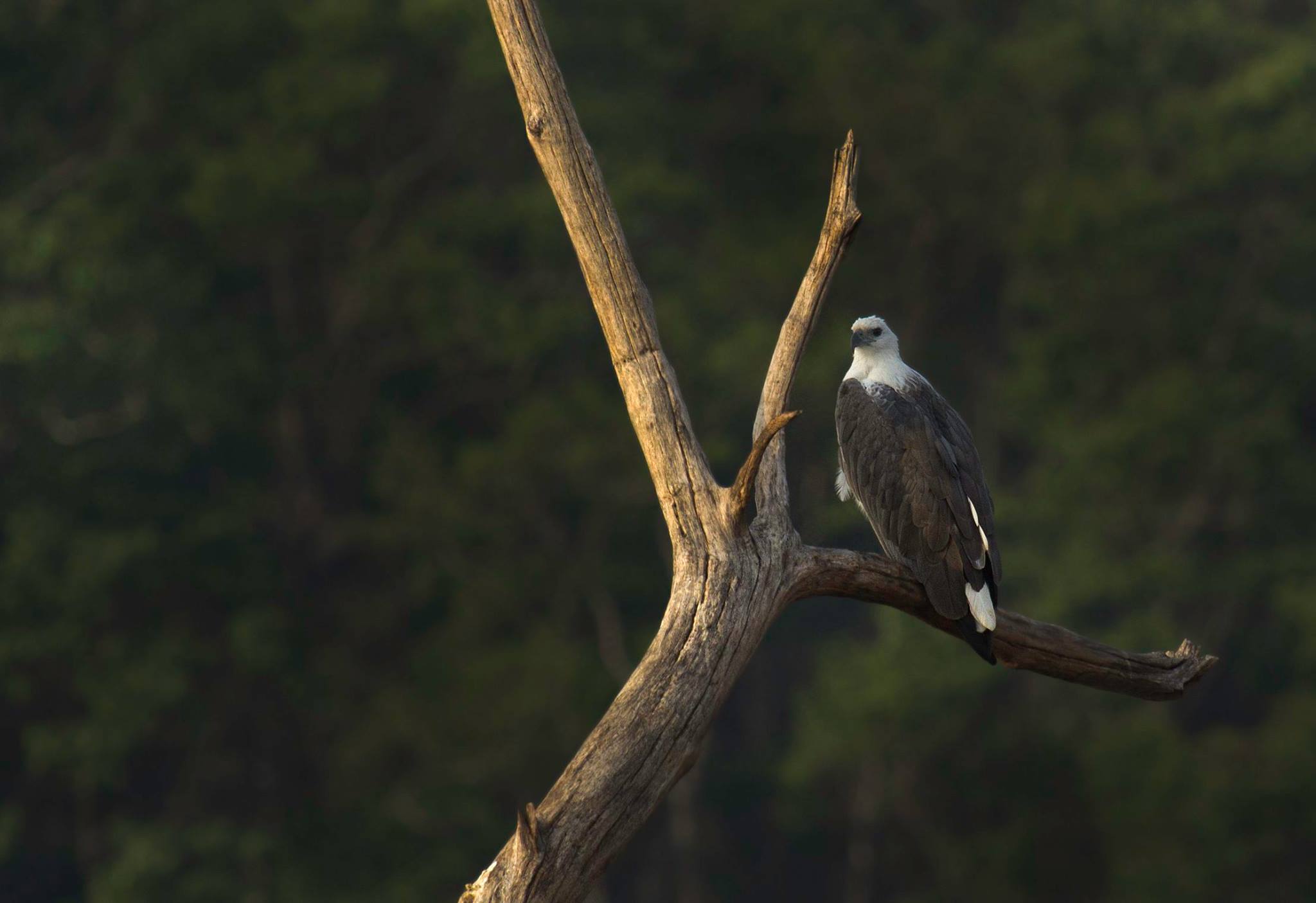
Bhadra Wildlife Sanctuary, Karnataka

The Salton Sea is a vital, threatened link between the Colorado River and coastal cities. PHOTOGRAPH BY CLAIRE MARTIN / INSTITUTE
Sometimes reading, like taking vitamins or swallowing that medicine, must be done without a spoonful of sugar. Sometimes we would rather read fairy tales and happily ever after while other times we must read the news, with the detailed pictures and some thoughtful analysis, to know what our future might look like, to get us thinking about what we might do about it if we do not like what we see. This is a must read that fits into the latter category:
…The air smelled sweet and vaguely spoiled, like a dog that has got into something on a hot day. When the wind blew, it veiled the mountains in dust and sent puckered waves to meet the frothy white flow from the pipe. The sea, which is called the Salton Sea, is fifteen times bigger than the island of Manhattan and no deeper in most places than a swimming pool. Since 1924, it has been designated as an agricultural sump. In spite of being hyper-saline, and growing saltier all the time, the sea provides habitat to some four hundred and thirty species of birds, some of them endangered, and is one of the last significant wetlands remaining on the migratory path between Alaska and Central America. Continue reading

I recently wrote an article for the Saporta Report, a metropolitan Atlanta newspaper, on the joys and possibilities of birding in Georgia. It might have some useful information if you’re ever in the area and want to identify the birds that are flying by overhead, so check it out:
…While the awesome wilderness of, say, the mountains of north Georgia guarantee an incredible experience for birders and other naturalists, local parks and preserves like Lullwater have much to offer as well. Just recently, for example, I stopped in at the Clyde Shepherd Nature Preserve (also in Decatur) and the Dunwoody Nature Center (in Dunwoody) and managed to get a few glimpses of some of the metro area’s more interesting avian visitors, including the pileated woodpecker, red-shouldered hawk, yellow-bellied sapsucker, and winter wren. A vigorous hike in Sweetwater Creek State Park (in Douglas County), also not far from downtown Atlanta, turned up a young Cooper’s hawk in addition to more common birds of the forest, such as titmice, nuthatches, woodpeckers, and so forth — a good day, considering that I was also treated to incredible vistas and the historic mill ruins on the Sweetwater’s banks. Continue reading
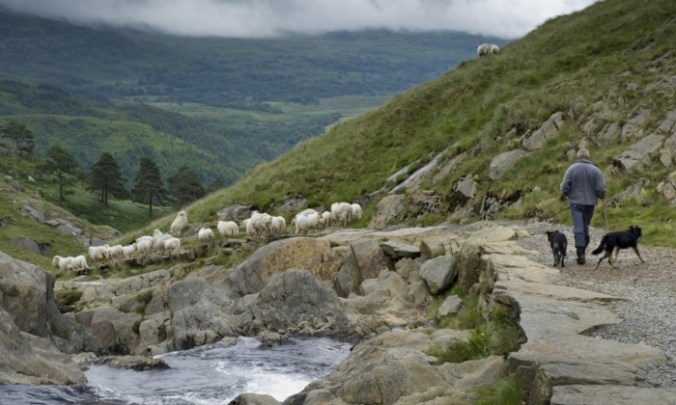
The National Trust is looking for a second shepherd to look after 1,600 mountain sheep in the hills and valleys around Hafod-y-Llan farm. Photograph: Joe Cornish
Thanks to Steven Morris and the Guardian for the public service of pointing out this job posting, on behalf of the UK’s excellent National Trust, which we have posted about on more than one occasion:
Wanted: patient, rain-loving shepherd for Snowdon conservation project
National Trust advertises for second shepherd to walk north Wales foothills to keep sheep away from vegetation such as bog asphodel and fruiting bilberries
Steven Morris
The successful candidate will need to love walking, fresh air, have appropriately trained dogs – and an awful lot of patience.
Applications are open for a man or woman prepared to work evenings and weekends in all elements as a shepherd on an innovative conservation project in the foothills of Snowdon in north Wales.
The idea of the project is to help restore sensitive mountain habitats such as upland heaths and flushes – damp areas – by gently coaxing and nudging sheep away from such areas.
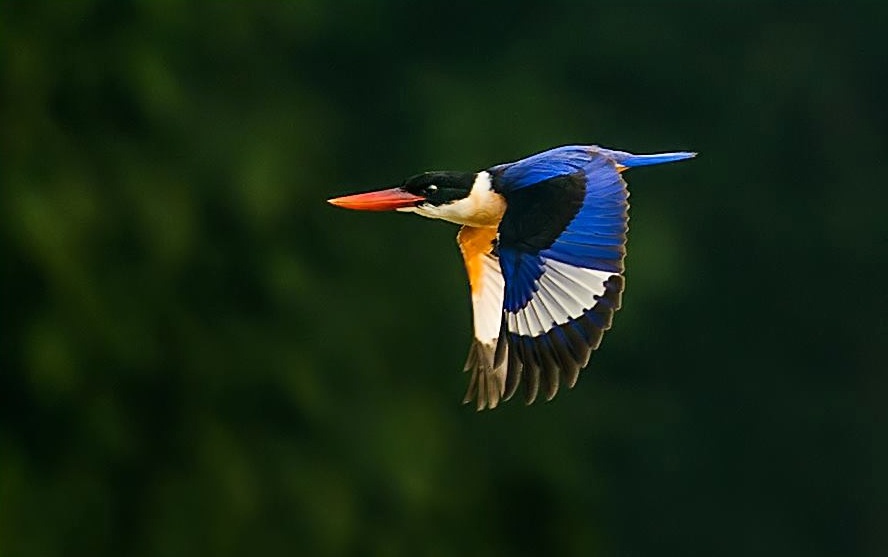
Bhitarkanika National Park, Orissa
Biophilia, the word, came to our attention several years ago, but the concept has been part of our personal ethos for decades. We’re particularly invigorated by the multi-faceted (pun not actually intended) way the word can be applied to so many concentrations, from the scientific, to the literary, to the artistic, to the spiritual.
The work of American artist Christopher Marley attracts on numerous levels. His new book inspires on the design front. For more images and information to pique the interest read McKenna Stayner’s piece in the New Yorker here.

About the book
Christopher Marley’s art expresses his passionate engagement with the beautiful forms of nature. Beginning with insects and moving on to aquatic life, reptiles, birds, plants, and minerals, Marley has used his skills as a designer, conservator, taxidermist, and environmentally responsible collector to make images and mosaics that produce strong, positive emotional responses in viewers. Marley has a brilliant eye for color and pattern in different natural objects, and he expertly captures the deep relationships among them. Biophilia (literally, “love of living things”) is a must-have for nature lovers, designers, artists, craftspeople, and anyone looking for visual inspiration in the arts.

Acuña de Chaupe has become the target of harassment and violence because she refuses to cede her land to Newmont. Photo credit: Latin American Mining Monitoring Programme
Thanks to EcoWatch for this story, which we had not previously posted about but which highlights a cause worthy of supporting in Peru:
…Newmont is majority owner of the massive Peruvian gold mine Yanacocha, the second largest gold mine in the world, and its planned Conga gold and copper mine nearby would be even larger, requiring a farming community to move and the four lakes they rely on for irrigation to be drained.
But the community has so far refused to relinquish its treasured land and lakes, and in response activists say the company has reacted with intimidation and harassment.
One person particularly in the company’s cross-hairs is Máxima Acuña de Chaupe, says activist Mirtha Vásquez, a Peruvian lawyer at Wednesday’s meeting. Continue reading
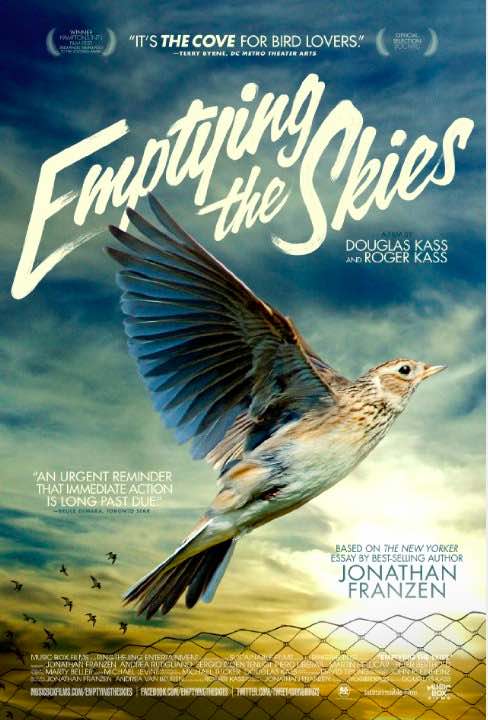 Our literary bird-loving activist took it to another level, as the film (click above) testifies well. Really, this must stop. Thanks to the Cornell Lab of Ornithology for bringing this to our attention with this interview:
Cornell Lab: Where are you from, how did you find out about this issue—and what made you want to make this film?
Roger Kass: Born and raised in Bedford, New York, I have a background in law and movie production. I first learned of the issues presented in Emptying the Skies by reading Jonathan Franzen’s story in the New Yorker magazine and wanted to make a film about it to bring these terrible truths to a larger audience.
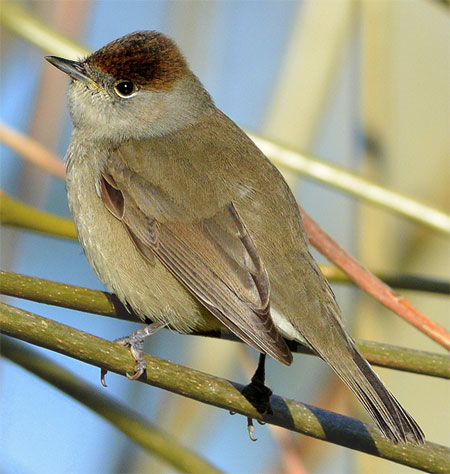
The Blackcap (Sylvia atricapilla) is a commonly hunted species in the Mediterranean. This female safely returned to her northern breeding grounds in England. Photo by jefflack Wildlife & Nature via Birdshare.
The main characters in the movie are environmentalists and people who love animals, but they don’t seem like bird watchers exactly. What motivates them to take this interest in tiny songbirds? Follow-up question: they are all men. Why do you think there were no women?
Doug Kass: As is often the case, there were a lot of things we weren’t able to put into the final film. Most CABS members we met were very passionate bird watchers and had extensive lists of sightings, as well as favorite locations, and bucket lists. You could describe them as “extreme bird-watchers,” because unlike most birders, they come into physical contact with the birds.
If you are podcast-oriented, give Leonard Lopate a listen on this topic: Continue reading
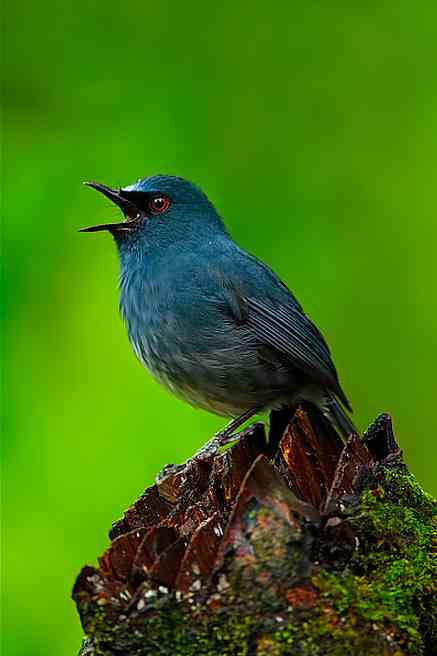
Thattekkad Bird Sanctuary, Kerala

 Organikos