Flipping Tortoises

Credit: RubberBall / Alamy. Via BBC

A couple of our contributors have connections to tortoises through the Galápagos Islands, or at least from reading about them in the news. We’d always been aware of the danger for tortoises if they were flipped on their backs, but had never given the issue much evolutionary thought to consider the variations in the animals’ shells. Now, scientists at the University of Belgrade have published a paper on the self-righting ability of Hermann’s tortoises, which live in the Mediterranean. Matt Walker writes for the BBC:

Depending on your point of view, it is one of life’s great questions.

How does a tortoise that has flipped onto its back, get up again?

It’s not a rhetorical question, and it goes beyond being a metaphorical or metaphysical query, or a subject for drunken debate.

For a tortoise it is a deadly serious matter; being able to right itself counts as one of life’s epic struggles, a potential matter of life and death.

Continue reading

Particulate Matter Pollution

A view of the Eiffel Tower through smog in March. Several regions of France experienced high levels of particulate pollution that month. Credit Patrick Kovarik/Agence France-Presse — Getty Images. Via The New York Times.

We’re always interested in learning about pollution and ways to counter it, no matter what kind of pollution it is. Roughly a week ago Michael Greenstone, the Milton Friedman professor of economics at the University of Chicago, wrote a piece for the New York Times about particulate matter pollution, which we have limited knowledge of. Some of the data Greenstone explained was fairly surprising, and we learned more about this serious form of air pollution. Here he is on the topic:

The World Health Organization considers fine particulate matter pollution levels higher than 10 micrograms per cubic meter to be unsafe. The majority of American cities are in the safe zone, with the average pollution level at 9.6. Thirty-three percent of cities are above the W.H.O. standard. Those cities tend to be geographically dispersed throughout the United States, but are predictably cities with heavy industry and driving, like Cleveland, Chicago, Los Angeles and Philadelphia. Outside of the W.H.O., the United States has its own particulate matter standard of 12 micrograms per cubic meter. The pollution in 13 percent of American cities is higher than that.

Continue reading

A Word About Our Partners

Research trips, especially international ones, take a lot of money to organize and execute properly. There’s flights, gear, accommodations, food, and other logistical or supply costs that add up to a hefty sum, and field scientists can rarely afford to foot the bill themselves. That’s where large, well-funded organizations like the Smithsonian Institution come in. The coordination and leadership of a museum and research body like the Smithsonian, paired with additional support in the form of grants or gear from other groups, is what makes a successful research trip possible.

For our Jamaica expedition, we’re Continue reading

Using Gravity as Glue

Michael Grab, whose work we have shared previously, is still working his magic with rocks. Stacking stones with the upmost precision and patience, he then destroys his precarious creations in ways that look amazing when played backwards, as shown towards the end of the video above. Grab shares with thisiscolossal:

Balance requires a minimum of three contact points. Luckily, every rock is covered in a variety of tiny to large indentations that can act as a natural tripod for the rock to stand upright, or in most orientations you can think of with other rocks. By paying close attention to the vibrations of the rocks, you will start to feel even the smallest “clicks” as the notches of the rocks are moving over one another. In the finest “point-balances,” these clicks can be felt on a scale smaller than millimeters, and in rare cases can even go undetected, in which case intuition and experience become quite useful.

Continue reading

Tents and Traps

Yesterday I mentioned live mammal trapping, and our original post describing the Golden Swallow Jamaica Expedition referred to animal surveys as well. Today we tried setting up our tents and our traps, to make sure everything is in working order and also to see how fast we can build up and break down the gear. We’re each using our own personal tent — two Marmots and an Eureka — and we’ll have three Tomahawk Live Trap cages for the surveying.

Continue reading

Teen Invents Lego Braille Printer

We’re constantly amazed at the inventiveness and creativity of people around the world. A few weeks ago, PBS aired a story about a thirteen-year-old entrepreneur who created a braille printer out of Legos that is cheap enough to provide better opportunities for literacy among the sight-impaired. Quotes from the transcript are below, or you can click on the video above to watch the feature.

JACKIE JUDD: At the age of 12, Shubham Banerjee learned how random the universe can be.  One seemingly inconsequential occurs, in this case the ring of a doorbell, and life changes in a big way.

SHUBHAM BANERJEE: I looked out.  No one was there.  But I did see a flyer over there, and which asked for donations for the visually impaired.

I asked — I didn’t know why.  I just asked a random question to my parents.  How do blind people read?  They didn’t really have time for me, so they said: “Sorry, I’m busy.  Can you go Google it?”

JACKIE JUDD: And one thing lead to another.

Continue reading

Cod, Revisited

Atlantic Cod. Photo credit Pat Morris.

We’re always happy to find another reason to link to an old environmental history post on cod, or fish stocks in general. In an op-ed for the New York Times a few days ago, environmental and maritime historian W. Jeffrey Bolster starts to answer the question, “Where have all the cod gone?”

PORTSMOUTH, N.H. — IN November, regulators from the National Oceanic and Atmospheric Administration shut down recreational and commercial cod fishing in the Gulf of Maine, that enchanting arm of the coastal sea stretching east-northeast from Cape Cod. They did not have much choice: Federal law requires action to rebuild fish stocks when they are depleted, and recent surveys revealed cod populations to be at record lows, despite decades of regulations intended to restore them.

Continue reading

The Golden Swallow Expedition

From left: Justin Proctor, Seth Inman, and John Zeiger.

It’s now been several months since we last shared any news on the Smithsonian Institution’s expedition to search for the Golden Swallow (Tachycineta euchrysea) in Jamaica, where no sightings have been reported since 1989 — and even that report is a little questionable. While the Hispaniolan subspecies of the Golden Swallow is labeled as vulnerable, the Jamaican subspecies is labeled as critically endangered and possibly extinct, so this research trip is designed to lend some more finality to the issue. If our team of three positively identifies a Golden Swallow in Cockpit Country or the Blue Mountains between mid-January and late March, it will be the first confirmed sighting of the species in Jamaica in several decades, and new conservation efforts might be kick-started into action. If during our pair of one month trips to these two isolated areas of Jamaica we don’t see any signs of the Golden Swallow, the ornithological community can move a little closer to declaring the Jamaican subspecies of Tachycineta euchrysea extinct.

Continue reading

The Gears in Planthopper Nymph Legs

Igor Siwanowicz’s image of planthopper nymph gears won 9th place in the Olympus BioScapes International Digital Imaging Competition. Photo by Igor Siwanowicz, HHMI Janelia Research Campus, Ashburn, Virginia. Via Science Friday.

In September of 2013, Science published a paper by Malcolm Burrows and Gregory Sutton titled, “Interacting Gears Synchronize Propulsive Leg Movements in a Jumping Insect.” The two British biologists were discussing the fascinating structures they had found in the legs of small insects called planthoppers. At the top joints of each pair of legs, the tiny jumping insects had gears with interlocking teeth that synchronized the kicking motion between the two appendages, so that the planthoppers could jump straight rather than slightly to the left or right if one leg had acted even slightly before the other.

Covering the story back in September, Joseph Stromberg wrote for Smithsonian Magazine that:

To the best of our knowledge, the mechanical gear—evenly-sized teeth cut into two different rotating surfaces to lock them together as they turn—was invented sometime around 300 B.C.E. by Greek mechanics who lived in Alexandria. In the centuries since, the simple concept has become a keystone of modern technology, enabling all sorts of machinery and vehicles, including cars and bicycles.

Continue reading

On the Art of Snowflakes

Snowflake, by Steve Begin/flickr/CC BY-NC-SA 2.0

For those of our readers in the appropriate climates to be receiving snow this time of year, we have some information on snowflake collection/observation that might be of interest; for those in milder or more tropical climes, we have a science experiment to create your own crystal formation in the shape of a snowflake! Let’s start with finding snowflakes in the wild. You can start by watching this Snowflake Safari video from Science Friday, or if you prefer reading, we have excerpts below (also via SciFri) from the book Mama Gone Geek by science writer Lynn Brunelle:

When the snow starts falling, grab your kids, coats and boots, a couple of pieces of black construction paper, and a magnifying glass or two if you have them. As the snow is falling around you, catch a couple of snowflakes on your black construction paper and observe them with your magnifying glass, comparing how the snowflakes are similar and different. Count how many sides or points the snowflakes have and if any snowflakes appear to match.

Continue reading

Bats Sing Like Birds Do. Who Knew?

Pipistrellus nathusii, a species of European bat.

We recently learned that certain types of fruit bat can echolocate with their wings, and now we’re discovering that some bats also make sounds for reasons other than sonar or distress calls! Although bat songs have been recorded as much as four decades ago, more and more singing bat species are being found by scientists today, and these batsongs seem to function the same way that birdsongs do. As Robert Krulwich points out for NPR, there are very few types of mammal that sing, so it’s nice to see the club growing. Krulwich’s article continues below:

Bats produce “pings” or “clicks,” right? They make these high-pitched sounds, too high for us to hear, but when their cries ricochet off distant objects, the echoes tell them there’s a house over there, a tree in front of them, a moth flying over on the left. And so they “see” by echolocation. That’s their thing. They are famously good at it.

Continue reading

A Random Walk Into Science

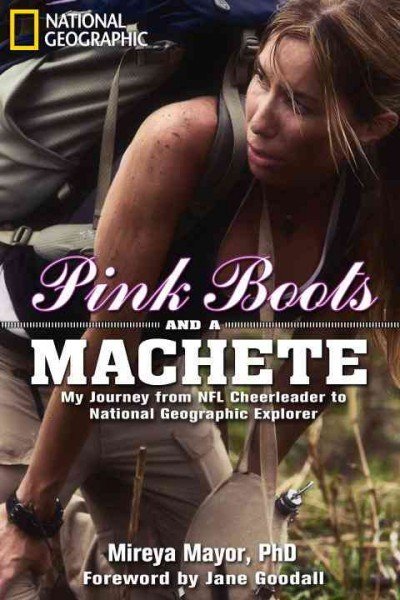
9781426207211_custom-35a4548b8f07b01d4c9e9152d330cf0d69e5ce53-s400-c85

This title of the book to the left, and of the podcast interview (“Trading Pom-Poms For Field Boots”) on the National Public Radio (USA) series called “My Big Break”–and even the opening line belowgive the false impression that this may be a dilettante story; but not at all. It is about discovering science in a classroom and coming to love it thanks to a deep experience in nature:

Mireya Mayor’s life plays out like an adventure film.

She’s a globe-trotting anthropologist, primatologist, wildlife expert and conservationist. As the first female wildlife correspondent for the Ultimate Explorer series on National Geographic Channel, she’s gone diving with great whites, she’s rappelled down cliffs and she was even charged by an angry silverback gorilla.

But some of her fans might be surprised by what Mayor was up to before she trekked around remote regions of the world. Continue reading

2014 Food Writing, Putting 2015 In Perspective

My mother thought of food the way we all now do: as a means of self-definition. CREDIT ILLUSTRATION BY MICHAEL GILLETTE

My mother thought of food the way we all now do: as a means of self-definition. CREDIT ILLUSTRATION BY MICHAEL GILLETTE

When a writer of John Lanchester’s deep quality and broad diversity uses the word repent, we take note. This reflection on the current state of foodie-ism caught our attention a couple months ago as we were well into 51’s first season open, and preparing for the next opening, reminding us to keep it all real, in perspective. Below we excerpt what should be read from beginning to end, using the dangerous ellipsis as carefully as we can but hoping you will click over to the source:

…Once upon a time, food was about where you came from. Now, for many of us, it is about where we want to go—about who we want to be, how we choose to live. Food has always been expressive of identity, but today those identities are more flexible and fluid; they change over time, and respond to different pressures. Some aspects of this are ridiculous: the pickle craze, the báhn-mìboom, the ramps revolution, compulsory kale. Is northern Thai still hot? Has offal gone away yet? Is Copenhagen over? The intersection of food and fashion is silly, just as the intersection of fashion and anything else is silly. Underlying it, however, is that sense of food as an expression of an identity that’s defined, in some crucial sense, by conscious choice. For most people throughout history, that wasn’t true. The apparent silliness and superficiality of food fashions and trends touches on something deep: our ability to choose who we want to be. Continue reading

Citizen Science, Decades In Development

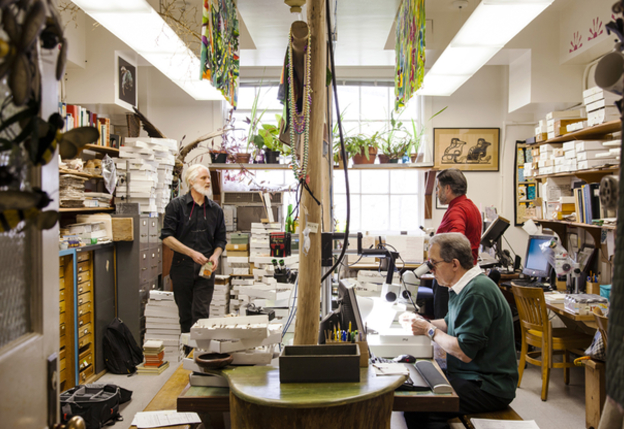
In Droege's lab at the Patuxent Wildlife Research Center, pizza boxes provide storage to thousands of pinned bee specimens. Volunteers Gene Scarpulla (in green) and Tim McMahon peer through microscopes to ID the insects.  Credit: Robert Wright

In Droege’s lab at the Patuxent Wildlife Research Center, pizza boxes provide storage to thousands of pinned bee specimens. Volunteers Gene Scarpulla (in green) and Tim McMahon peer through microscopes to ID the insects. Credit: Robert Wright

We started, before even knowing the terminology, paying attention to citizen science on this blog when we began to understand the parallels with entrepreneurial conservation. And now we link to stories whenever we can that help us better understand it:

Three Generations of Citizen Science: The Incubator

Once Sam Droege gets a research project up and running, he dreams up a new one–and builds it.

BY ANDY ISAACSON

It was a bright, breezy day in late April, the flowering azaleas having finally shrugged off the winter that overstayed its welcome, when Sam Droege sailed onto the grounds of the U.S. National Arboretum in Washington, D.C., behind the wheel of a pterodactyl. It was actually a ’98 forest-green Saturn, which Droege had painted with yellow wings and a red-and-yellow beak that tapered to a point down the center of the hood. A piece of wood, lined with a rusty crosscut saw, had been bolted to the roof: the crest. Little jingle bells, inspired by richly adorned buses in Pakistan, dangled from chains screwed into the rear bumper. Droege still had designs for neon undercarriage lights, and a mosaic of mirror shards to line the car’s ceiling–“but why stop there?” he wondered. It was a work in progress.

Continue reading