Ezhara Ponnana is a unique temple festival at Ettumanoor, a temple to Lord Shiva near Kottayam. “Ezhara” means seven-and-a-half and “Ponnana” means golden elephant. Statues of these elephants are made of nearly 13 kg of gold each. Seven of the elephants are two feet high, but the eighth one is only one foot tall, which gives the procession and festival of Ezhara Ponnana its name. Continue reading
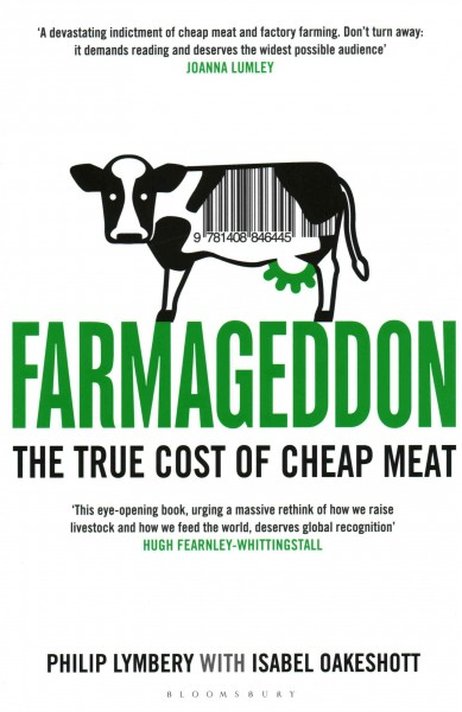
Farmageddon, Reviewed
As Kayleigh continues work begun last month, bringing our attention to all the ways we can improve our food sourcing, this book review seems timely. Barbara King, the reviewer, is a noted anthropologist but even more noted author on the topic of animal emotions. We have not read the book yet, but as always with a good book review our attention is drawn to reasons why we might, or might not, make time for this one.

Thanks to National Public Radio (USA) for sharing the review:
For Philip Lymbery, head of the U.K.-based Compassion in World Farming and his co-author Isabel Oakeshott, a visit to California’s Central Valley amounted to an encounter with suffering.
In Farmageddon: The True Cost of Cheap Meat, Lymbery and Oakeshott write that the mega-dairies of the Central Valley are “milk factories where animals are just machines that rapidly break down and are replaced.” At one huge dairy they visited, cows stood idly outdoors, some in shade and some in the sun. No grass cushioned their feet and certainly none was available to eat since, like almost all factory-farm cows, the animals were maintained on an unnatural diet of crops such as corn. The stench in the air was “a nauseous reek.” Continue reading
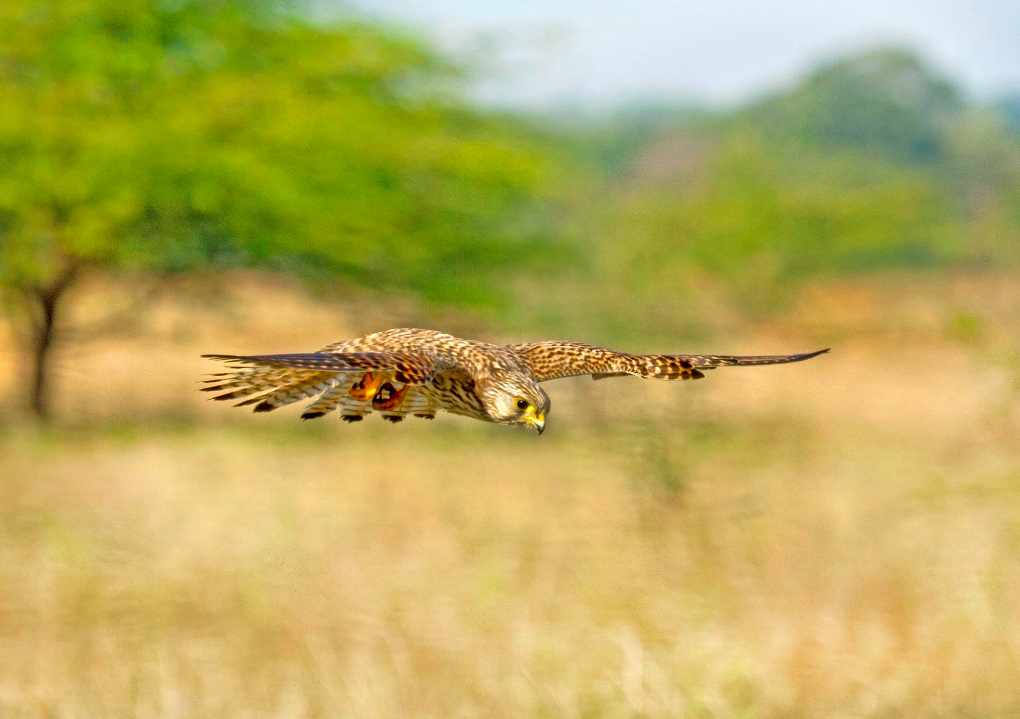
Bird of the Day: Kestrel (Outskirts of Bangalore, Karnataka)
Thank You, General Mills
I came across this article on Grist.com about General Mills’s new action plan to reduce their contribution to climate change. After being called out by Oxfam International, Oxfam says that General Mills will be, “the first major food and beverage company to promise to implement long-term science-based targets to cut emissions.”
With both a mitigation and adaptation plan, I am pretty impressed by this corporations efforts to take responsibility of their role. On the official page of their website describing this policy, they cite the 2014 Intergovernmental Panel on Climate Change (IPCC) Working Group II Summary for Policy Makers, which suggests to me that they have people on their team helping them make really informed decisions grounded in scientific evidence. I appreciate in the report the full acknowledgement of the IPCC’s call to action:
“Science based evidence suggests we must limit the global mean temperature rise to less than 2 degrees Celsius above preindustrial levels in order to avoid permanently altering the atmosphere and negatively impacting the environmental, social and economic systems that sustain us – both today and in the future.”
I haven’t seen a big corporation like this that would normally be considered a “dirty business” so blatantly speak to the environmental reality we face. To see a corporation cite this gives me hope that mainstream conversations around climate change are moving towards what we can do and away from whether or not its real. I hope more corporations follow their lead just for the sake of drumming the beat of awareness.
The true colors of this policy will show in how effectively it is implemented, because that will determine whether it is a fluffy ‘greenwashing’ tactic with loopholes built in.
Here are a few of the main points of the policy:
- Set global targets and track progress related to reductions in GHG emissions, energy, water, transportation, packaging and solid waste.
- Support the Innovation Center for U.S. Dairy commitment to reduce fluid milk GHG emissions by 25 percent by 2020. Work with smallholder and conventional farmers to strengthen globally sustainable farming practices.
- Address GHG emissions due to land use change through sustainable sourcing efforts in key supply chains and growing regions. Our aim is to achieve zero net deforestation in high-risk supply chains by 2020. We will regularly report progress towards the zero net deforestation goal.
- Ensure responsible governance and oversight of all sustainability efforts, including climate mitigation and adaptation. Convene the General Mills Sustainability Governance Committee 3 times per year to review and approve strategies, programs and key investments.
- Report progress against goals – our own as well as those in our broader supply chain – on an annual basis via our Global Responsibility Report, available on the General Mills website
For a more extensive look at the report, click here.
While I raise my eyebrows at some of the vague wording in their initiatives, like “support”, “work with”, and “ensure” that are less concrete objectives, I also see timelines and checkpoints to keep themselves more accountable to this than they had to. I have learned to appreciate initiatives that move in the direction of the ideal, rather than criticizing anything that doesn’t model the most perfect action. While it is good to remain skeptical, I think it is important to acknowledge leadership in the right direction when we see it.

24/7 Birdwatch
In the interest of what we consider essential news about environmental or conservation issues we occasionally share an article in its entirety here, with the encouragement to give the source its due. The nature of blogging is to be quick but not sloppy, brief but clear, and missionary but unorthodox.
The link to this article is deeply missionary, in that our blog has more bird-related content than any other type of content; birds are both a metric for and icon of our conservation mission; quoting the article in entirety is our unorthodox way of getting the writer’s attention (and if he or the publication prefers we will be happy to reduce our republishing of this article to the normal “fair use” excerpt standard) because his article is about the topic Seth has been working on for the last several years at the Cornell Lab of Ornithology and its far reaches. We think he might find the work Seth and James are doing at Xandari an interesting extension of this article’s focus:
Thanks to Cornell Lab of Ornithology webcams and local bird enthusiasts, anyone in the world can see into the lives of a family of red-tailed hawks that resides on a light-pole about 80 feet above an athletic field on campus.
More than five million viewers across 200 countries have been following the exploits of Ezra (father) and Big Red (mother) and their offspring since in 2012. This year three nestlings hatched.
Glory Of The Past – Allappuzha
Situated at the south-western tip of Lake Vembanad, Allappuzha had its heyday as a commercial hub in 1775-76 when Dewan Raja Keshavadas built it as a major port of the erstwhile Travancore state. Allapuzha had the dual advantage of cheap inland water transport on its eastern end and calm seas suitable for an all-weather port on the west. Continue reading

Bird of the Day: Common Sandpiper (Appledore Island, Maine)
Notes from the Garden: Building a house or a vegetable cage?
Building a 15 meter x 20 meter vegetable cage is no small feat. The last estimate we had was that it would cost about 4 lakhs, which is apparently the cost of a small house. A lakh is a unit in the South Asian numbering system equivalent to 100,000. So, is 400,000 rupees worth it for a vegetable cage? I think spending energy to get a smarter design would be more worth it.
With the help of Raxa Collective’s head engineer, it is very likely we will be able to lower that cost significantly. As I talked about in my post about quantifying farm-to-table, I think that with a combination of lowering the cost and then taking advantage of the monkey-protected area as vigorously as possible with efficient use of the space, it will be worth it. There are elements of farm-to-table that are not quantifiable but can be seen in the overall conservation story of supporting smart land-use practices.
At the end of the day, at least the food here is locally sourced mostly from the Cumbum vegetable market in Tamil Nadu. This market is only about 25 km away and the farmers in that market are relatively close. This is far better then the way most food is sourced in the United States.
In the United States, eating local is a challenge. Most agriculture in the states is for corn and soybeans, rather than vegetables. And “local” is difficult when the local environment has few green spaces left, let alone farmland. So even though we don’t have “monkey-challenges” to growing our food locally in the states, we have monocultures and rapid suburbanization keeping us farther and farther away from fresh food. Continue reading
A Story About Patagonia, A Company We Believe In, And Relate To

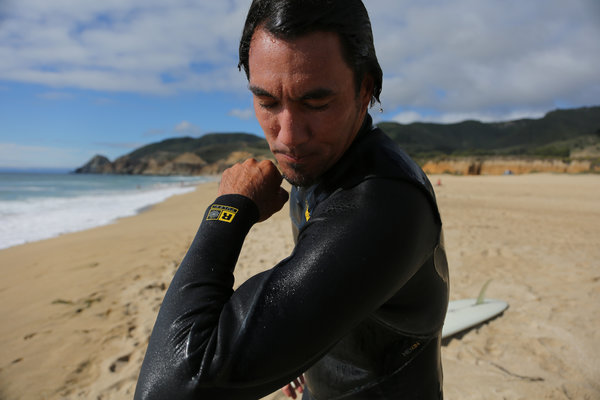
Jon Kitamura in a Patagonia wet suit at Montara State Beach, California. Credit Jim Wilson/The New York Times
We hope one day to have as many participant observers like Jake, saying things like this about some of our group’s initiatives, as Patagonia has admirers. The company gets alot of good press, and for all the right reasons. We have not tired of it yet. Fans of the founder already, we also believe in his company, and (as if anyone needed to be convinced) this New York Times profile helps to understand why:
…“We had customers looking for safe alternatives for those with latex allergy, and then we had customers looking for alternatives to petroleum-based products,” Mr. Martin said, “so a number of companies had been approaching us.” Continue reading
Bicycle Zeitgeist
We love design and we love bicycles, and we’ve been writing about their innovation-intersection long before Gianluca’s collapsable model came to our attention.
But we’re grateful for the reminders of the creativity that urges us to upcycle, recycle and craft our “ride”.
Temple Dance – Kerala
Kerala temples offer a veritable array of performing arts, often related to religious rituals and and mythological stories. The rhythm and elegance of the temple dances of Kerala are a result of the various cultural influences that took place in the state. The dramatic costumes, vibrant colors, and throbbing music all make watching temple dances an unforgettable experience. Continue reading
Notes from the Garden: Learning and Harvesting
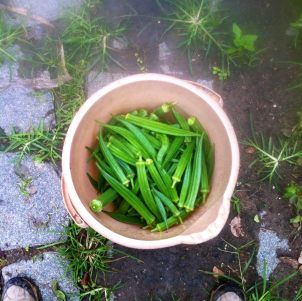
In Cardamom County today, we harvested spinach, ladiesfinger (okra), mint, beans, and parsley. Our full wheelbarrow is heading straight to the kitchen. How many hotels have you heard of that grow a good portion of the food on site?

We have been hoping to get the monkey-proof vegetable cage approved so that we can grow the majority of our staple foods on site. Today, I will be meeting with one of the head engineers to see how we can make the design more smart: cut cost but still get the job done.
Reflecting: Half-a-World Away
Five months have elapsed since my departure from Cardamom County and Raxa Collective in Kerala — sufficient time, in my opinion, to think back on my experience and growth during my adventures there, as well as the time I have spent back in the United States.
Words cannot express how thankful I am for having been given the opportunity to travel farther and live longer away from home than I ever have before, and in a truly amazing, diverse, and different region of the world than I could ever imagine. The head honchos, Crist and Amie Inman, have an ethos rooted deeply in progressive ecological conservation that is truly admirable, and for the area they are established, borderline revolutionary.
Add Agrivoltaics To Your Green Vocabulary
Thanks to Conservation, and particularly Courtney White, for this synopsis:
What is the best way to utilize sunlight—to grow food or to produce fuel?
For millennia, the answer was easy: we used solar energy to grow plants that we could eat. Then, in the 1970s, the answer became more complex as fields of photovoltaic panels (PVPs) began popping up all over the planet, sometimes on former farmland. In the 1990s, farmers began growing food crops for fuels such as corn-based ethanol. The problem is that the food-fuel equation has become a zero-sum game. Continue reading
Melodious Rhythms of India: the Nadaswaram
Kerala lays claim to a wide range of native musical instruments, which all together play host to a great range of unique sounds and melodies. The nadaswaram is a wooden-body pipe about two and a half feet long. This double-reed wind instrument is typically played during temple rituals and processions, weddings, and other celebrations. The nadaswaram is thought to achieve the peak of its acoustic quality in open environments where the sounds can resonate outwards, which is why it has evolved into a procession instrument. Continue reading
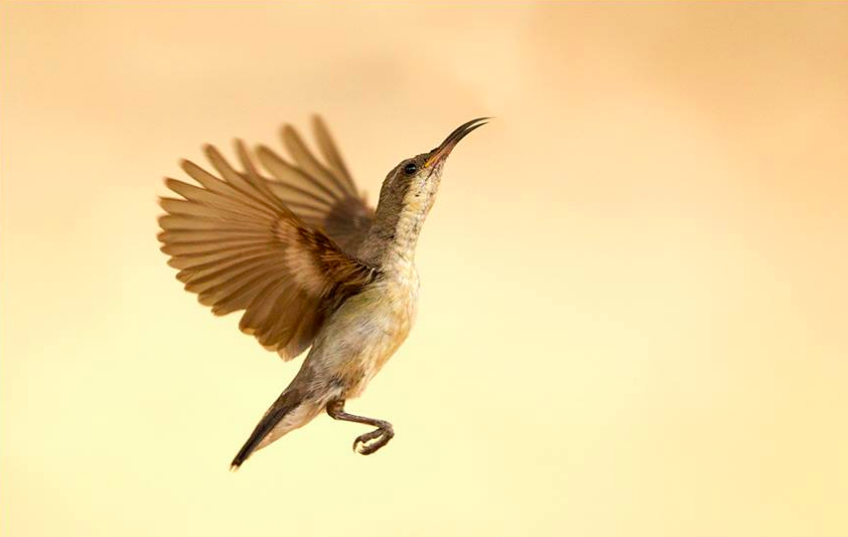
Bird of the Day: Purple-rumped Sunbird
Visiting Madurai Meenakshi Amman Temple

Upon visiting the Meenakshi Temple, I removed my shoes, checked my bag at the door and proceeded my barefoot adventure through the eastern tower of the temple city. Maduri is known as temple city because of how vast the Meenakshi temple is. There are 12 towers, the four larger ones face each of the directions North, East, South, and West. We explored the 1000 pillar hall, the holy pond, and many other parts of the ancient temple. It seemed like every corridor and wall had some sort of sacred art or story to it. The history of the temple is as vast as temple city itself. The temple dates back at least 2500 years. In 1310, the temple was almost completely destroyed by an Islamic conqueror and so many of the important sculptures were destroyed. It was restored in the 14th century though by Hindu kings who regained power.
Edakkal Caves – Wayanad
Edakkal Caves are situated in Wayanad district near Sulthan Bathery. This prehistoric rock shelter made up of natural rock formations includes a massive boulder wedged in between two huge vertical outcroppings, forming a large cave. Petroglyph writing inside the cave form inscriptions of human and animal figures with peculiar headdresses as well as drawings of wheels, bows, knives and trees. Continue reading
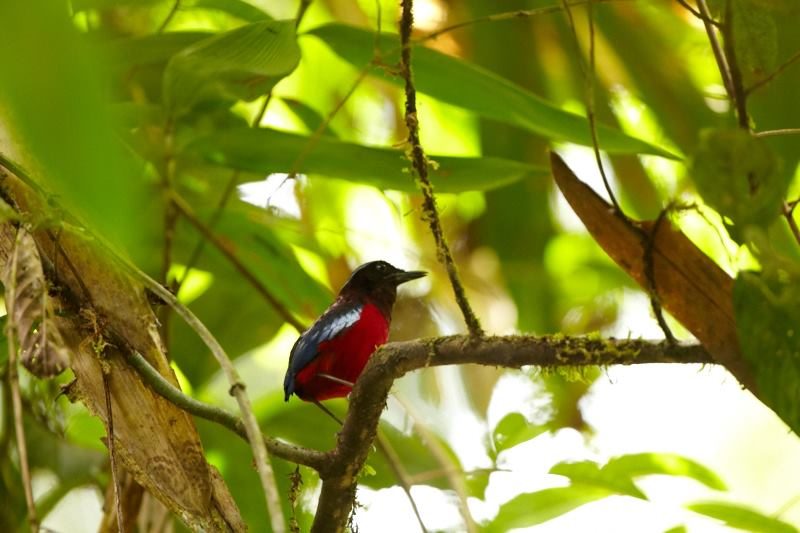
Bird of the Day: Black and Crimson Pitta (Tawau Hills Park, Borneo)
When Monkeys Lend a Hand
While we face the “monkey-challenges” at Cardamom County other forms of agriculture (or in this case, animal husbandry) have found forms of “primate collaboration”.
Thanks to The Hindu‘s K.A. Shaji for this timely story.
The term ‘monkey shepherd’ may not sound absurd here. A female monkey, aged about eight years, and her two children shepherd a flock of 150 goats on a farm at this picturesque hill station in Palakkad. Continue reading