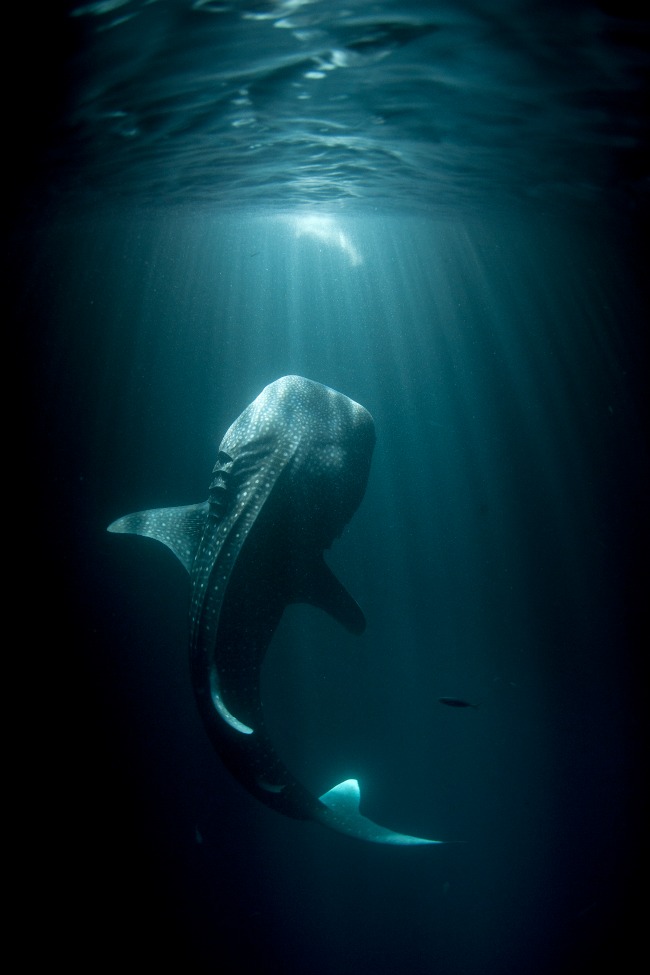
Whale shark. (Thomas Peschak / University of Chicago Press)
We note from time to time the tallies of our most popular posts and writers. Seth still has the record for “most instantaneously viral” with Volcano Sandboarding (3,000+ views in the first couple days after it was posted); Tim’s Carbon Emissions Series: Vacationers’ Diets is by far the most viewed with nearly 9,000 readers to date; Salim is by far the most widely read of our contributors, just having passed the 50,000 mark for views of his daily series on the natural and cultural heritage of south India (Thiruvathira Kali (Traditional dance of Kerala) being the most popular with nearly 3,000 views).
Phil’s most recent post has been a runaway hit, and rapidly approaching 1,000 views within a couple weeks it is on pace to put him in the ranks of our most popular contributors. So when we saw the photo above, we thought of Phil’s series with the hope he contributes another post soon. Dr. Tenner’s book review, from which that photo comes, provides an essential reminder of facts, as well as visual testament to the beauties and tragedies associated with sharks, to counter whatever perverse attention those Shark Week shows purvey:
…Thomas Peschak makes an eloquent visual case for the sublimity of sharks—and also for their conservation. He notes that the media still devotes far more attention to rare shark attacks than to the urgent need to protect them from human depredation, especially the shark fin trade. He might have noted that Peter Benchley, who became wealthy through the 1970s novel and film Jaws, regretted the fear he had sown and became a shark advocate. In the long run, though, China’s removal of Mao Tse-Tung’s ban on shark fin soup as bourgeois decadence in 1987 may have resulted in more shark slaughter than all the horror books, films, and news items together. Great conservation photography like Peschak’s, one must hope, will have the power to change attitudes globally…
Continue reading →


















 Organikos